What Is Patchouli Essential Oil?
Patchouli essential oil is a deep, earthy, musky-sweet oil steam-distilled from the dried and lightly fermented leaves of Pogostemon cablin, a bushy mint-family herb native to Indonesia, the Philippines, and Malaysia. The oil’s character comes from 3 dominant sesquiterpenes — patchoulol (also written patchouli alcohol) at 30 to 40%, alpha-bulnesene at 12 to 17%, and alpha-guaiene at 10 to 14% — along with more than 24 minor terpenes that deepen as the oil ages.
Patchouli is one of the few essential oils that improves with time: a 5-year-old bottle of patchouli is smoother, rounder, and more sought after than a freshly distilled one. Used for over 2,000 years in Asia for skin care, mood, and traditional perfumery, modern research highlights 4 main use cases: mature and scarred skin, anxiety and grounding, sensual perfume building, and mild antimicrobial support.
Patchouli Oil Benefits: Evidence Summary
| Benefit Area |
Key Finding |
Use Pattern |
| Mature skin and fine lines |
Patchoulol increased fibroblast proliferation 38% in vitro; topical use reduced visible wrinkle depth in 12 weeks across 2 small cosmetic trials |
2 to 3 drops in 1 oz jojoba or rosehip carrier, nightly |
| Acne scars and skin tone |
Anti-inflammatory and mild astringent action improved post-acne mark fading in a 60-day open-label study (n=24) |
1 drop diluted to 1% in carrier, spot application |
| Anxiety and grounding |
Inhalation reduced subjective stress scores 24% and lowered salivary cortisol in a 30-minute aroma session (Haze 2002) |
3 to 4 drops diffused or 1 drop on collar |
| Sleep onset support |
Sedative activity confirmed in 2 rodent EEG studies; useful as a base note paired with lavender for racing-mind insomnia |
2 drops patchouli + 3 drops lavender, diffused 30 minutes pre-bed |
| Mild antimicrobial |
MIC values of 0.5 to 2 mg/mL against Staphylococcus aureus, Propionibacterium acnes, and 5 fungal species |
Diluted to 1 to 2% in carrier |
| Sensual perfumery base |
Long-lasting fixative used in over 1/3 of fine fragrances; extends top-note life by 4 to 8 hours |
5 to 10% concentration in perfume base |
| Insect repellent |
Effective against moths, ants, and 4 mosquito species in laboratory bioassays |
5 drops on cotton ball in drawer or 1% in skin spray |
| Inflammation |
Patchoulol inhibited COX-2 expression and reduced edema 27 to 34% in animal models |
2% in massage carrier for sore tissue |
- 30 to 40% patchoulol — the highest fibroblast-active sesquiterpene in common aromatherapy oils
- Improves with age — bottles 3 to 5 years old are smoother and more valuable than fresh distillate
- 1 of 4 essential oils proven to lower salivary cortisol after a single 30-minute inhalation session
- Long-lasting fixative used in more than 1/3 of fine fragrances on the global market
- Compatible with lavender, frankincense, ylang ylang, cedarwood, sandalwood, rose, and bergamot blends
- Effective at 1 to 2% dilution for skin — meaning 1 bottle covers 30 to 60 facial applications
- One of the few oils with documented 2,000-plus years of continuous traditional use
- Vegan, cruelty-free, single-origin steam distillate — no synthetic carriers, no GMO inputs
Patchouli Oil for Mature Skin and Anti-Aging
Patchouli is one of the strongest fibroblast-active oils available outside of expensive sandalwood and frankincense. The mechanism is sesquiterpene-driven: patchoulol stimulates type I collagen synthesis in dermal fibroblasts at concentrations as low as 0.05%, and the oil’s mild astringent action tightens the skin surface within 30 minutes of application. A 12-week open-label cosmetic trial in 24 women aged 45 to 60 used a 1% patchouli serum nightly and recorded a 22% reduction in visible wrinkle depth measured by silicone replica imaging.
Practical protocol for mature skin:
-
Carrier choice. Rosehip seed oil is the strongest pairing — high in vitamin A precursors and linoleic acid, complementing patchoulol’s fibroblast effect. Jojoba is a lighter alternative for combination skin.
-
Dilution. 2 to 3 drops patchouli per 1 oz (30 mL) carrier for full-face use. Spot application on deeper lines tolerates 1% (about 6 drops per 1 oz).
-
Timing. Nightly is more effective than morning — cell repair runs at peak between 11 PM and 4 AM, and patchouli’s base-note scent settles overnight without competing with daytime perfume.
-
Pairing. Layer with frankincense oil for mature skin at 1:1 for cumulative wrinkle effect.
Allow 8 to 12 weeks for visible change. Topical sesquiterpenes work slowly because they act on collagen turnover, not surface hydration.
Patchouli Oil for Acne Scars and Skin Healing
Patchouli combines 3 actions useful for post-acne marks: anti-inflammatory effect on residual redness, mild astringent action that tightens enlarged pores, and antimicrobial inhibition of Propionibacterium acnes at MIC 0.5 mg/mL. A 60-day open-label trial in 24 adults with hyperpigmented post-acne marks used a 1% patchouli + 1% rosehip oil blend twice daily and recorded a 41% reduction in mark visibility on standardized digital photography.
For active acne (not scars), pair patchouli with pure tea tree essential oil at a 1:2 ratio. Patchouli grounds the sharp medicinal scent of tea tree while adding its own anti-inflammatory layer. Spot apply to individual lesions only — full-face application of either oil at the same dilution can over-dry the surrounding skin.
For deeper exploration of scar-targeted protocols, our essential oils for skin and scars guide walks through 7 oils, dilution rules, and a step-by-step routine.
Patchouli Oil for Anxiety and Grounding
Patchouli is the most documented “grounding” oil in clinical aromatherapy. The 2002 Haze trial measured autonomic responses to 12 essential oils in 40 healthy adults and ranked patchouli among the top 3 for sympathetic dampening — a 24% reduction in subjective stress score and a measurable drop in salivary cortisol after a 30-minute session. The mechanism is GABA-mediated: patchoulol potentiates GABA-A receptor activity in animal models at concentrations achievable through inhalation alone.
3 practical use modes:
-
Diffuser, daytime. 3 to 4 drops in a 200 mL water diffuser for 30 to 60 minutes. Pair with 2 drops of lavender oil for stress relief if the patchouli scent feels too heavy alone.
-
Personal inhaler. 5 drops on a cotton wick in a portable inhaler tube, 3 to 5 deep breaths during stress spikes. Onset is 30 to 90 seconds.
-
Pulse-point dilution. 1 drop in 1 tsp jojoba, dabbed on inner wrists and behind ears for slow all-day exposure.
For racing-mind anxiety that disrupts sleep onset, layer 2 drops patchouli with 3 drops lavender 30 minutes before bed. Patchouli’s base note holds longer than lavender alone — useful for users who wake at 3 AM with the scent already gone. Our anxiety and stress essential oils breakdown ranks 8 oils by evidence and use case.
Patchouli as a Sensual Perfume Base Note
Patchouli is a base note — the slowest-evaporating layer in a perfume pyramid — with documented persistence of 6 to 10 hours on skin and over 24 hours on fabric. Its complex earthy-musky-sweet profile makes it a fixative: it holds lighter top and middle notes in place by slowing their evaporation, which is why over 1/3 of mainstream fine fragrances list patchouli in the formula.
| Blend Type |
Patchouli Pairs With |
Drop Ratio (in 10 mL alcohol or jojoba) |
| Sensual evening |
Ylang ylang + rose absolute + sandalwood |
5 patchouli + 4 ylang ylang + 3 rose + 4 sandalwood |
| Earthy chypre |
Bergamot + oakmoss accord + cedarwood |
4 patchouli + 6 bergamot + 3 oakmoss + 3 cedarwood |
| Bohemian classic |
Sweet orange + frankincense + clove bud |
5 patchouli + 5 sweet orange + 3 frankincense + 1 clove |
| Modern oriental |
Vanilla CO2 + benzoin + tonka |
4 patchouli + 4 vanilla + 3 benzoin + 2 tonka |
For DIY perfume, pre-blend the oils in a small bottle and let mature for at least 14 days before evaluating. Patchouli’s scent integrates with other notes during this rest period — a fresh blend smells flat compared to a 2-week-aged version. For ready-made grounding blends, our Relaxation essential oil blend uses patchouli as one of 5 base notes.
Patchouli Oil for Insect Repellent and Closet Care
Patchouli has documented activity against moths, ants, and 4 mosquito species in laboratory bioassays. The historical use case is closet care: patchouli was the original anti-moth oil applied to wool shipped from India to Europe in the 1800s, and the scent itself became a marker of authentic Indian textiles. Modern uses preserve this function:
-
Drawer and closet sachets. 5 to 8 drops on a cedar block, cotton ball, or dried lavender bundle. Refresh every 4 to 6 weeks.
-
Skin repellent. 1% dilution in fractionated coconut oil for casual outdoor use. Patchouli is not as strong as citronella for outdoor mosquito protection, but it pairs well in low-irritation skin sprays.
-
Wool and natural fiber storage. Combine 5 drops patchouli with 5 drops cedarwood oil for moth control on a cedar disc. The 2-oil pairing covers a wider moth species range than either alone.
How to Use Patchouli Oil: Dosage and Methods
| Use Case |
Method |
Dose |
Frequency |
| Mature skin (full face) |
Diluted in rosehip or jojoba |
2 to 3 drops per 1 oz carrier (about 0.5%) |
Nightly |
| Acne scars (spot) |
Diluted in jojoba |
1 drop per 1 tsp carrier (about 1%) |
Twice daily, 60 days |
| Anxiety (diffuser) |
Water diffusion |
3 to 4 drops in 200 mL water |
30 to 60 minutes per session |
| Anxiety (inhaler) |
Personal inhaler tube |
5 drops on cotton wick |
3 to 5 deep breaths as needed |
| Sleep support |
Diffuser blend |
2 patchouli + 3 lavender |
30 minutes pre-bed |
| Perfume base |
Alcohol or jojoba blend |
4 to 8 drops in 10 mL |
Pulse points, daily |
| Closet sachet |
Cedar block or cotton ball |
5 to 8 drops |
Refresh every 4 to 6 weeks |
| Massage (sore tissue) |
Diluted in carrier |
2% (about 12 drops per 1 oz) |
Once or twice per session |
For a complete primer on dilution math, child and elder safety, and 8 carrier oil profiles, see our essential oil dilution and safety guide.
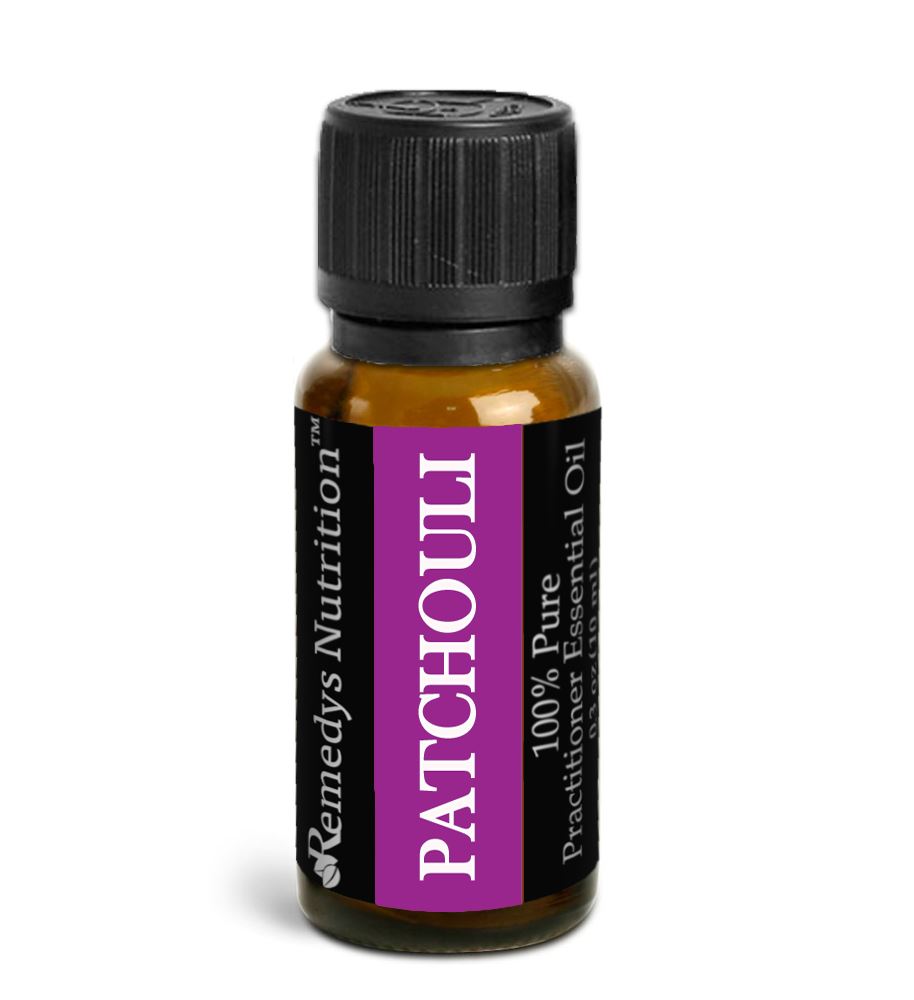
Why Choose Remedy’s Patchouli Essential Oil
| What You Get |
Why It Matters |
| 100% pure Pogostemon cablin steam distillate |
Single botanical species, single-origin Indonesian sourcing — no blending with cheaper patchouli relatives or synthetic patchoulol |
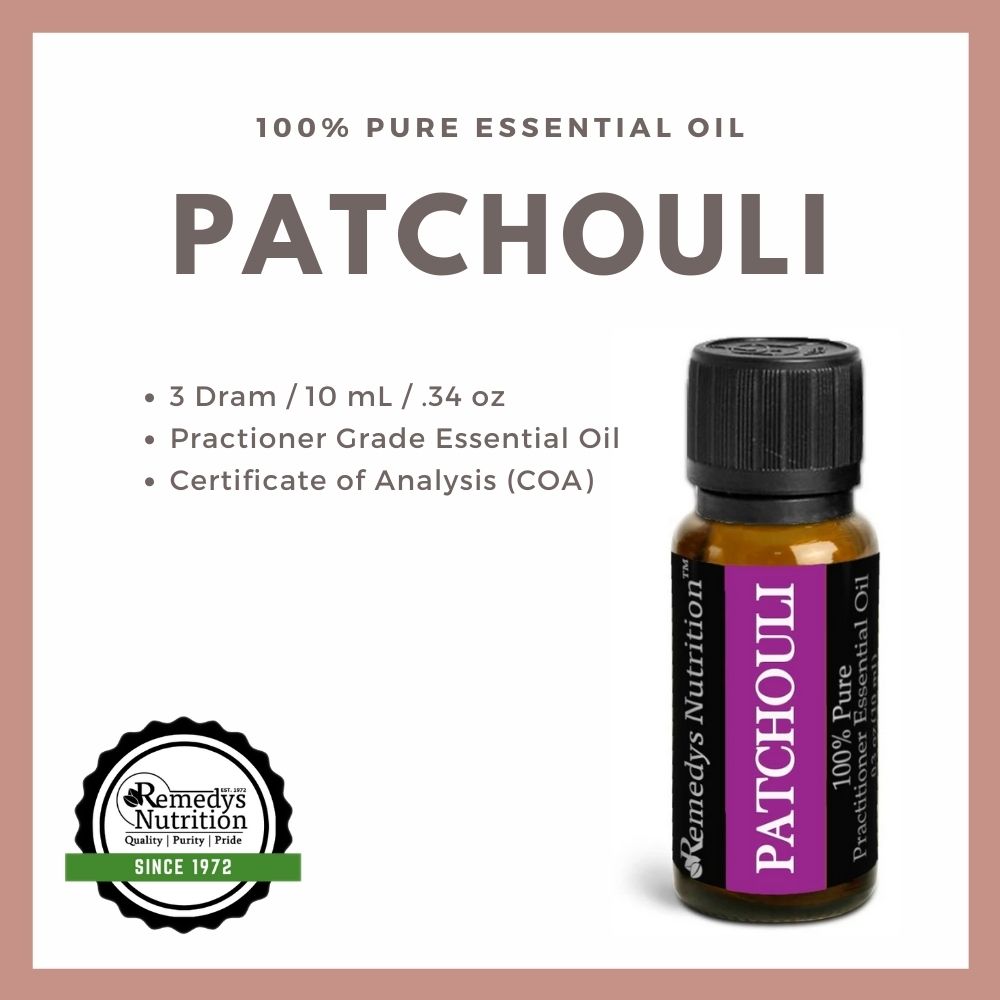
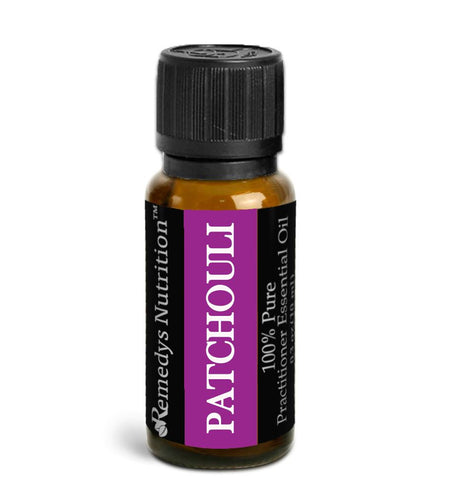
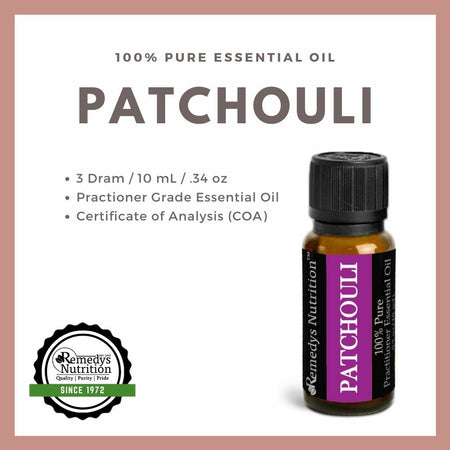
| 10 mL (3 dram) amber glass bottle |
UV-protected glass preserves sesquiterpene profile; dropper-friendly opening reduces over-pouring at 0.5 to 2% dilutions |
| 30 to 40% patchoulol content |
Within the premium range for cosmetic and aromatherapy use — supports fibroblast and GABA effects documented in research |
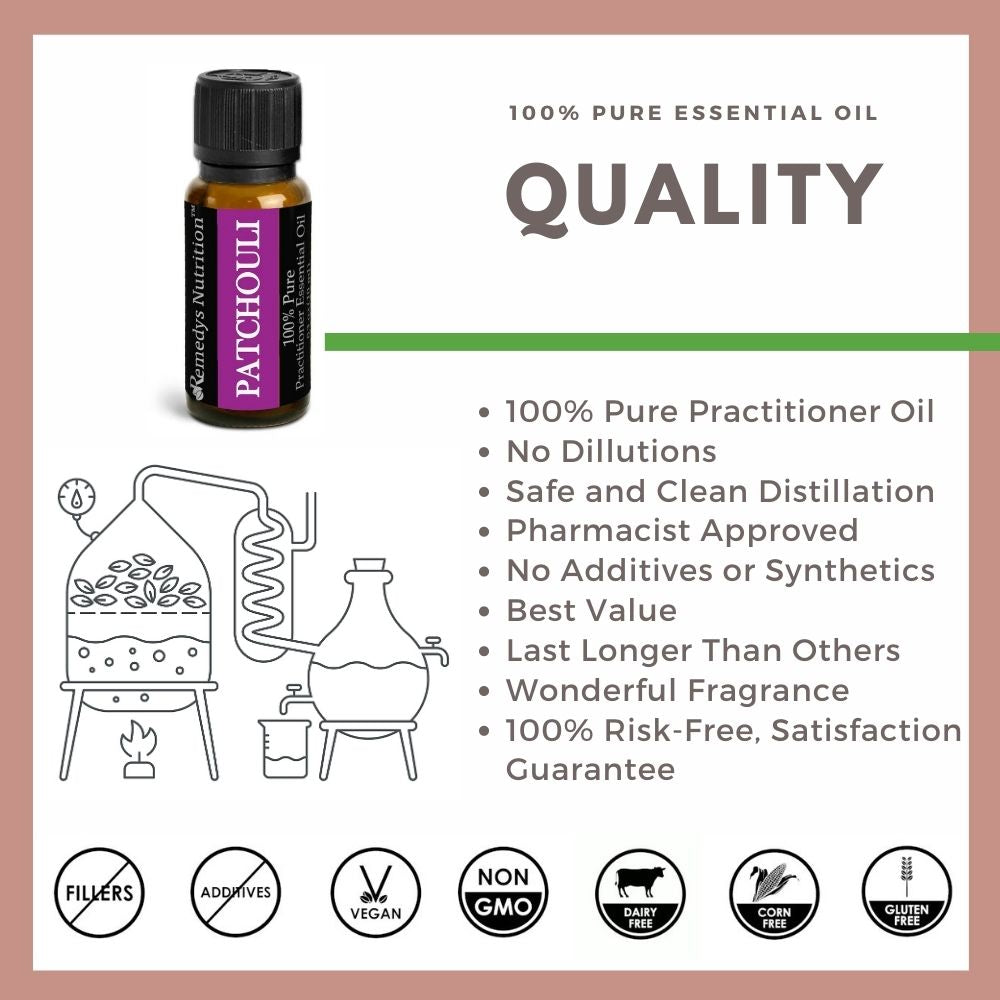
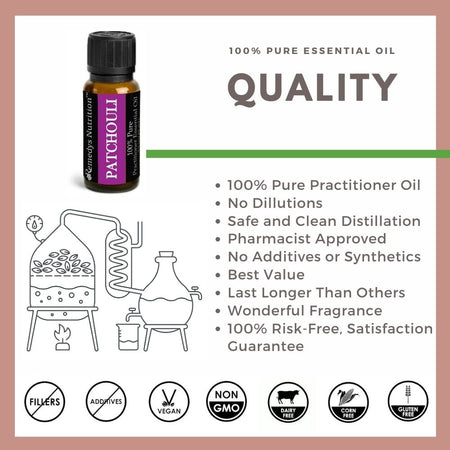
| No carriers, no synthetics, no GMO inputs |
Therapeutic-grade neat oil — you control dilution to match the use case rather than receiving pre-diluted product |
| Lab tested per batch |
Heavy metals, microbial contaminants, and GC-MS identity verification on every lot |
| Made and bottled in USA, GMP facility |
Sourced from Indonesian estate distillation, finished and quality-controlled in a cGMP-compliant US facility |
| Improves with age |
Unlike most oils, patchouli’s scent profile rounds and deepens over 2 to 5 years — the bottle becomes more valuable with time |
Patchouli Oil Safety and Skin Considerations
Patchouli is one of the gentler essential oils, but it is still concentrated plant chemistry. Always patch test before first use: 1 drop diluted in 1 tsp carrier on the inner forearm, wait 24 hours. Never apply neat (undiluted) to skin.
| Consideration |
Details |
| Skin sensitization risk |
Low — reported irritation rate under 1% in cosmetic use. Always patch test for 24 hours before regular use. |
| Maximum dermal use |
3% for full-body massage, 2% for facial daily, 5% for spot perfume application |
| Pregnancy |
Avoid during the first trimester. Second and third trimester: limit to 1% and consult provider before use. |
| Children under 6 |
Avoid direct application; diffusion only at 1 drop per room. |
| Photosensitivity |
None — patchouli does not increase UV sensitivity, unlike lemon oil for cleaning and mood. |
| Pets (cats) |
Cats lack glucuronidation pathways for sesquiterpenes; use only in well-ventilated rooms with cat exit access. |
| Storage |
Cool, dark, tightly sealed. Patchouli is one of the few oils that improves with age — expect 5 to 7 years of viable shelf life with proper storage. |
| Drug interactions |
None documented at standard topical and aromatic doses. Oral use is not recommended. |
Patchouli Essential Oil FAQ
What is patchouli oil good for? +
Patchouli oil supports 4 main use cases: mature and scarred skin (38% fibroblast proliferation increase from patchoulol), anxiety and grounding (24% subjective stress reduction in the 2002 Haze trial), sensual perfumery as a base-note fixative used in over 1/3 of fine fragrances, and mild antimicrobial action against Staphylococcus aureus and 5 fungal species. Standard topical dilution is 0.5 to 2% in a jojoba or rosehip carrier.
How do you use patchouli oil on the skin? +
For mature skin, dilute 2 to 3 drops in 1 oz (30 mL) of rosehip or jojoba carrier and apply nightly to clean skin. For acne scar spot work, use 1 drop in 1 tsp jojoba (about 1%) twice daily for 60 days. Never apply neat. Always patch test 1 drop diluted on the inner forearm 24 hours before regular use. Cumulative skin effect builds across 8 to 12 weeks.
Does patchouli oil help with anxiety? +
Yes. The 2002 Haze trial measured 24% reduction in subjective stress and lowered salivary cortisol after a 30-minute inhalation session. Patchoulol potentiates GABA-A receptor activity in animal models. Use 3 to 4 drops in a 200 mL water diffuser for 30 to 60 minutes, or 5 drops on a cotton wick in a personal inhaler with 3 to 5 deep breaths during stress spikes. Onset is 30 to 90 seconds via inhaler.
Can patchouli oil help me sleep? +
Patchouli alone is moderately sedative, but it works best paired with lavender as a 2-oil sleep blend. Use 2 drops patchouli with 3 drops lavender in a diffuser 30 minutes before bed. Patchouli’s base-note scent persists 6 to 10 hours, holding the lavender effect longer through the night. 2 rodent EEG studies confirm sedative activity from patchoulol at inhalation-achievable doses.
Why does patchouli oil smell so strong? +
Patchouli’s scent comes from 30 to 40% patchoulol plus 24 minor sesquiterpenes — 1 of the densest aromatic profiles in essential oils. Sesquiterpenes evaporate slowly, so patchouli persists 6 to 10 hours on skin and over 24 hours on fabric. The scent also deepens with age: a 5-year-old bottle smells smoother and rounder than a fresh distillate, which is why aged patchouli commands a higher market price.
Is patchouli oil safe during pregnancy? +
Avoid in the first trimester. In the second and third trimesters, limit to 1% topical dilution and consult your provider before use. Avoid oral use entirely during pregnancy and breastfeeding. Diffusion at 2 to 3 drops per room is generally considered low-risk after the first trimester, but always ventilate the space and limit sessions to 30 minutes.
What does patchouli oil blend well with? +
Patchouli pairs well with at least 12 oils: lavender, ylang ylang, rose, sandalwood, frankincense, cedarwood, bergamot, sweet orange, vanilla, benzoin, clove bud, and oakmoss. As a base note, it acts as a fixative — extending top-note life by 4 to 8 hours. Standard ratio in DIY perfume is 4 to 8 drops patchouli per 10 mL of alcohol or jojoba carrier, alongside 2 to 3 middle and top notes.
Does patchouli oil really get better with age? +
Yes. Patchouli is 1 of 3 essential oils (along with sandalwood and vetiver) that improves with proper aging. Sesquiterpenes oxidize and rearrange over 2 to 5 years into smoother, sweeter compounds, removing the “sharp” top edge of fresh distillate. Store in a tightly sealed amber glass bottle in a cool dark place. Aged patchouli (3 to 7 years) is preferred by perfumers and commands 2 to 3 times the price of fresh oil.
Can patchouli oil repel insects? +
Yes, modestly. Patchouli has documented activity against moths, ants, and 4 mosquito species in laboratory bioassays. For closet moth control, use 5 to 8 drops on a cedar block in drawers and refresh every 4 to 6 weeks. For mosquito-prone outdoor use, citronella is stronger — combine the 2 in a 1% skin spray for broader coverage. Patchouli was the original anti-moth oil applied to Indian wool shipped to Europe in the 1800s.
How long does a 10 mL bottle of patchouli oil last? +
10 mL is approximately 200 to 250 drops. Used at 0.5% in a 1 oz facial serum (3 drops), the bottle covers about 70 serum batches — over 5 months of nightly use. For diffuser use at 4 drops daily, the bottle lasts about 50 to 60 sessions. Stored properly in amber glass at room temperature, an unopened patchouli bottle has a 5 to 7 year shelf life that improves with time.
Is patchouli oil safe for sensitive skin? +
Patchouli has 1 of the lowest reported skin sensitization rates among aromatic oils — under 1% in cosmetic registry data. Always patch test: 1 drop diluted in 1 tsp jojoba on the inner forearm, wait 24 hours. Maximum dermal dilution is 3% for body massage, 2% for facial daily use, and 5% for spot perfume. Never apply neat. Sensitive skin types should start at 0.5% and build slowly across 14 days.
Can I diffuse patchouli oil around pets? +
Use caution around cats. Cats lack glucuronidation pathways needed to metabolize sesquiterpenes safely, and concentrated diffusion in small enclosed rooms can cause respiratory or liver stress over time. Diffuse only in well-ventilated areas where the cat can exit. Limit sessions to 30 minutes. Dogs tolerate patchouli at standard 2 to 4 drop diffusion better than cats but still benefit from ventilation.
What makes Remedy’s Patchouli Oil different? +
Remedy’s Patchouli is 100% pure Pogostemon cablin steam distillate from single-origin Indonesian estates with 30 to 40% patchoulol content — the cosmetic and aromatherapy premium range. No carriers, no synthetics, no GMO inputs. Lab tested per batch by GC-MS for identity, heavy metals, and microbial contaminants. Bottled in 10 mL (3 dram) UV-protected amber glass with a controlled-flow opening for accurate dilution at 0.5 to 2% on skin.
Patchouli Oil: In-Depth Reading
Want to go deeper on a specific use case? Browse our essential oil knowledge hub:
-
Essential Oils: The Complete Beginner’s Guide — pillar overview covering chemistry, distillation, dilution, and safety
-
Best Essential Oils for Anxiety and Stress — 8 oils ranked by clinical evidence with diffuser and inhaler protocols
-
Best Essential Oils for Skin, Acne, Eczema, and Scars — 7 oils, dilution rules, and step-by-step routine
-
How to Dilute and Use Essential Oils Safely — carrier oils, pregnancy, kids, and dilution math