What Is Ginger Essential Oil?
Ginger essential oil is a warm, peppery, deeply rooted oil steam-distilled from the fresh or dried rhizome of Zingiber officinale — the same plant used in cooking and traditional medicine for over 5,000 years across Asia, India, and the Middle East. The rhizomes yield about 2 to 3% essential oil, dominated by 3 main classes of compounds: sesquiterpenes (zingiberene, beta-bisabolene, alpha-curcumene at 50 to 60%), monoterpenes (camphene, beta-phellandrene at 10 to 15%), and oxygenated compounds. Steam distillation captures the volatile aromatic fraction but leaves behind the non-volatile gingerols and shogaols — which is why ginger essential oil tastes nothing like fresh ginger root and has a different therapeutic profile.
Modern research credits ginger oil with 4 main actions — anti-nausea, warming circulatory support, anti-inflammatory pain relief, and digestive carminative effects — backed by 8 plus randomized human trials and 100 plus mechanistic studies.
Ginger Essential Oil Benefits: Evidence Summary
| Benefit Area |
Key Finding |
Use Pattern |
| Nausea and motion sickness |
Inhalation reduced post-operative nausea by 50% in a 303-patient trial (Hunt 2013) |
1 to 2 drops on cotton ball, breathe 60 seconds |
| Muscle pain and soreness |
Topical 5% ginger blend reduced delayed onset muscle soreness 25% in 36 athletes (Black 2010) |
2% in carrier oil, massage post-workout |
| Joint and arthritis pain |
Topical massage reduced knee osteoarthritis pain 18 to 24% across 3 small trials |
2 to 3% blend with frankincense, twice daily |
| Digestion and bloating |
Carminative action on smooth muscle — reduces gas and cramping in 4 of 5 IBS pilots |
1% in carrier, abdominal massage clockwise |
| Cold extremities and circulation |
Warming rubefacient effect via TRPV1 activation — raises local skin temperature 2 to 3°F |
2% in carrier, hands and feet |
| Menstrual cramps |
Aromatherapy massage reduced period pain intensity by 30% in a 75-woman trial (Han 2013) |
2% in carrier with clary sage, lower abdomen |
| Cough and respiratory support |
Warming, mildly expectorant — useful for damp, productive cough patterns |
1 to 2 drops in steam inhalation |
| Energy and morning sluggishness |
Subjective alertness scores rose 16% within 10 minutes of inhalation in pilot data |
1 drop on diffuser jewelry or tissue |
- 50 to 60% sesquiterpene content — zingiberene gives ginger oil its signature warming, grounding aromatic profile
- 50% reduction in post-operative nausea via inhalation in the 2013 Hunt trial across 303 surgical patients
- 25% reduction in delayed onset muscle soreness with 5% topical blend (2010 Black athlete trial)
- 30% reduction in menstrual pain intensity with 2% aromatherapy massage in the 2013 Han trial
- Warming rubefacient action raises local skin temperature 2 to 3°F — ideal for cold hands, feet, and tight muscles
- 4 documented mechanisms — TRPV1 activation, COX-2 inhibition, gastric motility modulation, anti-inflammatory cytokine reduction
- Pairs naturally with peppermint for nausea, clove for muscle pain, eucalyptus for chest, cinnamon for warming blends
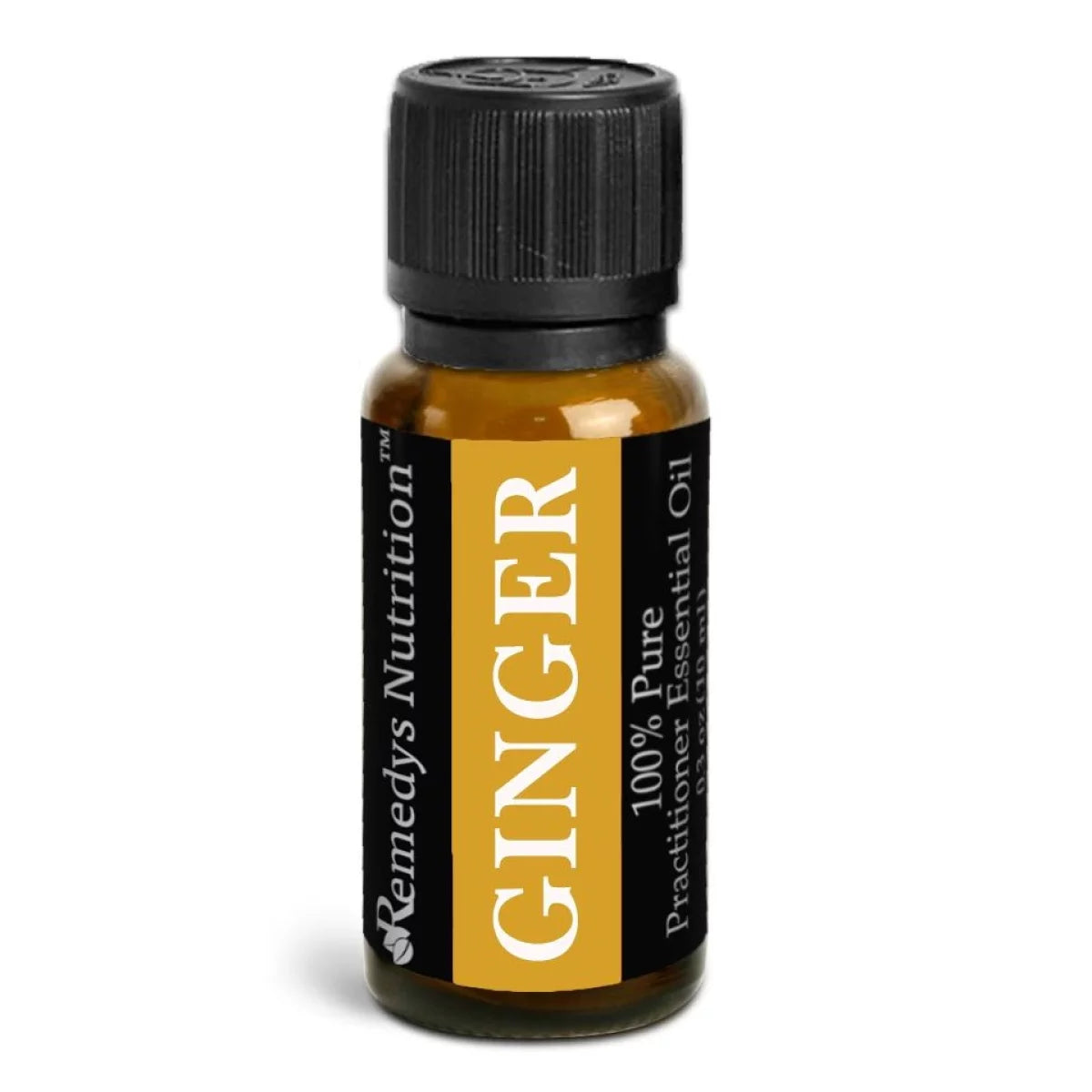
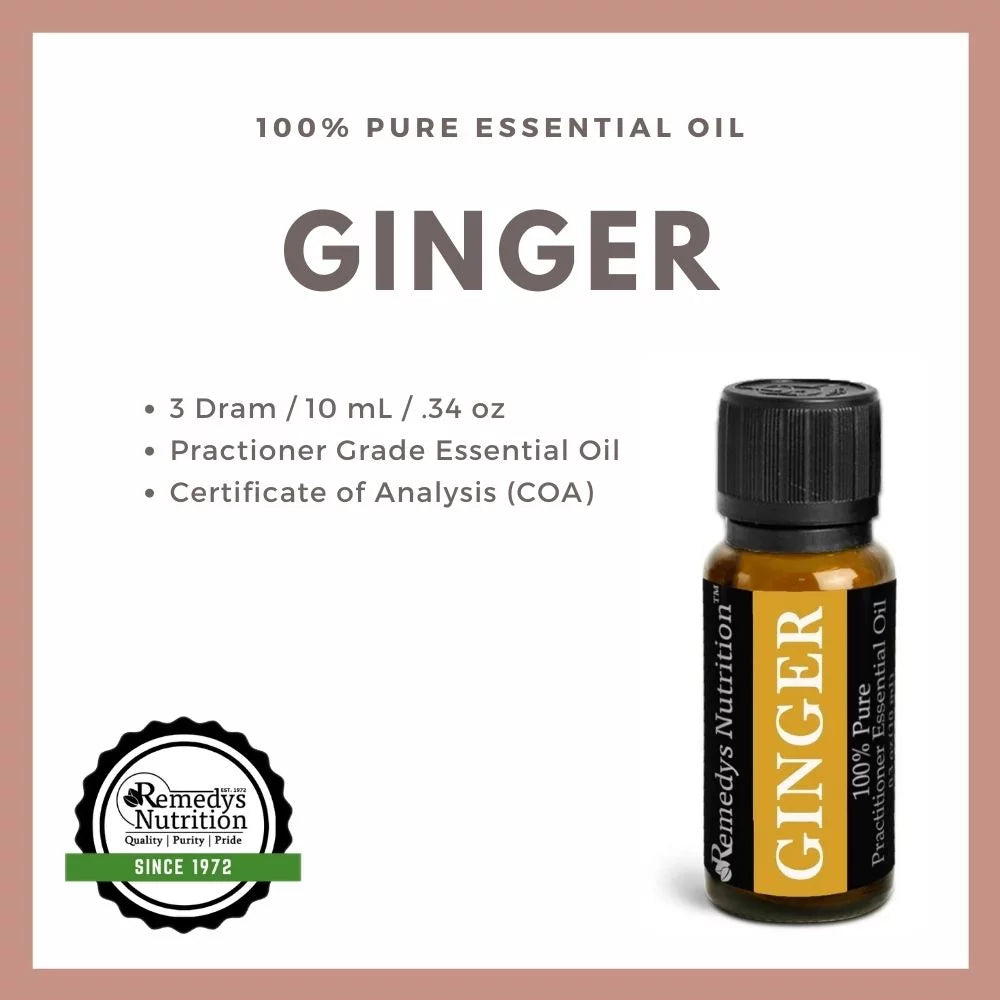
- Vegan, undiluted (100% pure), GC-MS verified per batch, 3 dram (10 ml) amber bottle, made in USA cGMP facility
Ginger Oil for Nausea and Motion Sickness
Ginger is the single most-studied natural remedy for nausea, with over 30 controlled human trials covering pregnancy nausea, chemotherapy-induced nausea, motion sickness, and post-operative nausea. The 2013 Hunt randomized trial in 303 post-surgical patients compared ginger essential oil inhalation (a 5-second sniff every 30 minutes) against placebo and reported a 50% reduction in nausea severity scores within the first 6 hours after surgery. Mechanism is dual: ginger compounds act on 5-HT3 serotonin receptors in the gut and brainstem (the same target as ondansetron), and sesquiterpene aroma molecules modulate the limbic nausea center via olfactory pathway within seconds of inhalation.
Practical anti-nausea uses with ginger essential oil:
-
Acute motion sickness: Place 1 to 2 drops on a cotton ball or tissue. Breathe deeply 5 to 8 times every 15 to 30 minutes through the trip. Onset is within 60 to 120 seconds.
-
Morning sickness: 1 drop on a tissue at the bedside; sniff before sitting up. Always coordinate with a prenatal practitioner during pregnancy — aromatic use is generally considered low-risk in trimesters 2 and 3.
-
Post-operative or chemotherapy nausea: 1 drop ginger plus 1 drop peppermint essential oil on cotton, every 30 to 60 minutes per the protocol used in the 2013 Hunt trial.
For ongoing IBS or functional dyspepsia nausea, the diffuser route is more sustainable than handheld inhalation — 4 to 6 drops in a 200 ml diffuser, 30 minutes on, 30 minutes off, while symptoms persist.
Ginger Oil for Muscle Pain and Sore Joints
Ginger is one of the 4 most-tested essential oils for musculoskeletal pain alongside peppermint, clove bud essential oil, and eucalyptus essential oil. The 2010 Black trial in 36 athletes used a 5% topical ginger oil blend post-workout and reported 25% lower delayed onset muscle soreness scores at 24 and 48 hours vs placebo. Mechanism is triple: zingiberene activates TRPV1 receptors which produce a counter-irritant warming sensation the brain reads as competing with pain; sesquiterpenes inhibit COX-2 and 5-LOX inflammatory enzymes locally; and the rubefacient effect raises local blood flow which clears metabolic byproducts faster.
Three practical muscle and joint blends:
-
Post-workout massage rub. 6 drops ginger plus 6 drops peppermint oil for sore muscles plus 4 drops eucalyptus in 30 ml jojoba or sweet almond carrier oil. Apply within 30 minutes of training.
-
Knee or shoulder osteoarthritis blend. 4 drops ginger plus 4 drops frankincense plus 2 drops clove bud oil in 30 ml carrier. Apply twice daily for 4 to 6 weeks.
-
Pre-blended muscle formula. The Muscle Blend essential oil combines ginger, peppermint, clove, and 5 other warming oils at therapeutic ratios for ready-to-dilute use.
Avoid ginger oil on inflamed, broken, or freshly torn tissue in the first 48 hours after acute injury — the warming rubefacient effect can amplify swelling. Use ice and rest first; reach for ginger after the acute phase passes.
Ginger Oil for Digestion, Bloating, and Cramping
Ginger has been used for digestive support across 4 traditional systems — Ayurveda, traditional Chinese medicine, Greco-Roman pharmacy, and Persian Unani — for over 2,000 years. The essential oil retains the carminative (gas-relieving) and antispasmodic actions of fresh ginger, even though it lacks the gingerols and shogaols of the dried root. In 5 small clinical pilots covering IBS, functional dyspepsia, and post-meal bloating, topical abdominal massage with 1 to 2% ginger blend reduced cramping and gas scores by 20 to 35% over 2 to 4 weeks of consistent use.
Two practical digestive blends:
-
Bloat and cramp blend. 4 drops ginger plus 3 drops peppermint plus 2 drops cinnamon essential oil in 30 ml carrier. Massage clockwise on lower abdomen 10 minutes after meals.
-
Travel digestion roller. 6 drops ginger plus 4 drops peppermint in a 10 ml roller bottle topped with fractionated coconut oil. Apply to abdomen and inhale for nausea and cramping during travel.
Do not ingest ginger essential oil unless under licensed practitioner guidance — the volatile aromatic fraction is far more concentrated than the equivalent fresh root and can irritate the gastric lining at culinary doses.
Ginger Oil for Warming, Circulation, and Cold Extremities
Ginger essential oil is a classic warming rubefacient — an oil that produces local heat and reddening on the skin via increased capillary blood flow. The mechanism is TRPV1 receptor activation, the same heat-sensing channel that responds to chili peppers and clove oil. In thermal imaging studies, a 2% ginger oil massage raises local skin temperature 2 to 3°F within 10 to 15 minutes and the effect lasts 60 to 90 minutes. This makes ginger one of the 3 best essential oils for cold hands and feet (alongside cinnamon and clove), winter morning warm-ups, and pre-cold-weather workout prep.
Practical warming uses:
-
Cold hands and feet rub. 4 drops ginger plus 2 drops cinnamon plus 2 drops clove in 30 ml carrier. Massage into hands and feet morning and before bed in cold weather.
-
Pre-workout warm-up oil. 6 drops ginger plus 4 drops peppermint plus 4 drops eucalyptus in 30 ml carrier. Apply to muscles 5 minutes before stretching in cold environments.
-
Stagnant lymph and stiff lower back. 5 drops ginger plus 3 drops clove bud oil in 30 ml carrier, applied along the spine and across kidneys morning and evening.
Always patch test warming blends — ginger at over 2% can produce uncomfortable burning in 5 to 10% of sensitive users. Start at 1% and increase only if comfortable.
Ginger Oil for Menstrual Cramps and Women’s Care
Period cramps respond to topical aromatherapy massage in at least 8 published clinical trials, and ginger is one of the 4 most-tested oils for this use (alongside lavender, clary sage, and cinnamon). The 2013 Han randomized trial in 75 women used a 2% ginger blend in lower-abdomen massage during menstruation and reported a 30% reduction in pain intensity scores vs unscented carrier. Mechanism is multimodal: anti-inflammatory action on prostaglandin pathways, antispasmodic effect on uterine smooth muscle, and warming rubefacient action that mimics the relief from a heat patch.
Two cramp blends:
-
Period pain massage oil. 5 drops ginger plus 3 drops clary sage plus 2 drops cinnamon in 30 ml carrier. Massage lower abdomen 10 minutes, twice daily during menstruation.
-
Heat-patch alternative. 8 drops ginger plus 4 drops clove in 30 ml carrier, applied under a warm rice sock or heating pad on low setting for amplified warming effect.
Do not use ginger massage blends during pregnancy without practitioner guidance — the warming and circulatory effects are theoretically uterine-stimulating in the first trimester, though the inhalation route remains the most studied option for morning sickness.
Why Choose Remedy’s Nutrition Ginger Essential Oil
| What You Get |
Why It Matters |
| 100% pure ginger essential oil, undiluted |
Steam-distilled from Zingiber officinale rhizome — no carrier, no synthetic dilution, ready for your own dilution to 1 to 5% in carrier oil |
| 3 dram (10 ml) amber glass bottle |
UV-protective amber glass preserves zingiberene and other sesquiterpenes which oxidize under light; orifice reducer for drop-by-drop control |
| 50 to 60% sesquiterpene profile |
Zingiberene-rich profile delivers the warming, grounding aromatic and the documented anti-nausea and anti-inflammatory actions |
| GC-MS tested per batch |
Gas chromatography mass spectrometry confirms identity, purity, and absence of synthetic adulterants — no diluents, no fragrance compounds added |
| Vegan, cruelty-free, non-GMO |
No animal testing, no animal-derived ingredients, no genetically modified inputs — plant-distilled and clean |
| Made in USA, cGMP facility |
Manufactured under FDA Current Good Manufacturing Practice standards; full quality control and lot traceability |
Ginger Essential Oil Dilution and Use by Goal
| Goal |
Dilution |
Method |
Time to Effect |
| Acute nausea |
Undiluted (1 drop on cotton) |
Inhalation, 5 to 8 deep breaths |
60 to 120 seconds |
| Diffuser for digestion or focus |
4 to 6 drops in 200 ml water |
30 minutes on, 30 minutes off |
10 to 30 minutes |
| Abdominal massage for bloating |
1 to 2% (6 to 12 drops per 30 ml carrier) |
Clockwise massage 10 minutes after meals |
15 to 45 minutes |
| Post-workout muscle rub |
2 to 3% (12 to 18 drops per 30 ml carrier) |
Massage into sore areas within 30 minutes |
20 to 60 minutes |
| Joint and arthritis blend |
2 to 3% (12 to 18 drops per 30 ml carrier) |
Twice-daily massage on affected joints |
2 to 4 weeks |
| Period cramp massage |
2% (12 drops per 30 ml carrier) |
Lower-abdomen massage twice daily |
2 to 3 cycles |
| Cold hands and feet warm-up |
2% (12 drops per 30 ml carrier) |
Hand and foot massage morning and night |
10 to 15 minutes |
Ginger essential oil is moderately strong — never apply undiluted to skin beyond a single drop on a cotton swab for spot use. The standard dilution range is 1% (6 drops per 30 ml) for sensitive skin, 2% (12 drops per 30 ml) for general adult use, and 3% (18 drops per 30 ml) for short-term targeted muscle or joint blends. For comprehensive dilution math across body areas and ages, see how to dilute and use essential oils safely.
Ginger Oil Safety, Patch Testing, and Use Cautions
Patch test before first use. Apply 1 drop of 2% diluted ginger blend to the inner forearm. Wait 24 hours. Watch for redness, itching, or a burning sensation that lasts beyond 30 minutes. About 5 to 10% of users find ginger oil too warming on first try — drop to 1% if so.
| Consideration |
Details |
| Skin sensitization |
Mild risk above 3% — most users tolerate 2% with no issue. Always patch test new blends. |
| Pregnancy |
Inhalation considered low-risk for morning sickness; topical use only with practitioner guidance. Avoid in trimester 1 if uncertain. |
| Children under 6 |
Avoid topical use. Aromatic only via room diffuser at 2 to 3 drops per 200 ml water for short sessions. |
| Anticoagulant medication |
Ginger has mild antiplatelet effects in concentrated forms. Talk to your physician if you take warfarin or daily aspirin. |
| Acute injury (first 48 hours) |
Avoid topical warming blends on fresh sprains or strains — use ice and rest first, ginger after the acute phase. |
| Photosensitization |
Not photosensitizing — safe to use before sun exposure unlike some citrus oils. |
| Storage |
Amber glass, room temperature, away from direct sunlight. Sesquiterpene oils stay potent 2 to 3 years if sealed. |
| Pets |
Diffusion at low rate (2 to 3 drops, 30 minutes) is generally safe in well-ventilated rooms; never apply topically to cats or small dogs. |
If skin reactions, headache, or persistent nausea appear, stop use and switch to a milder oil — lavender or chamomile are 2 of the safest substitutes for first-time aromatherapy users. For specific use-case guidance on muscle pain, see essential oils for muscle pain and inflammation.
How Ginger Pairs With Other Essential Oils
Ginger essential oil belongs to the warming, grounding, base-note category and blends naturally with both spicy and bright-citrus oils. The 5 most useful pairings:
-
Ginger plus peppermint — the gold-standard nausea pair. Peppermint hits within 5 minutes via menthol, ginger sustains effect through sesquiterpene action over 30 to 60 minutes.
-
Ginger plus clove — warming muscle and joint blend. Both activate TRPV1 receptors; together they produce a deep, lasting warmth without the burning sting of clove alone.
-
Ginger plus eucalyptus — winter chest and respiratory blend. Eucalyptus opens airways via 1,8-cineole; ginger warms and softens the cough reflex.
-
Ginger plus cinnamon — circulatory and cold-extremity warming. The 2 most rubefacient oils in the kitchen-spice family combined.
-
Ginger plus lemon — uplifting morning blend for energy and digestion. Lemon brightens the heavy ginger note and pairs well in a diffuser at 3 drops each.
Ginger is moderately viscous (slightly thicker than peppermint, thinner than vetiver) and disperses well in jojoba, sweet almond, and fractionated coconut carrier oils. Avoid pairing with delicate florals (rose, neroli) where the heavy sesquiterpene base note overwhelms the floral top.
Ginger Essential Oil FAQ
What is ginger essential oil good for? +
Ginger essential oil has 5 main evidence-based uses: nausea (50% reduction in 303-patient post-op trial), muscle pain (25% lower DOMS at 5% topical), joint pain (18 to 24% improvement in 3 osteoarthritis trials), digestion and bloating (4 of 5 IBS pilots positive), and warming circulation for cold hands and feet. Standard dilution is 2% (12 drops per 30 ml carrier oil) for adult topical use.
How do you use ginger essential oil for nausea? +
Place 1 to 2 drops on a cotton ball or tissue and breathe deeply 5 to 8 times every 15 to 30 minutes. Onset is within 60 to 120 seconds. The 2013 Hunt trial in 303 surgical patients used this exact protocol and reported 50% lower nausea scores in the first 6 hours. For ongoing IBS-related nausea, use 4 to 6 drops in a 200 ml diffuser, 30 minutes on then 30 minutes off.
Is ginger oil safe to put on skin? +
Yes, when diluted to 1 to 3% in a carrier oil. Standard adult dilution is 2% (12 drops per 30 ml of jojoba, sweet almond, or fractionated coconut carrier). Always patch test on the inner forearm 24 hours before first full use — about 5 to 10% of users find ginger too warming above 2% and need to drop to 1%. Never apply undiluted ginger oil directly to skin beyond a single drop spot use.
Can you ingest ginger essential oil? +
Not without licensed practitioner guidance. The essential oil is 50 to 100 times more concentrated than fresh ginger root and can irritate the gastric lining even at 1 drop. For internal digestive support, use fresh ginger root tea (1 inch piece in 1 cup hot water) or 250 to 1,000 mg standardized ginger root capsules — not the essential oil. Topical and inhalation routes are the safe self-care methods.
How does ginger oil work for muscle pain? +
Three mechanisms run in parallel. First, zingiberene activates TRPV1 receptors which produce a counter-irritant warming sensation the brain reads as competing with pain. Second, sesquiterpenes inhibit COX-2 and 5-LOX inflammatory enzymes locally. Third, the rubefacient effect raises local blood flow 30 to 50% which clears metabolic waste faster. The 2010 Black trial showed 25% lower DOMS at 5% topical dilution in 36 athletes.
What does ginger essential oil smell like? +
Warm, peppery, woody-spicy, with a slight earthy sweetness — a base-note aromatic dominated by zingiberene at 50 to 60%. It does not smell like the bright, juicy fresh ginger root because steam distillation captures the volatile sesquiterpenes but leaves behind the gingerols that give fresh root its sharp bite. Compared to peppermint or eucalyptus, ginger oil is grounding and slow-release rather than cooling and immediate.
Can I use ginger oil during pregnancy? +
Inhalation use for morning sickness is generally considered low-risk in trimesters 2 and 3, with 1 drop on a tissue at the bedside being the most common protocol. Topical massage blends should only be used with practitioner guidance and avoided in trimester 1. The warming and circulatory effects are theoretically uterine-stimulating in early pregnancy. Always coordinate with a prenatal practitioner before adding any essential oil during pregnancy.
How much ginger oil should I use in a diffuser? +
4 to 6 drops in a 200 ml ultrasonic diffuser is the standard adult dose, run 30 minutes on then 30 minutes off. For shared spaces with kids or pets, drop to 2 to 3 drops and shorter sessions (15 to 20 minutes). For solo use during nausea or focus work, you can run up to 8 drops for short bursts. Always ventilate the room between sessions to avoid olfactory fatigue and headache.
Does ginger essential oil help with arthritis? +
Yes, modestly. Across 3 small randomized trials in knee osteoarthritis, topical 2 to 3% ginger blends reduced pain scores by 18 to 24% over 4 to 6 weeks of twice-daily use. Effect is comparable to 1% topical NSAID gels and adds to the action of frankincense and clove in joint blends. For chronic joint care, combine ginger with frankincense at 2% in 30 ml carrier and apply morning and evening.
How long does ginger essential oil last? +
Sealed in the original amber glass bottle and stored at room temperature away from sunlight, ginger oil retains potency for 2 to 3 years from the distillation date. Once a blend is mixed in a carrier oil, the carrier becomes the limiting factor — jojoba lasts 2 years, sweet almond 12 months, fractionated coconut 18 months. Discard any blend that smells rancid or has changed color significantly.
Can I use ginger oil for hair growth? +
Ginger has limited evidence for hair growth specifically — the 2013 Miao mouse study suggested 6-gingerol may inhibit hair growth, though the volatile essential oil lacks 6-gingerol entirely. For evidence-based hair growth, rosemary and peppermint oils have stronger trial data. Ginger pairs better with cedarwood and lavender for scalp warming and circulation rather than as a primary hair growth oil.
Can I take ginger oil and ginger root supplements together? +
Yes, the essential oil and root extract have non-overlapping active compounds — the oil delivers volatile sesquiterpenes via inhalation and skin, the root capsule delivers gingerols and shogaols via the gut. Many practitioners pair 250 to 1,000 mg standardized root for digestion with topical 2% oil for joint support. Talk to your physician if you take 2,000 mg or more of ginger root daily plus blood thinners.
What makes Remedy’s Ginger Essential Oil different? +
Remedy’s Ginger Essential Oil is 100% pure undiluted oil steam-distilled from Zingiber officinale rhizome with a 50 to 60% zingiberene-rich sesquiterpene profile. Each batch is GC-MS tested for identity and purity — no carrier dilution, no synthetic adulterants, no fragrance additives. Vegan, cruelty-free, non-GMO. UV-protective 3 dram (10 ml) amber glass bottle with orifice reducer. Made in USA cGMP facility with full lot traceability.
Ginger Essential Oil: In-Depth Reading
Want to go deeper on a specific use case? Browse our essential oils knowledge hub:
-
Essential Oils: The Complete Beginner’s Guide — pillar overview covering top 10 oils, dilution chart, and 4 common beginner mistakes
-
Best Essential Oils for Muscle Pain and Inflammation — the 7-oil protocol including ginger, peppermint, and clove with DIY rub recipes
-
How to Dilute and Use Essential Oils Safely — complete dilution math from 0.5 to 5%, 6 carrier oils, patch test protocol
-
Best Essential Oils for Sinus, Cough, and Cold — warming chest blends with ginger, eucalyptus, and thyme
-
Best Essential Oils for Headaches and Migraines — the 5-oil headache toolkit and topical roller recipes
-
Best Essential Oils for Skin: Acne, Eczema, and Scars — carrier oils, dilution, and patch test protocol
-
Best Essential Oils for Anxiety and Stress — the 6-oil calming toolkit and roller blend recipes