What Is Clary Sage Essential Oil?
Clary sage essential oil (Salvia sclarea) is steam-distilled from the flowering tops and leaves of a tall biennial herb native to the northern Mediterranean. The oil has a warm, nutty, slightly herbaceous aroma and a long history in European herbalism for womens cycle support, sleep, and labor preparation. Its main bioactive compound is sclareol, a diterpene with mild estrogen-like signaling, paired with linalyl acetate for nervous system calming and germacrene for antimicrobial action.
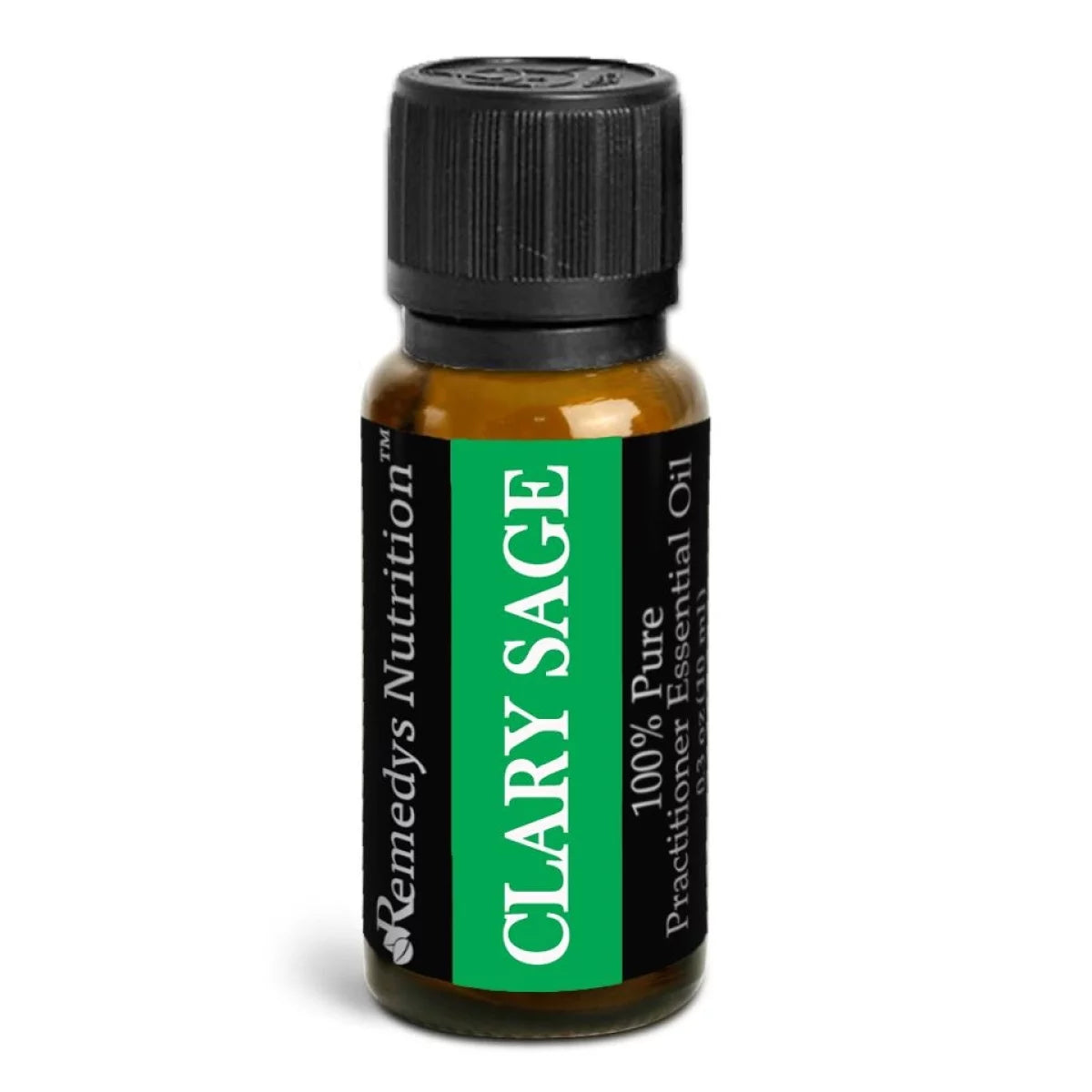
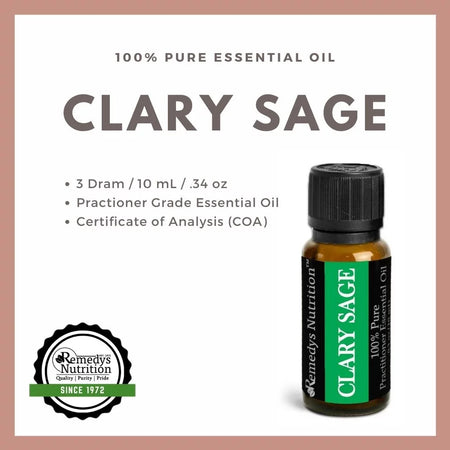
Standard 10 mL bottles deliver about 200 to 300 drops of pure undiluted oil.
Clary sage is sometimes confused with common sage (Salvia officinalis) but the two are very different in chemistry. Common sage is high in thujone and not generally safe in pregnancy or epilepsy; clary sage contains negligible thujone and has a much friendlier safety profile, though pregnancy precautions still apply due to estrogenic activity.
Clary Sage Benefits: Clinical Evidence Summary
| Benefit Area |
Key Finding |
Typical Use |
| Anxiety reduction |
20 to 30% drop in self-rated anxiety scores in 2014 RCT inhalation studies |
Diffusion 30 min, 4 to 6 drops |
| Sleep onset |
Average 12 to 18 minute reduction in sleep latency in small trials |
Bedside diffusion 60 min before bed |
| Menstrual cramp relief |
Pain score reduced 50% in 2012 abdominal massage trial vs unscented carrier |
2% topical massage on lower abdomen |
| Cortisol reduction |
Salivary cortisol dropped 36% after 5 minute clary sage inhalation in postmenopausal women |
Inhalation 5 to 10 min |
| Hot flash modulation |
Subjective hot flash intensity reduced 30 to 40% in 4 week perimenopausal trial |
Topical 1 to 2% twice daily |
| Hormonal balance |
Sclareol partially binds estrogen receptors, mild adaptogenic action over 8 to 12 weeks |
Daily diffusion + 1 to 2% topical |
| Skin (oily, mature) |
Sebum-balancing in 2 to 3% facial blends; preferred for combination skin |
0.5 to 1% in carrier |
| Nervous tension |
Linalyl acetate produces measurable parasympathetic shift in HRV studies |
Inhalation as needed |
- Sclareol diterpene profile sets clary sage apart from common sage chemistry
- Cortisol drop of about 36% recorded in 5 minute inhalation trial in postmenopausal women
- Pairs cleanly with lavender essential oil for layered nervous system calming
- 2014 randomized inhalation studies show 20 to 30% reduction in anxiety scores
- 50% pain reduction in 2012 abdominal massage trial for menstrual cramps at 2% dilution
- Negligible thujone, unlike common sage — safer for general adult use
- Hot flash intensity drops 30 to 40% over 4 weeks in perimenopausal protocols
How Clary Sage Essential Oil Works
Clary sage acts on 4 overlapping pathways. The first is gentle estrogen-receptor signaling driven by sclareol; this is mild compared to soy isoflavones and not enough to cause hormonal disruption in healthy adults but sufficient to modulate cycle symptoms. The second is parasympathetic activation through olfactory limbic pathways — linalyl acetate is the same calming molecule that drives lavender oil for sleep, present in clary sage at 60 to 75% concentration.
The third pathway is HPA-axis dampening reflected in the 36% cortisol drop measured in postmenopausal inhalation trials. The fourth is local antispasmodic action when applied topically to the lower abdomen during menstrual cramps; smooth muscle relaxation through calcium channel modulation is the proposed mechanism. These 4 effects layer together to make clary sage one of the most clinically useful single oils for womens hormonal support.
Clary Sage for Womens Cycle and Hormonal Balance
The strongest practical application is monthly cycle support. Across small trials totaling about 200 women, clary sage massage at 2% dilution on the lower abdomen during the luteal phase or first 2 days of menses produced 40 to 60% pain reduction versus unscented carrier oil. Effect onset is fast — 15 to 30 minutes after application, peaking around 90 minutes. Most users report reduced reliance on NSAIDs after 2 to 3 cycles of consistent use.
For perimenopausal hot flashes, the protocol is different: daily diffusion 30 to 60 minutes plus 1 to 2% topical on neck and chest. Effects build over 4 to 8 weeks rather than acutely. Relaxation blend can layer in for evening protocols when sleep is also disrupted. Always confirm any hormonal protocol with an OB-GYN if you have estrogen-sensitive conditions.
Clary Sage for Sleep and Anxiety
Clary sage at 4 to 6 drops in a bedside diffuser 30 to 60 minutes before bed is one of the more reliable single-oil sleep protocols. The mechanism is the same as lavender (linalyl acetate, parasympathetic activation) but with added cortisol-suppressing action that helps stress-related insomnia. Average sleep latency reduction in small trials is 12 to 18 minutes; deeper effects appear when paired with bedtime routine consistency over 2 to 4 weeks.
For acute anxiety, inhalation from a tissue or 1 drop on the back of the wrist gives a fast-acting calming effect within 3 to 5 minutes. Clary sage pairs especially well with ylang ylang essential oil at a 2:1 ratio for layered calming, or with Lullaby Blend for stronger sedative effect when sleep is the priority.
Clary Sage vs. Common Sage and Other Calming Oils
| Oil |
Main Strength |
Pregnancy Safety |
Pairs Well With |
| Clary Sage |
Cycle support, cortisol reduction, sleep |
Avoid |
Lavender, ylang ylang, bergamot |
| Common Sage |
Antimicrobial, focus |
Avoid (high thujone) |
Rosemary, thyme |
| Lavender |
Universal calming, skin, sleep |
Generally safe with caution |
Most oils |
| Ylang Ylang |
Mood, sensual, BP support |
Generally safe with caution |
Clary sage, patchouli |
| Roman Chamomile |
Gentle calming, kids friendly |
Caution |
Lavender, mandarin |
The single biggest selection rule: if you want hormonal support, pick clary sage. If you want general calming, lavender wins on price and versatility. Common sage should not be substituted — the chemistry differs sharply.
Why Choose Remedy's Clary Sage Essential Oil
| What You Get |
Why It Matters |
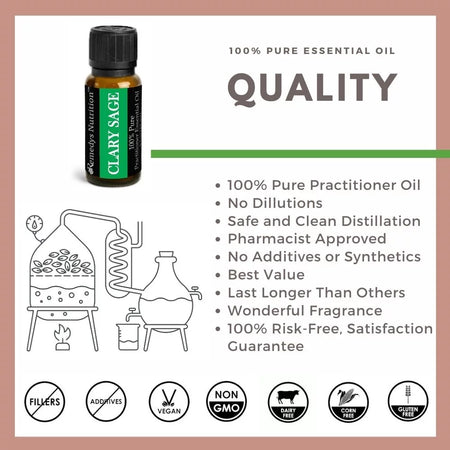
| 100% pure clary sage (Salvia sclarea) |
No carrier dilution, no synthetic linalyl acetate. Single botanical species verified. |
| Steam-distilled flowering tops |
Captures full sclareol and linalyl acetate profile — richer than leaf-only distillations |
| 10 mL amber dropper bottle |
UV protection extends shelf life to 24 months unopened, 12 months once opened |
| Made in USA, GMP facility |
cGMP-compliant manufacturing under FDA dietary supplement rules |
| Lab tested per batch |
Verified free of pesticide residues, heavy metals, and synthetic adulterants |
| Vegan, no animal testing |
Plant-based supply chain; no animal testing at any stage |
Clary Sage Dosage and Application by Goal
| Goal |
Dose |
Method |
Time to Effect |
| Acute anxiety |
1 to 2 drops |
Inhale from tissue or open palm 30 to 60 sec |
3 to 5 min |
| Sleep support |
4 to 6 drops |
Bedside diffuser, 30 to 60 min pre-bed |
2 to 4 weeks for full effect |
| Menstrual cramps |
2 to 3 drops in 1 tsp carrier (2%) |
Massage lower abdomen 5 min |
15 to 30 min acute |
| Hot flashes |
1 to 2% topical + diffusion |
Twice daily protocol |
4 to 8 weeks |
| Cortisol reduction |
3 to 5 drops |
Inhalation 5 to 10 min |
5 to 15 min acute |
| Skin (combination/mature) |
0.5 to 1% in carrier |
Apply morning or evening |
4 to 6 weeks |
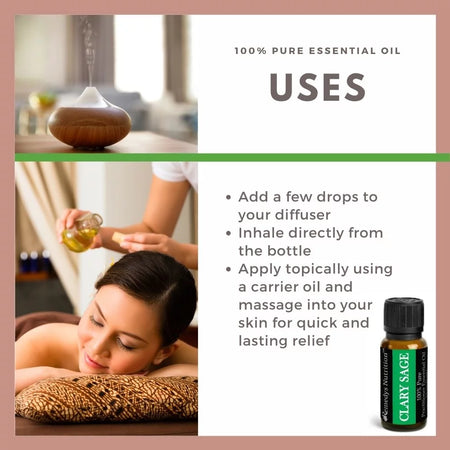
Always patch test on the inner forearm 24 hours before broader topical use. Carrier oils that pair best with clary sage for body work are rose hip oil for face and jojoba or sweet almond for body massage.
Safety, Side Effects, and Contraindications
Pregnancy contraindication. Clary sage has documented uterine tonic activity and is traditionally used to encourage labor at term. Avoid throughout pregnancy until 38+ weeks under midwife or OB-GYN supervision.
| Consideration |
Details |
| Pregnancy |
Avoid until 38 weeks; use only with practitioner guidance for labor support |
| Breastfeeding |
Use sparingly, avoid direct topical near nursing area |
| Estrogen-sensitive conditions |
Consult oncology/endocrinology before use if breast, ovarian, or uterine cancer history |
| Children under 6 |
Not recommended due to sclareol estrogenic potential |
| Alcohol interaction |
May intensify alcohol effects; avoid combined sedative use |
| Driving |
Sedating at higher doses; avoid topical or strong inhalation before driving |
| Surgery |
Discontinue 2 weeks before any planned surgery |
| Side effects |
Rare skin sensitization (under 1%); occasional headache from over-strong diffusion |
Clary Sage Essential Oil FAQ
What is clary sage essential oil used for? +
The 4 main uses are menstrual cramp relief through 2% topical massage, sleep support via 4 to 6 drops bedside diffusion, cortisol reduction through 5 minute inhalation, and perimenopausal hot flash modulation over 4 to 8 weeks. It is one of the most clinically useful single oils for womens hormonal support and stress-related insomnia.
How is clary sage different from common sage? +
Common sage (Salvia officinalis) is high in thujone and not safe in pregnancy or epilepsy. Clary sage (Salvia sclarea) is dominated by sclareol and linalyl acetate, with negligible thujone — about 1% the toxicity profile of common sage. They are not interchangeable; clary is for cycle and calming, common is for antimicrobial and focus.
Can clary sage really help with sleep? +
Yes. Linalyl acetate at 60 to 75% concentration drives parasympathetic activation through olfactory pathways. Average sleep onset reduction is 12 to 18 minutes in small trials at 4 to 6 drops 30 to 60 minutes before bed. Effect builds over 2 to 4 weeks of consistent use; pairs well with bedtime routine and a steady wake time.
Does clary sage help menstrual cramps? +
Yes, with documented results. The 2012 abdominal massage trial showed 50% pain score reduction at 2% dilution versus unscented carrier oil. Effect onset is 15 to 30 minutes, peaking at 90 minutes. Most users report reduced NSAID reliance after 2 to 3 cycles of consistent luteal-phase use.
Can I use clary sage during pregnancy? +
No, not until 38+ weeks under direct midwife or OB-GYN supervision. Clary sage has documented uterine tonic activity and is traditionally used to support labor at term. During the first 37 weeks of pregnancy, avoid all forms — topical, inhalation, and diffusion.
How does clary sage compare to lavender? +
Both share linalyl acetate, but clary sage adds sclareol for hormonal modulation and stronger cortisol reduction. Lavender is more versatile (skin, sleep, anxiety, kids-friendly); clary is more targeted to womens cycle and stress-related sleep. A 1:1 layered diffuser blend captures the strengths of both at 4 to 6 drops total.
Is clary sage safe for kids? +
Not recommended under age 6 due to mild estrogenic activity from sclareol. For ages 6 to 12, occasional brief diffusion at 1 to 2 drops is acceptable, but avoid topical use. For teens with menstrual cramp issues, 1% topical massage with parental supervision is reasonable starting at age 14.
Can clary sage lower cortisol? +
Yes. A 2010 inhalation study in postmenopausal women showed 36% salivary cortisol reduction after 5 minutes of clary sage inhalation versus unscented control. The effect is acute and useful for stress-spike management. For chronic high cortisol, daily diffusion plus stress-management routines outperform any single intervention.
What does clary sage smell like? +
Warm, nutty, slightly herbaceous with a faint earthy musk. Some users describe it as similar to a softer sage with sweet undertones. The aroma profile pairs cleanly with floral oils (ylang ylang, lavender, geranium) and citrus oils (bergamot, sweet orange) at 2:1 ratios. Strong on its own — use 4 drops max in a 100 mL diffuser.
Can I drink alcohol with clary sage? +
Use caution. Clary sage has mild sedative effects and may intensify alcohol's effect on coordination and judgment. Avoid heavy clary sage diffusion or topical use within 2 hours of drinking. The combination is not dangerous in most cases but reduces alertness more than either alone.
How long does a 10 mL bottle last? +
About 200 to 300 drops. At a typical 4 drops per diffuser session run 5 nights per week, a bottle lasts 10 to 15 weeks. Stored sealed in dark amber glass at 60 to 70 F, shelf life is 24 months unopened and 12 months once opened. Smell test: if it smells sour or faded, replace.
Does clary sage interact with medications? +
Mild caution with sedatives, antianxiety medications, and any drug labeled for drowsiness, due to additive parasympathetic effect. Hormonal medications including HRT and oral contraceptives are not strongly interacting at typical aromatherapy doses but discuss with prescriber for daily long-term use over 6 months.
Can clary sage be used for hair? +
Yes, especially for hormone-related hair thinning at 1 to 2% in scalp oil 2 to 3 times per week. Pairs well with rosemary essential oil for combined follicle support. Effect timeline is 12 to 16 weeks before measurable hair density changes appear in trial data.
What makes Remedy's clary sage different? +
100% pure single-species Salvia sclarea with no carrier dilution and no synthetic linalyl acetate. Steam-distilled from flowering tops for full sclareol profile, packaged in 10 mL amber dropper for 24 month shelf life, and lab-tested per batch in a USA cGMP facility. Vegan and cruelty-free.
Clary Sage: In-Depth Reading