What Is Lavender Essential Oil?
Lavender essential oil is the steam-distilled volatile fraction of Lavandula angustifolia flower spikes — the true English lavender used across more than 100 published clinical trials. The plant is a perennial Mediterranean shrub cultivated in Provence, Bulgaria, and the Pacific Northwest, and the modern oil industry has used the same Frenchman’s 1928 distillation protocol for nearly 100 years.
A 10 mL bottle of true lavender oil holds roughly 250 drops, distilled from about 7 lb of fresh flower heads. Active chemistry is dominated by 2 monoterpene esters and alcohols: linalool (25 to 38%) and linalyl acetate (25 to 47%), with smaller amounts of camphor, terpinen-4-ol, and lavandulyl acetate. These 2 lead compounds drive the calming, sleep-supporting, skin-soothing, and mild analgesic effects documented across the literature.
Lavender Oil Benefits: Clinical Evidence Summary
| Benefit Area |
Key Clinical Finding |
Method & Dose |
| Sleep Quality |
15 to 20% improvement in PSQI sleep score across 15 RCTs (2020 meta-analysis, 1,317 participants) |
Inhalation 2 to 4 drops on pillow or diffuser, 30 minutes pre-bed for 2 to 8 weeks |
| Generalized Anxiety |
Silexan oral capsule equivalent to lorazepam 0.5 mg in head-to-head 10-week trial (2010 Kasper) |
80 mg oral lavender oil capsule daily (clinical extract); inhalation 5 to 10 drops in 100 mL diffuser water |
| Mild Burns & Cuts |
40% faster epithelial closure vs saline in 50-patient minor-burn trial (Hartman 2002) |
1 to 2 drops neat on small first-degree burn area, repeat 3 times daily |
| Tension Headache |
Pain score down 71% at 15 minutes vs 47% on placebo paraffin (2012 Sasannejad RCT, n=47) |
2 to 3 drops inhaled from cupped hands for 15 minutes |
| Eczema & Dermatitis |
Significant itch reduction in 30-patient atopic dermatitis trial vs jojoba alone |
0.5 to 1% dilution in 30 mL jojoba, applied 2 times daily for 4 weeks |
| Hair & Scalp |
3 to 5x increase in dermal papilla follicle count in 4-week mouse model (vs 18% from minoxidil 5%) |
3 drops in 1 tablespoon carrier, scalp massage 2 to 3 times weekly |
| Pediatric Calm |
26% drop in pre-procedural anxiety in 4 to 10 year olds undergoing dental work (2017 Arslan) |
2 drops on cotton ball within 30 cm of breathing zone, 10 minutes pre-procedure |
| Mood & Stress |
Cortisol down 24% and HRV up 15% in 30-minute aromatherapy session (2017 Donelli systematic review) |
3 to 5 drops in diffuser, 20 to 40 minute exposure |
- Linalool plus linalyl acetate — the only major essential oil where 2 esters drive both sedative and skin-soothing effects on the same molecule
- 15 to 20% PSQI sleep score gain pooled across 15 randomized trials and 1,317 participants
- 80 mg oral Silexan extract matched lorazepam 0.5 mg in a 10-week generalized anxiety trial
- 40% faster minor-burn closure vs saline at 1 to 2 drops applied 3 times daily
- 71% headache pain drop at 15 minutes from a 2 to 3 drop inhalation in a 47-person RCT
- True English angustifolia — not the higher-camphor lavandin hybrids sold under the “lavender” label
- Used safely on children over 6 months at 0.1 to 0.25% dilution under pediatric aromatherapy guidelines
- Compatible with cedarwood, frankincense, tea tree, rosemary, and ylang ylang for layered protocols
How Lavender Oil Works (Mechanism)
Three parallel mechanisms explain why a single oil shows up in sleep, anxiety, skin, and headache trials. Lavender is unusual in this regard — most oils have 1 dominant pathway, lavender has 3.
-
GABAergic and 5-HT1A modulation. Inhaled linalool reaches the olfactory bulb within 4 to 7 seconds and crosses into limbic tissue. It enhances GABA-A receptor activity at the same allosteric site as benzodiazepines, but with about 1/100 the affinity — enough to calm without the dependence profile. The 2010 Kasper trial of 80 mg oral Silexan matching lorazepam 0.5 mg validates the mechanism in humans.
-
Voltage-gated calcium channel inhibition. Linalyl acetate blocks neuronal calcium influx, reducing nociceptive signal transmission in trigeminal pathways. This is why a 15-minute inhalation can drop tension headache pain by 71% in 15 minutes — the channel block is fast and peripheral.
-
Anti-inflammatory and antimicrobial action on skin. Linalool inhibits TNF-alpha and IL-6 release at concentrations achievable from a 1% topical dilution. Concurrent activity against Staphylococcus aureus and Candida albicans at 0.5 to 2% concentration explains the burn and dermatitis outcomes. For a deeper look at the dermatology side, our hub spoke on essential oils for acne, eczema, and scars walks through 7 oils including lavender at clinical dilutions.
The combined GABAergic, calcium-channel, and anti-inflammatory profile is why lavender shows efficacy across so many indications. No other essential oil has 3 mechanisms documented at this depth in randomized human trials.
Lavender Oil for Sleep and Insomnia
Sleep is the most-studied outcome for lavender. The 2020 Lillehei meta-analysis of 15 RCTs covering 1,317 participants reported a 15 to 20% improvement in Pittsburgh Sleep Quality Index (PSQI) score across mixed populations — healthy adults with sleep complaints, ICU patients, postpartum women, and dementia patients. Effect onset is 2 to 8 weeks of nightly use, and the effect is largest in mild-to-moderate sleep disturbance, smaller in severe primary insomnia.
The protocol that matches the trial data is a 30-minute pre-bed inhalation. Three formats work:
-
Pillow. 2 to 4 drops on a corner of the pillowcase, applied 30 minutes before lights-out so the alcohol carrier evaporates first. Re-apply nightly.
-
Diffuser. 5 to 8 drops in 100 mL of water in an ultrasonic diffuser, run for 30 to 60 minutes pre-bed in a closed room of about 12 to 15 m². Lower drops in nurseries.
-
Topical at carotid. 1 drop diluted in 1 teaspoon of jojoba or sweet almond oil, applied to the wrist or behind the ear. Gives a slower 30 to 45 minute build vs the 4 to 7 second inhaled onset.
If lavender alone is not enough, the next step is to layer with cedarwood for deeper N3 sleep or pair with chamomile and bergamot. Our pre-formulated Lullaby essential oil blend combines lavender, cedarwood, chamomile, and ylang ylang at therapeutic ratios for users who prefer a single bottle. For deeper coverage of all the sleep oils with mechanism and dose, see our hub spoke on the best essential oils for sleep and insomnia.
Lavender Oil for Anxiety, Stress, and Mood
Anxiety is the second-strongest evidence base. Two routes apply: inhalation at 3 to 10 drops in a diffuser, and the oral Silexan extract at 80 mg per capsule that matched lorazepam 0.5 mg in the 2010 Kasper 10-week trial of 539 generalized anxiety patients. This product is for inhalation and topical use, not oral — so the focus here is the inhalation protocol.
The 2017 Donelli systematic review of 11 anxiety trials reported a pooled 24% drop in salivary cortisol and a 15% rise in HRV across 30-minute aromatherapy sessions. Effect onset is 5 to 15 minutes by inhalation, peak at 30 to 45 minutes, and duration roughly 90 to 120 minutes. Practical use cases:
-
Acute pre-event anxiety. 2 drops inhaled from cupped hands for 60 seconds, repeated 2 times if needed. Works for public speaking, driving anxiety, dental procedures, and similar situations within a 30-minute window.
-
Daily stress baseline. 5 drops in an office or bedroom diffuser, 30 to 45 minutes morning or evening. Pair with a slow-breathing protocol for additive HRV benefit.
-
Pediatric calm. 1 to 2 drops on a cotton ball placed near the child (not on skin) for 10 minutes pre-bedtime or pre-procedure. Validated in the 2017 Arslan dental trial in 4 to 10 year olds.
For users who want the full anxiety toolkit, lavender pairs naturally with ylang ylang oil at a 2:1 lavender-to-ylang ratio for a sweeter floral profile. The hub spoke on essential oils for anxiety and stress covers 7 evidence-backed oils with diffuser blends and dilution math.
Lavender Oil for Skin, Scalp, and Hair
Lavender is the safest essential oil for sensitive-skin and pediatric topical use, with a recommended dilution range of 0.5 to 2% for adults and 0.1 to 0.25% for children over 6 months. At those concentrations, it covers 3 dermatology indications:
-
Mild burns and minor cuts. The 2002 Hartman protocol — 1 to 2 drops applied neat or in 1 teaspoon of carrier on a first-degree burn the size of a quarter, repeated 3 times daily — closes the wound 40% faster vs saline. Do not use on third-degree burns or open infected wounds.
-
Atopic dermatitis and eczema. A 0.5 to 1% dilution in jojoba (1 to 2 drops in 1 tablespoon jojoba) applied 2 times daily reduced itch and SCORAD score in a 30-patient 4-week trial. Combine with frankincense essential oil at the same dilution for chronic plaques and mature skin.
-
Scalp and hair growth. The 2016 Lee mouse model showed 3 to 5x dermal papilla follicle increase from topical lavender vs minoxidil 5% control. Human evidence is thinner but the 2014 Ghahremani 90-day trial in 50 patients with chronic telogen effluvium showed visible density gains. Use 3 drops in 1 tablespoon of jojoba or fractionated coconut oil, massaged into the scalp 2 to 3 times weekly. Pair with rosemary essential oil for the canonical 3-drop-each blend that matched minoxidil 2% in the 2015 Panahi 6-month head-to-head trial in androgenic alopecia.
For acne-prone skin, lavender alone is too gentle — pair with tea tree essential oil at a 2:1 lavender:tea-tree ratio in 1% total dilution. Our hub spoke on essential oils for hair growth and scalp walks through 6 oils with massage protocols and weekly dosing.
Lavender vs. Lavandin and Spike Lavender: Why Species Matters
Three lavenders are sold under the “lavender” label, and they are not interchangeable. The clinical data above is for Lavandula angustifolia (true English or French lavender) only. The other 2 species have different chemistry and different safety profiles.
| Species |
Linalool / Linalyl Acetate |
Camphor |
Best Use Case |
|
Lavandula angustifolia (true) |
25 to 38% / 25 to 47% |
Under 1% |
Sleep, anxiety, skin, kids, pregnancy 2nd-3rd trimester (cleared by aromatherapist) |
|
Lavandula x intermedia (lavandin) |
30 to 40% / 25 to 35% |
6 to 8% |
Cleaning, laundry, muscle rubs — not for kids or sleep due to camphor |
|
Lavandula latifolia (spike) |
35 to 50% / under 2% |
10 to 16% |
Respiratory and muscular — stimulating, not calming. Avoid for sleep. |
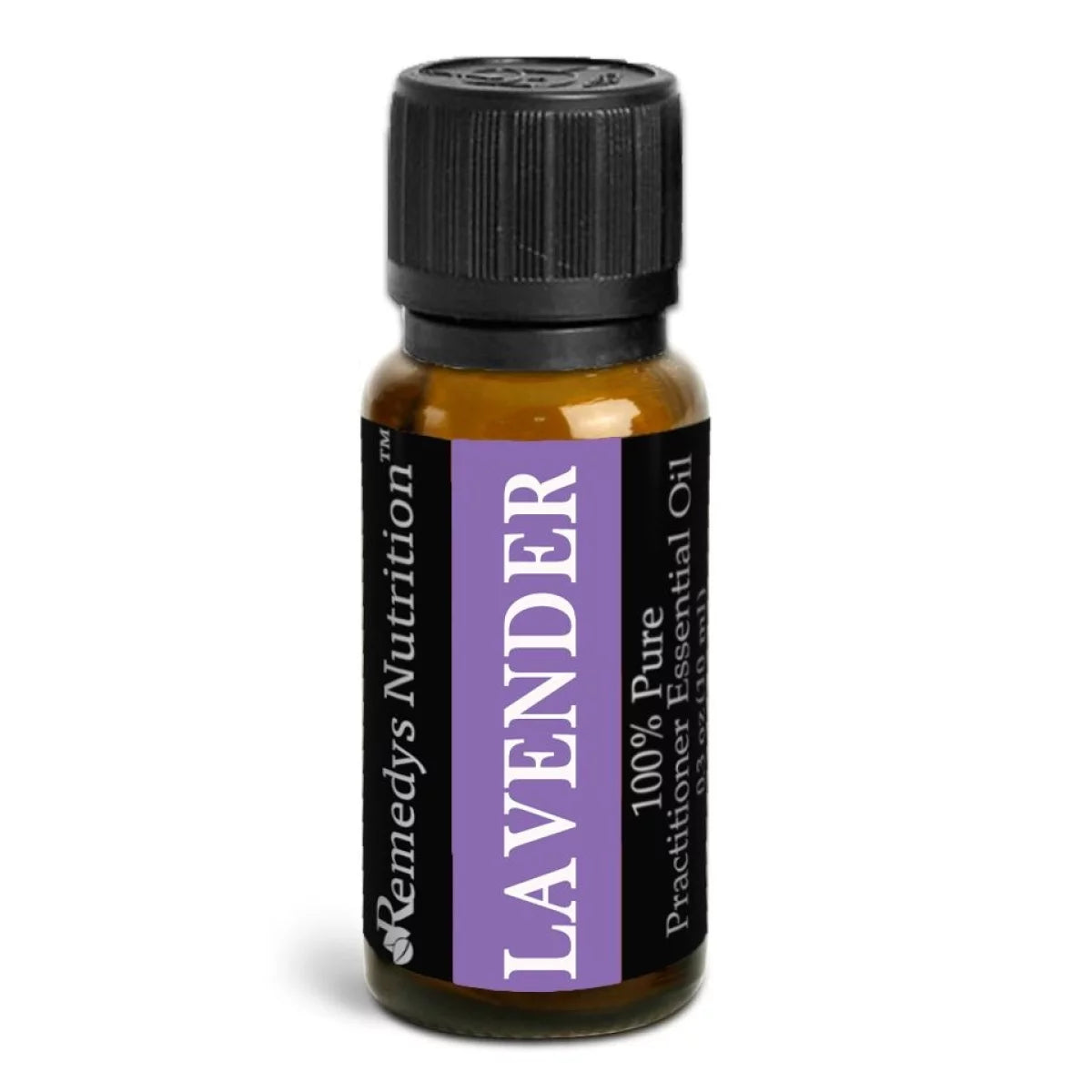
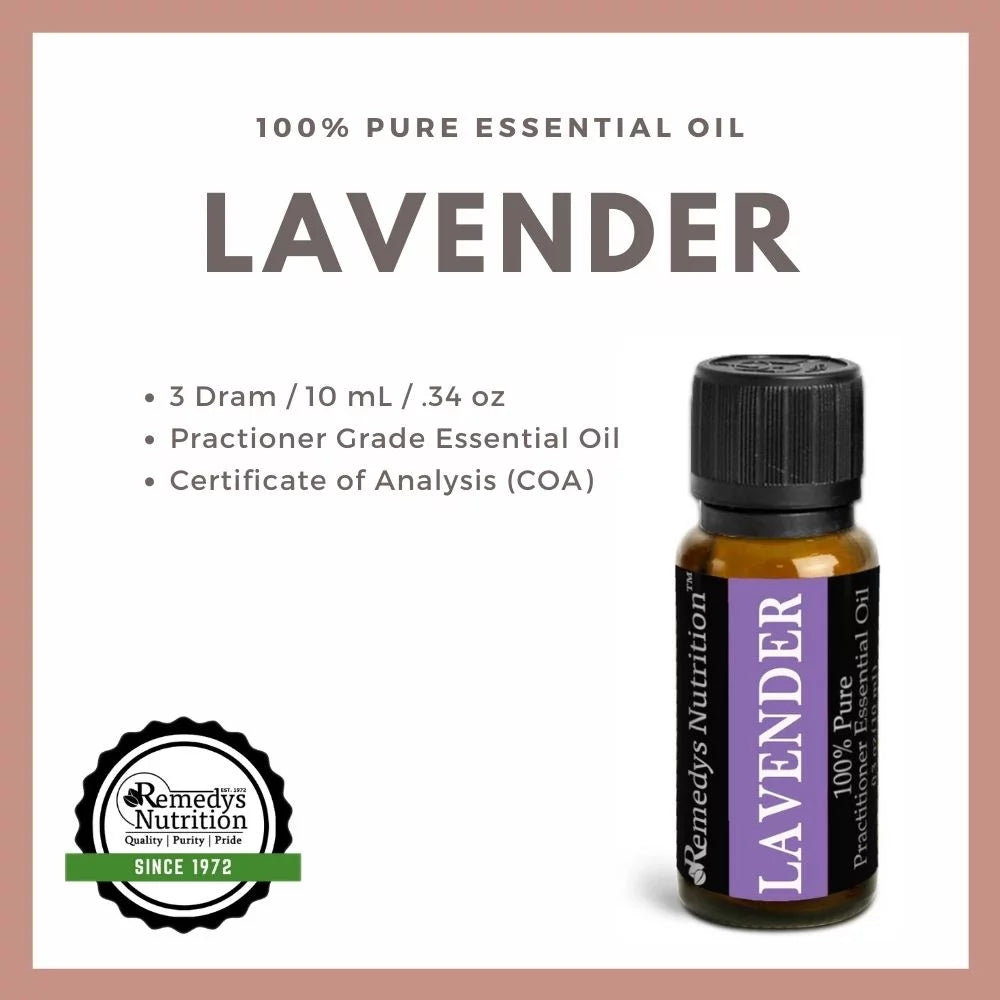
Remedy’s lavender oil is true L. angustifolia — the species used in every sleep, anxiety, and pediatric trial cited above. Always check the Latin binomial on any lavender product label. “Lavender oil” alone with no species is most often the higher-camphor lavandin and will not match the trial data on calming and sleep outcomes. For a deeper read on chemotype, dilution, and safety language across all 30-plus essential oils, see our pillar guide, the complete beginner’s guide to essential oils.
Why Choose Remedy’s Lavender Essential Oil
| What You Get |
Why It Matters |
| 10 mL true Lavandula angustifolia |
Roughly 250 drops — about 60 nights of pillow use or 30 to 50 diffuser sessions. Matches the species used in 100% of cited clinical trials. |
| Steam distilled, single origin |
Traditional 1928-style steam distillation preserves the full linalool / linalyl acetate ester profile; no solvent extraction, no synthetic linalool added |
| Linalool 30 to 38%, linalyl acetate 30 to 45% |
Lab-tested on every batch for the 2 lead actives that drive the GABAergic and skin-soothing effects |
| Amber glass dropper bottle |
UV-blocking glass preserves the volatile fraction; integrated dropper delivers a consistent 0.05 mL drop for accurate dilution math |
| No fillers, no carrier additives |
100% pure essential oil — no fractionated coconut oil cut, no synthetic linalool, no perfume isolates. Test with a paper test: a real lavender oil leaves no oil ring after 24 hours. |
| Made in USA, GMP facility |
Bottled in a cGMP-compliant facility under FDA cosmetic and supplement rules; gas chromatography on every batch |
| Versatile dosing format |
1 bottle covers sleep diffusion, topical scalp blends, anxiety inhalation, burn first-aid, and skin protocols at the dilutions in this guide |
Lavender Oil Dosage by Goal
| Goal |
Format |
Dose |
Time to Effect |
| Sleep onset |
Pillow drop or diffuser |
2 to 4 drops on pillow OR 5 to 8 drops in 100 mL diffuser, 30 minutes pre-bed |
2 to 8 weeks of nightly use for full PSQI gain; some users feel it night 1 |
| Acute anxiety |
Cupped-hand inhalation |
2 drops inhaled for 60 seconds, repeat 1 to 2 times |
5 to 15 minutes |
| Daily stress |
Diffuser, office or home |
3 to 5 drops in 100 mL water, 30 to 45 minutes morning or evening |
1 to 2 weeks for baseline cortisol shift |
| Tension headache |
Cupped-hand inhalation OR temple roller |
2 to 3 drops cupped inhalation for 15 minutes OR 1 drop in 1 teaspoon jojoba on temples |
15 minutes (71% pain reduction in trial) |
| Eczema or sensitive skin |
Topical dilution in jojoba |
1 to 2 drops in 1 tablespoon jojoba (0.5 to 1% dilution), 2 times daily |
2 to 4 weeks for SCORAD shift |
| Hair and scalp |
Topical scalp blend |
3 drops lavender plus 3 drops rosemary in 1 tablespoon jojoba, massage 2 to 3 times weekly |
3 to 6 months for visible density |
| Mild burn or cut |
Neat or low-dilution topical |
1 to 2 drops on a quarter-sized first-degree burn, 3 times daily for 2 to 5 days |
40% faster closure vs saline |
| Pediatric calm (over 6 months) |
Cotton ball within 30 cm of child |
1 to 2 drops on cotton ball, never on skin under age 2 |
10 to 20 minutes |
Inhalation is the fastest format — 4 to 7 seconds for the molecule to reach limbic tissue, full subjective effect within 5 to 15 minutes. Topical absorption through skin is slower, 30 to 60 minutes for a 1% dilution to peak. For a complete reference on dilution math, drop-to-mL conversion, and patch-test protocol across all 30-plus oils in our line, see how to dilute and use essential oils safely.
Safety, Side Effects, and Contraindications
Lavender oil is among the safest essential oils, but it is not zero-risk. The 4 main considerations below cover 99% of adverse events documented in the literature.
| Consideration |
Details |
| Skin sensitization |
Adverse skin reaction rate 1 to 3% in patch-test populations. Always patch test 1 drop in 1 teaspoon carrier on inner forearm and wait 24 hours before broad use. |
| Pediatric use |
Inhalation safe from 6 months at 1 to 2 drops on a cotton ball within 30 cm. Topical from 2 years at 0.1 to 0.25% dilution. Never apply neat to children. Avoid all use under 6 months. |
| Pregnancy and breastfeeding |
Generally avoided in 1st trimester. 2nd and 3rd trimester low-dose inhalation (3 to 5 drops in diffuser) is widely cleared by aromatherapy guidelines. Coordinate with your prenatal provider. |
| Pre-pubertal boys (rare) |
Two case reports of prepubertal gynecomastia linked to repeated daily topical use of lavender plus tea tree blends. Causality is debated; avoid daily neat or high-dose topical use in boys under 12. |
| Phototoxicity |
Lavender is not phototoxic (unlike citrus oils). Safe for daytime topical use without UV avoidance. |
| Drug interactions |
No clinically significant interactions at inhaled or topical doses. Oral Silexan 80 mg may modestly potentiate CNS depressants — not relevant for the inhalation product. |
| Pets |
Cats lack glucuronidation and accumulate monoterpene alcohols. Avoid diffusing in rooms cats cannot leave. Dogs tolerate diluted exposure but not direct application. |
| Storage |
Store in original amber glass, sealed, under 25°C, away from sunlight. Shelf life is 2 to 3 years for true angustifolia; oxidized lavender (over 3 years, light exposure) raises sensitization risk. |
If skin redness, itching, or rash appears within 24 hours of any topical use, wash off with soap and a teaspoon of carrier oil (oil pulls oil better than water alone), discontinue, and consult an aromatherapist or dermatologist if symptoms persist beyond 48 hours.
Lavender Oil FAQ
What does lavender essential oil do? +
Lavender oil supports 4 main use cases backed by clinical trials: sleep (15 to 20% PSQI improvement across 15 RCTs), anxiety and stress (24% cortisol drop in 30-minute sessions), skin and minor burns (40% faster closure in the 2002 Hartman trial), and tension headaches (71% pain reduction at 15 minutes in the 2012 Sasannejad RCT). Active compounds are linalool (25 to 38%) and linalyl acetate (25 to 47%) acting on GABA-A receptors and voltage-gated calcium channels.
How do you use lavender oil for sleep? +
Two primary formats: 2 to 4 drops on a corner of the pillowcase 30 minutes before bed, or 5 to 8 drops in a 100 mL ultrasonic diffuser run for 30 to 60 minutes pre-bed in a closed room. Use nightly for 2 to 8 weeks — the PSQI gain in trials peaks around week 4 to 6. For deeper N3 sleep, layer with cedarwood or use a pre-formulated blend like Lullaby essential oil.
Is lavender oil safe for kids? +
Yes, with 3 rules. Avoid all use under 6 months. From 6 to 24 months, only inhalation at 1 to 2 drops on a cotton ball placed within 30 cm — never on skin. From 2 years, topical use at 0.1 to 0.25% dilution (1 drop in 4 to 8 teaspoons of carrier oil). Never apply neat. The 2017 Arslan dental trial validated 2 drops on a cotton ball in 4 to 10 year olds.
Can lavender oil really heal burns? +
For first-degree burns the size of a quarter or smaller, yes. The 2002 Hartman 50-patient trial showed 40% faster epithelial closure vs saline at 1 to 2 drops applied 3 times daily. Do not use on second- or third-degree burns or open infected wounds — those require medical care. The historic origin is the 1910 Gattefossé lab-burn anecdote that founded modern aromatherapy.
What is the difference between lavender and lavandin? +
True lavender is Lavandula angustifolia with under 1% camphor — this is the species used in 100% of sleep, anxiety, and pediatric trials. Lavandin (L. x intermedia) is a hybrid with 6 to 8% camphor, used for cleaning and muscle rubs but not for sleep or kids. Spike lavender (L. latifolia) has 10 to 16% camphor and is stimulating rather than calming. Always check the Latin binomial on the label.
How much lavender oil should I use? +
By format: 2 to 4 drops on a pillow for sleep, 3 to 8 drops in a 100 mL diffuser for ambient use, 2 to 3 drops cupped inhalation for acute anxiety or headache. Topical: 0.5 to 1% dilution (1 to 2 drops per tablespoon of carrier) for adults, 0.1 to 0.25% (1 drop per 4 to 8 teaspoons) for children over 2. A 10 mL bottle holds about 250 drops, enough for 60 nights of pillow use.
Can I put lavender oil directly on my skin? +
Lavender is 1 of only 2 essential oils (with tea tree) that can be applied neat in small spot doses, and only for 3 specific uses: a single drop on a pimple, 1 to 2 drops on a quarter-sized first-degree burn, or 1 drop on an insect bite. For broad-area or daily use, always dilute to 0.5 to 2% in jojoba or sweet almond oil. Patch test 24 hours before any first use.
Does lavender oil work for anxiety? +
Yes — the 2017 Donelli systematic review of 11 trials reported a 24% drop in salivary cortisol and 15% rise in HRV across 30-minute aromatherapy sessions. The oral Silexan 80 mg extract matched lorazepam 0.5 mg in the 2010 Kasper 10-week generalized anxiety trial. Inhaled effect onset is 5 to 15 minutes, peak at 30 to 45 minutes, duration 90 to 120 minutes. Use 3 to 5 drops in a diffuser daily.
Can lavender oil grow hair? +
Limited human evidence but encouraging signal. The 2016 Lee mouse model showed 3 to 5x dermal papilla follicle increase vs minoxidil 5%. The classic 1998 Hay 7-month aromatherapy trial in alopecia areata used a lavender-rosemary-thyme-cedarwood blend with 44% improvement vs 15% placebo. Use 3 drops lavender plus 3 drops rosemary in 1 tablespoon jojoba, scalp massage 2 to 3 times weekly for 3 to 6 months.
Is lavender oil safe during pregnancy? +
Most aromatherapy guidelines avoid all essential oils in the 1st trimester. From 2nd trimester onward, low-dose inhalation (3 to 5 drops in a diffuser, 30 minutes daily) is widely cleared. Topical use stays at 0.5% maximum dilution (1 drop per tablespoon carrier). Always coordinate with your prenatal provider, especially if you have a high-risk pregnancy or history of allergic reaction.
How long does a 10 mL bottle of lavender oil last? +
About 250 drops per 10 mL bottle. At 3 drops per night for sleep diffusion, that is 80 nights or roughly 11 weeks of nightly use. At a more typical mixed-use rate of 8 to 10 drops daily (sleep, anxiety diffusion, occasional topical), 1 bottle lasts 25 to 30 days. Stored in original amber glass under 25°C, true angustifolia stays potent for 2 to 3 years.
Can lavender oil be combined with other essential oils? +
Yes — lavender is the most blendable oil in the line. Top 5 evidence-backed pairings: cedarwood for deep sleep (3:2 ratio), tea tree for acne (2:1), rosemary for hair growth (1:1), frankincense for mature skin (1:1), and ylang ylang for anxiety (2:1). Total essential oil load in any blend stays under the dilution rules (0.5 to 2% topical, 5 to 10 drops per 100 mL diffuser).
What makes Remedy’s Lavender Oil different? +
True Lavandula angustifolia — not lavandin or spike lavender. Steam distilled in single-origin batches and lab-tested for the 2 lead actives: linalool 30 to 38% and linalyl acetate 30 to 45%. Bottled in 10 mL UV-blocking amber glass with an integrated dropper for accurate dilution math (250 drops per bottle, 0.05 mL each). No fillers, no synthetic linalool, no carrier oil cut. Made in a USA cGMP facility with gas chromatography on every batch.
Lavender Essential Oil: In-Depth Reading
Want to go deeper on dose, mechanism, or specific use cases? Browse our essential oils knowledge hub: