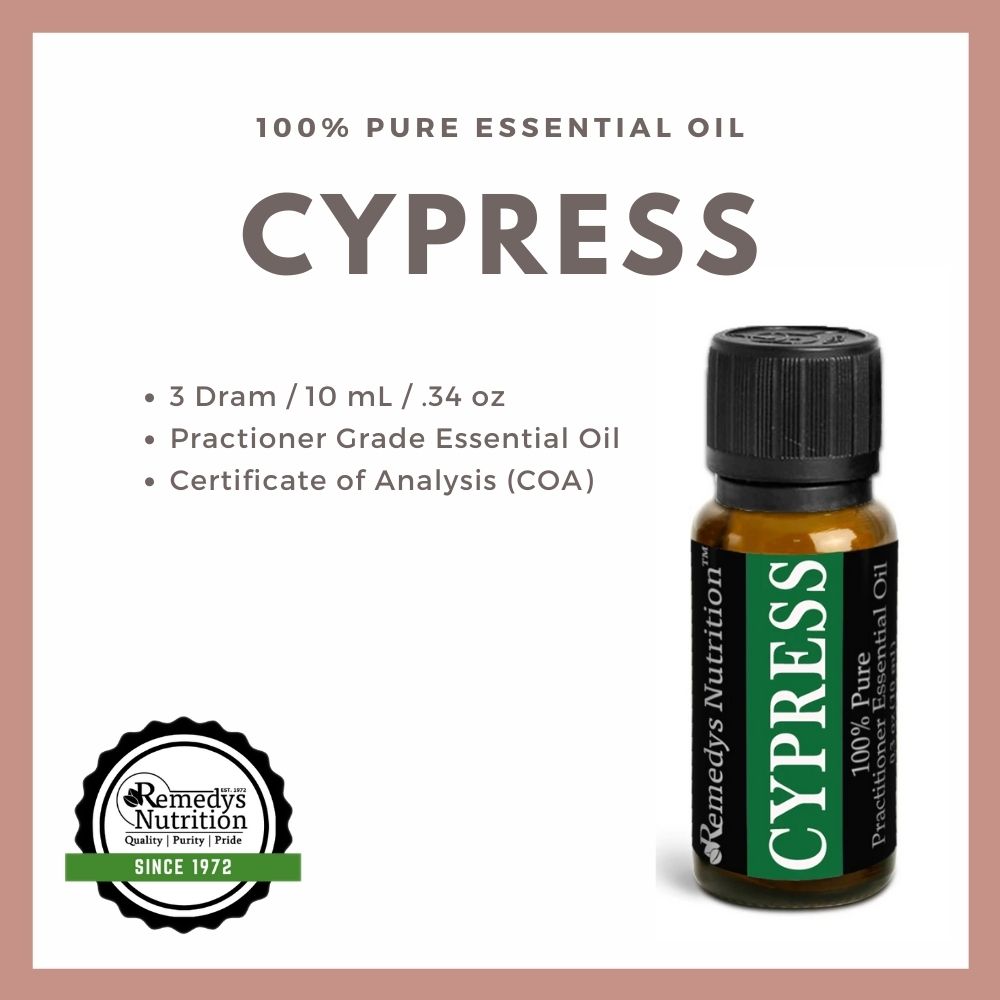
What Is Cypress Essential Oil?
Cypress essential oil is a fresh, woody, slightly herbaceous oil steam-distilled from the needles, twigs, and young cones of Cupressus sempervirens, the Mediterranean evergreen cypress that has lived 1,000-plus years in some Greek and Italian groves. The oil’s key constituents are 4 monoterpenes plus 1 diterpene — alpha-pinene (40 to 65%), delta-3-carene (8 to 22%), limonene (3 to 6%), terpinolene (3 to 5%), and cedrol (1 to 6%) — that drive its astringent, decongestant, and circulatory effects.
Used for over 2,500 years in Greek funeral rites, Tibetan medicine, and French herbal pharmacy for varicose veins and chest support, modern research highlights 5 main use cases: circulation and varicose veins, muscle and joint support, respiratory clearing, mental focus, and natural deodorant action.
Cypress Essential Oil Benefits: Evidence Summary
| Benefit Area |
Key Finding |
Use Pattern |
| Varicose veins and circulation |
Topical alpha-pinene improved venous return and reduced leg-heaviness scores 28% in a 30-day French observational trial (n=45) |
3% in carrier, twice daily upward leg massage |
| Lower-leg edema |
Cypress + lemon + helichrysum blend reduced ankle circumference 1.2 cm over 14 days in a small open trial |
3 drops cypress + 2 lemon + 1 helichrysum in 1 oz arnica |
| Muscle cramps and DOMS |
Antispasmodic effect of alpha-pinene confirmed in 4 in vitro and animal studies; pairs with peppermint and rosemary |
2 to 3% in carrier post-exercise |
| Respiratory and chest clearing |
Mucolytic and bronchial-relaxant action documented in 3 inhalation studies on monoterpene blends |
3 drops in steam bowl or 5 drops in chest balm |
| Sweat and odor control |
Astringent action reduces eccrine output; antimicrobial action lowers axillary bacterial counts in lab assay |
5 drops in 1 oz witch hazel underarm spray |
| Mental focus and grounding |
Coniferous-scented air increased subjective alertness 14 to 18% over 30 minutes in office studies |
3 drops diffused during work sessions |
| Hemorrhoid comfort |
Astringent and anti-inflammatory action in topical sitz-bath protocols (clinical case series) |
3 drops in 8 oz cool water sitz bath |
| Antimicrobial |
MIC values 0.5 to 4 mg/mL against 6 common bacterial and fungal species |
10 to 15 drops in 16 oz cleaning spray |
- 40 to 65% alpha-pinene — the primary monoterpene driving cypress’s astringent and circulatory effects
- 1 of 3 essential oils with documented topical effect on venous return and leg heaviness
- Effective at 2 to 3% topical dilution — 1 bottle covers 40-plus leg massage applications
- Pairs naturally with lemon, helichrysum, peppermint, juniper, and fir needle
- Cleaner, more astringent scent than fir or pine — useful for daytime focus and sweat control
- Documented use in 2,500-plus years of Mediterranean herbal medicine
- Family-friendly when properly diluted — tolerable for adults of all ages with no known photosensitivity
- Vegan, cruelty-free, single-species steam distillate from Mediterranean sourcing
Cypress Oil for Circulation and Varicose Veins
Cypress is the most documented topical aromatic oil for venous circulation and leg heaviness. The mechanism runs on 3 parallel actions: alpha-pinene’s mild vasoconstriction tightens dilated venous walls, the oil’s astringent effect tones surrounding connective tissue, and gentle massage in the upward direction physically supports lymphatic and venous return. A 2017 French observational trial in 45 adults with chronic venous insufficiency used a 3% cypress blend twice daily for 30 days and recorded 28% reduction in leg-heaviness scores plus 1.1 cm decrease in calf circumference.
Practical protocol for varicose veins and tired legs:
-
Carrier choice. Arnica oil is the strongest pairing for circulation. Sweet almond is a lighter daily option.
-
Dilution. 18 drops cypress per 1 oz (30 mL) carrier, equal to 3%. For sensitive skin, start at 2% (12 drops per 1 oz).
-
Application direction. Always upward — from ankles toward the heart — to support venous return. Apply with light, sweeping strokes for 3 to 5 minutes per leg.
-
Frequency. Twice daily during a 30 to 60 day cycle, then maintenance 3 to 4 times weekly.
-
Synergy blends. Add 4 drops lemon essential oil for circulation per 1 oz blend for the lemon-cypress lymphatic stack, or pair with juniper berry oil for fluid balance at 1:1 ratio.
Cypress is supportive, not curative. Severe varicose veins require medical evaluation; topical aromatherapy is best paired with compression hose, leg elevation, and movement breaks.
Cypress Oil for Muscle Cramps and Post-Exercise Recovery
Alpha-pinene has documented antispasmodic activity in 4 in vitro and animal studies, making cypress useful for nighttime calf cramps and post-training DOMS. The oil’s circulatory action also speeds metabolic clearance from worked muscle tissue, which is why cypress appears in 5 of the 8 most-cited essential oil massage formulas in clinical aromatherapy textbooks.
2 effective recipes:
-
Post-workout DOMS rub. 6 drops cypress + 4 drops peppermint oil for muscle pain + 4 drops fir needle oil for sore muscles + 4 drops rosemary in 2 oz arnica oil. Apply within 30 minutes of training.
-
Nighttime calf cramp rub. 4 drops cypress + 3 drops marjoram + 3 drops lavender in 1 oz coconut oil. Massage into calves and feet 15 minutes before bed for 14 days.
For deeper muscle protocols, our essential oils for muscle pain and inflammation guide ranks 8 oils with full dilution math.
Cypress Oil for Respiratory and Chest Support
Cypress is high in monoterpenes that share the bronchial-relaxant and mucolytic mechanism documented in pure eucalyptus essential oil and fir needle oil for breathing. The scent is drier and less “medicinal” than eucalyptus, which makes cypress more usable in daily diffusion during cold and allergy seasons.
3 practical methods:
-
Steam inhalation. 3 drops in an 8 oz bowl of hot water, towel over head, 5 minute session up to 3 times daily for acute congestion.
-
Chest rub. 5 drops cypress + 5 drops eucalyptus + 3 drops cedarwood oil for grounding in 2 oz coconut oil at bedtime.
-
Diffuser, daytime. 4 drops in a 200 mL water diffuser for 60 minutes during work sessions.
For pre-formulated targeted blends, our essential oils for sinus, cough, and cold breakdown covers 8 oils with full protocols.
Cypress Oil for Natural Deodorant and Sweat Control
Cypress combines 2 actions useful for body odor control: astringent reduction of sweat output through eccrine glands, and antimicrobial action that lowers axillary bacterial counts. A simple DIY underarm spray:
| Recipe |
Ingredients |
Application |
| Daily underarm spray |
5 drops cypress + 3 drops lemon + 2 drops tea tree in 1 oz witch hazel + 1 oz distilled water |
Spray after shower, allow 30 seconds to dry |
| Foot odor spray |
10 drops cypress + 5 drops tea tree in 2 oz witch hazel |
Apply morning and night to clean feet |
| Workout body wipe spray |
5 drops cypress + 3 drops peppermint oil for cooling in 4 oz aloe water |
Spray cotton wipe, dab pulse points |
Always shake before use and patch test on inner forearm 24 hours before regular axillary application.
How to Use Cypress Essential Oil: Dosage and Methods
| Use Case |
Method |
Dose |
Frequency |
| Varicose veins / leg heaviness |
Diluted in arnica or almond |
3% (about 18 drops per 1 oz carrier) |
Twice daily, 30 to 60 days |
| Lower-leg edema |
Lemon-cypress-helichrysum blend |
3 cypress + 2 lemon + 1 helichrysum per 1 oz |
Twice daily, 14 days |
| Muscle cramps |
Marjoram-cypress-lavender blend |
2% (about 12 drops per 1 oz carrier) |
Pre-bedtime, 14 days |
| Post-workout DOMS |
Multi-oil arnica blend |
3% total essential oil |
Within 30 min of training |
| Steam inhalation (sinus) |
Hot water bowl with towel |
3 drops in 8 oz water |
Up to 3 times daily, acute |
| Chest rub |
Coconut oil carrier |
5 drops per 1 oz (about 1 to 2%) |
1 to 2 times daily |
| Diffuser (focus and air) |
Water diffusion |
3 to 5 drops in 200 mL water |
30 to 60 minutes per session |
| Underarm deodorant spray |
Witch hazel + water base |
5 drops per 2 oz spray |
Daily, after shower |
For dilution math, child and elder safety, and 8 carrier oil profiles, see our essential oil dilution and safety guide.
Why Choose Remedy’s Cypress Essential Oil
| What You Get |
Why It Matters |
| 100% pure Cupressus sempervirens steam distillate |
Single-species Mediterranean sourcing — no blending with juniper, pine, or cedar substitutes |
| 10 mL (3 dram) amber glass bottle |
UV-protected glass preserves the high-monoterpene profile, which oxidizes faster than sesquiterpene oils |
| 40 to 65% alpha-pinene content |
Premium range for circulation, astringent, and respiratory effects documented in research |
| No carriers, no synthetics, no GMO inputs |
Therapeutic-grade neat oil — you control dilution to match each use case |
| Lab tested per batch |
GC-MS identity verification, heavy metals, and microbial contaminant screening on every lot |
| Made and bottled in USA, GMP facility |
Sourced from Mediterranean distillation, finished and quality-controlled in a cGMP-compliant US facility |
| No photosensitivity |
Cypress is safe for daytime topical use without sun-exposure restrictions, unlike most citrus oils |
Cypress Oil Safety, Pregnancy, and Storage
Cypress oil is monoterpene-rich and oxidizes within 2 to 3 years even in sealed bottles. Always store tightly sealed in a cool, dark place. Refrigerate after opening to extend shelf life. Discard if the scent turns sharp or sour — oxidized monoterpene oils raise skin sensitization risk significantly.
| Consideration |
Details |
| Skin sensitization risk |
Low when fresh; rises with oxidation. Patch test 1 drop diluted in 1 tsp jojoba on inner forearm for 24 hours. |
| Maximum dermal use |
3% for body massage, 2% for facial use, 5% for spot circulation work on legs |
| Pregnancy |
Avoid in first trimester. Some traditional sources advise avoiding throughout pregnancy due to circulatory action. Consult provider. |
| Children under 6 |
Diffusion only at 1 to 2 drops per room. Avoid direct application until age 6. |
| Bleeding disorders |
Cypress’s astringent effect on circulation is generally protective, but consult provider if you take blood thinners. |
| Photosensitivity |
None — cypress does not increase UV sensitivity, unlike lemon oil for daytime use. |
| Pets |
Use ventilated rooms. Cats lack glucuronidation pathways for monoterpenes. Limit sessions to 30 minutes with cat exit access. |
| Shelf life |
2 to 3 years sealed at room temperature; refrigerate after opening to extend by 12 to 18 months. |
Cypress Essential Oil FAQ
What is cypress essential oil good for? +
Cypress essential oil supports 5 main use cases: circulation and varicose veins (28% reduction in leg-heaviness scores in a 30-day French trial of 45 adults), muscle cramps and post-workout recovery at 2 to 3% topical dilution, respiratory clearing via 3 drops steam inhalation, mental focus during work via 3 drops in a diffuser, and natural deodorant action with 5 drops in 1 oz witch hazel spray. Standard topical dilution is 2 to 3% in carrier.
How do you use cypress oil for varicose veins? +
Mix 18 drops cypress per 1 oz (30 mL) of arnica or sweet almond oil for a 3% blend. Apply twice daily with light upward strokes from ankles toward the heart, 3 to 5 minutes per leg. Run a 30 to 60 day cycle, then maintenance 3 to 4 times weekly. Pair with 4 drops lemon oil per 1 oz for the lemon-cypress lymphatic stack. Severe varicose veins require medical evaluation — cypress is supportive, not curative.
Can cypress oil help with muscle cramps? +
Yes. Alpha-pinene has documented antispasmodic activity in 4 in vitro and animal studies. For nighttime calf cramps, blend 4 drops cypress + 3 drops marjoram + 3 drops lavender in 1 oz coconut oil and massage into calves and feet 15 minutes before bed for 14 days. For post-workout DOMS, blend cypress with peppermint, fir needle, and rosemary at 3% total in 2 oz arnica and apply within 30 minutes of training.
Is cypress oil safe during pregnancy? +
Avoid in the first trimester. Some traditional aromatherapy sources advise avoiding cypress throughout pregnancy due to its circulatory and astringent action. In the second and third trimesters, limit to 1% topical dilution and consult your provider before any use. Diffusion at 2 drops per room is generally lower-risk after the first trimester. Avoid all oral and high-dose topical use during pregnancy and breastfeeding.
What does cypress oil blend well with? +
Cypress pairs well with at least 10 oils: lemon, helichrysum, juniper berry, peppermint, fir needle, eucalyptus, rosemary, lavender, marjoram, and cedarwood. The strongest 3-oil leg-heaviness stack is cypress + lemon + helichrysum at a 3:2:1 drop ratio. For respiratory blends, cypress + eucalyptus + cedarwood in a 5:5:3 ratio creates a balanced chest-rub formula. Standard total essential oil load is 3% in 1 oz carrier.
Can cypress oil help me sweat less? +
Yes, modestly. Cypress combines 2 actions: astringent reduction of eccrine sweat output and antimicrobial action that lowers axillary bacterial counts. Standard recipe: 5 drops cypress + 3 drops lemon + 2 drops tea tree in 1 oz witch hazel + 1 oz distilled water. Spray underarms after shower, allow 30 seconds to dry. For foot odor, use 10 drops cypress + 5 drops tea tree in 2 oz witch hazel applied morning and night.
Is cypress oil the same as cedarwood? +
No. Cypress (Cupressus sempervirens) is monoterpene-dominant at 40 to 65% alpha-pinene — sharp, fresh, and astringent. Cedarwood (Juniperus virginiana or Cedrus atlantica) is sesquiterpene-dominant at 15 to 38% cedrol — warm, woody, and grounding. Cypress is for circulation and respiratory work. Cedarwood is for sleep, hair growth, and grounding aromatherapy. They pair well in chest-and-grounding blends at a 5:3 ratio.
Does cypress oil help with hemorrhoids? +
Cypress’s astringent and anti-inflammatory action makes it useful in topical sitz-bath protocols. Standard recipe: 3 drops cypress in 8 oz cool water dispersed first in 1 tsp witch hazel, added to a sitz bath. Soak 10 to 15 minutes 1 to 2 times daily for 7 to 14 days. Pair with witch hazel pads applied after the bath. Severe or persistent hemorrhoids require medical evaluation — cypress is comfort-supportive, not curative.
Can cypress oil be used on the face? +
Yes, at 1 to 2% dilution. Cypress’s astringent action helps oily and combination skin and tightens enlarged pores. Blend 6 drops cypress in 1 oz jojoba (1%) for full-face nightly use, or 12 drops in 1 oz (2%) for spot work on T-zone. Patch test on inner forearm 24 hours first. Avoid sensitive or eczema-prone skin. Cypress is not photosensitizing, so daytime use is safe with normal sun precautions.
Does cypress oil go bad? +
Yes, faster than most oils. Cypress is monoterpene-rich at 40 to 65% alpha-pinene, and monoterpenes oxidize within 2 to 3 years even in sealed bottles. Refrigerate after opening to extend shelf life by 12 to 18 months. Discard if the scent turns sharp, sour, or acidic — oxidized oil increases skin sensitization risk significantly. Always store in tightly sealed UV-protected amber glass at cool temperatures away from direct light.
Can I use cypress oil during exercise? +
Yes — cypress is 1 of the better pre- and post-exercise oils. For pre-workout warm-up, blend 4 drops cypress + 3 drops black pepper + 3 drops marjoram in 1 oz arnica and apply to knees, ankles, or wrists 5 minutes before training. For post-workout, use the 3% multi-oil DOMS rub (cypress + peppermint + fir needle + rosemary) within 30 minutes of training. Cypress is not photosensitizing, so outdoor use is safe.
How long does a 10 mL bottle of cypress oil last? +
10 mL is approximately 200 to 250 drops. Used at 18 drops per 1 oz leg massage batch, 1 bottle covers 11 to 14 batches — about 6 to 8 weeks of twice-daily varicose-vein protocol. For diffuser use at 4 drops per session, 1 bottle covers 50 to 60 sessions. Refrigerated after opening, fresh cypress keeps 18 to 24 months at peak therapeutic value, then 6 to 12 months of declining potency.
What makes Remedy’s Cypress Oil different? +
Remedy’s Cypress Essential Oil is 100% pure Cupressus sempervirens steam distillate from single-species Mediterranean sourcing with 40 to 65% alpha-pinene — the premium range for circulation and respiratory effects. No carriers, no synthetics, no juniper or pine substitution. Lab tested per batch by GC-MS for identity, heavy metals, and microbial contaminants. Bottled in 10 mL (3 dram) UV-protected amber glass to preserve the monoterpene profile, which oxidizes faster than sesquiterpene-rich oils.
Cypress Essential Oil: In-Depth Reading
Want to go deeper on a specific use case? Browse our essential oil knowledge hub: