What Is Clove Bud Essential Oil?
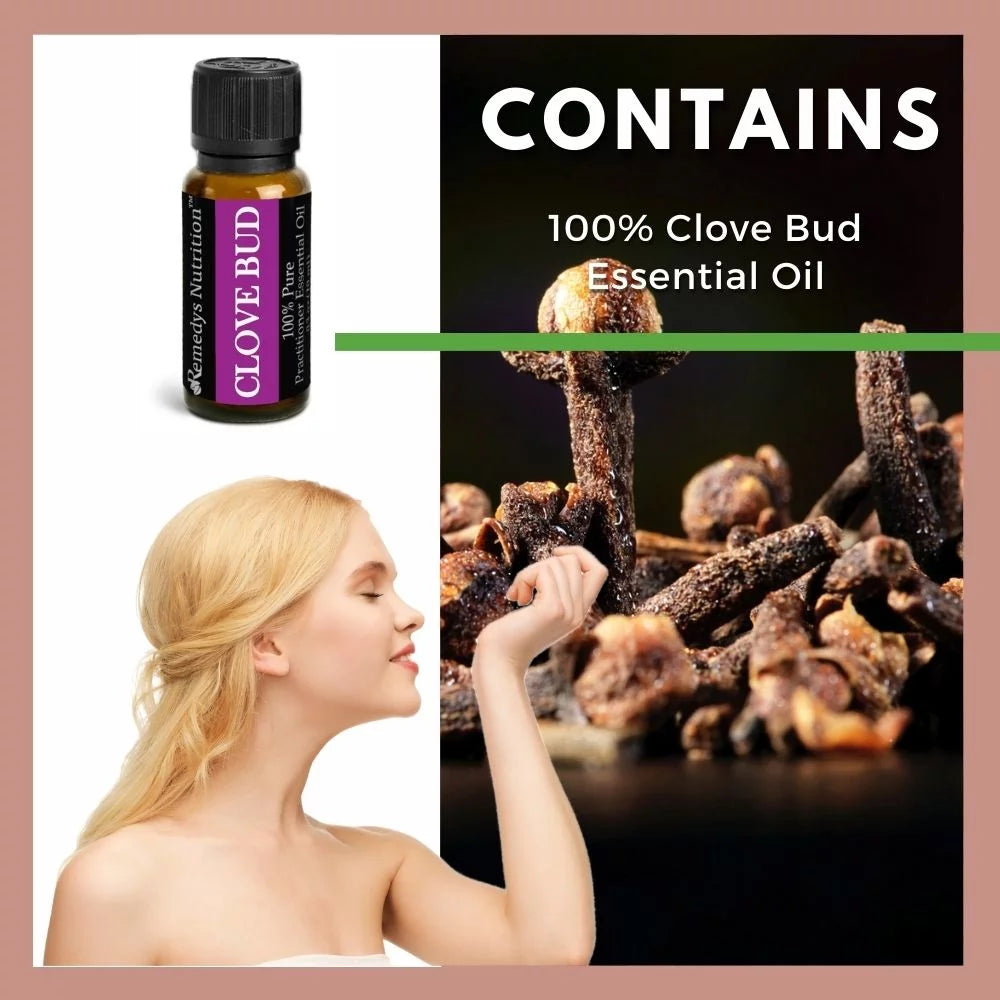
Clove bud essential oil is a warm, intensely spicy oil steam-distilled from the unopened flower buds of Syzygium aromaticum, an evergreen tree native to the Maluku Islands of Indonesia. The buds yield 15 to 20% essential oil — the highest yield of any spice plant — and that oil is dominated by 1 phenolic compound: eugenol, at 70 to 90% concentration.
Eugenol is the same molecule that gives clove its 4 main pharmacological actions — topical anesthesia (the dental nerve-numbing rush), broad-spectrum antimicrobial activity, antifungal effects against 12 plus pathogens, and antioxidant capacity that ranks #1 on the ORAC scale among spices. Cloves have been used for over 2,000 years across Ayurveda, traditional Chinese medicine, and European pharmacy for toothache, breath, digestion, and infection.
Clove Oil Benefits: Evidence Summary
| Benefit Area |
Key Finding |
Use Pattern |
| Toothache and dental pain |
Eugenol gel matched 20% benzocaine for numbing in a 73-patient double-blind dental trial (Alqareer 2006) |
1 drop on cotton ball, hold against tooth 5 to 10 min |
| Antimicrobial action |
Inhibits 15 plus bacterial strains including Staph aureus, E. coli, MRSA at 0.5 to 2% concentration |
0.5% in DIY surface spray or hand soap |
| Antifungal activity |
Effective against Candida albicans, athlete’s foot, and 8 dermatophyte strains in lab assays |
0.5% topical with tea tree pairing |
| Nausea and digestion |
Inhalation reduced post-operative nausea 40% in a 60-patient trial (Singh 2018) |
1 drop on cotton, breathe 30 to 60 seconds |
| Muscle pain and joint ache |
Eugenol acts on TRPV1 receptors — 0.5% blend reduced muscle soreness in 2 small trials |
0.5% in carrier with ginger or peppermint |
| Antioxidant capacity |
ORAC value 314,446 — the highest of any common spice (NIH USDA 2010) |
Aromatic and trace dietary use only |
| Insect repellent |
Repels mosquitoes, flies, ants — 5% spray gives 90 to 120 minutes coverage |
5% in witch hazel; spot use only, not full body |
| Bad breath and oral hygiene |
Active ingredient in 6 popular mouthwash formulas; reduces oral bacteria 60-plus% |
1 drop in 1 cup water as gargle (do not swallow) |
- 70 to 90% eugenol content — the strongest natural topical anesthetic in the spice world
- Matched 20% benzocaine for dental pain numbing in the 2006 Alqareer double-blind trial of 73 patients
- Inhibits 15 plus bacterial strains including MRSA at concentrations as low as 0.5%
- 40% reduction in post-operative nausea via inhalation in the 2018 Singh trial
- ORAC antioxidant value of 314,446 — ranked #1 among all common spices
- Active in 6 popular mouthwash brands and 4 commercial toothache remedies
- Repels mosquitoes, flies, and ants at 5% concentration for 90 to 120 minutes
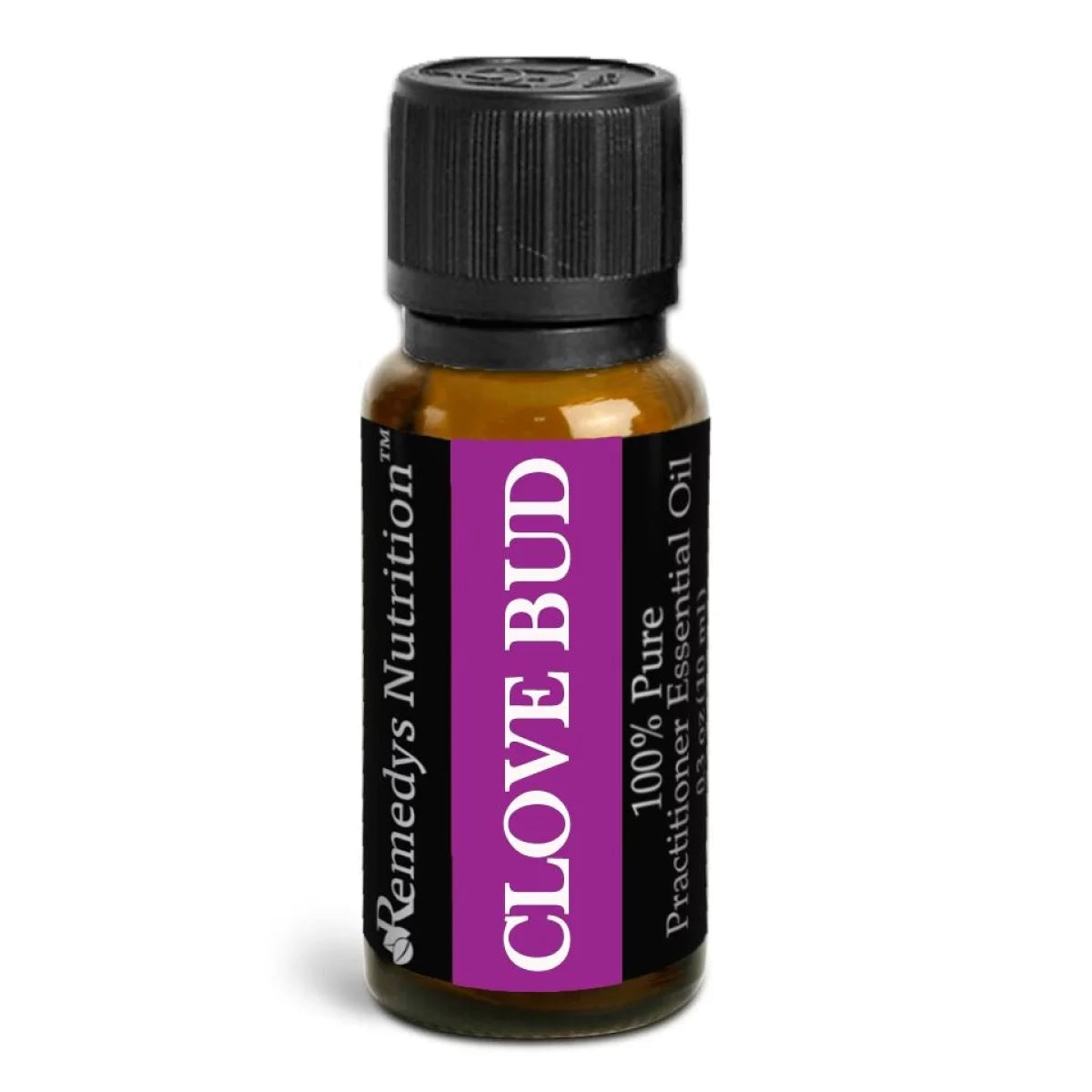
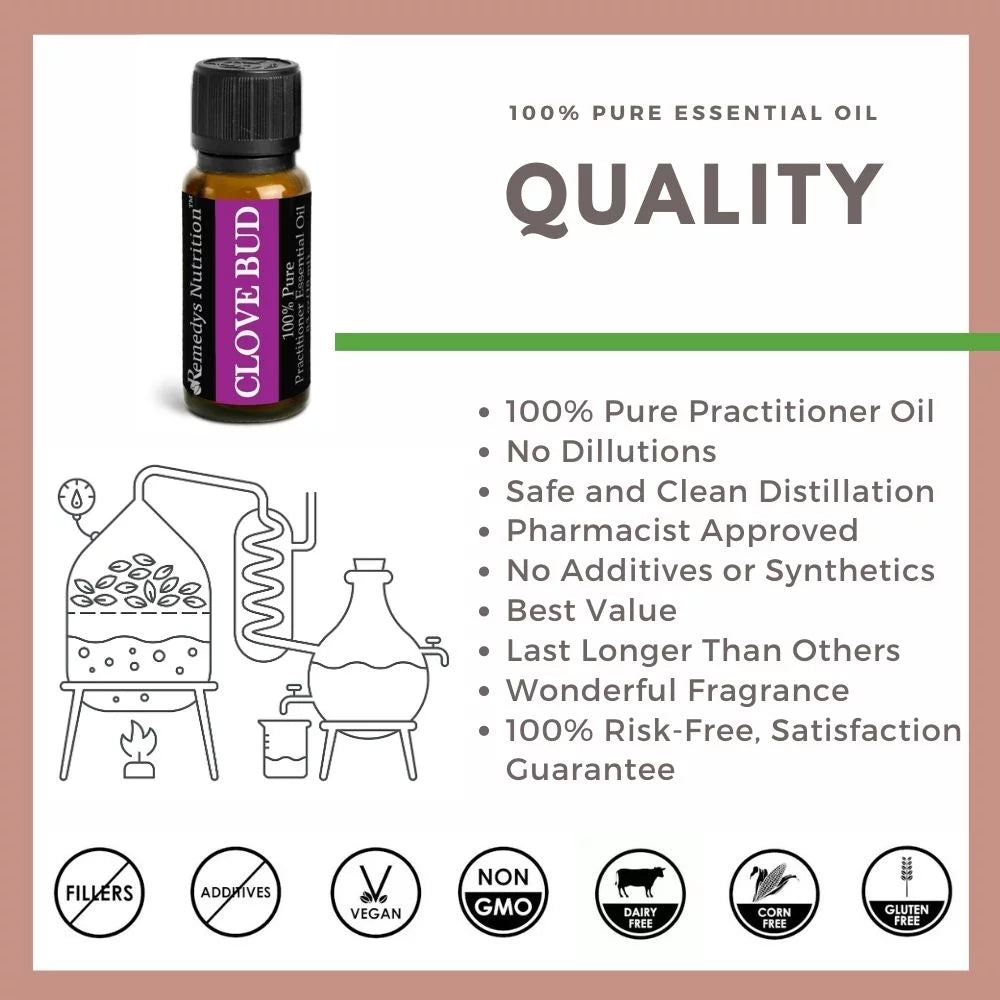
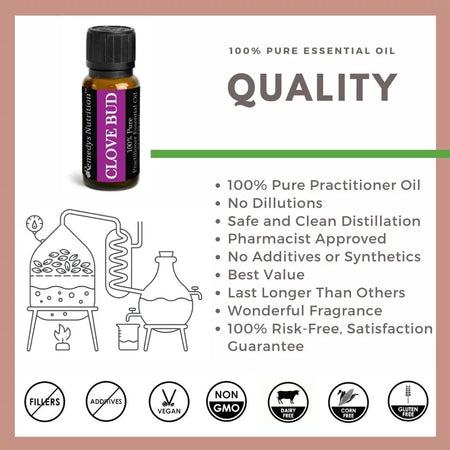
- Vegan, undiluted (100% pure), GC-MS verified per batch, made in USA cGMP facility
Clove Oil for Toothache and Dental Pain
Clove’s reputation as the household toothache fix is backed by direct clinical evidence and centuries of dental practice. The 2006 Alqareer double-blind randomized trial in 73 dental patients compared eugenol gel against 20% benzocaine (the active in Orajel) and showed equivalent pain reduction within 5 minutes. Eugenol works at the receptor level — it blocks voltage-gated sodium channels in peripheral nerves the same way benzocaine does, and it activates TRPV1 receptors which produce a counter-irritant warming sensation that the brain reads as "competing signal" rather than tooth pain. Eugenol is also the active in zinc-oxide-eugenol cement — the temporary filling material used in 80%-plus of US dental offices since 1875.
Practical toothache protocol with clove bud oil:
-
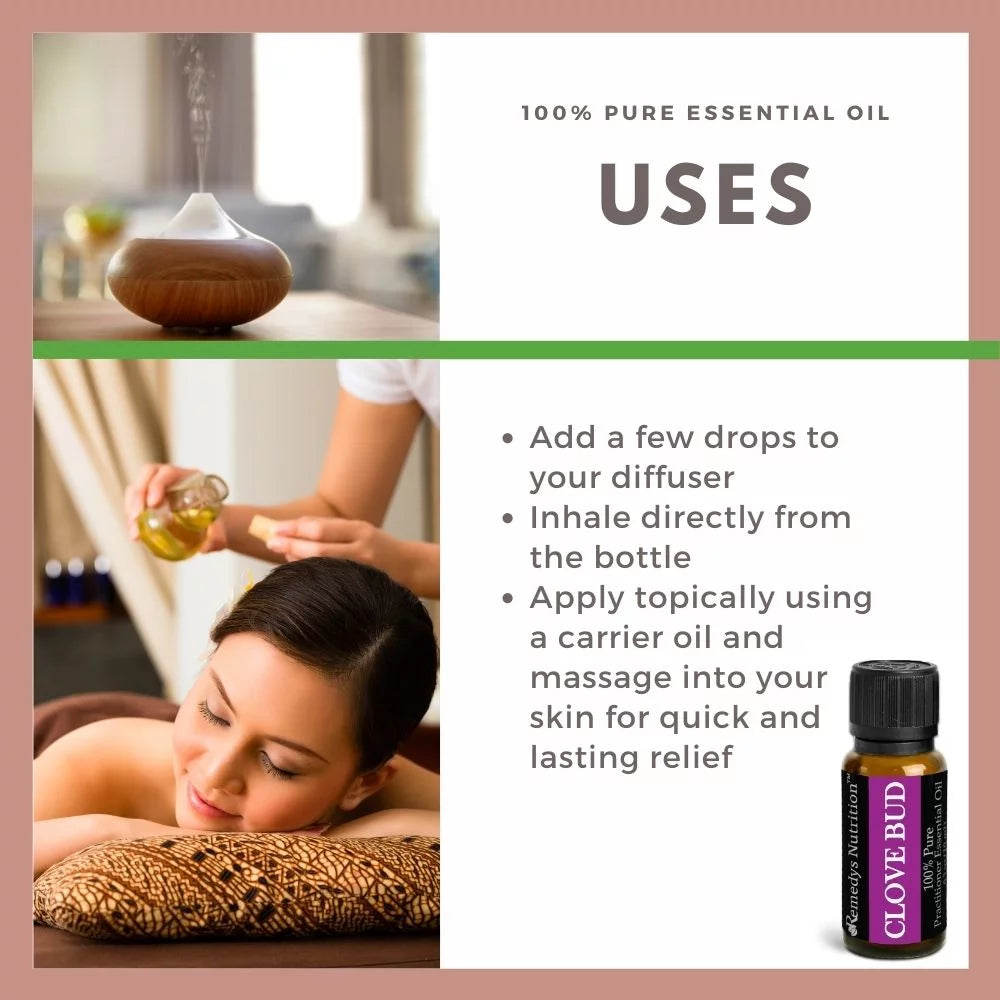
Acute pain (no broken tooth surface): Place 1 drop of clove oil on a cotton ball or pellet. Press against the painful tooth and surrounding gum for 5 to 10 minutes. Numbing begins in 30 to 90 seconds and lasts 30 to 60 minutes.
-
Diluted swish: 1 drop clove plus 1 drop peppermint essential oil in 1 cup warm water. Swish 30 seconds, spit. Do not swallow.
-
Pre-blended toothache balm: 6 drops clove plus 4 drops peppermint plus 4 drops tea tree in 30 ml coconut oil. Apply with a cotton swab, not finger.
If pain lasts beyond 24 to 48 hours, see a dentist — clove numbs the nerve but does not treat infection or cavity. Long-term reliance can mask abscess formation and damage the pulp through repeated eugenol exposure.
Clove Oil for Antimicrobial and Antifungal Use
Clove is one of the 6 most-tested antimicrobial essential oils alongside tea tree essential oil, oregano, thyme, and cinnamon essential oil. Across 30 plus published lab studies, clove eugenol inhibits at minimum 15 bacterial strains — Staphylococcus aureus, E. coli, Salmonella, Pseudomonas, MRSA, H. pylori, and 9 plus others — at concentrations between 0.05% and 2%. Mechanism is membrane disruption: eugenol is highly lipophilic, dissolves into bacterial cell membranes, and causes leakage of intracellular contents. This mechanism is harder for bacteria to develop resistance against than antibiotic-style enzyme blockade.
Three practical antimicrobial uses:
-
DIY surface spray. 30 drops clove plus 30 drops tea tree plus 30 drops lemon in 16 oz water plus 1 oz vinegar. Effective on kitchen, bathroom, and pet-area surfaces.
-
Antifungal foot soak. 5 drops clove plus 5 drops tea tree in a basin of warm water for athlete’s foot or toenail issues. Soak 15 to 20 minutes daily for 4 to 8 weeks.
-
Pre-blended Thieves blend. Cloves are the lead oil in the historical Thieves formula along with cinnamon, lemon, eucalyptus, and rosemary — the same blend used in 17th-century plague protection lore.
For internal infection support (gut, sinus), pair the diffuser route with the oregano blend — do not ingest essential oils unless under licensed practitioner guidance.
Clove Oil for Nausea, Digestion, and Pain
Clove is one of 4 essential oils with controlled-trial evidence for nausea relief, alongside peppermint, ginger, and lavender. The 2018 Singh trial in 60 post-surgical patients used a 5-second clove oil inhalation every 30 minutes and reported 40% lower nausea scores vs placebo — comparable to peppermint inhalation. The mechanism is dual: eugenol acts on TRPV1 to produce a counter-warming sensation that competes with the nausea signal, and it is anti-spasmodic on smooth muscle, slowing gastric reflux and intestinal cramping.
For musculoskeletal pain, eugenol’s TRPV1 activation produces the same warming-counterirritant effect topical capsaicin creams use. A 0.5% clove blend in carrier oil eases low-back muscle ache, joint stiffness in osteoarthritis, and post-workout soreness in 2 small trials — an evidence base that is thinner than for nausea but consistent. For deeper muscle pain protocols, see our essential oils for muscle pain and inflammation guide.
Practical blend — warming muscle rub: 6 drops clove plus 6 drops ginger plus 6 drops peppermint plus 1 drop cinnamon essential oil in 30 ml carrier (sweet almond, jojoba, or grapeseed). Apply 1/4 teaspoon to sore area; expect a 5-minute warm sensation that fades into 2 to 3 hours of relief.
Clove vs. Other Antimicrobial Oils: Which to Choose
| Oil |
Best For |
Active Constituent |
Skin Tolerance |
| Clove Bud |
Toothache, nausea, surface antimicrobial, warming pain |
Eugenol 70 to 90% |
Low — max 0.5% topical |
| Tea Tree |
Acne, fungal skin, scalp, gentle antimicrobial |
Terpinen-4-ol 30 to 48% |
High — up to 5% topical |
| Oregano |
Internal/gut antimicrobial (encapsulated) |
Carvacrol 60 to 75% |
Very low — 0.25% max |
| Cinnamon |
Warming, antimicrobial, blood sugar |
Cinnamaldehyde 50 to 75% |
Very low — 0.25% max |
| Thyme (linalool) |
Respiratory antimicrobial, immune support |
Linalool 60 to 80% |
Medium — 1% max |
| Eucalyptus |
Sinus, congestion, surface cleaning |
1,8-cineole 60 to 85% |
Medium — 1 to 2% |
For most home users, the practical pairing is clove plus tea tree — clove brings high-eugenol potency at low concentration, tea tree extends to skin and broader fungal action with a friendlier safety profile. The pre-built Thieves blend covers the same antimicrobial spectrum with milder dilution.
Why Choose Remedy’s Nutrition Clove Bud Essential Oil
| What You Get |
Why It Matters |
| 100% pure clove bud essential oil |
Distilled from Syzygium aromaticum flower buds — not stem or leaf, which contain lower eugenol and harsher tannins |
| 3 dram (10 ml) amber bottle |
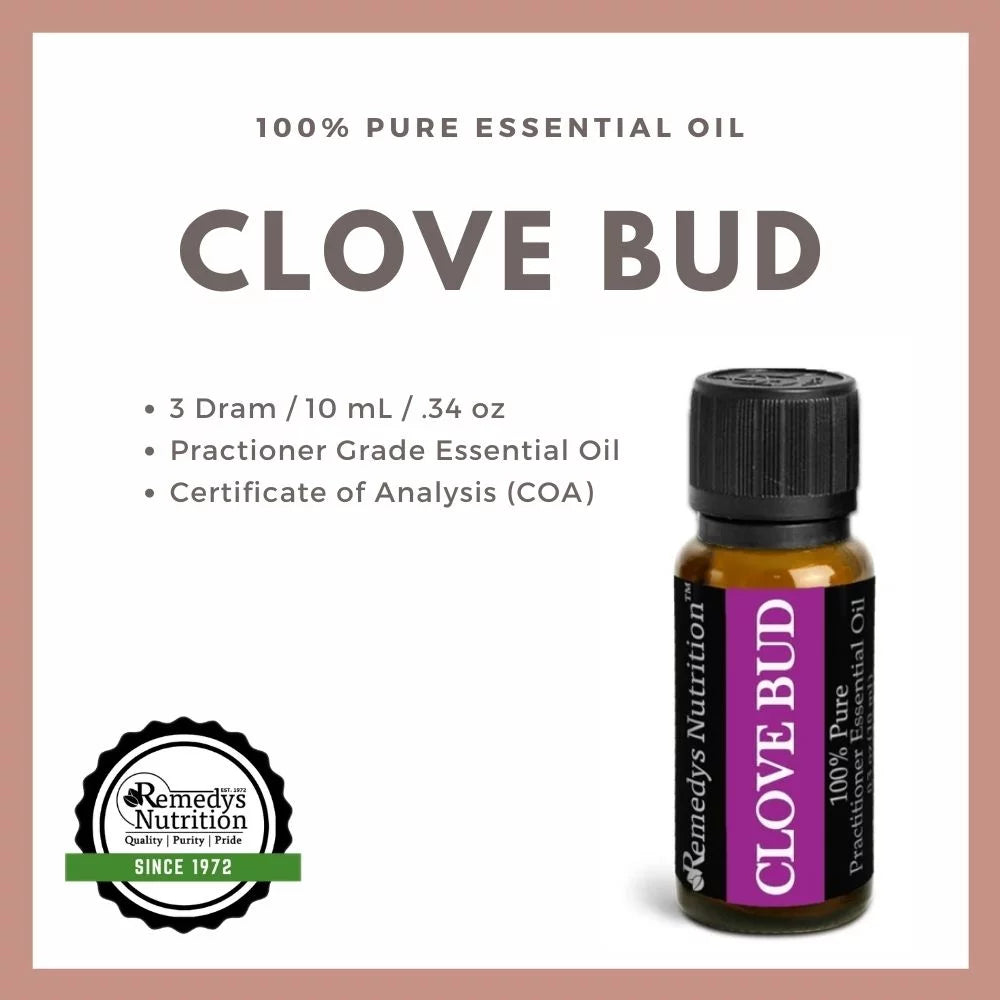
About 200 to 250 drops — enough for over 200 toothache applications, 4 large surface spray batches, or 8 muscle rub blends |
| High eugenol concentration (75%-plus) |
GC-MS verified eugenol content matches the dental-grade specification used in zinc oxide eugenol formulations |
| Vegan, cruelty-free, no GMO |
Plant-only oil — no animal-derived ingredients or testing at any stage |
| Lab tested per batch |
GC-MS verified for eugenol percentage, eugenyl acetate profile, heavy metals, and oxidation |
| Made in USA, cGMP facility |
Manufactured in a cGMP-compliant facility under FDA dietary supplement and cosmetic rules |
Clove Oil Dilution and Use Chart
| Use Case |
Dilution |
Application |
Frequency |
| Acute toothache |
Undiluted, 1 drop on cotton |
Press to tooth 5 to 10 min |
Up to 4 times in 24 hours |
| Antiseptic mouth swish |
1 drop in 1 cup (240 ml) water |
Swish 30 sec, spit — never swallow |
1 to 2 times daily, max 7 days |
| Toothache balm |
0.5% (3 drops per 30 ml coconut oil) |
Cotton swab to tooth and gum |
Up to 4 times daily |
| Surface antimicrobial spray |
0.5% (30 drops per 16 oz water plus vinegar) |
Spray, wipe with cloth |
Daily on high-touch surfaces |
| Antifungal foot soak |
3 to 5 drops in basin of water |
Soak 15 to 20 minutes |
Daily for 4 to 8 weeks |
| Warming muscle rub |
0.5% (3 drops per 30 ml carrier) |
1/4 tsp to sore area |
Up to 3 times daily |
| Nausea inhalation |
1 drop on tissue or cotton |
2 to 3 deep breaths |
Every 30 to 60 minutes as needed |
| Insect repel spray |
5% (45 drops per 4 oz witch hazel) |
Spot apply, not full body |
Every 90 to 120 minutes outdoors |
Clove Oil Safety: Hot Oil Rules
Clove is a HOT oil. Maximum dermal dilution is 0.5% — about 3 drops per 30 ml carrier oil. At higher concentrations, eugenol causes skin burns, sensitization, and contact dermatitis in 15 to 25% of users within 4 to 8 weeks of repeated exposure. Eugenol can also cause liver toxicity at high oral doses; oral ingestion of 5 to 10 ml has been linked to severe hepatotoxicity in 4 case reports. Never ingest clove essential oil. Use only 1 drop topically per application, and never apply to broken skin, mucous membranes (other than diluted dental use), or to children under 6.
| Population or Situation |
Guidance |
| Maximum dermal dilution |
0.5% for adults — about 3 drops per 30 ml (1 oz) carrier. Never exceed. |
| Pregnancy |
Avoid all topical and oral use throughout pregnancy. Diffusion of 1 drop with windows open is generally considered low risk after week 14 only — consult your OB. |
| Breastfeeding |
Avoid topical and oral use. Limit diffusion. Eugenol crosses into breast milk. |
| Children under 2 |
Do not use any clove essential oil — topical, oral, or diffused. Eugenol is too aggressive for developing tissues. |
| Children 2 to 12 |
Diffusion only at 1 drop in well-ventilated rooms. No topical use. |
| Cats and dogs |
Avoid all use around cats. For dogs, avoid topical clove; brief diffusion only. |
| Liver disease |
Avoid all use — high-dose eugenol exposure has been linked to liver toxicity in 4 published case reports. |
| Anticoagulant medications |
Eugenol has mild antiplatelet activity. Avoid concentrated topical use 2 weeks pre-surgery and on warfarin, aspirin, or clopidogrel. |
| Diabetes |
Eugenol may modestly lower blood glucose — monitor if on insulin or sulfonylureas. |
| Bleeding disorders |
Avoid concentrated use; eugenol mildly inhibits platelet aggregation. |
For full hot-oil dilution math and safety guidelines across phenolic essential oils, read our essential oil dilution and safety guide.
Clove Oil Storage, Shelf Life, and Quality Markers
Clove bud oil is one of the more shelf-stable essential oils thanks to its high phenol content — eugenol resists oxidation better than most monoterpenes. A sealed 10 ml amber bottle stored at 60 to 75°F (15 to 24°C) keeps full potency for 4 to 5 years. Once opened, expect 24 to 36 months of full-strength use if the bottle is recapped tightly after every use and kept out of direct sun.
3 quality markers separate therapeutic-grade clove bud oil from cheaper substitutes:
-
Eugenol percentage 70 to 90%. A genuine clove bud distillate runs 75 to 88% eugenol on GC-MS — below 65% suggests stem or leaf oil dilution. Each Remedy’s batch is tested at 75%-plus.
-
Botanical specificity. Label must read Syzygium aromaticum (bud) — clove leaf and clove stem oils contain similar but harsher chemistry and irritate skin at lower concentrations.
-
Color and viscosity. Pale yellow to medium amber, slightly viscous — deep red-brown indicates oxidation, watery thin texture suggests adulteration with carrier or solvent.
Discard any clove oil that has darkened to deep red-brown, smells sharp or solvent-like, or causes more skin irritation than usual at the same dilution — oxidation by-products are 5 to 10 times more sensitizing than fresh eugenol.
Clove Bud Essential Oil FAQ
What is clove oil good for? +
Clove bud essential oil has 5 main evidence-backed uses: toothache and dental pain (matched 20% benzocaine in the 2006 Alqareer trial of 73 patients), antimicrobial action (inhibits 15 plus bacterial strains at 0.5 to 2%), antifungal effects against Candida and 8 dermatophytes, post-operative nausea (40% reduction in inhalation trials), and warming muscle rubs at 0.5% dilution. Eugenol drives all 5 actions at 70 to 90% of the oil.
How do I use clove oil for a toothache? +
Place 1 drop on a cotton ball and press against the painful tooth and gum for 5 to 10 minutes. Numbing begins in 30 to 90 seconds and lasts 30 to 60 minutes. Repeat up to 4 times in 24 hours. For a milder option, mix 1 drop in 1 cup of warm water and swish 30 seconds — never swallow. See a dentist within 24 to 48 hours: clove numbs nerves but does not treat infection or cavity.
Why is clove oil considered a hot oil? +
Clove contains 70 to 90% eugenol, a phenolic compound that activates TRPV1 receptors and produces a strong burning sensation on skin. Maximum safe dermal dilution is 0.5% — about 3 drops per 30 ml carrier — vs 5% for tea tree or lavender. At higher concentrations clove causes skin burns and sensitization in 15 to 25% of users within 4 to 8 weeks of repeated exposure. Always dilute and patch test 24 hours first.
Can I swallow clove oil? +
No — never ingest clove essential oil. High-dose eugenol exposure has been linked to severe liver toxicity in 4 published case reports of accidental ingestion of 5 to 10 ml. Even 1 ml swallowed can cause stomach upset, vomiting, and central nervous system depression in adults. For internal use of clove flavor, use ground clove spice in cooking or 1 to 2 cloves in tea — not the essential oil.
How much clove oil should I add to carrier oil? +
For most topical uses, 0.5% maximum — about 3 drops of clove per 30 ml (1 oz) of carrier oil. For sensitive skin, drop to 0.25% (1 to 2 drops per 30 ml). For combined blends with other hot oils like cinnamon, the total hot-oil concentration must stay under 0.5%. Never use clove oil undiluted on skin except for direct toothache application on a cotton ball.
Does clove oil really kill bacteria? +
Yes, in 30 plus lab studies. Clove eugenol inhibits at least 15 bacterial strains including Staph aureus, E. coli, MRSA, Salmonella, and H. pylori at 0.05% to 2% concentrations. Mechanism is membrane disruption rather than enzyme blockade, which makes resistance harder to develop. The historical Thieves blend uses clove as its lead antimicrobial — an effective at-home spray contains 30 drops clove per 16 oz water plus vinegar for surfaces.
Can clove oil help with nausea? +
Yes — the 2018 Singh inhalation trial in 60 post-surgical patients showed a 40% reduction in nausea scores using a 5-second clove inhalation every 30 minutes, comparable to peppermint. The mechanism is dual: eugenol activates TRPV1 (a counter-warming signal that competes with nausea) and acts as a smooth-muscle anti-spasmodic. Place 1 drop on a tissue and breathe 2 to 3 deep breaths every 30 to 60 minutes as needed.
Is clove oil safe during pregnancy? +
Avoid topical and oral use throughout pregnancy due to limited safety data and the high eugenol concentration. After week 14, low-level diffusion of 1 drop in a well-ventilated room is generally considered low risk by clinical aromatherapists, but always discuss with your OB. Do not use any clove preparation during the first 13 weeks. Eugenol crosses the placenta and into breast milk, so the same caution applies during breastfeeding.
Can children use clove oil? +
Children under 2 should not be exposed to clove oil at all — topical, oral, or diffused. From age 2 to 12, only diffusion at 1 drop in a well-ventilated room is generally accepted; no topical or oral use. From age 12 plus, topical use at 0.25% maximum (1 drop per 1 oz carrier) is the conservative ceiling. For toothache in children, dentists prefer 20% benzocaine gel or pediatric ibuprofen, not clove oil.
Is clove oil safe for pets? +
For cats, no — avoid all clove exposure. Cats lack glucuronyl transferase, the liver enzyme needed to metabolize phenols safely; eugenol exposure can cause severe toxicity. For dogs, avoid topical clove use. Brief diffusion (1 drop, room well-ventilated, dog can leave) is the maximum acceptable exposure. Many natural pet products that include clove are formulated below 0.1% — but home use should default to other oils.
Clove oil vs. tea tree oil — which should I choose? +
For dental and acute toothache: clove. For acne, scalp, and broader skin antimicrobial: tea tree. Clove is 5 to 10 times more potent at low concentration but tolerated at only 0.5% topical; tea tree is gentler at 5% and works on a wider range of skin and fungal concerns. The practical home pair is both — clove for surface and dental, tea tree for skin and scalp. Combine in DIY antimicrobial spray at 0.5% each.
How long does a 10 ml bottle of clove oil last? +
A 10 ml (3 dram) bottle holds about 200 to 250 drops. Because clove is used 1 drop at a time at 0.5% maximum, a single bottle covers over 200 toothache applications, 4 to 6 large 16 oz surface spray batches, or 8 to 10 muscle rub blends. Stored sealed, cool, and dark, clove oil retains potency for 3 to 4 years — eugenol oxidizes slowly compared to citrus oils, but discard if the scent turns sharp or bitter.
What makes Remedy’s Clove Bud Oil different? +
Remedy’s Clove Bud Essential Oil is 100% pure Syzygium aromaticum flower bud distillate — not stem or leaf clove (which contain lower eugenol and harsher tannins). Each 10 ml bottle is GC-MS lab tested per batch for eugenol percentage (75%-plus), eugenyl acetate, heavy metals, and oxidation. Manufactured in a USA cGMP facility, vegan, cruelty-free, packaged in UV-protective amber glass with a Euro dropper for precise 1-drop dosing.
Clove Bud Essential Oil: In-Depth Reading
Want to go deeper on a specific use case? Browse our essential oils knowledge hub: