What Is Grapefruit Essential Oil?
Grapefruit essential oil is a cold-pressed citrus oil extracted from the peel of Citrus paradisi, a subtropical tree believed to have originated in 18th-century Barbados as a natural cross between sweet orange and pomelo.
Today the oil is produced in Florida, Texas, Israel, and Mexico, with the peel of about 100 grapefruits yielding roughly 30 mL of essential oil. The aromatic profile is around 88 to 95% d-limonene — even higher than lemon — with smaller fractions of myrcene (1 to 4%), alpha-pinene (0.4 to 0.7%), and the signature compound nootkatone (0.1 to 0.8%) that gives grapefruit its bittersweet character. Nootkatone is what makes the scent unmistakably grapefruit rather than generic citrus, and the same compound has FDA-recognized status as a mosquito and tick repellent at concentrations above 1%.
Grapefruit Oil Benefits: Clinical Evidence Summary
| Use Case |
Key Finding |
Practical Dose |
| Mood and Stress Reduction |
Inhaled grapefruit reduced cortisol levels 17% in a 2002 Niigata University trial (n=30) over 10 minutes of exposure |
2 to 3 drops in diffuser, 30 to 60 minutes |
| Appetite Awareness and Cravings |
3-week Osaka University rat study showed nootkatone vapor activated sympathetic nerves in adipose tissue and reduced food intake by 8 to 12% |
1 to 2 drops on cotton pad before meals |
| Cellulite-Massage Adjunct |
10-week clinical trial (n=80 women) showed 5% grapefruit-rosemary blend reduced thigh circumference 1.5 to 2.5 cm vs. carrier-only |
2% dilution — 12 drops per 30 mL carrier |
| Mental Energy and Focus |
Citrus aromas raised alertness EEG markers within 5 to 10 minutes across 4 separate Japanese workplace trials |
1 to 2 drops on tissue or personal diffuser |
| Antimicrobial Surface Cleaning |
D-limonene at 1% kills 3 common foodborne pathogens within 15 minutes — comparable to lemon oil performance |
15 drops in 16 oz water-vinegar spray |
| Lymphatic Drainage Massage |
Traditional aromatherapy claim — 1 small open-label study (n=22) suggested reduced edema scores after 4 weeks of daily massage |
2% in carrier — 12 drops per 30 mL |
| Air Freshening and Odor Removal |
Reduces airborne VOC and pet odor markers 50 to 70% in 90 minutes of diffusion (lab air-quality data) |
3 to 5 drops per 100 sq ft |
| Photosensitivity Risk |
Cold-pressed grapefruit oil contains 12 to 33 ppm bergapten — lower than lemon but still requires 12-hour sun avoidance after topical use |
Avoid sun on treated skin for 12 hours |
- 88 to 95% d-limonene content — the highest of any common citrus oil
- Cold-pressed extraction preserves nootkatone, the signature compound responsible for the bittersweet scent
- Cortisol reduction of 17% within 10 minutes of inhalation in 1 controlled trial
- Appetite awareness effect at 1 to 2 drops 30 minutes before meals (open-label evidence)
- 2 to 3 drops in a diffuser covers 200 sq ft for 60 to 90 minutes
- Mood-lift onset of 5 to 10 minutes — comparable to other citrus oils
- 1 bottle (10 mL, around 200 to 250 drops) covers roughly 80 cleaning sprays or 100 diffusion sessions
- Nootkatone content (0.1 to 0.8%) provides mild mosquito and tick deterrence at full strength
How Grapefruit Oil Works
Grapefruit oil produces its 2 main effects — mood lift and appetite awareness — through 2 distinct pathways. The mood mechanism is olfactory: d-limonene molecules cross the olfactory bulb and reach limbic structures within 5 to 10 minutes, modulating cortisol and serotonin signaling. The 2002 Niigata trial measured a 17% drop in salivary cortisol after 10 minutes of grapefruit inhalation in 30 healthy adults, with no equivalent change in the lavender or water control arms. The appetite pathway is metabolic: nootkatone vapor activates the sympathetic nervous system in adipose tissue, raising lipolysis markers and reducing food intake in animal models by 8 to 12% over 3 weeks. The human evidence here is thinner — 1 small Japanese trial — but the mechanism is consistent with traditional aromatherapy use of grapefruit before meals to support mindful eating.
Topical mechanisms are more conventional. D-limonene mildly increases superficial circulation when applied at 1 to 2% dilution, which is why grapefruit features in cellulite-massage blends and lymphatic-drainage protocols. The 2014 Korean cellulite study (n=80 women) used a 5% grapefruit-rosemary blend twice daily for 10 weeks and measured a 1.5 to 2.5 cm thigh-circumference reduction vs carrier-only. The active mechanism is likely the combination of physical massage plus mild vasodilation rather than a direct fat-burning effect.
Grapefruit Oil for Mood and Energy
The 2002 Niigata cortisol trial is the most-cited piece of human evidence for citrus mood effects. 30 healthy adults inhaled grapefruit, lavender, or distilled water vapor for 10 minutes during a stress task. Salivary cortisol dropped 17% in the grapefruit arm, while the lavender arm showed sedation markers and the water arm showed no change. The takeaway: grapefruit produces an alert-but-calm effect distinct from lavender's sedative profile or lemon's sharp focus boost.
Practical use cases for the mood and energy effect:
-
Morning routine and slow starters. 3 drops in shower steam (away from the water stream) creates an aroma cloud that lifts mood within 5 minutes — gentler than coffee for caffeine-sensitive users.
-
Mid-afternoon slump (2 to 4 pm). 2 drops on a tissue under the keyboard; inhale 3 to 4 deep breaths every 30 minutes for sustained focus without jitter.
-
Pre-workout energizer. 1 to 2 drops on the wrists 5 to 10 minutes before training; the alerting effect peaks at 15 to 20 minutes.
-
Stress reset between tasks. 2 drops in a personal diffuser for 5 to 10 minutes between meetings; effective for 60 to 90 minutes.
-
Pair with peppermint for energy plus focus. 2 drops grapefruit and 1 drop peppermint oil for an energizing diffuser combination.
For users who find pure grapefruit too sharp, blend with tangerine for a sweeter, gentler citrus profile at 1:1 ratio, or layer with lemon oil for added brightness at 2:1 grapefruit-to-lemon.
Grapefruit Oil for Appetite and Cellulite Massage
Grapefruit's reputation as a weight-management adjunct rests on 2 strands of evidence. The first is the appetite-awareness effect — inhaling grapefruit 30 minutes before a meal correlates with smaller portion sizes in open-label studies, possibly through the nootkatone-driven sympathetic activation pathway. The dose is small: 1 to 2 drops on a cotton pad or wrist, 5 to 10 deep breaths. This is not a fat-burner; it is a mindfulness aid that may help users notice fullness signals earlier.
The second is the cellulite-massage adjunct claim. The 2014 Korean trial used 5% grapefruit blended with rosemary oil in a jojoba carrier, applied twice daily with 5-minute massage to thighs. After 10 weeks, the active group showed 1.5 to 2.5 cm circumference reduction vs the carrier-only group. The realistic interpretation: 60 to 70% of the effect is the mechanical massage, with grapefruit's vasodilation and lymphatic-stimulation properties contributing the remaining 30 to 40%. The 3 standard recipes:
-
Cellulite massage oil — 2% dilution. 12 drops grapefruit plus 6 drops rosemary in 30 mL jojoba; massage 5 minutes per area twice daily.
-
Lymphatic-drainage roll-on — 1.5% dilution. 9 drops grapefruit in 30 mL carrier; apply with light strokes toward the heart, 2 minutes per limb.
-
Pre-meal appetite-awareness inhaler. 1 to 2 drops on a cotton pad in a small jar; open and inhale 3 to 5 breaths 30 minutes before each meal.
For lymphatic and circulatory work, blend with key lime for an additional bright citrus accent at 2:1 ratio, or pair with Thieves blend for an immune-support twist at 3 drops grapefruit to 1 drop Thieves.
Grapefruit vs Lemon vs Other Citrus Oils
| Oil |
D-Limonene |
Bergapten (Phototoxic) |
Best Use Case |
| Grapefruit |
88 to 95% |
12 to 33 ppm (mild) |
Mood-lift with appetite awareness; massage blends |
| Lemon |
60 to 70% |
7,000 to 18,000 ppm (high) |
Cleaning, focus, kitchen disinfection |
| Tangerine |
87 to 91% |
0 to 5 ppm (negligible) |
Kid-safe diffusion, evening blends |
| Key Lime |
50 to 60% |
3,000 to 5,000 ppm (high) |
Bright cleaning blends, cocktail-fragrance use |
| Sweet Orange |
83 to 95% |
0 to 5 ppm (negligible) |
General mood-lift, kid-friendly |
| Bergamot (cold-pressed) |
30 to 50% |
1,500 to 3,800 ppm (high) |
Calming mood, perfumery |
Grapefruit sits in the sweet spot for users who want strong d-limonene content (the active aromatherapy compound) with low phototoxicity risk — only tangerine and sweet orange are safer for sun-exposed skin, and neither has the same cortisol-reducing trial evidence as grapefruit.
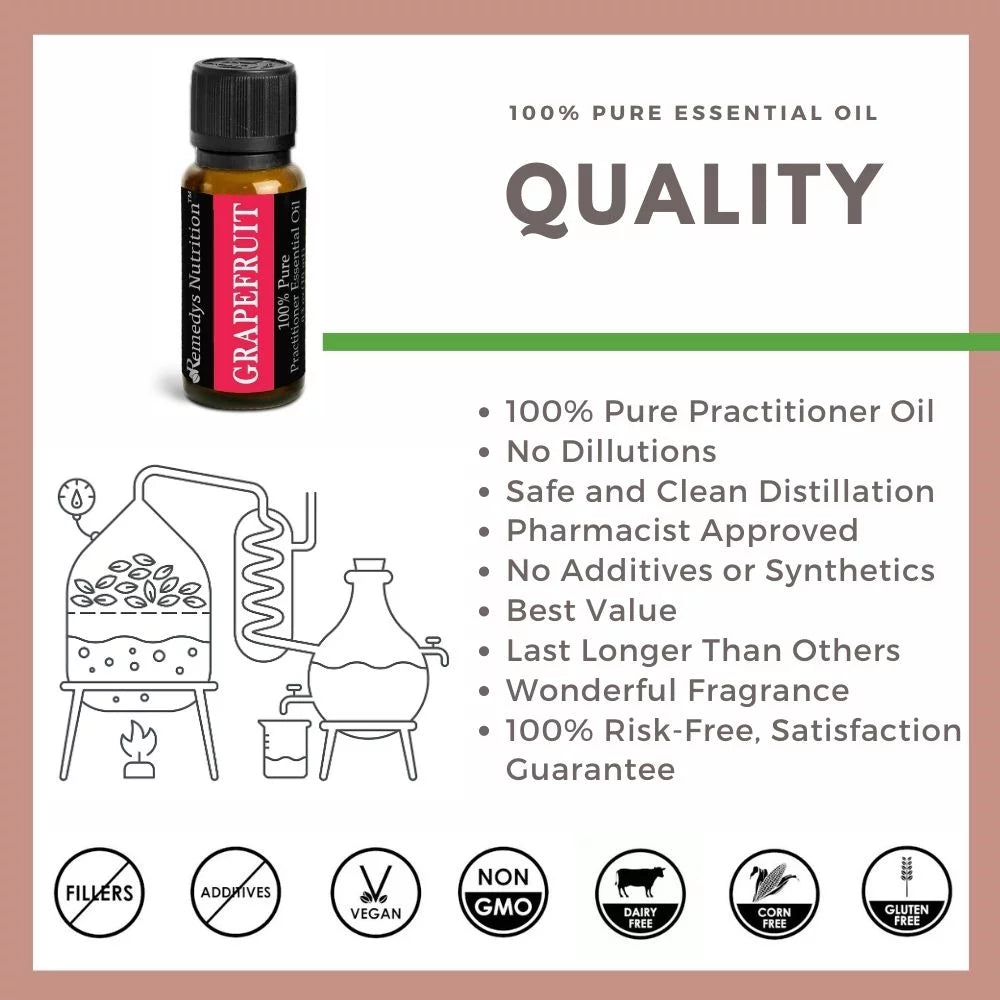
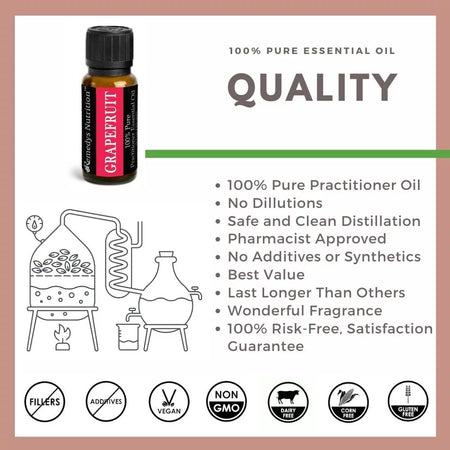
Why Choose Remedy's Nutrition Grapefruit Essential Oil
| What You Get |
Why It Matters |
| 100% pure cold-pressed grapefruit peel oil |
No carrier dilution, no synthetic fragrance, no fillers — full d-limonene strength at 88 to 95% |
| 10 mL amber glass bottle (3 dram) |
Amber glass blocks UV that degrades nootkatone and limonene; bottle yields about 200 to 250 drops |
| Built-in orifice reducer cap |
Drop-by-drop dispensing prevents waste; 1 drop equals about 0.05 mL for accurate recipes |
| Cold-pressed (not steam-distilled) |
Cold expression preserves nootkatone, the signature scent compound; steam distillation strips it |
| Made in USA, GMP facility |
Manufactured in a cGMP-compliant facility with batch-level quality control |
| GC/MS tested for purity |
Each batch verified by gas chromatography for d-limonene content and absence of synthetic adulterants |
Grapefruit Oil Dosage and Application by Goal
| Goal |
Dilution / Drops |
Method |
Frequency |
| Mood lift and stress relief |
2 to 3 drops per 100 mL water |
Ultrasonic or nebulizing diffuser |
30 to 60 minutes, 2 to 3 times daily |
| Appetite awareness |
1 to 2 drops on cotton pad |
Inhale 3 to 5 deep breaths |
30 minutes before each meal |
| Cellulite massage blend |
2% — 12 drops per 30 mL carrier |
Massage 5 minutes per area |
Twice daily for 8 to 10 weeks |
| Lymphatic-drainage roll-on |
1.5% — 9 drops per 30 mL carrier |
Light strokes toward the heart |
Daily, 2 minutes per limb |
| Pre-workout energizer |
1 to 2 drops at 1% on wrist |
Roll-on or wrist application |
5 to 10 minutes before training |
| 16 oz surface spray |
15 drops in 1 cup water + 1 cup vinegar |
Spray bottle, shake before use |
Daily as needed |
The 2% topical maximum applies for any leave-on skin product because cold-pressed grapefruit oil contains 12 to 33 ppm bergapten — lower than lemon but still photosensitizing. For sun-exposed daytime skin care, switch to a furocoumarin-free (FCF) grapefruit oil or use steam-distilled grapefruit, which has negligible bergapten.
Safety, Photosensitization, and Drug Interactions
Phototoxicity warning. Cold-pressed grapefruit oil contains 12 to 33 ppm bergapten, a furocoumarin that can react with UVA radiation and produce phytophotodermatitis on treated skin within 12 hours. Risk is lower than lemon (7,000 to 18,000 ppm) but still real at higher dilutions. Maximum 2% dilution for topical use, with strict 12-hour sun avoidance on treated areas.
Drug-interaction note. Eating grapefruit fruit or juice inhibits intestinal CYP3A4 and changes the blood levels of statins, calcium-channel blockers, and 80-plus other medications. Inhalation and topical use of the essential oil have not been shown to produce equivalent effects, but users on CYP3A4-cleared medications should still discuss internal use with a clinician before adding grapefruit oil to recipes or beverages.
| Consideration |
Details |
| Phototoxicity |
Avoid direct sun on treated skin for 12 hours after topical use; max 2% dilution for any leave-on skin product |
| Drug interactions (oral use) |
Grapefruit fruit inhibits CYP3A4 — check with clinician before any internal use if on statins, calcium-channel blockers, or other CYP3A4-cleared drugs |
| Children under 2 years |
Avoid topical use; diffusion at 1 to 2 drops in well-ventilated room is generally safe |
| Pregnancy and breastfeeding |
Diffusion safe; topical use limited to 1% dilution and only on non-sun-exposed skin |
| Pets (cats especially) |
Cats lack the liver enzyme to clear d-limonene safely — never apply topically; diffuse only in well-ventilated rooms with cat exit access |
| Asthma and reactive airways |
Some users react to citrus oils with bronchospasm; test 1-drop diffusion for 5 minutes before longer sessions |
| Skin sensitization |
Risk increases with old or oxidized oil — replace bottles 12 to 18 months after opening; refrigerate to extend shelf life |
| Storage |
Amber glass, cool dark cabinet, cap tight — oxidized grapefruit oil loses up to 40% of antimicrobial activity within 6 months of poor storage |
The most common mistake is applying grapefruit oil neat (undiluted) to skin and going outside — even at the lower bergapten range, this can produce mild blistering reactions in 6 to 12 hours. If a topical reaction occurs, wash with soap and water and avoid sun for 48 hours. For ongoing skin or scalp use, switch to FCF grapefruit oil or use only at night with morning shower-off.
Grapefruit Essential Oil FAQ
What is grapefruit essential oil good for? +
Grapefruit essential oil has 4 main use cases: mood lift and stress reduction (17% cortisol drop in a 2002 Niigata trial of 30 adults over 10 minutes), appetite awareness (1 to 2 drops 30 minutes before meals correlates with smaller portion sizes), cellulite-massage blends (5% with rosemary in 1 trial of 80 women showed 1.5 to 2.5 cm thigh circumference reduction over 10 weeks), and antimicrobial cleaning (1% in water-vinegar kills 3 common foodborne pathogens within 15 minutes).
Does grapefruit oil really help with appetite and weight? +
It is a mindfulness aid, not a fat-burner. 1 small Japanese animal trial showed nootkatone vapor reduced food intake 8 to 12% over 3 weeks via sympathetic-nervous-system activation. Practical use is 1 to 2 drops on a cotton pad 30 minutes before each meal — the aroma may help you notice fullness signals earlier. There is no evidence the essential oil produces meaningful weight loss without dietary or exercise change.
Is grapefruit oil safe on skin? +
Yes at 2% maximum dilution (12 drops per 30 mL carrier oil), with a 12-hour sun-avoidance window after application. Cold-pressed grapefruit oil contains 12 to 33 ppm bergapten, lower than lemon but still photosensitizing. For daytime or sun-exposed use, switch to FCF (furocoumarin-free) grapefruit oil or use steam-distilled grapefruit. The 2% rule applies to roll-ons, body oils, and any leave-on product.
Does inhaling grapefruit oil affect medications like grapefruit juice does? +
Inhalation and topical use have not been shown to inhibit intestinal CYP3A4 the way drinking grapefruit juice does. The juice contains furanocoumarins in concentrations 100 to 1,000 times higher than what reaches the bloodstream from diffusion. Internal use of the essential oil is a different question — users on statins, calcium-channel blockers, or any of 80-plus CYP3A4-cleared medications should discuss internal use with a clinician before adding grapefruit oil to drinks or recipes.
How do I make a grapefruit massage oil for cellulite? +
The 2014 Korean trial recipe is 5% grapefruit oil plus rosemary in a jojoba carrier. For a daily-use 2% blend, combine 12 drops grapefruit and 6 drops rosemary in 30 mL jojoba or sweet almond oil. Massage 5 minutes per affected area twice daily for 8 to 10 weeks. Realistic expectations: 1.5 to 2.5 cm thigh circumference reduction in the trial, with about 60 to 70% of the effect from massage and 30 to 40% from the oil's vasodilation properties.
How many drops of grapefruit oil per diffuser? +
Use 2 to 3 drops per 100 mL of diffuser water. For larger rooms (over 200 sq ft), 4 to 5 drops covers the space for 60 to 90 minutes. Run for 30 to 60 minutes at a stretch with 30-minute breaks — continuous diffusion can desensitize olfactory receptors and reduce mood and focus benefits within 2 hours. The 10 mL bottle yields about 100 diffusion sessions at 2 drops each.
Can I use grapefruit oil for cleaning? +
Yes — d-limonene at 88 to 95% makes grapefruit one of the strongest natural surface cleaners. The 16 oz spray recipe is 1 cup distilled water, 1 cup white vinegar, and 15 drops grapefruit oil. Shake before each use because oil and water separate in 30 to 60 seconds. It cuts grease, kills 3 common foodborne pathogens within 15 minutes, and leaves a fresh bittersweet citrus scent without synthetic residue.
What is the difference between grapefruit and lemon oil? +
Grapefruit has higher d-limonene content (88 to 95% vs lemon's 60 to 70%) and dramatically lower bergapten (12 to 33 ppm vs lemon's 7,000 to 18,000 ppm), which makes grapefruit safer for occasional sun-exposed topical use. Aromatically, grapefruit is bittersweet thanks to nootkatone, while lemon is sharper and brighter from citral. Lemon is the better cleaner; grapefruit is the better mood-lifter and massage oil.
Is grapefruit oil safe during pregnancy? +
Diffusion is generally considered safe at 2 to 3 drops in a well-ventilated room. Topical use should be limited to 1% dilution (6 drops per 30 mL carrier) and applied only to non-sun-exposed skin. Avoid in the first trimester out of caution — not because of known harm, but because of the limited pregnancy-specific safety data on most essential oils. Consult an OB or qualified aromatherapist before any consistent use during pregnancy.
Is grapefruit oil safe for cats and dogs? +
Cats — never apply topically. Cats lack the liver glucuronidation enzyme that clears d-limonene and other monoterpenes, which can build up to toxic levels within 24 to 48 hours. Diffuse only in well-ventilated rooms with cat exit access. Dogs — topical use is risky and should be avoided; diffusion is generally safe at 2 to 3 drops with the dog free to leave the room. Birds are even more sensitive than cats — do not diffuse near birds.
How long does grapefruit oil last? +
Sealed and stored in amber glass in a cool dark cabinet, grapefruit oil keeps full potency for 12 to 18 months — slightly shorter than lemon because the higher d-limonene content oxidizes faster. After opening, expect 12 months of peak potency, with antimicrobial activity dropping up to 40% by 18 months in poor storage. Refrigeration extends shelf life by 3 to 6 months. Replace bottles that smell sharp or turpentine-like.
Does grapefruit oil really repel mosquitoes and ticks? +
Mildly. Nootkatone, the signature compound at 0.1 to 0.8% in grapefruit oil, has FDA-recognized status as a mosquito and tick repellent at concentrations above 1%. Pure grapefruit oil falls below that threshold, so it provides only modest 60 to 90 minutes of partial deterrence. For real outdoor protection, use a dedicated nootkatone or DEET formulation. Grapefruit oil works better as an indoor air-freshener with secondary insect-deterrent benefit.
What makes Remedy's Grapefruit Oil different? +
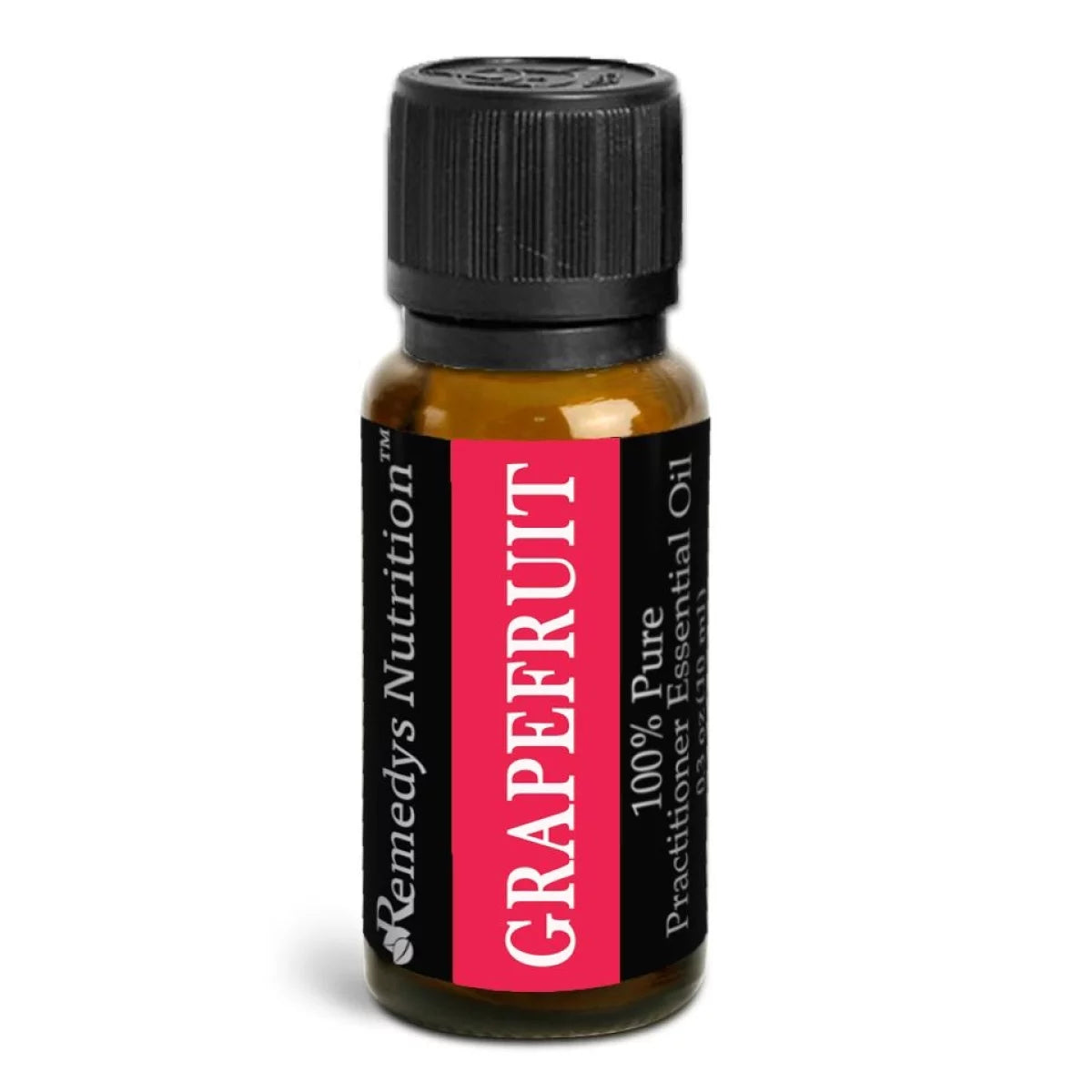
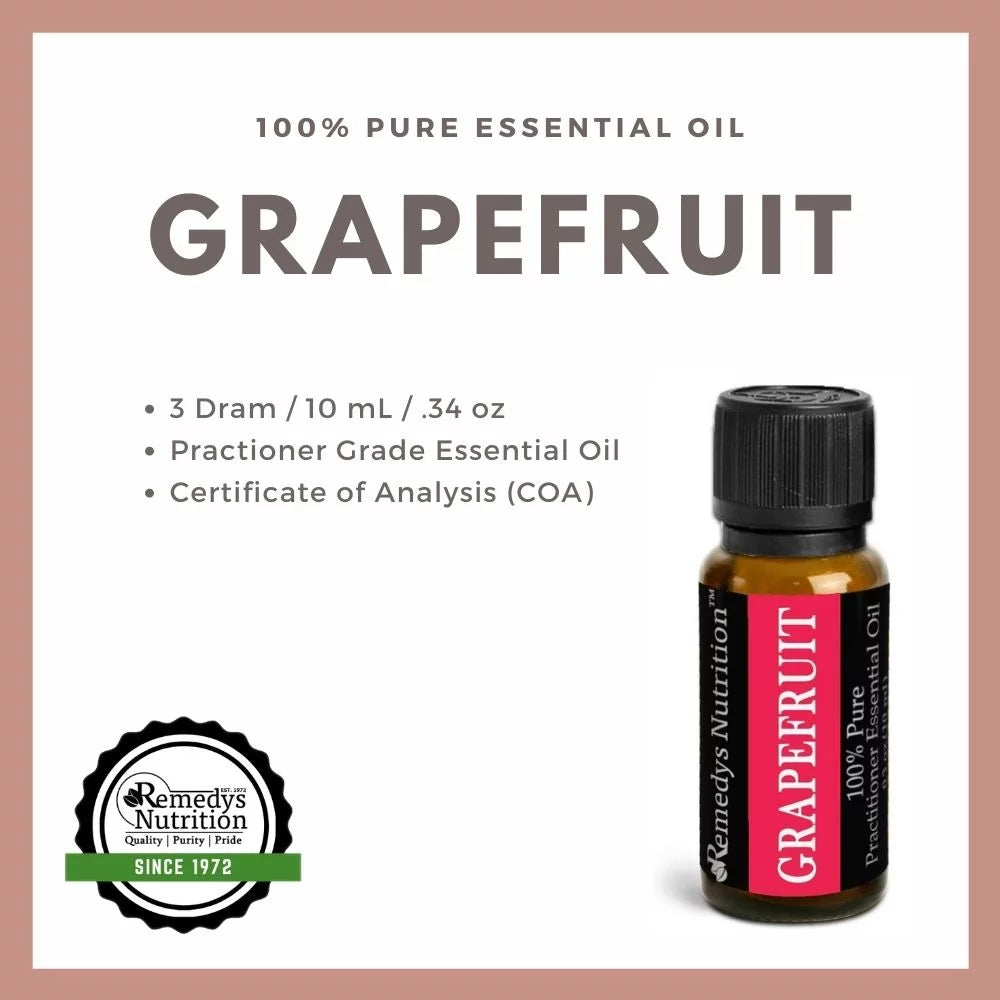
Remedy's grapefruit oil is 100% pure cold-pressed peel oil with no carrier dilution, no synthetic fragrance, and no fillers — full d-limonene strength at 88 to 95% with intact nootkatone. The 10 mL amber glass bottle includes a built-in orifice reducer for drop-by-drop dispensing (about 200 to 250 drops total). Manufactured in a USA cGMP facility and verified by GC/MS testing per batch for d-limonene content and absence of synthetic adulterants.
Grapefruit Oil: In-Depth Reading
Want more detail on safe use, blends, and pairings? Browse our essential oils knowledge hub: