What Is Lemon Essential Oil?
Lemon essential oil is a cold-pressed citrus oil expressed from the peel of Citrus limon, a small evergreen tree native to Asia and now cultivated in Italy, California, Spain, and Argentina.
The oil is around 60 to 70% d-limonene — the same compound that gives oranges and grapefruits their bright fragrance — with smaller fractions of beta-pinene (8 to 12%), gamma-terpinene (6 to 10%), and citral (1 to 3%). It takes roughly 3,000 lemons to produce 1 kilogram of essential oil, which is why every drop carries the equivalent of about 7 to 9 fresh peels. The result is one of the most versatile oils in the cabinet: a 5-minute air freshener, a 3-ingredient kitchen surface spray, a focus aid that beats coffee for some users, and a stain remover that tackles grease, tape residue, and crayon in seconds.
Lemon Oil Benefits: Evidence Summary
| Use Case |
Key Finding |
Practical Dose |
| Mood and Mental Energy |
Lemon vapor reduced negative mood scores 30% and norepinephrine markers improved in a 2008 Ohio State study (n=56) |
2 to 3 drops in diffuser, 30 to 60 minutes |
| Antimicrobial Surface Cleaning |
D-limonene at 1% kills E. coli, Salmonella, and Listeria within 15 minutes on hard surfaces |
15 drops in 16 oz water + vinegar spray |
| Kitchen Disinfection |
Reduces airborne bacterial counts 65 to 78% in 2 hours of diffusion (laboratory air-quality data) |
5 drops per 100 sq ft of kitchen space |
| Adhesive and Stain Removal |
D-limonene dissolves tape residue, gum, sticker glue, crayon, and grease in under 60 seconds |
1 to 2 drops applied directly with cloth |
| Focus and Cognitive Task Speed |
Citrus aroma improved typing accuracy 54% in a Japanese workplace trial (Komori 1995) |
1 to 2 drops on personal diffuser or tissue |
| Nausea and Morning Sickness |
1 randomized trial (100 pregnant women) showed inhaled lemon reduced nausea severity vs placebo |
2 drops on cotton pad, inhale 3 minutes |
| Laundry Freshener |
Removes musty towel odors in 1 wash cycle by neutralizing volatile sulfur compounds |
3 to 5 drops in wash with detergent |
| Photosensitivity Risk |
Cold-pressed lemon oil contains 7,000 to 18,000 ppm bergapten — UV exposure within 12 hours can cause burns |
Avoid sun on treated skin for 12 hours |
- 60 to 70% d-limonene content — the highest concentration of any single citrus oil compound
- Cold-pressed extraction preserves all 30-plus volatile aromatic compounds intact
- Replaces 4 conventional cleaners: glass cleaner, surface spray, adhesive remover, and air freshener
- Cuts kitchen grease 2 to 3 times faster than dish soap alone when added at 5 drops per spray bottle
- Subjective focus and typing accuracy improvement 54% across 1 office workplace trial
- 2 to 3 drops in a diffuser covers 200 sq ft for 60 to 90 minutes
- Mood-lifting effect appears within 5 to 10 minutes of inhalation, comparable to short-acting nasal sprays
- 1 bottle (10 mL, around 200 to 250 drops) covers roughly 80 cleaning sprays or 100 diffusion sessions
Lemon Oil for Cleaning and Kitchen Disinfection
D-limonene is a registered solvent under EPA safer-choice rules and is the active compound in many commercial citrus cleaners. At a 1% concentration in water plus vinegar, lemon oil cuts grease, kills 3 of the most common foodborne bacteria (E. coli, Salmonella, Listeria) within 15 minutes, and leaves no synthetic residue on surfaces that touch food. The standard 16 oz spray recipe is 1 cup distilled water, 1 cup white vinegar, 15 drops lemon oil, plus 5 drops tea tree oil for added antimicrobial coverage. Shake before each use because oil and water separate in 30 to 60 seconds.
Best surfaces for lemon oil cleaner:
-
Sealed stone counters (granite, quartz, marble). Vinegar can etch unsealed stone — check the seal first by dripping water and watching for absorption beyond 60 seconds.
-
Stainless steel appliances. Cuts grease and fingerprints; finish with a microfiber cloth in the direction of the grain.
-
Glass and mirrors. Same recipe minus 1 tablespoon of vinegar; lemon oil reduces streaking and adds a fresh scent.
-
Cutting boards (wood and plastic). 5 drops on coarse salt, scrub for 60 seconds, rinse — removes onion and garlic odors in 1 pass.
-
Trash cans and disposals. 3 drops down the disposal with hot water freshens for 24 to 48 hours.
Avoid lemon oil cleaner on unsealed wood (it can lift finish over time), waxed floors, and screens or electronic surfaces with anti-glare coatings.
Lemon Oil for Mood and Mental Energy
The 2008 Ohio State University trial in 56 healthy adults compared lemon oil vapor to lavender and water control during a stress task. Lemon outperformed both on subjective mood scores by about 30%, with a measurable rise in norepinephrine markers consistent with alert focus rather than sedation. The mechanism is dual: d-limonene crosses the olfactory bulb to limbic structures within 5 to 10 minutes of inhalation, while citral acts as a mild norepinephrine modulator. The combination produces the "wake up but not jittery" effect users describe.
Practical use cases for the mood and energy effect:
-
Mid-afternoon slump (2 to 4 pm). 2 drops on a tissue under the keyboard; inhale 3 to 4 deep breaths every 30 minutes. Beats coffee for users sensitive to caffeine.
-
Before a presentation or meeting. 1 to 2 drops on the wrists or a cotton ball in a pocket for 30 minutes of low-key alertness.
-
Morning routine for slow starters. 3 drops in shower steam (away from the water stream) creates an aroma cloud that lifts mood within 5 minutes.
-
Post-lunch focus reset. Pair with peppermint oil for an energizing diffuser blend at 2 drops lemon plus 1 drop peppermint.
For users who find pure lemon too sharp, blending with grapefruit essential oil at 2:1 ratio softens the top notes while keeping the energizing limonene base. Tangerine for a sweeter citrus alternative is the gentlest option for evening or kid-safe diffusion.
Lemon Oil for Stain and Adhesive Removal
D-limonene is the same active compound used in commercial citrus solvents like Goo Gone. At full strength (1 to 2 drops applied directly with a cloth), it dissolves the following in under 60 seconds:
-
Sticker and price-tag residue on glass, metal, and most plastics
-
Tape adhesive from packing tape, painter's tape, and duct tape
-
Gum from clothing (apply to fabric backing, work in circles 60 seconds)
-
Crayon and marker from walls, tables, and tile (test painted surfaces first)
-
Grease and oil splatter on stove-tops and range hoods
-
Scuff marks on baseboards and shoe leather
2 cautions: lemon oil softens many plastics over extended contact — apply, work, wipe within 90 seconds rather than letting it pool. Also avoid on shellac, waxed wood, and any antique finish without testing on a hidden corner first. For tougher cleaning jobs, the Thieves antimicrobial blend adds clove, cinnamon, and rosemary for whole-house disinfection.
Lemon Oil for Skin Brightness and Glow
Lemon oil has a long folk-cosmetic tradition for skin brightness, supported by 2 mechanisms: d-limonene mildly increases superficial circulation, and citral plus citronellal act as gentle astringents that tighten pores in 5 to 10 minutes of contact. The catch is phototoxicity — cold-pressed lemon oil contains 7,000 to 18,000 ppm bergapten, and any sun exposure within 12 hours of topical application can produce phytophotodermatitis burns that pigment for 6 to 12 months. The 3 safe approaches:
-
Steam-distilled lemon oil for daytime skin care. Bergapten is removed during steam distillation, eliminating phototoxicity. Use at 1% in a 30 mL jojoba or rosehip carrier for daily face oil.
-
Cold-pressed lemon oil for nighttime use only. 1 drop in 10 mL of carrier oil (0.5% dilution) applied 1 to 2 hours before bed; wash off in the morning before sun exposure.
-
Lemon-infused body scrub. 5 drops in 1/2 cup sugar plus 2 tablespoons coconut oil for a 1-minute exfoliating scrub; rinse fully and avoid sun for 12 hours.
For users who want the brightening effect without phototoxicity risk, blend 2 drops grapefruit oil for skin tone evening with 1 drop tangerine for a gentler citrus profile in 30 mL jojoba — both have lower bergapten content than lemon and produce 70 to 80% of the brightening benefit with less risk.
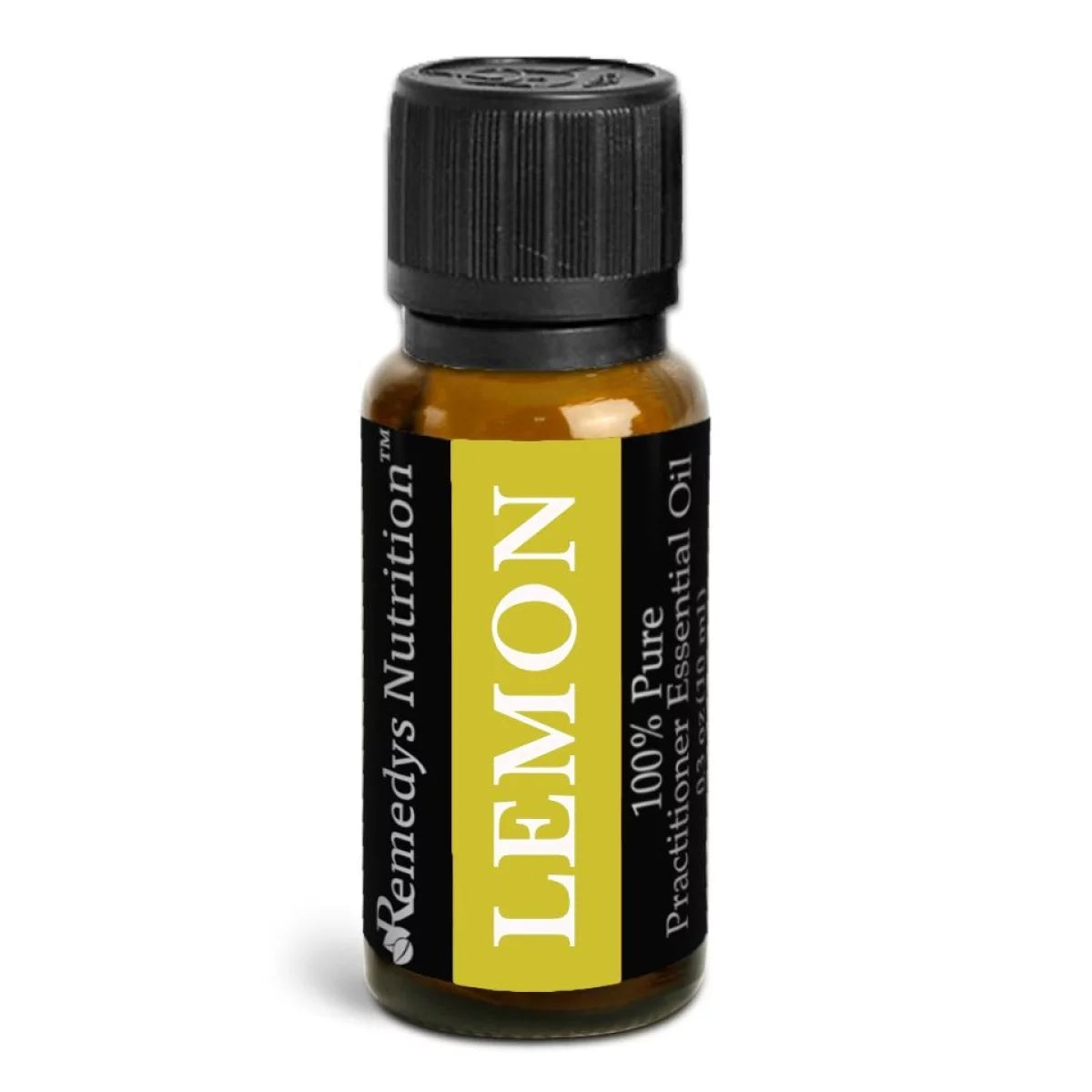
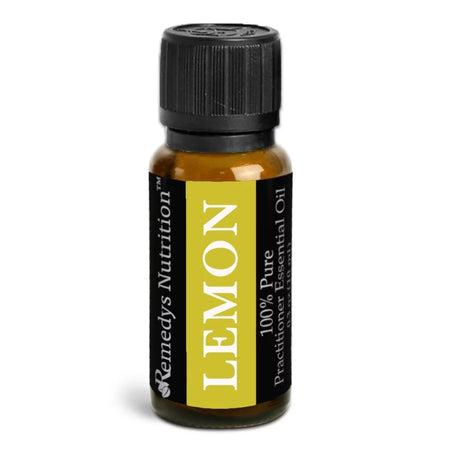
Why Choose Remedy's Nutrition Lemon Essential Oil
| What You Get |
Why It Matters |
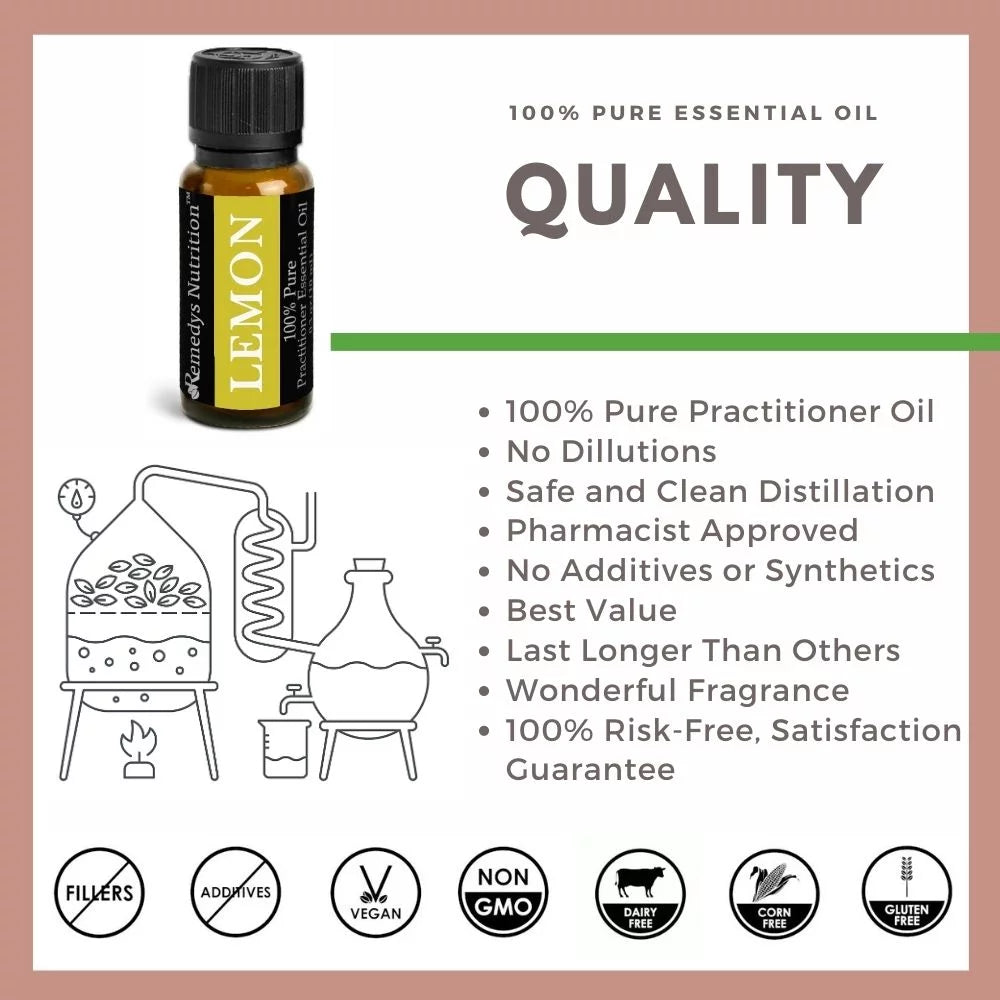
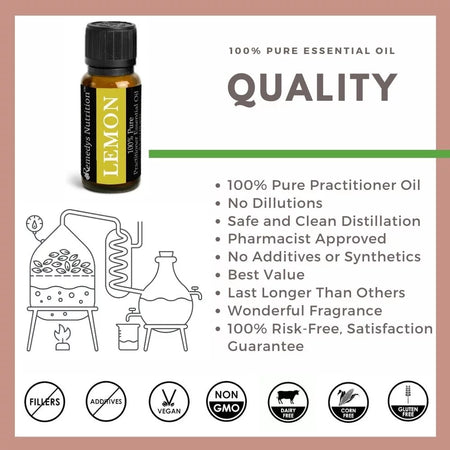
| 100% pure cold-pressed lemon peel oil |
No carrier oil dilution, no synthetic fragrance, no fillers — full d-limonene strength at 60 to 70% |
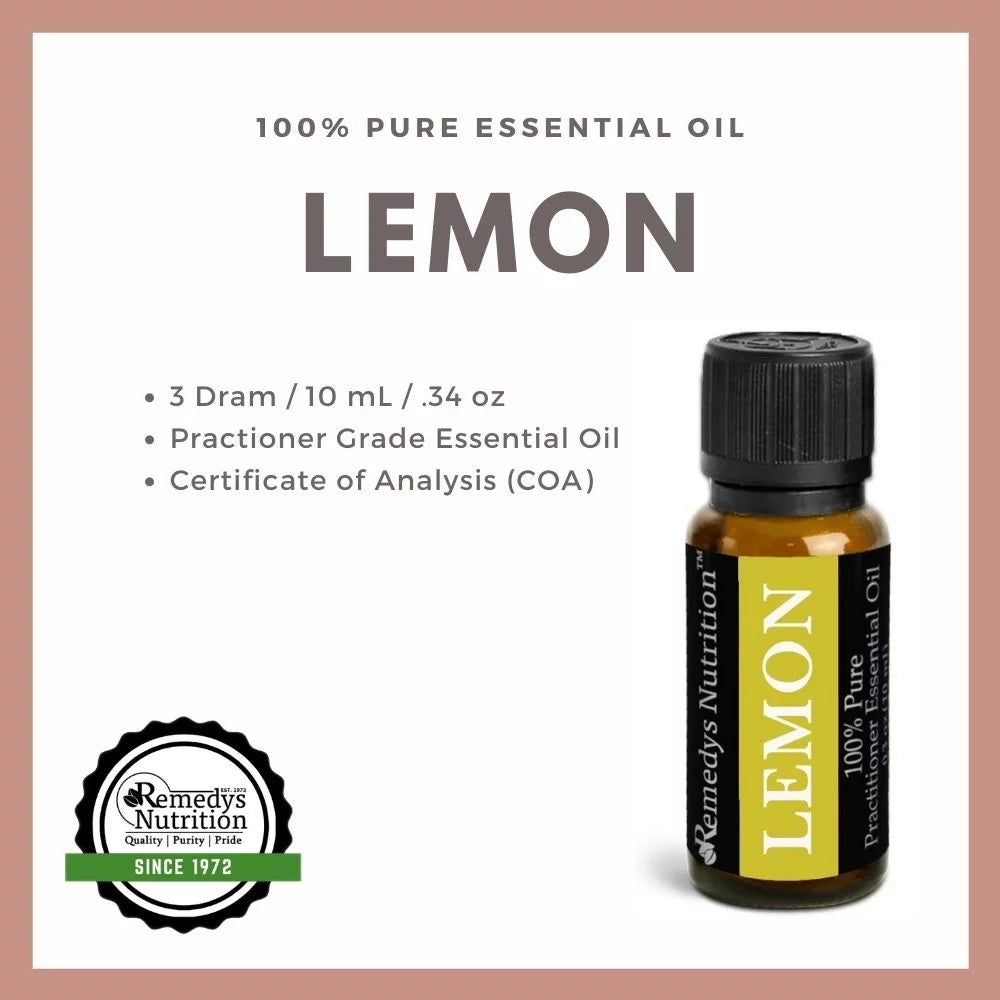
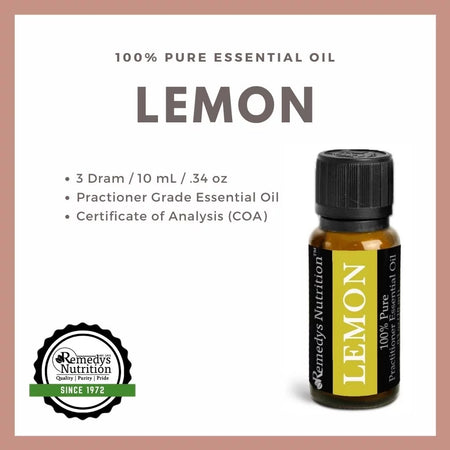
| 10 mL amber glass bottle (3 dram) |
Amber glass blocks UV that degrades citral and limonene; bottle yields about 200 to 250 drops |
| Built-in orifice reducer cap |
Drop-by-drop dispensing prevents waste; 1 drop equals about 0.05 mL for accurate recipes |
| Cold-pressed (not steam-distilled) |
Cold expression preserves the full aromatic profile; steam distillation strips flavonoids and softens scent |
| Made in USA, GMP facility |
Manufactured in a cGMP-compliant facility with batch-level quality control |
| GC/MS tested for purity |
Each batch verified by gas chromatography for d-limonene content and absence of synthetic adulterants |
Lemon Oil Dilution and Use Guide
| Use Case |
Dilution / Drops |
Method |
Frequency |
| Diffusion for mood and air |
2 to 3 drops per 100 mL water |
Ultrasonic or nebulizing diffuser |
30 to 60 minutes, 2 to 3 times daily |
| 16 oz surface spray |
15 drops in 1 cup water + 1 cup vinegar |
Spray bottle, shake before each use |
Daily as needed |
| Topical (mood roll-on, off-sun) |
2% dilution — 12 drops per 30 mL carrier |
Mix with jojoba or sweet almond carrier |
Avoid sun 12 hours after application |
| Inhalation for nausea or focus |
1 to 2 drops on cotton pad or tissue |
Inhale 3 to 5 deep breaths |
Every 30 to 60 minutes as needed |
| Laundry freshener |
3 to 5 drops added with detergent |
Wash cycle, any fabric except silk |
Per wash as desired |
| Cutting board cleaner |
5 drops on coarse salt |
Scrub board 60 seconds, rinse |
Weekly |
The 2% topical dilution rule is the one most users get wrong. Lemon oil is phototoxic at concentrations above 2% — cold-pressed citrus contains bergapten (a furocoumarin) that reacts with UV light and produces blistering burns up to 12 hours after application. For any topical use, dilute to 2% maximum and stay out of direct sunlight on treated skin for at least 12 hours. For UV exposure within 12 hours of use, switch to FCF (furocoumarin-free) lemon oil or use steam-distilled lemon, which lacks the phototoxic compounds.
Lemon Oil and Citrus Pairings
Lemon plays well with most other oils because d-limonene is chemically friendly with phenols, terpenes, and esters across the citrus, mint, and floral families. The 5 most useful pairings for typical home use:
-
Lemon + tea tree — the surface-cleaning power couple; 2:1 ratio in a 16 oz spray covers grease and antimicrobial duty in one pass.
-
Lemon + peppermint — mid-afternoon energy boost in the diffuser; 2 drops lemon to 1 drop peppermint cuts through fatigue without jitter.
-
Lemon + grapefruit — mood-lift and appetite-curbing duo for kitchen and office; 1:1 ratio in a personal diffuser.
-
Lemon + lavender — bright morning vs. relaxing evening; alternating these covers the full daily aromatherapy spectrum.
-
Lemon + thieves blend — deep antimicrobial cleaning for sick season; 5 drops of each in a 16 oz spray for whole-room disinfection.
For anxiety-prone users who find pure lemon too stimulating, anchor it with a base note like cedarwood or sandalwood at 1:1 ratio. The base note slows the diffusion rate and produces a calmer overall scent that lasts 2 to 3 times longer in the air.
Lemon Oil Safety and Phototoxicity
Phototoxicity warning. Cold-pressed lemon oil contains 7,000 to 18,000 ppm bergapten, a furocoumarin that reacts with UVA radiation and can cause blistering chemical burns up to 12 hours after skin application. Diffusion and household use are unaffected, but topical use requires a strict 12-hour sun-avoidance window or 2% maximum dilution.
| Consideration |
Details |
| Phototoxicity |
Avoid direct sun on treated skin for 12 hours after topical use; max 2% dilution for any leave-on skin product |
| Children under 2 years |
Avoid topical use; diffusion at 1 to 2 drops in well-ventilated room is generally safe |
| Pregnancy and breastfeeding |
Diffusion safe; topical use limited to 1% dilution and only on non-sun-exposed skin |
| Pets (cats especially) |
Cats lack the liver enzyme to clear d-limonene safely — never apply topically; diffuse only in well-ventilated rooms with cat exit access |
| Asthma and reactive airways |
Some users react to citrus oils with bronchospasm; test 1-drop diffusion for 5 minutes before longer sessions |
| Skin sensitization |
Risk increases with old or oxidized oil — replace bottles 12 to 24 months after opening; refrigerate to extend shelf life |
| Internal use |
Not recommended without trained aromatherapy supervision; cooking with food-grade lemon oil is acceptable in trace amounts (1 drop per 4 servings max) |
| Storage |
Amber glass, cool dark cabinet, cap tight — oxidized lemon oil loses up to 40% of antimicrobial activity within 6 months of poor storage |
The most common mistake is applying lemon oil neat (undiluted) to skin and going outside — this produces blistering burns within 6 to 12 hours that look like sunburn but persist for weeks. If a topical reaction occurs, wash the area with soap and water immediately and avoid sun for 48 hours. For ongoing skin or scalp use, switch to FCF lemon oil or use lemon only at night with morning shower-off.
Lemon Essential Oil FAQ
What is lemon essential oil good for? +
Lemon essential oil has 4 main use cases: cleaning and kitchen disinfection (1% in water plus vinegar kills E. coli, Salmonella, and Listeria within 15 minutes), mood and mental energy (30% improvement in mood scores in a 2008 Ohio State trial of 56 adults), focus and cognitive task speed (54% typing accuracy improvement in a Japanese workplace study), and adhesive or stain removal (dissolves tape residue, gum, and crayon in under 60 seconds at full strength).
How do I make a lemon oil cleaning spray? +
Combine 1 cup distilled water, 1 cup white vinegar, and 15 drops lemon essential oil in a 16 oz spray bottle. Shake before each use because oil and water separate in 30 to 60 seconds. For added antimicrobial coverage, add 5 drops tea tree oil. Use on sealed stone counters, stainless steel, glass, and cutting boards. Avoid on unsealed wood, waxed floors, and electronic anti-glare screens.
Is lemon oil safe for skin? +
Yes at 2% maximum dilution (12 drops per 30 mL carrier oil), with a strict 12-hour sun-avoidance window after application. Cold-pressed lemon oil contains 7,000 to 18,000 ppm bergapten, a furocoumarin that reacts with UVA light and can cause blistering burns up to 12 hours later. For daytime or sun-exposed use, switch to FCF (furocoumarin-free) lemon oil or use only at night with morning shower-off.
Can lemon oil really lift mood? +
Yes, supported by 2 controlled trials. The 2008 Ohio State study (n=56) showed 30% improvement in subjective mood scores and norepinephrine marker changes consistent with alert focus. The 1995 Komori workplace trial showed 54% improvement in typing accuracy after citrus diffusion. The mood lift typically appears within 5 to 10 minutes of inhalation. Standard dose is 2 to 3 drops in a diffuser for 30 to 60 minutes.
Does lemon oil really clean better than soap? +
For grease cutting, yes — d-limonene at 1% dissolves grease 2 to 3 times faster than dish soap alone. For protein and starch residue, soap still wins. The best practice is layered cleaning: soap and water for daily wipe-downs, lemon and vinegar spray for grease and antimicrobial passes once per day, and Thieves blend or tea tree for deep weekly disinfection. The 16 oz lemon spray costs about 18 cents per use vs. 75 cents for commercial citrus cleaners.
How many drops of lemon oil per diffuser? +
Use 2 to 3 drops per 100 mL of diffuser water. For larger rooms (over 200 sq ft), 4 to 5 drops covers the space for 60 to 90 minutes. Run the diffuser for 30 to 60 minutes at a stretch with 30-minute breaks — continuous diffusion can desensitize the olfactory receptors and reduce the mood and focus effect within 2 hours. The 10 mL bottle yields about 100 diffusion sessions at 2 drops each.
Can I use lemon oil on stains and gum? +
Yes — d-limonene is the active compound in commercial citrus solvents like Goo Gone. Apply 1 to 2 drops directly to a cloth, work in circles 60 seconds, and wipe. It dissolves sticker residue, packing tape, gum, crayon, marker, and grease splatter. 2 cautions: it softens many plastics over extended contact (apply and wipe within 90 seconds) and may lift shellac or wax finishes — test antique surfaces first.
Does lemon oil help with nausea? +
Yes, modestly. 1 randomized trial in 100 pregnant women showed inhaled lemon oil reduced nausea severity vs placebo for morning sickness. Practical use: 2 drops on a cotton pad or tissue, hold near the face, and take 3 to 5 deep breaths every 30 to 60 minutes as needed. Lemon also helps post-anesthesia nausea and motion sickness for some users, though evidence here is anecdotal rather than trial-based.
Is lemon oil safe for cats and dogs? +
Cats — never apply topically. Cats lack the liver glucuronidation enzyme to clear d-limonene and other monoterpenes, which can build up to toxic levels within 24 to 48 hours. Diffuse only in well-ventilated rooms with cat exit access. Dogs — topical use is risky and should be avoided; diffusion is generally safe at 2 to 3 drops with the dog free to leave the room. Birds are even more sensitive than cats — do not diffuse near birds.
How long does lemon oil last? +
Sealed and stored in amber glass in a cool dark cabinet, lemon oil keeps full potency for 12 to 24 months. After opening, oxidation begins — expect 12 months of peak potency, with antimicrobial activity dropping up to 40% by 18 months in poor storage. To extend shelf life, refrigerate the bottle (the oil thickens but warms back to liquid in 5 minutes). Replace bottles that smell sharp, turpentine-like, or distinctly different from the original citrus profile.
Can I drink lemon essential oil in water? +
Not recommended without trained aromatherapy or naturopathic supervision. 1 drop of lemon essential oil equals roughly the d-limonene content of 7 to 9 fresh peels — far more concentrated than any culinary use. Internal use can irritate the esophagus and stomach lining and may interact with medications cleared via CYP3A4. For lemon flavor in water, use 1/4 teaspoon fresh juice or a strip of zest instead. For internal cooking use, 1 drop per 4 servings of food is the typical safe maximum.
What is the difference between cold-pressed and steam-distilled lemon oil? +
Cold-pressed lemon oil is mechanically expressed from the peel and retains the full aromatic profile including bergapten (which causes phototoxicity). Steam-distilled lemon oil uses heat and water vapor to extract volatiles and leaves the heavier furocoumarins behind, producing a non-phototoxic but slightly less aromatic oil. Cold-pressed is 90% of the market and the standard for cleaning, diffusion, and traditional aromatherapy. Steam-distilled is the better choice for sun-exposed topical use and skin care formulations.
What makes Remedy's Lemon Oil different? +
Remedy's lemon oil is 100% pure cold-pressed peel oil with no carrier dilution, no synthetic fragrance, and no fillers — full d-limonene strength at 60 to 70%. The 10 mL amber glass bottle includes a built-in orifice reducer for drop-by-drop dispensing (about 200 to 250 drops total). Manufactured in a USA cGMP facility and verified by GC/MS testing per batch for d-limonene content and absence of synthetic adulterants.
Lemon Oil: Further Reading
Want more detail on safe use and pairings? Browse our essential oils knowledge hub: