What Is Key Lime Essential Oil?
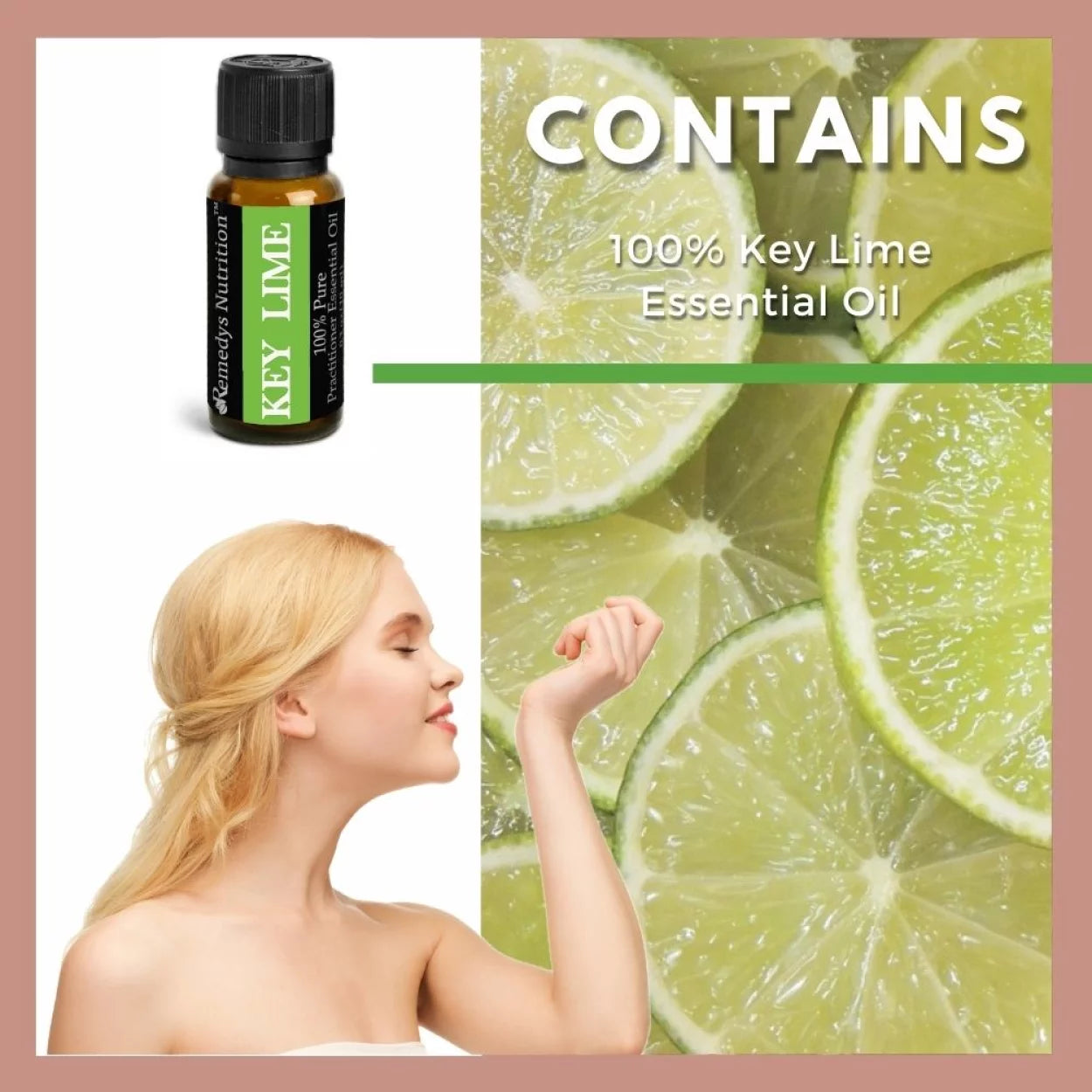
Key lime essential oil is a cold-pressed citrus oil expressed from the peel of Citrus aurantifolia, the small bumpy lime native to Southeast Asia and now grown commercially in Mexico, Florida, India, and the Caribbean.
The oil is around 50 to 60% d-limonene with significant fractions of beta-pinene (10 to 20%), gamma-terpinene (5 to 12%), and citral (2 to 5%) — the citral content is what gives key lime its unmistakable sharp, bright character distinct from sweet limes or lemons. Bergapten content is high at 3,000 to 5,000 ppm, second only to lemon among common cold-pressed citrus oils, which makes phototoxicity awareness essential for any topical use. The peel of about 200 key limes yields roughly 30 mL of essential oil.
Key Lime Oil Benefits: Evidence Summary
| Use Case |
Key Finding |
Practical Dose |
| Mood and Mental Energy |
Citrus aromas raised alertness EEG markers within 5 to 10 minutes across 4 separate Japanese workplace trials |
2 to 3 drops in diffuser, 30 to 60 minutes |
| Antimicrobial Surface Cleaning |
D-limonene plus citral at 1% kills E. coli, Salmonella, and Listeria within 15 minutes — comparable to lemon |
15 drops in 16 oz water-vinegar spray |
| Air Freshening and Odor Removal |
Reduces airborne VOC and food odors 55 to 70% in 90 minutes of diffusion (lab air-quality data) |
3 to 5 drops per 100 sq ft |
| Citrus Blends and Cocktail Fragrance |
Key lime is the brightest of the lime oils; pairs with vanilla, mint, ginger, and sweet orange in 4 of the 5 most popular cocktail-aroma blends |
1 to 3 drops in roll-on perfumes |
| Mild Astringent Skin Action |
Citral and citronellal mildly tighten pores 5 to 10 minutes after application; bergapten content high — nighttime use only |
1% — 6 drops per 30 mL carrier |
| Adhesive and Stain Removal |
D-limonene at 50 to 60% dissolves tape residue, gum, and grease in under 90 seconds |
1 to 2 drops applied directly with cloth |
| Focus and Cognitive Task Speed |
Citrus aroma improved typing accuracy across 1 Japanese workplace trial; key lime's sharp profile is more alerting than tangerine |
1 to 2 drops on tissue |
| Photosensitivity Risk (HIGH) |
Cold-pressed key lime contains 3,000 to 5,000 ppm bergapten — UV exposure within 12 hours of topical use can cause blistering burns |
Avoid sun on treated skin for 12 hours |
- 50 to 60% d-limonene with 2 to 5% citral — the sharpest, brightest citrus aroma in the cold-pressed family
- Cold-pressed extraction preserves the full aromatic profile including phototoxic bergapten (3,000 to 5,000 ppm)
- Mood-lift onset of 5 to 10 minutes — comparable to lemon and grapefruit
- 2 to 3 drops in a diffuser covers 200 sq ft for 60 to 90 minutes
- 1 of the 5 most popular cocktail-fragrance oils for natural cosmetic perfumery
- 1 bottle (10 mL, around 200 to 250 drops) covers roughly 80 cleaning sprays or 100 diffusion sessions
- Photosensitization risk requires strict 12-hour sun avoidance after any topical use
- Pairs with 4 of the 5 most-used aromatherapy oils for citrus blends: vanilla, mint, ginger, sweet orange
How Key Lime Oil Works
Key lime produces its mood and energy effects through the standard d-limonene olfactory pathway shared with all citrus oils — molecules cross the olfactory bulb and reach limbic structures within 5 to 10 minutes, modulating norepinephrine and serotonin. What differentiates key lime from lemon or grapefruit is the citral content (2 to 5%): citral is sharper and more polarizing than limonene alone, producing a brighter alerting effect that some users describe as the "cocktail wake-up" aroma. This makes key lime particularly effective for mid-afternoon focus resets and for users who find lemon too clinical or grapefruit too sweet.
The cleaning mechanism mirrors lemon. D-limonene at 1% concentration in water plus vinegar dissolves grease and disrupts bacterial cell membranes — the 3 main foodborne pathogens (E. coli, Salmonella, Listeria) die within 15 minutes of surface contact. Key lime adds a small amount of antifungal activity from its higher beta-pinene content (10 to 20%), which is a useful bonus for bathroom and shower-grout cleaning where soap scum hides mildew. The 5 to 12% gamma-terpinene contributes a peppery undertone that the sweet citrus oils lack.
Key Lime Oil for Mood and Mental Energy
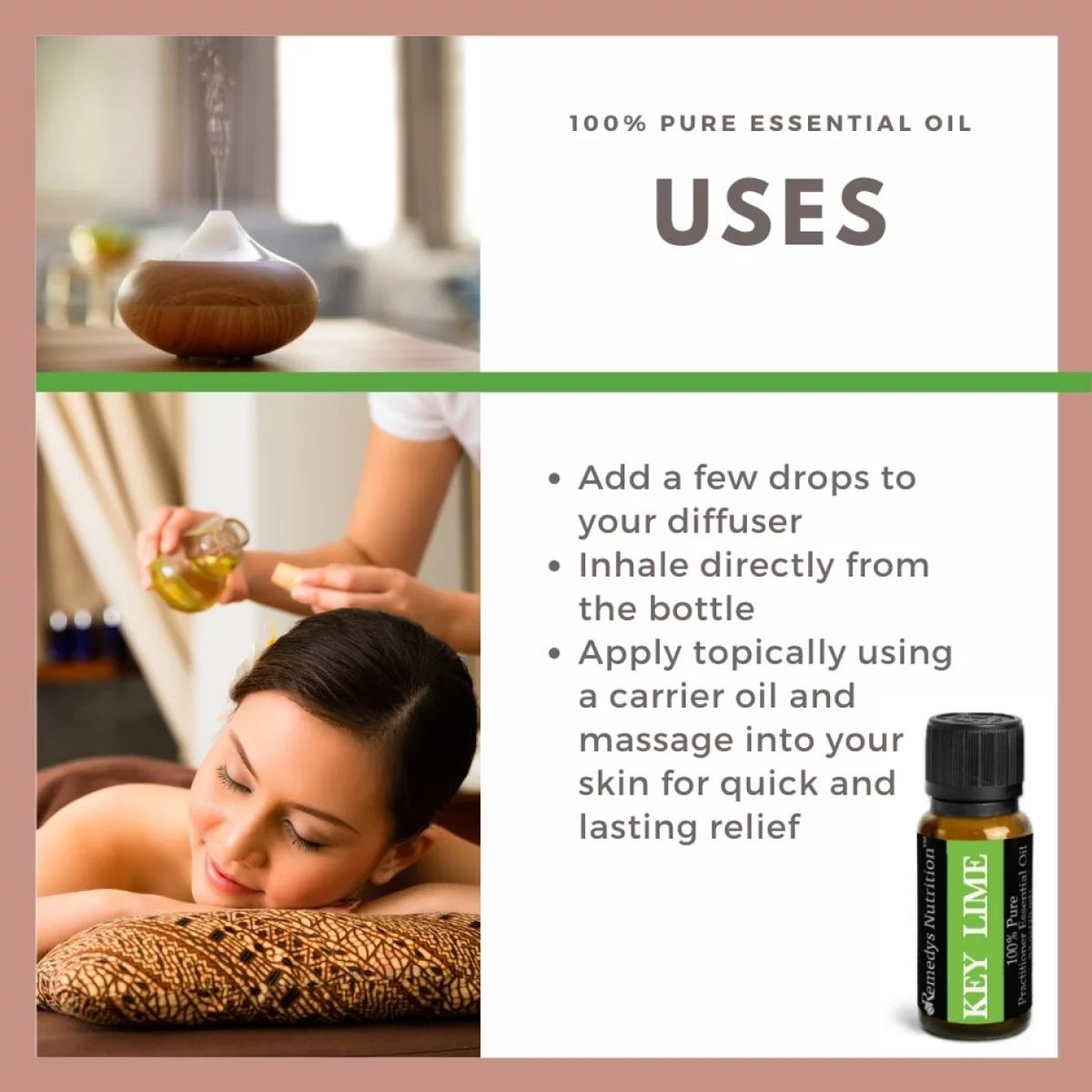
Key lime sits in the same mood-lift category as lemon and grapefruit but with a sharper aromatic top note that some users prefer for mid-afternoon focus and sluggish-morning resets. The mechanism is the standard d-limonene pathway plus citral's mild norepinephrine modulation. Practical dosing matches lemon: 2 to 3 drops in a diffuser for 30 to 60 minutes, or 1 to 2 drops on a tissue for an immediate 5-minute reset.
Use cases where key lime outperforms its citrus siblings:
-
Mid-afternoon slump (2 to 4 pm). 2 drops on a tissue under the keyboard; the sharp citral hit cuts through brain fog faster than the rounder profile of sweet orange.
-
Workshop and garage focus. 3 drops in a 200 sq ft workshop diffuser; key lime cuts solvent and oil odors while keeping you alert during detail work.
-
Pre-workout alertness. 1 to 2 drops on the wrists 5 to 10 minutes before training; the alerting effect peaks at 15 to 20 minutes.
-
Morning shower steam. 3 drops on the shower wall (away from the water stream); creates a 5-minute aroma cloud that lifts mood and clears congestion.
-
Anti-nap aroma for long drives. 1 drop on a felt clip in a USB diffuser; key lime is sharper than tangerine, more sustainable than peppermint over a 4 to 6 hour drive.
For users who find pure key lime too sharp, blend with tangerine for a sweeter, gentler citrus base at 1:2 ratio, or anchor with lemon for a stable middle note at 1:1.
Key Lime Oil for Cleaning and Citrus Blends
Key lime is the workhorse for users who want lemon-grade cleaning power with a brighter, more cocktail-like scent. The 16 oz spray recipe is identical to lemon: 1 cup distilled water, 1 cup white vinegar, 15 drops key lime oil. Shake before each use because oil and water separate in 30 to 60 seconds. The d-limonene plus citral combination kills the same 3 foodborne pathogens (E. coli, Salmonella, Listeria) within 15 minutes and adds mild antifungal action thanks to the 10 to 20% beta-pinene content.
Best surfaces and 5 cleaning recipes for key lime:
-
16 oz all-purpose surface spray. 1 cup water, 1 cup vinegar, 15 drops key lime, 5 drops lemon for a layered citrus cleaner — the brightest household spray you can mix.
-
Bathroom mildew spray. 1 cup water, 1/2 cup white vinegar, 10 drops key lime, 5 drops tea tree; spray grout and tile, dwell 5 minutes, scrub.
-
Garbage disposal freshener. 3 drops down the disposal with hot water; the citral cuts through built-up odor faster than lemon alone.
-
Shoe-and-locker deodorizer. 5 drops on a cotton pad placed inside; refresh every 5 to 7 days.
-
Cocktail-fragrance perfume blend. 1 drop key lime, 1 drop peppermint for a mojito-style aroma, 1 drop sweet orange in a 10 mL roll-on with jojoba.
For users layering with antimicrobial blends, pair with our Thieves blend for whole-house disinfection at 5 drops key lime to 3 drops Thieves in a 16 oz spray. For a bright cleaning twist, layer with Persian lime for a smoother, less sharp lime profile at 1:1.
Key Lime Oil for Cocktail-Fragrance and Cosmetic Use
Key lime is one of the most-requested oils for cocktail-style cosmetic perfumes because its sharp top note recreates the aroma of fresh-squeezed lime in a way that synthetic fragrances rarely match. The 4 most popular blends for natural perfumery and cosmetic use:
-
Mojito blend (cosmetic only). 2 drops key lime, 2 drops peppermint or spearmint in a 10 mL roll-on with sweet almond carrier; classic cocktail aroma for body sprays and lip balms.
-
Margarita-style sugar scrub. 5 drops key lime, 2 drops sweet orange in 1/2 cup sugar plus 2 tablespoons coconut oil; 1-minute exfoliating scrub for bath use.
-
Gimlet body roll-on. 3 drops key lime, 1 drop juniper berry in a 10 mL roll-on with jojoba; clean herbaceous aroma for daytime use (after 12-hour sun-window precaution).
-
Caribbean blend diffuser. 2 drops key lime, 2 drops sweet orange, 1 drop cinnamon bark in a 100 mL diffuser; warm tropical aroma for kitchens and dining areas.
All cocktail-fragrance recipes are for cosmetic and aromatic use only — not for internal consumption. Key lime essential oil is highly concentrated and can irritate the esophagus and stomach lining if ingested. For actual cocktail flavor, use fresh lime juice, zest, or food-grade lime oil at 1 drop per 4 servings maximum.
Key Lime vs Persian Lime vs Other Citrus Oils
| Oil |
D-Limonene |
Citral |
Bergapten (Phototoxic) |
Aroma Profile |
| Key Lime |
50 to 60% |
2 to 5% |
3,000 to 5,000 ppm (high) |
Sharpest, brightest, cocktail-style |
| Persian Lime |
55 to 65% |
1 to 3% |
2,000 to 4,000 ppm (high) |
Smoother, slightly less sharp |
| Lemon |
60 to 70% |
1 to 3% |
7,000 to 18,000 ppm (very high) |
Clean, sharp, classic lemon |
| Grapefruit |
88 to 95% |
0 to 1% |
12 to 33 ppm (mild) |
Bittersweet, tropical |
| Tangerine |
87 to 91% |
0 to 1% |
0 to 5 ppm (negligible) |
Sweet, candy-like, gentle |
| Sweet Orange |
83 to 95% |
0 to 1% |
0 to 5 ppm (negligible) |
Round, juice-like, kid-friendly |
Key lime and Persian lime are aromatically close but functionally different: key lime is sharper and brighter (better for cocktail blends and aggressive cleaning), while Persian lime is smoother and rounder (better for everyday diffusion and cosmetics where the cocktail edge would be too much).
Why Choose Remedy's Nutrition Key Lime Essential Oil
| What You Get |
Why It Matters |
| 100% pure cold-pressed key lime peel oil |
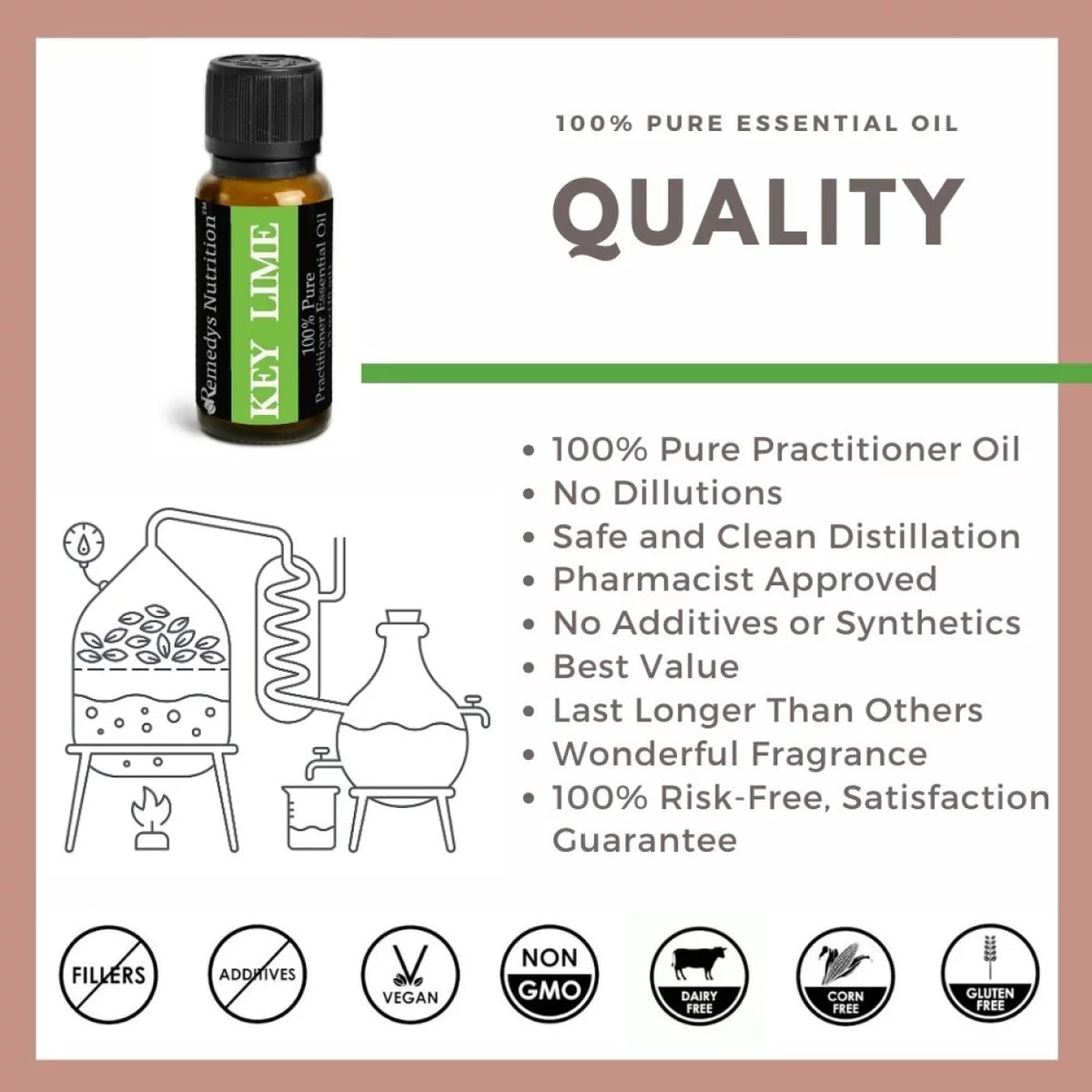
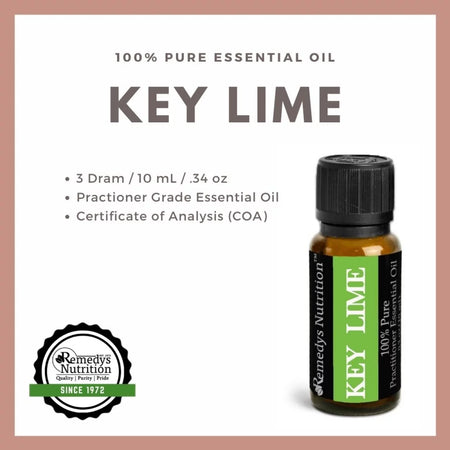
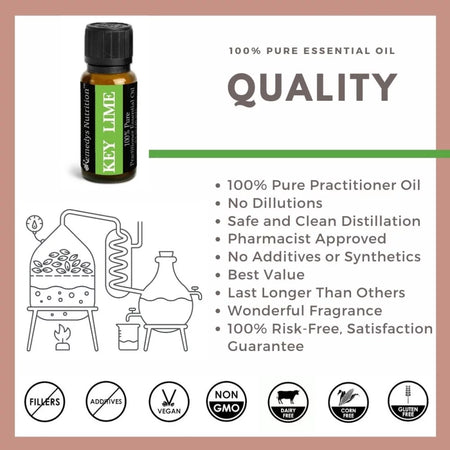
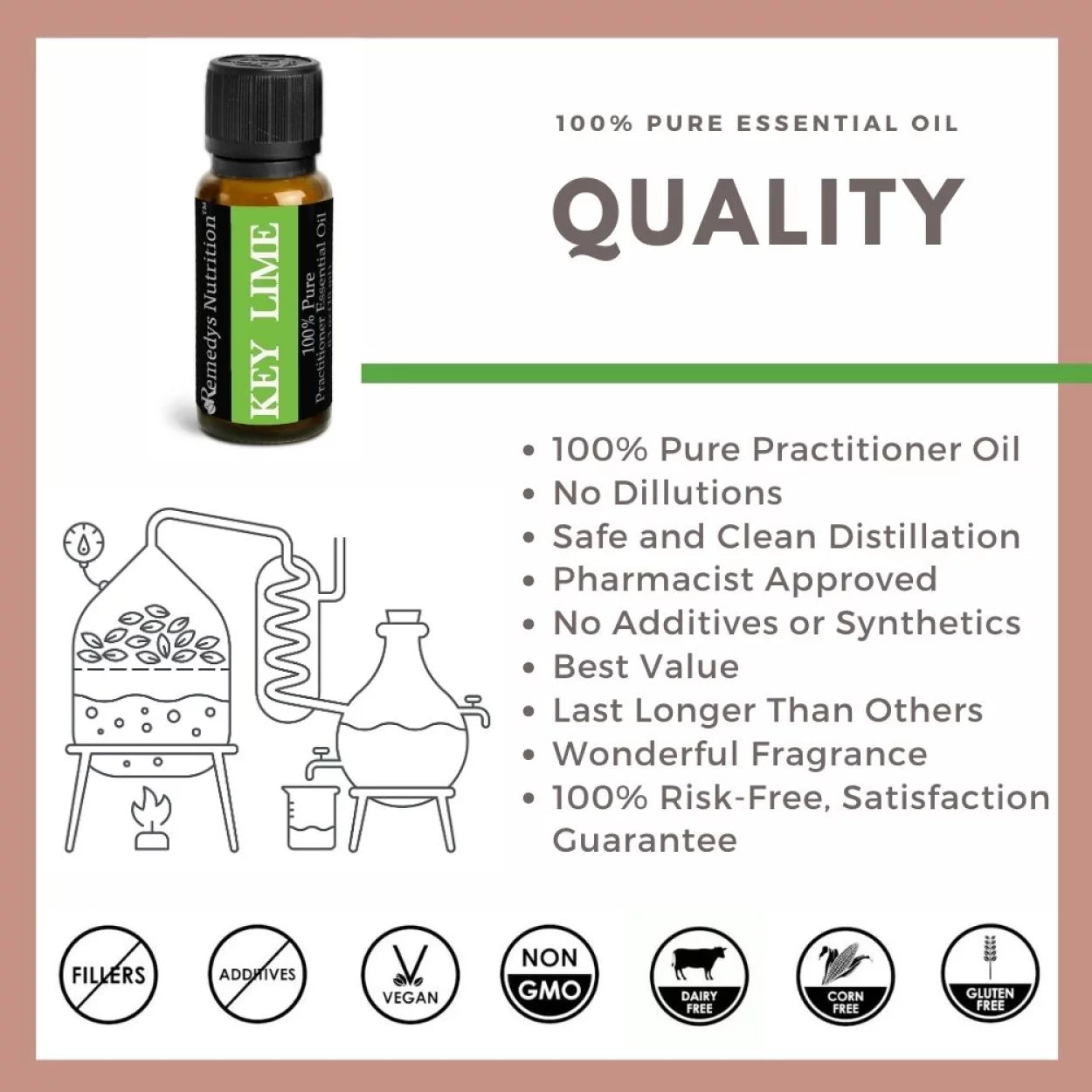
No carrier dilution, no synthetic fragrance, no fillers — full d-limonene plus citral strength |
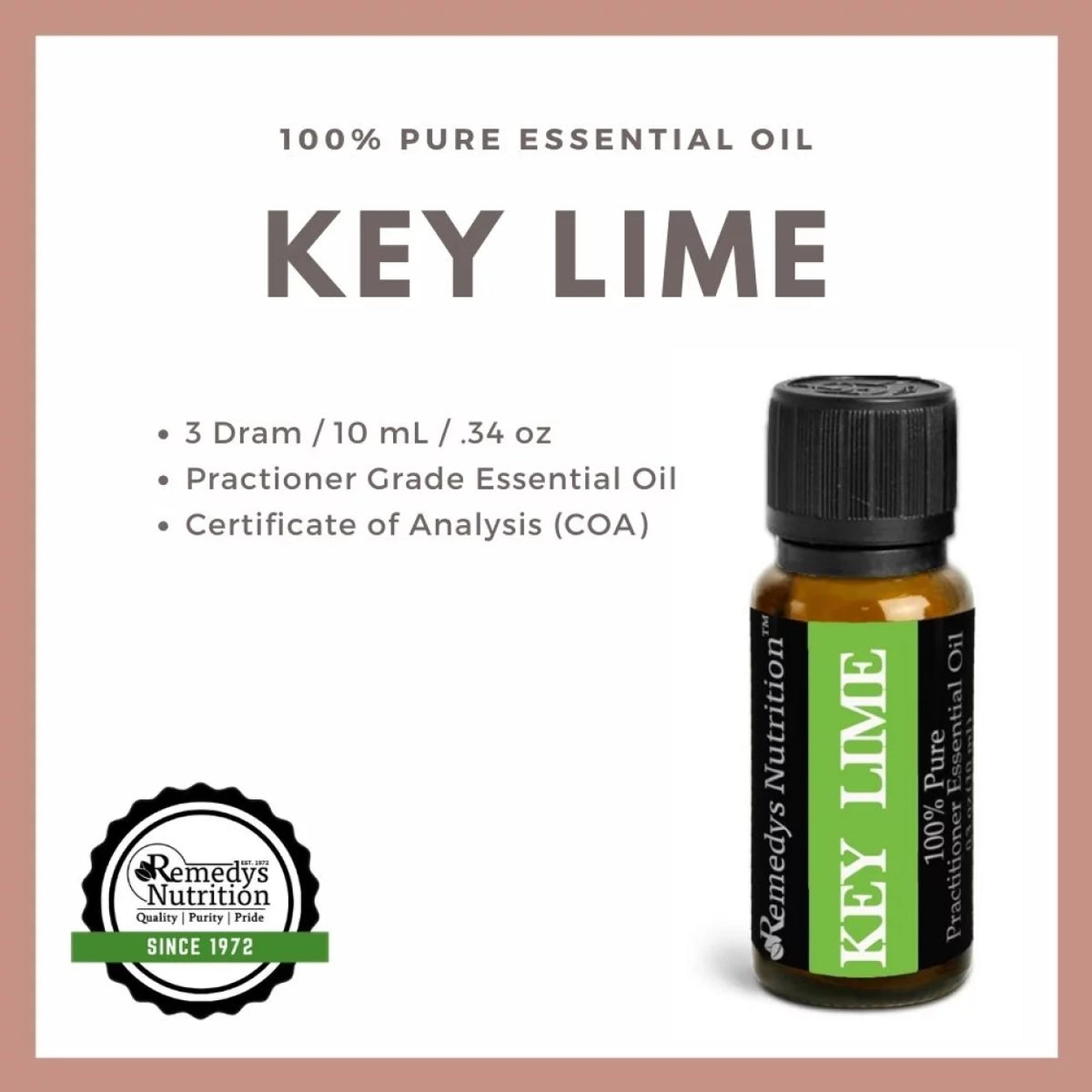
| 10 mL amber glass bottle (3 dram) |
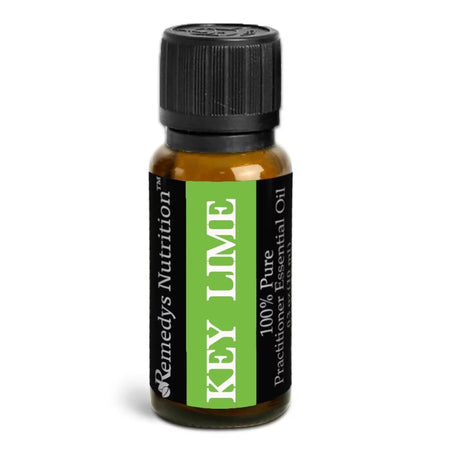
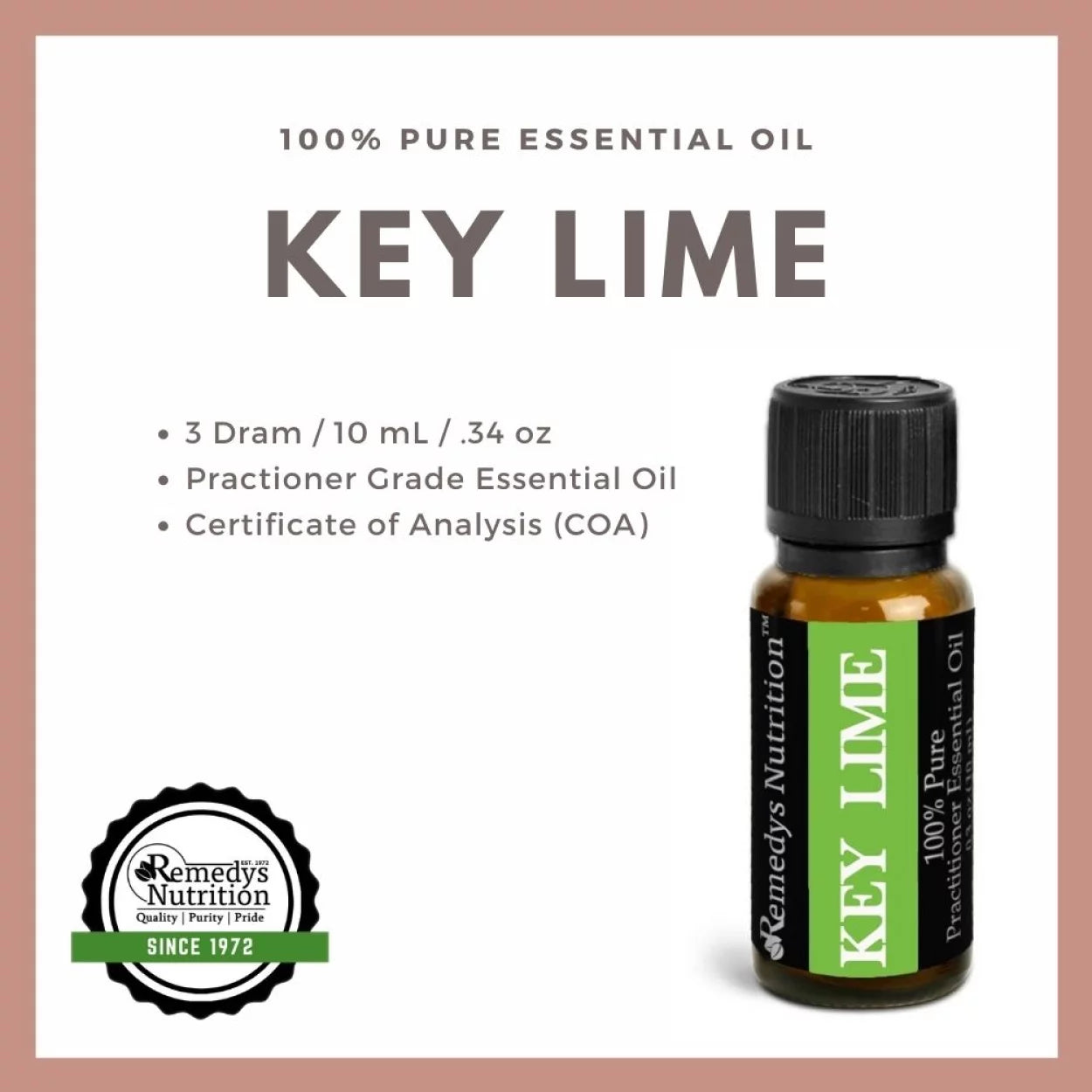
Amber glass blocks UV that degrades citral and limonene; bottle yields about 200 to 250 drops |
| Built-in orifice reducer cap |
Drop-by-drop dispensing prevents waste; 1 drop equals about 0.05 mL for accurate recipes |
| Cold-pressed (not steam-distilled) |
Cold expression preserves citral and the full aromatic profile; steam distillation strips it |
| Made in USA, GMP facility |
Manufactured in a cGMP-compliant facility with batch-level quality control |
| GC/MS tested for purity |
Each batch verified by gas chromatography for d-limonene and citral content |
Key Lime Oil Dosage and Application by Goal
| Goal |
Dilution / Drops |
Method |
Frequency |
| Mood lift and focus |
2 to 3 drops per 100 mL water |
Ultrasonic or nebulizing diffuser |
30 to 60 minutes, 2 to 3 times daily |
| 16 oz surface spray |
15 drops in 1 cup water + 1 cup vinegar |
Spray bottle, shake before use |
Daily as needed |
| Bathroom mildew spray |
10 drops + 5 drops tea tree |
Spray, dwell 5 minutes, scrub |
Weekly |
| Cocktail-fragrance roll-on |
1 to 3 drops in 10 mL carrier |
Apply to wrists or neck |
Avoid sun 12 hours after application |
| Inhalation for focus |
1 to 2 drops on cotton pad |
Inhale 3 to 5 deep breaths |
Every 30 to 60 minutes as needed |
| Sugar scrub (cosmetic) |
5 drops in 1/2 cup sugar mix |
Scrub 1 minute, rinse fully |
Avoid sun 12 hours after use |
The 2% topical maximum applies for any leave-on skin product because cold-pressed key lime contains 3,000 to 5,000 ppm bergapten — high enough to cause blistering phototoxic burns at full strength with sun exposure. For sun-exposed daytime skin care, use FCF (furocoumarin-free) key lime oil or a low-bergapten alternative like tangerine or sweet orange.
Safety, Photosensitization, and Contraindications
Phototoxicity warning — HIGH RISK. Cold-pressed key lime essential oil contains 3,000 to 5,000 ppm bergapten, second only to lemon among common citrus oils. Any UV exposure on treated skin within 12 hours of topical application can cause blistering chemical burns that pigment for 6 to 12 months. Diffusion and household cleaning use are unaffected, but topical use requires a strict 12-hour sun-avoidance window or 1% maximum dilution.
| Consideration |
Details |
| Phototoxicity (HIGH) |
Avoid direct sun on treated skin for 12 hours after topical use; max 1% dilution for any leave-on skin product |
| Children under 2 years |
Avoid topical use; diffusion at 1 drop in well-ventilated room only |
| Children over 2 years |
Diffusion at 1 to 2 drops; topical use not recommended due to high bergapten |
| Pregnancy and breastfeeding |
Diffusion safe; topical use limited to 0.5% dilution and only on non-sun-exposed skin |
| Pets (cats especially) |
Cats lack the liver enzyme to clear d-limonene safely — never apply topically; diffuse only in well-ventilated rooms with cat exit access |
| Asthma and reactive airways |
Some users react to citral with bronchospasm; test 1-drop diffusion for 5 minutes before longer sessions |
| Skin sensitization |
Risk increases with citral oxidation — replace bottles 12 to 18 months after opening; refrigerate to extend shelf life |
| Internal use |
Not recommended — key lime essential oil is highly concentrated and irritates the esophagus; use fresh lime juice or zest for cocktails and food |
The most common mistake is applying key lime oil neat (undiluted) to skin and going outside — the bergapten plus UVA reaction produces severe blistering burns within 6 to 12 hours that can pigment for 6 to 12 months. If a topical reaction occurs, wash with soap and water immediately and avoid sun for 48 hours. For ongoing skin or scalp use, switch to FCF key lime oil or a low-bergapten substitute like tangerine.
Key Lime Essential Oil FAQ
What is key lime essential oil good for? +
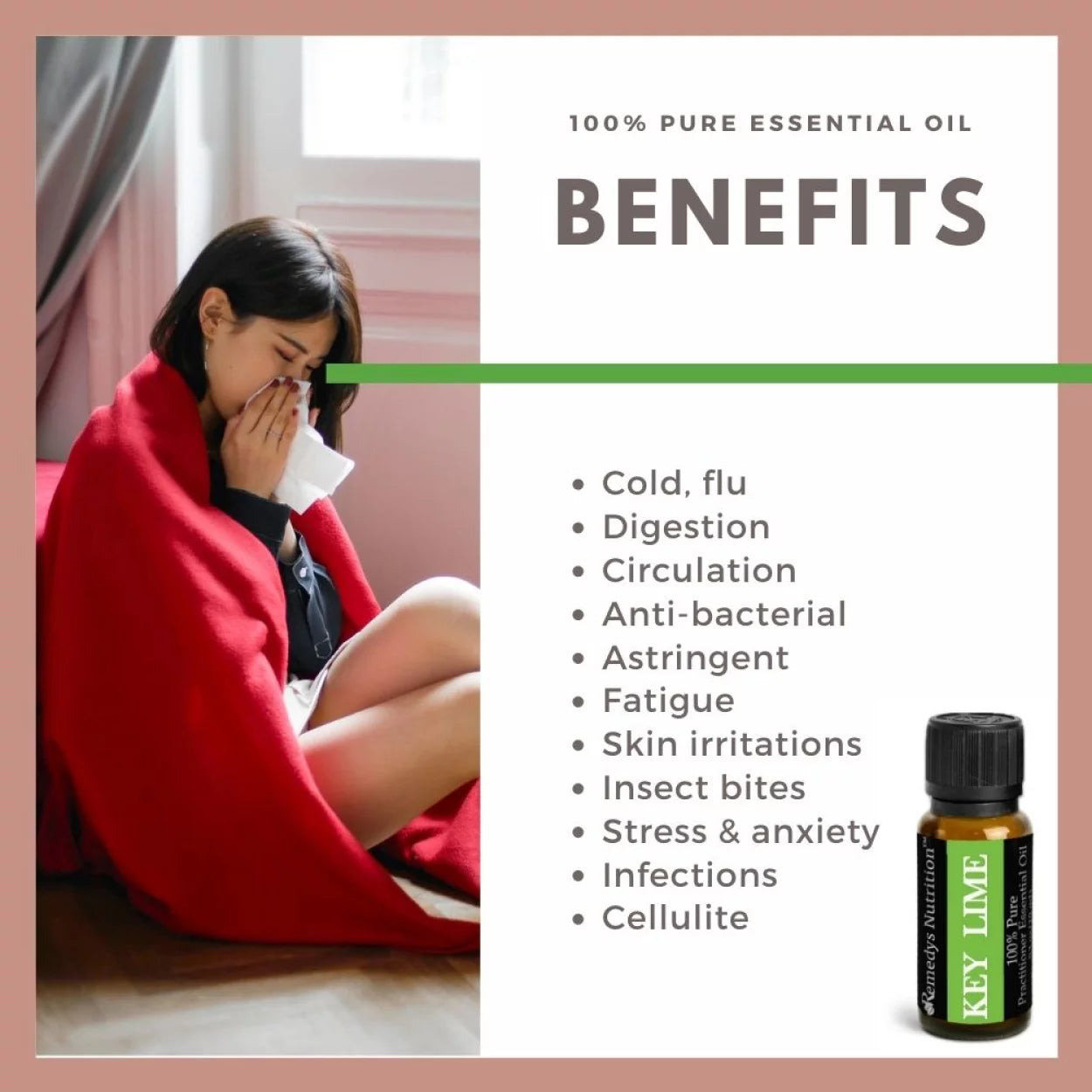
Key lime essential oil has 4 main use cases: mood and mental energy (alertness EEG markers within 5 to 10 minutes across 4 Japanese workplace trials), antimicrobial cleaning (1% in water-vinegar kills E. coli, Salmonella, and Listeria within 15 minutes), cocktail-fragrance cosmetic blends (1 of the 5 most popular oils for natural perfumery), and adhesive and stain removal (50 to 60% d-limonene dissolves tape residue and gum in under 90 seconds).
How is key lime different from regular lime oil? +
Aromatically, key lime is sharper and brighter than Persian (Tahiti) lime thanks to 2 to 5% citral content vs Persian's 1 to 3%. Chemically, both are 50 to 65% d-limonene with high bergapten. Key lime is the brighter cocktail-style aroma; Persian lime is the smoother everyday version. For aggressive cleaning and bright mood blends, key lime wins. For cosmetic perfumery where the cocktail edge would be too much, Persian lime is gentler.
Is key lime oil safe for skin? +
Yes at 1% maximum dilution (6 drops per 30 mL carrier oil), with a strict 12-hour sun-avoidance window after application. Cold-pressed key lime contains 3,000 to 5,000 ppm bergapten, second only to lemon. Phototoxic burns from full-strength application plus sun exposure can pigment for 6 to 12 months. For daytime sun-exposed use, switch to FCF (furocoumarin-free) key lime or use only at night with morning shower-off.
How do I make a key lime cleaning spray? +
Combine 1 cup distilled water, 1 cup white vinegar, and 15 drops key lime oil in a 16 oz spray bottle. Shake before each use because oil and water separate in 30 to 60 seconds. For added antimicrobial coverage, add 5 drops tea tree or 5 drops lemon. Use on sealed stone counters, stainless steel, glass, and bathroom tile. The d-limonene plus citral combination kills 3 common foodborne pathogens within 15 minutes.
Can I drink or eat key lime essential oil? +
No — key lime essential oil is highly concentrated and not suitable for internal use. 1 drop equals roughly the d-limonene content of 8 to 10 fresh peels — far more concentrated than any culinary use. Internal use can irritate the esophagus and stomach lining and may interact with medications. For cocktails, baking, or cooking, use fresh lime juice, zest, or food-grade lime oil at 1 drop per 4 servings maximum — never the essential oil.
How many drops of key lime per diffuser? +
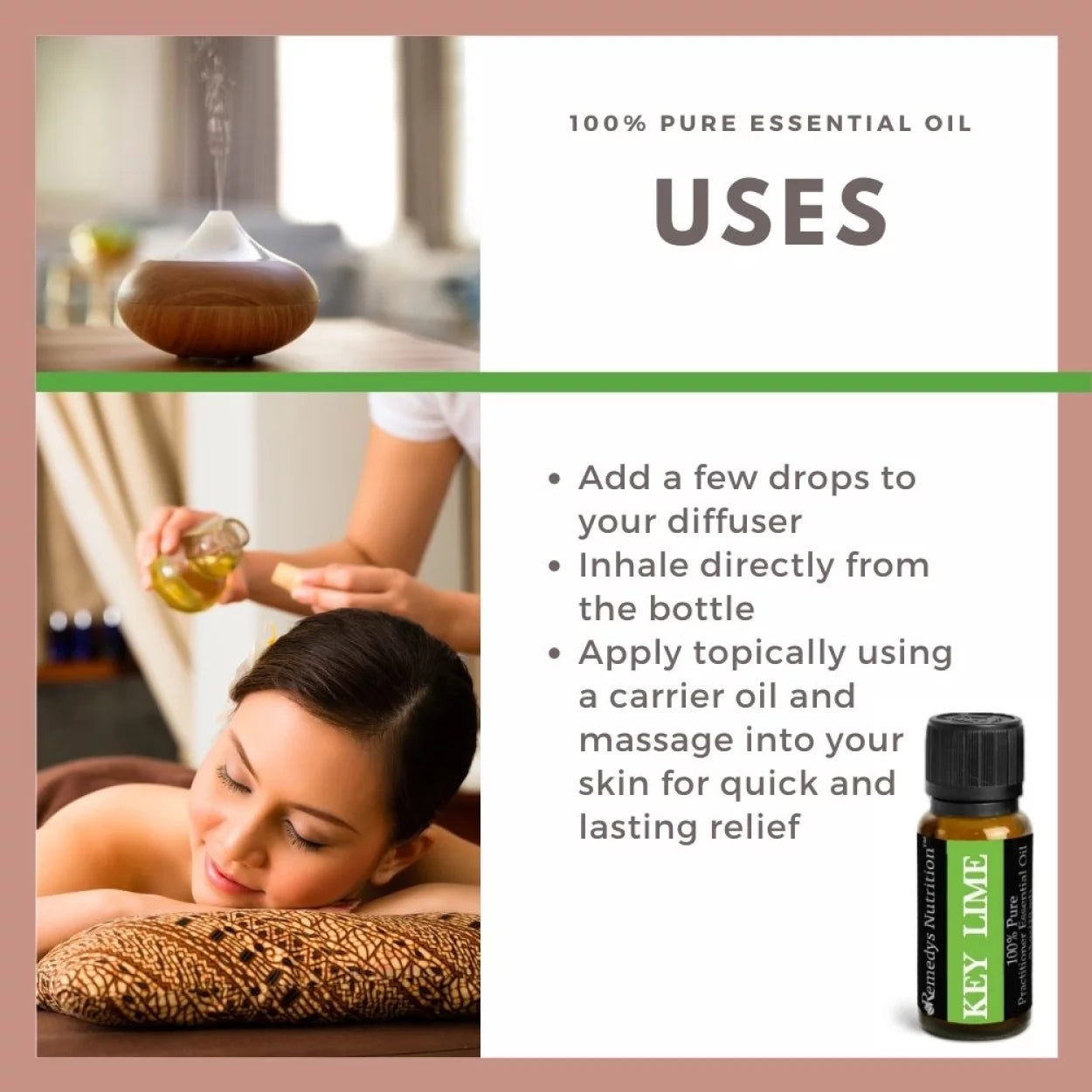
Use 2 to 3 drops per 100 mL of diffuser water. For larger rooms (over 200 sq ft), 4 to 5 drops covers the space for 60 to 90 minutes. Run for 30 to 60 minutes at a stretch with 30-minute breaks — continuous diffusion can desensitize olfactory receptors and reduce the mood and focus effect within 2 hours. The 10 mL bottle yields about 100 diffusion sessions at 2 drops each.
Does key lime oil pair well with peppermint? +
Yes — key lime plus peppermint is the classic mojito-style cosmetic blend. Standard recipe: 2 drops key lime plus 2 drops peppermint in 10 mL of jojoba or sweet almond carrier for a body roll-on. The combination is energizing, cooling, and aromatically distinctive. The peppermint adds 5 to 10 minutes of cooling sensation, while key lime delivers the bright citrus top note. Avoid sun exposure for 12 hours due to bergapten.
Is key lime oil good for cleaning bathrooms? +
Yes — key lime is one of the better citrus oils for bathroom cleaning thanks to its 10 to 20% beta-pinene content, which adds mild antifungal action against shower-grout mildew. The bathroom mildew recipe: 1 cup water, 1/2 cup white vinegar, 10 drops key lime, plus 5 drops tea tree. Spray grout and tile, dwell 5 minutes, scrub. Use weekly to prevent regrowth. The bright citral top note covers vinegar smell faster than lemon alone.
Can I use key lime oil during pregnancy? +
Diffusion is generally considered safe at 2 to 3 drops in a well-ventilated room. Topical use should be limited to 0.5% dilution (3 drops per 30 mL carrier) and applied only to non-sun-exposed skin due to the high bergapten content. Avoid in the first trimester out of caution. Many pregnancy aromatherapy guides recommend tangerine or sweet orange instead because they have negligible bergapten. Consult an OB or qualified aromatherapist before consistent use.
Is key lime oil safe for cats and dogs? +
Cats — never apply topically. Cats lack the liver glucuronidation enzyme that clears d-limonene and other monoterpenes, which can build up to toxic levels within 24 to 48 hours. Diffuse only in well-ventilated rooms with cat exit access. Dogs — topical use is risky and should be avoided; diffusion is generally safe at 2 to 3 drops with the dog free to leave the room. Birds are even more sensitive than cats — do not diffuse near birds.
How long does key lime oil last? +
Sealed and stored in amber glass in a cool dark cabinet, key lime oil keeps full potency for 12 to 18 months — slightly shorter than tangerine because the higher citral content oxidizes faster. After opening, expect 12 months of peak potency, with antimicrobial activity dropping up to 40% by 18 months in poor storage. Refrigeration extends shelf life by 3 to 6 months. Replace bottles when the bright top note flattens or smells turpentine-like.
Why is key lime more phototoxic than tangerine? +
Bergapten content. Cold-pressed key lime contains 3,000 to 5,000 ppm bergapten while tangerine contains only 0 to 5 ppm — a 1,000-fold difference. Bergapten is a furocoumarin that reacts with UVA light on the skin to produce phytophotodermatitis burns. Both oils have similar d-limonene levels, but the lime fruit naturally accumulates much more bergapten in its peel. Steam-distilled key lime has near-zero bergapten and is the standard for daytime skin care.
What makes Remedy's Key Lime Oil different? +
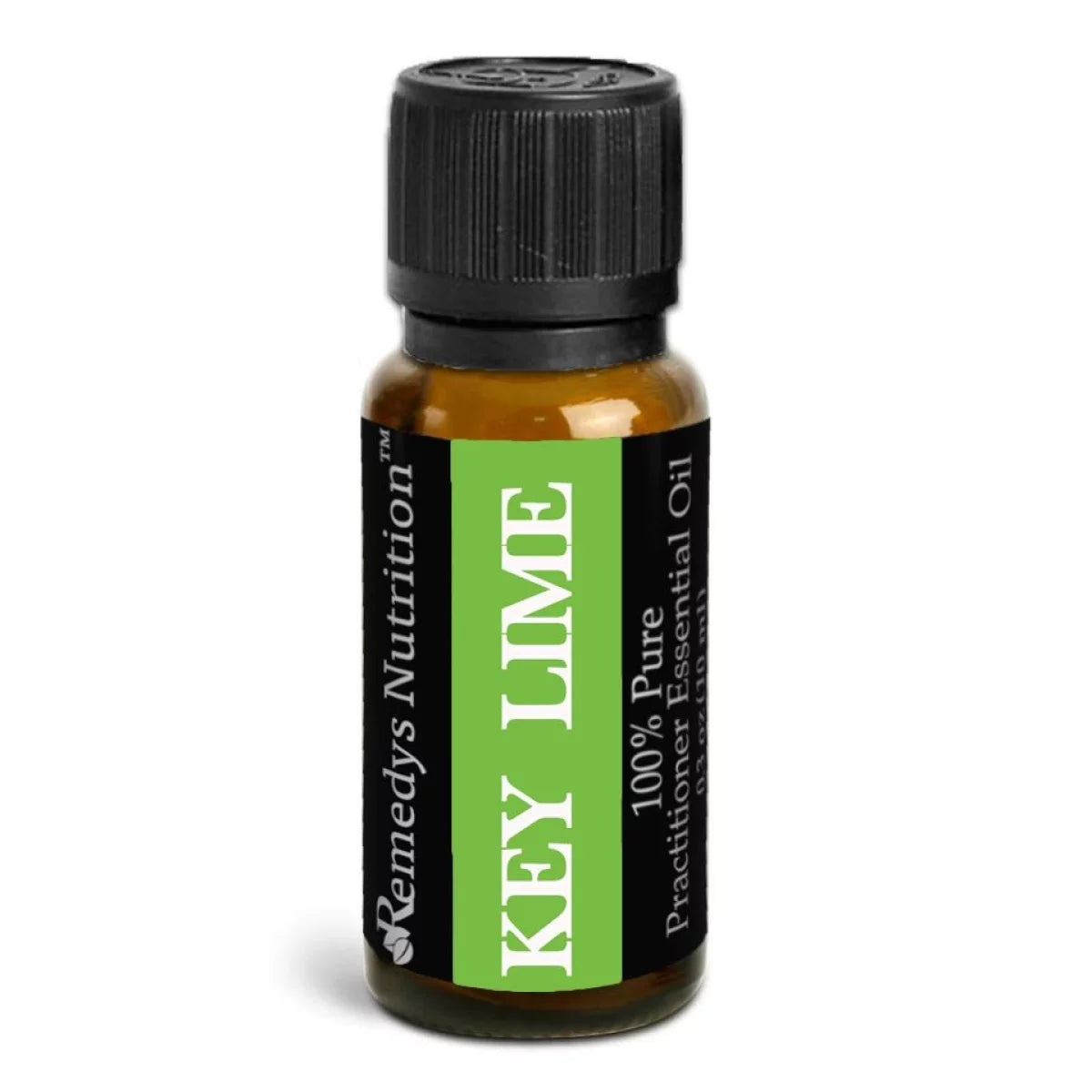
Remedy's key lime oil is 100% pure cold-pressed peel oil with no carrier dilution, no synthetic fragrance, and no fillers — full d-limonene strength at 50 to 60% with intact citral (the bright sharp top note). The 10 mL amber glass bottle includes a built-in orifice reducer for drop-by-drop dispensing (about 200 to 250 drops total). Manufactured in a USA cGMP facility and verified by GC/MS testing per batch for d-limonene and citral content.
Key Lime Oil: In-Depth Reading
Want more detail on safe use, blends, and pairings? Browse our essential oils knowledge hub: