
In a 2000 trial, 27 people rubbed fresh stinging nettle on a painful thumb for 1 week, the oldest nettle remedy for joints. Their pain fell more than with a stingless placebo.
A 2008 knee pilot found almost no difference, and the swallowed forms were mostly tested in blends. This page separates the 3 ways nettle is used for joints.
Quick Answer: Does Stinging Nettle Help Arthritis?
Possibly, on small evidence. In a 2000 crossover trial of 27 people with thumb osteoarthritis, 1 week of fresh nettle stings cut pain and disability more than a dead nettle placebo. A 2008 knee pilot found pain fell 1.7 points with nettle and 1.6 with placebo. Europe lists oral leaf for minor joint pain, up to 4 weeks.
Key Takeaways
- A 2000 trial of 27 people found stinging eased thumb pain.
- A 2008 knee pilot found 1.7 versus 1.6 points of pain relief.
- Oral nettle joint trials mostly used blends with 2 or more ingredients.
- Europe lists oral nettle leaf for minor joint pain for 4 weeks.
- The sting injects histamine, about 6.1 ng per hair, and lasts 12 hours.
Related Products
Three Ways Nettle Is Used for Joints
Nettle for arthritis means 3 different things, and the evidence for each is separate. The sting is applied to the skin over the joint, the leaf is swallowed as a capsule or tea, and some commercial joint blends add nettle to other ingredients.
- Sting (urtication): fresh leaf pressed on the skin over the joint.
- Swallowed leaf: capsule, extract or tea, taken daily.
- Blends: nettle plus fish oil, rosehip or devil's claw.
- Cream: 1 trial record, with no abstract to check.
Of 6 trial records on nettle and joints, 3 involve the sting or a cream, 2 test blends and 1 is laboratory work. The wider record is in what the 41 nettle trials tested.
The Sting Trials
The sting has the only single-ingredient trials. Patients pressed fresh nettle on the painful area once a day for 1 week, and the placebo in each case was a related plant that does not sting, which matters for how the results read.
| Study | Who | Placebo | Result |
|---|---|---|---|
| 1999 interviews | 18 self-selected nettle users | None | All but 1 felt it helped; only side effect a passing rash |
| 2000 thumb trial | 27 people, thumb or finger arthritis, crossover | White dead nettle | Less pain and disability than placebo after 1 week |
| 2008 knee pilot | 42 people aged 55 to 80 | A stingless nettle species | Pain down 1.7 vs 1.6 points |
In the thumb trial, both pain and disability scores fell significantly more after nettle.[1]Randomized controlled trial of nettle sting for treatment of base-of-thumb pain — Journal of the Royal Society of Medicine (2000) View source In the knee pilot, the 2 groups improved almost equally.[2]Nettle sting for chronic knee pain: a randomised controlled pilot study — Complementary Therapies in Medicine (2008) View source
A plant that stings is hard to disguise as one that does not, so blinding in these trials is weak. That is our reading, not the authors', and it is why the knee result matters.

How the Sting Works, and What It Costs
Each stinging hair is a tiny glass-like needle that breaks on contact and injects its contents. A 1991 study measured about 6.1 ng of histamine and 33 pg of serotonin per hair, and a stinging sensation lasting longer than 12 hours.
- Histamine: about 6.1 ng per hair.
- Lasting pain: oxalic and tartaric acid, in a related nettle species.
- Sensation: burning and itching for more than 12 hours.
- Theory: counter-irritation, a new sensation masking an old one.
The authors found mast cells increased in the skin 12 hours after contact.[3]Contact urticaria due to the common stinging nettle (Urtica dioica): histological, ultrastructural and pharmacological studies — Clinical and Experimental Dermatology (1991) View source A 2006 study traced the long-lasting pain to oxalic and tartaric acid.[4]Identification of oxalic acid and tartaric acid as major persistent pain-inducing toxins in the stinging hairs of the nettle — Annals of Botany (2006) View source
Swallowed Nettle and the Blends
Taking nettle by mouth for joints, as a capsule or as what a cup of nettle tea holds, is the traditional use Europe's regulator recognises. The human data are thin: 1 small cytokine study and 2 trials of blends.
- 1996: 20 healthy volunteers, leaf extract for 21 days; an inflammation marker fell 24%.
- 2009 blend: fish oil, vitamin E and nettle; painkiller use 6.5 vs 16.5 tablets a week.[6]Phytalgic, a food supplement, vs placebo in patients with osteoarthritis of the knee or hip: a randomised double-blind placebo-controlled clinical trial — Arthritis Research and Therapy (2009) View source
- 2017 blend: rosehip, nettle leaf and devil's claw in 92 people with knee arthritis.
- Nettle alone in arthritis patients: 0 oral trials found.
The 1996 study measured blood cells' response in a test tube, not joint pain.[5]Cytokine secretion in whole blood of healthy subjects following oral administration of Urtica dioica L. plant extract — Arzneimittel-Forschung (1996) View source
The 2017 blend improved knee pain scores 29.9 points against 10.2 for placebo.[7]A Rosa canina, Urtica dioica, Harpagophytum combination significantly reduces gonarthritis symptoms in a randomized, placebo-controlled double-blind study — Planta Medica (2017) View source In both blends, nettle's own share cannot be separated out.

Tea, Capsule or Sting?
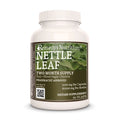
Each form fits a different person. The sting suits someone with 1 small, painful joint who tolerates a burning rash. A tea, or the 1000 mg leaf capsule we sell, suits someone who wants a daily traditional herb without touching the plant.
| Form | Evidence | Trade-off |
|---|---|---|
| Fresh sting | 2 small trials, 1 positive | A burning rash for 12 hours or more |
| Leaf tea | Traditional use only | Volume of 3 to 6 cups a day |
| Leaf capsule | Traditional use; no joint trial of capsules | A fixed amount, no taste |
| Blend | 2 positive trials | Nettle's share unknown |
Our capsule is whole dried leaf, not the extract used in the 1996 study, so it is a measured traditional amount rather than a copy of any trial.
When Joint Pain Needs More Than a Herb
Europe's monograph is explicit: if joint pain comes with swelling, redness or fever, see a doctor rather than self-treat. Those can signal gout, infection or inflammatory arthritis, which need diagnosis and treatment that nettle cannot replace.
- Hot, swollen joint: same-day medical advice.
- Fever with joint pain: urgent assessment.
- Morning stiffness over 30 minutes: ask about inflammatory arthritis.
- Painkillers: do not stop prescribed ones to try nettle.
The same monograph limits use to 4 weeks.[8]Community herbal monograph on nettle leaf (Urtica dioica, folium) — European Medicines Agency View source If you take blood thinners or blood pressure drugs, check the medicines nettle can interfere with first.
Speak to a Clinician Before Using Nettle for Joint Pain If
- You are pregnant, trying to conceive or breastfeeding
- You take warfarin or another blood thinner
- You take lithium, a diuretic (water pill) or blood pressure medicine
- You take insulin or another glucose-lowering medicine
- You have been told to limit fluids because of heart or kidney disease

Frequently Asked Questions
Do stinging nettles help arthritis? +
Possibly, for small joints. In a 2000 trial of 27 people, 1 week of stings eased thumb pain more than a stingless placebo; a 2008 knee pilot found 1.7 versus 1.6 points of relief.
What are some old-time remedies for arthritis? +
Nettle stinging is 1 of the oldest, along with warm compresses and herbal rubs. Of these, the nettle sting is one of the few with a small randomised trial behind it.
What is the strongest natural anti-inflammatory for arthritis? +
No natural product has a settled answer. Nettle's anti-inflammatory evidence in people is 1 small 1996 study of blood markers in 20 healthy volunteers, not arthritis patients.
What is the best supplement over the counter for arthritis? +
It depends on the joint and the diagnosis; ask a pharmacist. Nettle's best oral joint results come from 2 blends, so its own effect alone is unknown.
How do you use nettle sting for joint pain? +
Trial patients pressed fresh leaf onto the painful area once a day for 1 week. A 2011 user consensus agreed on a strong sting once a day; wear gloves when picking.
How long does a nettle sting last? +
The burning or itching can last more than 12 hours, according to a 1991 skin study. The rash usually fades within a day or 2.
How do you treat a nettle sting? +
Wash the skin with soap and water, avoid rubbing for 10 minutes, and use a cool compress. Seek help if swelling spreads or breathing is affected.
Can nettle replace my arthritis medicine? +
No. 0 trials tested nettle as a replacement, and Europe lists it only for minor joint pain. Discuss any change with your prescriber.
Is nettle tea good for arthritis? +
It is a traditional use, recognised by Europe's regulator at 2 to 4 g of leaf per cup, 3 to 6 times a day. No trial has tested nettle tea in arthritis.
Related Reading
Related Products