
Europe's medicines regulator lists only mild stomach upset and skin reactions as nettle leaf side effects, with 0 interactions reported. That is true for healthy adults, and it leaves out 5 groups of medicines.
Most nettle interaction warnings are theoretical, built from how the plant works rather than from cases. This page says which is which.
Quick Answer: What Are Stinging Nettle's Side Effects?
Nettle leaf is usually well tolerated: Europe's regulator lists mild nausea, diarrhoea and skin reactions. The cautions are interactions. Nettle increases urine, so it may add to diuretics, lithium and blood pressure drugs; a leaf extract lowered glucose in a 2013 trial; and it is a leafy green, which matters with warfarin.
Key Takeaways
- Europe's 2010 leaf monograph lists only mild stomach and skin reactions.
- 0 interactions are reported in the monograph, but 5 drug groups need care.
- Nettle increases urine, so 1 risk is higher lithium levels.
- A 2013 leaf extract trial lowered glucose in 92 insulin users.
- 2 case reports linked nettle to breast changes in 3 people.
Related Products
What the Regulator and the Trials Report
For a healthy adult, nettle leaf has a clean short-term record. Europe's monograph lists mild gastrointestinal complaints and skin reactions, with frequency not known, and no reported interactions or overdoses. The 2013 diabetes trial saw no change in liver or kidney tests.
- Stomach: nausea, vomiting or diarrhoea, usually mild.
- Skin: itching, rash or hives.
- Urination: more frequent, which is the traditional purpose.
- Missing: any trial longer than 12 months.
The monograph also advises against use under 12 years of age.[1]Community herbal monograph on nettle leaf (Urtica dioica, folium) — European Medicines Agency View source What nettle is and why people take it is in our stinging nettle overview.
The Interaction Table
Each caution below names its basis. Only 1 rests on a human trial; the others follow from nettle's diuretic action or its vitamin K as a leafy green, and none has been tested as a combination in people.
| Medicine | Why it matters | Basis |
|---|---|---|
| Warfarin and other vitamin K antagonists | Nettle is a leafy green; vitamin K changes warfarin's effect | Theoretical, by mechanism |
| Lithium | Diuretic-induced sodium loss can raise lithium levels | Theoretical, by mechanism |
| Diuretics (water pills) | Effects could add up | Theoretical; rat data |
| Blood pressure medicines | Nettle lowered pressure in rats and 1 small trial | Animal plus 1 small human trial |
| Insulin and diabetes drugs | Leaf extract lowered glucose | 1 human trial of 92 people |
Lithium's own label warns that diuretic-induced sodium loss may increase lithium levels.[2]Lithobid (lithium carbonate) prescribing information, Drug Interactions — DailyMed, US National Library of Medicine View source Nettle has never been tested with lithium, but it is taken to increase urine. Root and leaf differ too, so check which part of the plant you are taking.

Blood Thinners and Vitamin K
Warfarin works against vitamin K, so sudden changes in vitamin K intake can change its effect. Leafy greens are the main dietary source, and nettle is a leafy green. No study has measured how much vitamin K a nettle capsule or cup adds.
- What matters: consistency, not avoidance.
- Risky pattern: starting or stopping daily nettle without telling the clinic.
- Newer anticoagulants: no known vitamin K link, but still tell your prescriber.
- Before surgery: stop herbs 2 weeks ahead unless told otherwise.
Warfarin's own label asks for a consistent vitamin K intake and more frequent INR checks when starting or stopping botanicals.[3]Warfarin sodium prescribing information, Drug Interactions and Patient Counseling — DailyMed, US National Library of Medicine View source So a new daily nettle habit is something to agree with your clinic first.
Diuretics, Lithium and Blood Pressure
Nettle leaf is traditionally used to increase urine, and Europe's regulator accepts that use. That one action is why it sits beside water pills, lithium and blood pressure drugs on any sensible caution list.
- Rats: an infused extract raised urine output and lowered blood pressure.
- People: 1 small trial of 29 adults with mild hypertension, across 4 groups.
- Fluid limits: severe heart or kidney disease is a listed contraindication.
- What to do: tell your prescriber and watch for dizziness on standing.
In rats, the higher infused dose lowered pressure by 38% and looked toxic.[4]Acute diuretic, natriuretic and hypotensive effects of a continuous perfusion of aqueous extract of Urtica dioica in the rat — Journal of Ethnopharmacology (2000) View source The human trial gave 300 mL a day of extract to a small group.[5]Antihypertensive Indigenous Lebanese Plants: Ethnopharmacology and a Clinical Trial — Biomolecules (2019) View source

Blood Sugar Medicines
This is the interaction with human data behind it. Leaf extract lowered fasting glucose and HbA1c over 3 months in people already on insulin and oral drugs. On its own that is a possible benefit; added to medicine it is a possible low.
- Insulin and sulfonylureas: the combination carries the most risk.
- Signs of low sugar: shakiness, sweating, hunger, confusion.
- What to do: check readings more often for the first 2 weeks.
- Never: lower a diabetes dose yourself to make room for nettle.
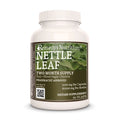
The trial dose was 500 mg of extract every 8 hours.[6]Improved glycemic control in patients with advanced type 2 diabetes mellitus taking Urtica dioica leaf extract: a randomized double-blind placebo-controlled clinical trial — Clinical Laboratory (2013) View source Our capsule, our single-ingredient nettle leaf, is 1,000 mg of whole leaf once a day, not an extract.
Hormones, Kidneys and the Liver
People also ask about breasts, kidneys and the liver. There are rare hormone-like case reports, a kidney caution from nephrologists, and no liver signal in the trials, which is not the same as long-term proof.
- Breast changes: 3 people in 2 case reports, nettle the only cause found.
- Kidneys: with kidney disease, ask your nephrologist first.
- Liver: no change in liver enzymes in the 3-month diabetes trial.
- Pregnancy: not recommended by Europe's regulator.
A 2014 study of 184 websites found nettle among 10 herbs sold for kidney disease without adequate human testing.[7]Internet claims on dietary and herbal supplements in advanced nephropathy: truth or myth — American Journal of Nephrology (2014) View source A 2021 case of galactorrhea cleared 1 week after stopping 500 mg of nettle.[8]Stinging Nettle (Urtica dioica): An Unusual Case of Galactorrhea — American Journal of Case Reports (2021) View source
How to Use It Safely
For a healthy adult who is not pregnant and takes none of the medicines above, nettle leaf has a reassuring short-term record. These habits cover almost all of the practical risk.
- One source: not a capsule plus a tea plus a blend.
- Count blends: some prostate formulas already contain nettle root.
- Set a limit: 4 weeks, then review, as Europe's monograph suggests.
- Pregnancy: read the pregnancy and breastfeeding question first.
- Stop: if a rash, swelling or breast change appears.
Stop or Speak to a Clinician First If
- You are pregnant, trying to conceive or breastfeeding
- You take warfarin or another blood thinner
- You take lithium, a diuretic (water pill) or blood pressure medicine
- You take insulin or another glucose-lowering medicine
- You have been told to limit fluids because of heart or kidney disease

Frequently Asked Questions
Who should not take stinging nettle? +
People who are pregnant or breastfeeding, anyone told to limit fluids for heart or kidney disease, children under 12, and anyone on warfarin, lithium, diuretics, blood pressure or diabetes medicine without their prescriber's agreement.
What not to mix with stinging nettle? +
Use care with 5 groups: warfarin, lithium, diuretics, blood pressure medicines and glucose-lowering drugs. Also avoid doubling up with blends that already contain nettle.
Is nettle hard on the kidneys? +
The 2013 diabetes trial saw no change in creatinine over 3 months. With kidney disease, nephrologists caution against herbs like nettle, so ask your specialist first.
Is nettle hard on the liver? +
No liver signal appeared in the trials; the 2013 trial saw no change in 2 liver enzymes over 3 months. Long-term data does not exist, so mention it if you have liver disease.
Can stinging nettle raise blood pressure? +
The data point the other way: nettle lowered blood pressure in rats and in 1 small human trial of 29 adults. That is why it needs care alongside blood pressure medicines.
What are the potential side effects of nettle leaf tea? +
Mild stomach upset, skin reactions and more frequent urination, per Europe's monograph. 2 case reports also linked nettle tea to breast changes, which is rare.
Does nettle interact with blood thinners? +
No study has tested it, but nettle is a leafy green and vitamin K changes warfarin's effect. Keep intake consistent and tell your clinic before your next INR test, usually within 1 to 2 weeks.
Can I take nettle with lithium? +
Not without your psychiatrist's agreement. Lithium's label warns that diuretic-induced sodium loss can raise lithium levels, and nettle is taken to increase urine. 0 studies tested the pair.
Can nettle lower blood sugar too far? +
It could add to diabetes drugs: in 1 trial, 500 mg of leaf extract every 8 hours lowered glucose in insulin users. Check readings more often for 2 weeks.
Should I stop nettle before surgery? +
Stopping herbs 2 weeks before a planned operation is a common precaution, especially those that affect blood pressure or blood sugar. Follow your surgical team's instructions.
Related Reading
- What Is Actually in Nettle Tea
- Nettle for Allergies: The Evidence
- What the Arthritis Trials Measured
Related Products