
Nettle leaf and nettle root come from 1 plant, but Europe's regulator gives them 2 separate monographs with 2 different uses. Of 10 nettle trials on prostate symptoms, 5 name the root and 0 the leaf.
Most labels and benefit lists blur the two, so a buyer can end up with the wrong part for the job. This page sets them side by side and shows which one each claim belongs to.
Quick Answer: Nettle Root vs Nettle Leaf, Which Is Better?
Neither is better overall; they do different jobs. Nettle root is the prostate supplement: Europe recognises it for urinary symptoms of an enlarged prostate, and every trial naming a part used root. Nettle leaf is the joint, allergy and tea supplement, recognised for minor joint pain and urinary flushing for up to 4 weeks.
Key Takeaways
- Europe publishes 2 separate nettle monographs, 1 for leaf and 1 for root.
- Of 10 nettle prostate trials, 5 name the root and 0 the leaf.
- The 2004 root trial gave 246 men 459 mg daily for 12 months.
- The 620-man trial found testosterone unchanged after 6 months on nettle.
- Leaf tea is traditionally 8 to 12 g daily, for 4 weeks.
Related Products
Same Plant, Different Chemistry
The leaf and the root of stinging nettle share a species and very little else. The leaf is a green, mineral-rich tissue full of flavonoids and phenolic acids. The root stores lignans, sterols and a lectin, and those are the compounds studied for the prostate.
- Leaf: flavonoids, phenolic acids, carotenoids, minerals.
- Root: lignans that bind a hormone carrier protein in lab tests.
- Root lectin: studied in the lab for immune effects.
- Both: sold as tea, capsule, tincture and extract.
A 2022 review assigns the root to prostate complaints and the leaves to arthritis, rheumatism and allergic rhinitis.[1]Nutritional and pharmacological importance of stinging nettle (Urtica dioica L.): A review — Heliyon (2022) View source Before the details, it helps to know how much nettle research involves people, because most of it does not.
Leaf and Root Side by Side
Europe's medicines regulator assessed each part on its own. Its 2 monographs differ on almost everything that matters to a buyer: the use, the amount, the length of use and who should not take it.
| Nettle leaf | Nettle root | |
|---|---|---|
| Latin name | Urticae folium | Urticae radix |
| Europe's traditional use | Minor joint pain; flushing the urinary tract | Urinary symptoms of an enlarged prostate |
| Typical traditional amount | 8 to 12 g of leaf a day as tea | About 450 to 480 mg of dry extract a day |
| Length of use | Up to 4 weeks for joint pain | Long-term use possible |
| Human trials naming the part | 2, nettle alone | 2 alone, plus 3 blends |
| Key compounds | Flavonoids, phenolic acids, minerals | Lignans, sterols, a lectin |
| Pregnancy | Not recommended | Not relevant (men) |
The leaf monograph lists minor joint pain and urinary flushing, for 2 to 4 weeks.[2]Community herbal monograph on nettle leaf (Urtica dioica, folium) — European Medicines Agency View source The root monograph, revised in 2025, lists prostate-related urinary symptoms after a doctor has excluded serious disease.[3]European Union herbal monograph on nettle root (Urtica dioica, radix), 2025 — European Medicines Agency View source

The Prostate Trials Used Root
Every nettle prostate trial that names a plant part used root, on its own or blended with saw palmetto or pygeum. The largest trial, of 620 men, does not name the part in its abstract, and that is worth knowing before anyone quotes it for a leaf product.
| Trial | Part and dose | Who and how long | Result |
|---|---|---|---|
| 2004, Germany | 459 mg root extract daily | 246 men, 12 months | Symptom score 18.7 to 13.0, vs 18.5 to 13.8 on placebo |
| 2005, Iran | Not named in the abstract | 620 men, 6 months | Symptom score 19.8 to 11.8, vs 19.2 to 17.7 on placebo |
| 2020, Iran | 450 mg root extract daily | 60 men, 12 weeks | Intermediate effect on symptom score; no side effects[5]Urtica Dioica Root Extract on Clinical and Biochemical Parameters in Patients with Benign Prostatic Hyperplasia, Randomized Controlled Trial — Pakistan Journal of Biological Sciences (2020) View source |
| 2005, PRO 160/120 | 120 mg root plus 160 mg saw palmetto, twice daily | 257 men, 24 weeks | Symptom score fell 6 points vs 4 on placebo |
| Any trial of the leaf | — | — | 0 prostate trials found |
In the 2004 German trial, symptom scores improved significantly more than placebo, but urine flow did not.[4]Stinging nettle root extract (Bazoton-uno) in long term treatment of benign prostatic syndrome (BPS): results of a randomized, double-blind, placebo controlled multicenter study after 12 months — Der Urologe (2004) View source
The 620-man trial also found prostate size fell from 40.1 to 36.3 cc.[6]Urtica dioica for treatment of benign prostatic hyperplasia: a prospective, randomized, double-blind, placebo-controlled, crossover study — Journal of Herbal Pharmacotherapy (2005) View source Its authors still asked for confirmation before calling nettle effective.
Root in Blends With Saw Palmetto
Much of the root's best evidence comes from 1 fixed blend, PRO 160/120, which pairs 160 mg of saw palmetto with 120 mg of nettle root per capsule. It has been compared with placebo and with 2 prescription drugs, finasteride and tamsulosin.
- Versus placebo: 257 men, 24 weeks, symptom score 6 points better vs 4.
- Versus finasteride: flow rose 1.9 vs 2.4 mL/s, not significantly different.
- Nighttime trips: fell by 0.8 vs 0.6 on placebo in pooled data.
- Nettle's own share: cannot be separated from the saw palmetto.
The placebo trial ran 24 weeks double-blind, then open for another 24.[7]Long-term efficacy and safety of a combination of sabal and urtica extract for lower urinary tract symptoms: a placebo-controlled, double-blind, multicenter trial — World Journal of Urology (2005) View source The finasteride comparison found fewer adverse events with the blend.[8]Combined sabal and urtica extract compared with finasteride in men with benign prostatic hyperplasia — BJU International (2000) View source
For choosing among prostate herbs, our guide shows how nettle root fits with saw palmetto and pygeum, and it covers the symptoms that need a doctor first.
Testosterone, Estrogen and Hair
Nettle root is marketed for testosterone because its lignans bind sex hormone-binding globulin in lab tests. The 1 large human trial that measured testosterone found no change, which is the most useful fact on this topic and the one most pages leave out.
- Lab finding: root lignans bind the hormone carrier SHBG.
- Lab finding: root compounds weakly inhibit aromatase.
- Human finding: testosterone unchanged in 620 men over 6 months.
- Hair: 0 human trials; 1 cell study of leaf extract.
The SHBG binding was shown in a test tube.[9]Lignans from the roots of Urtica dioica and their metabolites bind to human sex hormone binding globulin (SHBG) — Planta Medica (1997) View source The aromatase activity was weak to moderate, also in vitro.[10]Aromatase inhibitors from Urtica dioica roots — Planta Medica (1995) View source
For hair, a 2023 study found leaf extract lowered a hair-loss enzyme gene in skin cells.[11]Urtica dioica extract downregulates the gene expression of 5-alpha-reductase II in HaCaT cells — Georgian Medical News (2023) View source That is a cell result, not regrowth in people.

Allergies and Joints Belong to the Leaf
The uses that drive most nettle searches today, allergies, joints and tea, are leaf uses. The evidence for each is small, and in allergies it is not even clear which part was used, because the key abstract does not say.
- Allergies, 1990: freeze-dried nettle, part not named, 1 week.
- Allergies, 2017: root extract; placebo improved symptoms as much.
- Joints: fresh leaf stings, 1 positive trial and 1 neutral pilot.
- Blood sugar: leaf extract, 92 people, 3 months.
The 1990 trial and the 2017 trial between them decide whether nettle helps hay fever, and both are small.[12]Randomized, double-blind study of freeze-dried Urtica dioica in the treatment of allergic rhinitis — Planta Medica (1990) View source
The joint evidence rests on fresh leaf stings, applied to the skin rather than swallowed.[13]Randomized controlled trial of nettle sting for treatment of base-of-thumb pain — Journal of the Royal Society of Medicine (2000) View source
How to Read a Nettle Label
Because the 2 parts do different jobs, the label is where most buying mistakes happen. A product that says only nettle, or stinging nettle, without naming a part, leaves you unable to match it to any of the evidence above.
- Part: look for leaf, root, aerial parts or herb named in Supplement Facts.
- Form: whole dried plant, or an extract with a ratio such as 5:1.
- Amount: in mg per capsule and per daily serving.
- Other herbs: prostate blends often add saw palmetto or pygeum.
An extract ratio tells you how concentrated it is, but not which compounds were kept, so a 5:1 root extract and whole leaf cannot be compared by weight.
Which One Fits Your Goal
Put simply, choose by the job you want done, not by the word nettle on the bottle. This table matches each common goal to the part with the evidence, and to what we sell.
| Your goal | The part with the evidence | What to look for |
|---|---|---|
| Urinary symptoms of an enlarged prostate | Root, often with saw palmetto | A root product, after a doctor's check |
| Minor joint pain | Leaf, as tea or sting | Leaf, for up to 4 weeks |
| Seasonal allergies | Unclear: small leaf and root trials | Leaf, with modest expectations |
| A traditional green tea | Leaf | Dried leaf, named Urtica dioica |
| Testosterone | Neither, in people | No nettle product |
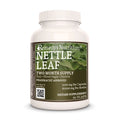
For the leaf goals, leaf-only nettle capsules give 1,000 mg of dried leaf each, with no root. For prostate symptoms, the root belongs in a separate, root-based product.
Speak to a Clinician Before Taking Nettle Root or Leaf If
- You are pregnant, trying to conceive or breastfeeding
- You take warfarin or another blood thinner
- You take lithium, a diuretic (water pill) or blood pressure medicine
- You take insulin or another glucose-lowering medicine
- You have been told to limit fluids because of heart or kidney disease
- You have urinary symptoms that have not been checked by a doctor

Frequently Asked Questions
Which is better, nettle leaf or nettle root? +
Neither overall. The root has the prostate trials and Europe's prostate listing; the leaf has the joint, allergy and tea uses. Of 10 prostate trials, 0 name the leaf.
Can you take nettle root every day? +
Europe's 2025 root monograph says long-term use is possible for prostate-related urinary symptoms, once a doctor has excluded serious conditions. Single-herb trials ran up to 12 months.
Does nettle root increase testosterone? +
Not in people, on current evidence. The 620-man trial measured testosterone and found it unchanged after 6 months; the hormone claims come from lab tests.
What are the side effects of nettle root? +
Europe's monograph lists stomach effects such as nausea, heartburn, fullness, wind and diarrhoea, and allergic skin reactions. The 2004 trial reported fewer events than placebo, 29 vs 38.
Does nettle root block estrogen? +
In a 1995 lab study, root compounds weakly to moderately inhibited aromatase, the enzyme that makes estrogen. 0 human studies show nettle root lowers estrogen.
Can stinging nettle cause erectile dysfunction? +
No trial we read reported it. The 2004 root trial of 246 men recorded fewer adverse events than placebo, and testosterone was unchanged in the 620-man trial.
What is the best herbal to shrink prostate? +
No herb reliably shrinks the prostate. In 1 trial, nettle cut average size from 40.1 to 36.3 cc over 6 months; a doctor should assess any urinary symptoms first.
Is stinging nettle root bad for kidneys? +
No kidney harm appears in the root trials. Europe advises seeing a doctor at once if fever, blood in the urine, pain or urinary retention appear, which 1 herb cannot treat.
Does nettle help hair growth? +
There are 0 human trials. A 2023 cell study found leaf extract lowered a hair-loss enzyme gene, which is a reason to study it, not evidence of regrowth.
Is stinging nettle tea good for the prostate? +
Leaf tea has no prostate trials. Europe's traditional root tea is 2 g of root in 150 mL of water, 2 to 3 times a day, which is a different product.
Related Reading
- Nettle Tea, Cup by Cup
- Nettle Stings for Arthritis, Tested
- Nettle Safety, Leaf and Root
- Nettle for Women: Pregnancy to Postpartum
Related Products