
PubMed lists 1,455 records on stinging nettle, yet only 11 of its 41 tagged trials gave people nettle alone to swallow. Just 2 of those 11 abstracts name the leaf, the part in our capsule.
That gap between leaf and root explains most of what you will read about nettle, so this page sorts every benefit by the part of the plant that was actually tested.
Quick Answer: What Is Stinging Nettle Good For?
Stinging nettle (Urtica dioica) is a wild plant whose leaf and root are sold as different supplements. The root has the prostate trials. The leaf has smaller evidence: 1 allergy trial lasting 1 week, a 2013 blood sugar trial of 92 people, and sting trials for joint pain. Of 41 tagged trials, 11 gave nettle alone by mouth.
Key Takeaways
- Stinging nettle leaf and root are 2 different supplements with different evidence.
- PubMed lists 41 nettle trials, and 11 tested nettle alone by mouth.
- 10 trials studied prostate symptoms; 5 name the root and 0 the leaf.
- The only leaf-type allergy trial lasted 1 week in 69 finishers.
- A 2013 leaf extract trial in 92 people lowered fasting glucose.
Related Products
One Plant, Two Different Supplements
Stinging nettle is Urtica dioica, a wild perennial covered in fine stinging hairs. Its leaf and its root are harvested, dried and sold separately, and they are studied for different things. A label that says only nettle does not tell you which evidence applies to it.
- Leaf (folium): used for joint pain, allergies, as a tea and as a food.
- Root (radix): used for urinary symptoms of an enlarged prostate.
- Seed: sold in small amounts, with very little human data.
- Not the same plant: purple dead nettle and horse nettle are other species.
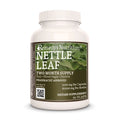
- Our capsule: 1,000 mg of dried leaf, no root.
A 2022 review puts the split plainly: the root is used for urinary complaints of benign prostatic hyperplasia, the leaves for arthritis, rheumatism and allergic rhinitis.[1]Nutritional and pharmacological importance of stinging nettle (Urtica dioica L.): A review — Heliyon (2022) View source That split decides why the root and the leaf are different products, and it runs through every section below.
The Size of the Evidence
Nettle has a long research record, but most of it sits in laboratories and animals. About 1 in 3 records is tagged as human, and the trials that do are spread thinly across prostate, allergy, joint and blood sugar questions.
| What PubMed holds on stinging nettle | Count |
|---|---|
| Records on stinging nettle (sea, dead and horse nettle excluded) | 1,455 |
| Records tagged as human | 480 |
| Records on animals only | 329 |
| Records tagged as clinical trials | 41 |
| Of those, nettle alone swallowed by people | 11 |
| Of those 11, abstracts that name the leaf | 2 |
| Of those 11, abstracts that name the root | 2 |
| Prostate-symptom trials that name the leaf | 0 |
We searched for Urtica dioica, Urtica urens, stinging nettle or nettle, and excluded sea nettle (a jellyfish), dead nettle and horse nettle. A few blend trials that write only urtica fall outside the count. Anyone can rerun these searches.

What the 41 Trial Records Actually Are
We read every record PubMed tags as a clinical trial on nettle. Most are not what a supplement buyer would picture, and this breakdown is the part no competing page prints.
| What was tested | Records |
|---|---|
| Nettle alone, swallowed by people | 11 |
| Multi-herb formulas that include nettle (7 for prostate) | 13 |
| Applied to the skin: sting, cream, gel, spray, mouthrinse | 9 |
| Homeopathy, another species, or not a nettle treatment (hens, lab work, a study named NETTLE) | 8 |
The 11 swallowed-nettle trials name the leaf twice and the root twice. The other 7 abstracts do not say which part was used, including the largest prostate trial of 620 men.[2]Urtica dioica for treatment of benign prostatic hyperplasia: a prospective, randomized, double-blind, placebo-controlled, crossover study — Journal of Herbal Pharmacotherapy (2005) View source Ours, a 1000 mg nettle leaf capsule, is whole dried leaf, a form none of the 11 abstracts describes.
Which Part Did Each Benefit Come From?
This is the table to keep in mind whenever you read a nettle benefits list. Each common claim is matched to the part of the plant behind it and the size of the human evidence.
| Use | Part in the trials | Best human evidence |
|---|---|---|
| Prostate symptoms (BPH) | Root extract | Several trials, mostly root or root combinations |
| Seasonal allergies | Freeze-dried nettle; a 2017 trial used root | 1 trial of 1 week, 1 trial where placebo matched it |
| Joint pain | Fresh leaf applied to the skin | 1 thumb trial of 27 people, 1 knee pilot |
| Blood sugar | Leaf extract | 1 trial of 92 people, 2 meta-analyses |
| Our capsule | Whole dried leaf, 1,000 mg | No trial used this exact form |
For prostate symptoms, the strongest single-herb trial gave 246 men 459 mg of root extract daily for 12 months.[3]Stinging nettle root extract (Bazoton-uno) in long term treatment of benign prostatic syndrome (BPS): results of a randomized, double-blind, placebo controlled multicenter study after 12 months — Der Urologe (2004) View source
A 2000 review of 44 studies still found no convincing evidence for nettle alone in prostate enlargement.[4]Phytotherapy for benign prostatic hyperplasia (systematic review of 44 studies) — Public Health Nutrition (2000) View source That is why our leaf capsule is sold as a leaf product, not a prostate one.

Allergies, Joints and the Tea
Searches for nettle tea for allergies rose 183% in the past 12 months, by our live keyword data. The evidence did not grow with them: the single allergy trial of freeze-dried nettle dates from 1990 and ran for 1 week.
- Allergy, 1990: 98 people enrolled, 69 finished, rated slightly better than placebo.
- Allergy, 2017: root extract for 1 month; placebo improved symptoms as much.
- Thumb pain, 2000: 27 people rubbed fresh leaf on the joint for 1 week.
- Tea: 0 trials tested nettle tea alone for allergies or joints.
In the 1990 trial, diary scores favoured nettle only slightly.[5]Randomized, double-blind study of freeze-dried Urtica dioica in the treatment of allergic rhinitis — Planta Medica (1990) View source The thumb trial found less pain than a dead nettle placebo.[6]Randomized controlled trial of nettle sting for treatment of base-of-thumb pain — Journal of the Royal Society of Medicine (2000) View source
Blood Sugar: The Leaf's Best Trial
The most solid human result for the leaf is about glucose, not allergies. In 2013, 92 people with type 2 diabetes on insulin took leaf extract or placebo alongside their usual drugs, and the extract group's fasting glucose, after-meal glucose and HbA1c fell.
- Dose: 500 mg of leaf extract every 8 hours, for 3 months.
- 2020 meta-analysis: 8 trials, 401 people, fasting glucose down 18 mg/dl.[8]The effect of nettle (Urtica dioica) supplementation on the glycemic control of patients with type 2 diabetes mellitus: A systematic review and meta-analysis — Phytotherapy Research (2020) View source
- Same analysis: HbA1c change was not significant.
- 2022 meta-analysis: 13 trials, HbA1c down 0.93 points.[9]Effects of Urtica dioica on Metabolic Profiles in Type 2 Diabetes: A Systematic Review and Meta-analysis of Clinical Trials — Mini Reviews in Medicinal Chemistry (2022) View source
The trial reported no effect on liver enzymes, creatinine or blood pressure.[7]Improved glycemic control in patients with advanced type 2 diabetes mellitus taking Urtica dioica leaf extract: a randomized double-blind placebo-controlled clinical trial — Clinical Laboratory (2013) View source The 2 reviews disagree on HbA1c, so anyone on glucose-lowering medicine should agree any nettle with their prescriber.
Who Might Reasonably Try the Leaf
Nettle leaf is a traditional herb and a food, with modest human data and a short list of real cautions. That makes it reasonable for some people and plainly wrong for others, and the difference is mostly about medicines and pregnancy.
- Reasonable: a healthy adult curious about seasonal comfort or joints, for 4 weeks.
- Reasonable: someone who likes how a cup of nettle tea compares but wants a measured amount.
- Wrong part: a man shopping for prostate support, who wants the root.
- Not without advice: anyone on blood thinners, lithium or diabetes drugs.
On those terms, a leaf capsule is a measured amount of a traditional herb, sold without a disease claim attached. Europe's medicines regulator lists nettle leaf for minor joint pain and urinary flushing, for up to 4 weeks.[10]Community herbal monograph on nettle leaf (Urtica dioica, folium) — European Medicines Agency View source
Speak to a Clinician Before Taking Stinging Nettle If
- You are pregnant, trying to conceive or breastfeeding
- You take warfarin or another blood thinner
- You take lithium, a diuretic (water pill) or blood pressure medicine
- You take insulin or another glucose-lowering medicine
- You have been told to limit fluids because of heart or kidney disease

Frequently Asked Questions
What are the uses of stinging nettles? +
Traditionally the leaf is used for joint pain, seasonal allergies and as a tea or food, and the root for urinary symptoms of an enlarged prostate. Human trials exist for each, but most are small; only 11 of 41 tagged trials gave nettle alone by mouth.
What does stinging nettle do for men? +
For men the main use is the root, for urinary symptoms of an enlarged prostate. A 2004 trial gave 246 men 459 mg of root extract daily for 12 months. The leaf has no prostate trial.
Is stinging nettle good for the prostate? +
The root has the evidence, not the leaf. Root trials found modest symptom-score gains, while a 2000 review of 44 studies found no convincing evidence for nettle alone.
What is the best way to consume stinging nettle? +
It depends on the goal: cooked young leaves or tea as food, a leaf capsule for a fixed 1,000 mg, or root extract for prostate symptoms. Do not eat the leaves raw; drying or cooking removes the sting.
What are stinging nettle capsules good for? +
A leaf capsule gives a fixed amount, 1,000 mg in ours, without brewing. No trial used a whole-leaf capsule, so it is a measured traditional amount, not a copy of a trial dose.
Can I take stinging nettle every day? +
Europe's regulator lists leaf products for up to 4 weeks at a time for joint pain. Short daily use is generally tolerated; check first if you take any of 5 drug types listed on this page.
Are stinging nettle and purple dead nettle the same thing? +
No. Purple dead nettle is Lamium purpureum, a mint relative with no stinging hairs. Stinging nettle is Urtica dioica, and 1 nettle trial even used dead nettle as its placebo.
Does stinging nettle lower blood sugar? +
In 1 trial of 92 people with type 2 diabetes, 500 mg of leaf extract every 8 hours lowered fasting glucose and HbA1c over 3 months. It is a reason for caution with diabetes drugs.
How strong is the evidence for stinging nettle? +
Modest. PubMed lists 1,455 records but 41 tagged trials, and only 11 tested nettle alone by mouth. Most are small, and 7 of those 11 abstracts do not name the plant part.
Is stinging nettle leaf the same as nettle root? +
No. They are 2 parts of 1 plant with different chemistry and different trials. The root is the prostate supplement; the leaf is the allergy, joint and tea supplement.
Related Reading
- Stinging Nettle Side Effects and Interactions
- Stinging Nettle for Joint Pain
- Nettle Tea in Pregnancy and Breastfeeding
Related Products