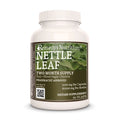

Nettle tea draws about 27,100 US searches a month, yet we found 0 trials of nettle tea on its own. The 1 tea trial in PubMed tested a multi-herb blend.
That makes nettle tea a pleasant, caffeine-free green drink with a traditional record rather than a tested remedy, and this page treats it that way.
Quick Answer: What Are the Benefits of Nettle Tea?
Nettle tea is an infusion of dried stinging nettle leaves: caffeine-free, grassy and spinach-like. No trial has tested it on its own. Europe's medicines regulator recognises nettle leaf tea, 2 to 4 g per cup, as a traditional remedy for minor joint pain and for increasing urine flow, for up to 4 weeks.
Key Takeaways
- Nettle tea is brewed from dried leaf and contains 0 caffeine.
- We found 0 trials of nettle tea on its own in people.
- Europe's traditional dose is 2 to 4 g of leaf per cup.
- That traditional use is limited to 4 weeks for joint pain.
- A 1980 case traced poisoning to nettle tea contaminated with belladonna.
Related Products
What Is in the Cup
Nettle tea is dried stinging nettle leaf steeped in hot water. The drying and heat disable the sting, so the tea is safe to drink. It has no caffeine and tastes grassy and mild, closer to spinach or green beans than to black or green tea.
- The plant: Urtica dioica leaf, sometimes with stems.
- Caffeine: none in pure nettle, some in blends with green or black tea.
- Taste: grassy, earthy, a little like cooked greens.
- Root tea: a different product, brewed for prostate symptoms.
The leaves carry flavonoids, phenolic acids, carotenoids and minerals, according to a 2022 review of nettle as a food.[1]Stinging Nettle (Urtica dioica L.): Nutritional Composition, Bioactive Compounds, and Food Functional Properties — Molecules (2022) View source For the plant itself and its trials, start with what stinging nettle actually is.
How to Make It
Nettle tea needs no special equipment. The amount Europe's medicines regulator lists for a traditional nettle leaf tea is 2 to 4 g of dried leaf per cup, which is roughly 1 to 2 heaped teaspoons.
- Put 2 to 4 g of dried nettle leaf in a cup or infuser.
- Pour over about 150 to 250 mL of water just off the boil.
- Cover and steep for 5 to 10 minutes.
- Strain, then add lemon or honey if you like.
Fresh leaves work too, picked young and handled with gloves; hot water removes the sting.

What the Evidence Covers
Most nettle tea benefit lists borrow results from trials that used capsules, extracts or the root. Sorting them by what was actually tested shows how little was done with the cup itself.
| Claim | What was actually tested | Tea tested? |
|---|---|---|
| Joint pain | Fresh leaf rubbed on the skin; leaf extract capsules | No |
| Allergies | Freeze-dried nettle for 1 week, in 1990 | No |
| Blood sugar | Leaf extract capsules, 500 mg every 8 hours | No |
| Breast milk | A multi-herb tea blend containing nettle | Only as a blend |
| Urine flow | Traditional use, recognised by Europe's regulator | Traditional only |
Europe's regulator accepts nettle leaf tea on long-standing use for minor joint pain and for flushing the urinary tract, with 8 to 12 g of leaf a day.[2]Community herbal monograph on nettle leaf (Urtica dioica, folium) — European Medicines Agency View source That is a traditional listing, not proof from a trial. For a fixed amount without brewing, our nettle leaf capsules hold 1,000 mg of dried leaf each.
Women, Hair and Iron
Searches for nettle tea benefits for women have risen about 20-fold since early 2024, and the claims behind them are hormones, hair and iron. Here is where each one stands, claim by claim, before any cup is poured.
- Hormones: 1 trial gave 450 mg a day for hot flashes; it was not tea.[3]Urtica dioica in comparison with placebo and acupuncture: A new possibility for menopausal hot flashes: A randomized clinical trial — Complementary Therapies in Medicine (2019) View source
- Hair: 0 human trials of nettle tea for hair growth.
- Iron: nettle is a green leaf, but a cup is not an iron supplement.
- Hormone side effects: 2 case reports linked nettle tea to breast changes.
In a 2007 report, a man developed breast enlargement and a woman milk discharge, with nettle tea the only cause found.[4]Gynaecomastia in a man and hyperoestrogenism in a woman due to ingestion of nettle (Urtica dioica) — New Zealand Medical Journal (2007) View source These are 2 cases, not a rate. Pregnancy is its own topic: whether nettle tea is safe in pregnancy.

Buying and Storing Loose Nettle
The one serious nettle tea poisoning on record was not caused by nettle. In 1980, a woman developed atropine poisoning, and the tea she drank was contaminated with belladonna, a toxic plant mixed into the batch.
- Buy: from a supplier that names Urtica dioica and the country of origin.
- Foraging: only if you can tell nettle from look-alikes with certainty.
- Store: airtight, dry and out of light; replace leaf that smells musty.
- Discard: any batch with stray berries, seeds or unfamiliar leaves.
The authors called for checks on the purity of tea herbs.[5]Atropine poisoning from 'health tea' (stinging nettle tea contaminated with belladonna) — Fortschritte der Medizin (1980) View source A sealed, labelled product removes that particular risk, whichever form you choose.
Who Should Skip the Daily Cup
Tea feels gentler than a capsule, and it may be, but it is the same leaf with the same cautions. The regulator's own warning concerns people told to drink less fluid, because nettle is taken to increase urine.
- Fluid restriction: severe heart or kidney disease.
- Medicines: blood thinners, lithium, diuretics, blood pressure or diabetes drugs.
- Pregnancy and breastfeeding: not recommended without your midwife or doctor.
- Children under 12: not established, per the same monograph.
If one of those applies, read what not to mix with nettle tea before the first cup.
Speak to a Clinician Before Drinking Nettle Tea Daily If
- You are pregnant, trying to conceive or breastfeeding
- You take warfarin or another blood thinner
- You take lithium, a diuretic (water pill) or blood pressure medicine
- You take insulin or another glucose-lowering medicine
- You have been told to limit fluids because of heart or kidney disease

Frequently Asked Questions
What happens if I drink nettle tea daily? +
Most people notice nothing beyond more frequent urination, because nettle leaf is taken to increase urine. Europe's regulator lists leaf tea for up to 4 weeks at a time, and no trial has followed daily tea drinkers for longer.
Is it better to drink nettle tea in the morning or at night? +
Either works, since it has 0 caffeine. Because it can increase urination, many people prefer it before mid-afternoon so it does not wake them at night.
How fast does nettle tea work? +
No trial has timed it. The traditional use for minor joint pain is judged over up to 4 weeks; a cup is not a fast-acting remedy.
Can nettle tea make you sleepy? +
Nettle has no known sedative effect and 0 caffeine. If you feel sleepy, it is more likely the warm drink or the hour than the leaf.
Does nettle tea have iron? +
Nettle leaf contains minerals including iron, but a cup made from 2 to 4 g of leaf is not a reliable iron source. Iron deficiency needs testing and a measured supplement.
What organ is nettle tea good for? +
Its traditional listing in Europe concerns the urinary tract, flushing it as an adjunct in minor complaints, and minor joint pain. No trial shows it targets 1 organ.
Are milk thistle and stinging nettle the same? +
No. Milk thistle is Silybum marianum, a liver herb from a different family. Stinging nettle is Urtica dioica. They appear together in 1 diabetes trial blend.
Does nettle tea have caffeine? +
Pure nettle tea has 0 caffeine. Blends that add green or black tea do contain it, so read the ingredient list.
What does nettle tea taste like? +
Grassy and mild, a little like spinach or cooked greens. Steeping longer than 10 minutes makes it stronger and more earthy.
How much stinging nettle per day? +
For tea, Europe's traditional listing is 2 to 4 g of leaf per cup, 8 to 12 g a day in total. For a capsule, follow the label; ours is 1 capsule of 1,000 mg daily.
Related Reading
- Nettle Tea for Allergies, Checked
- Nettle for Arthritis: Sting or Swallow?
- Nettle Root vs Nettle Leaf
Related Products