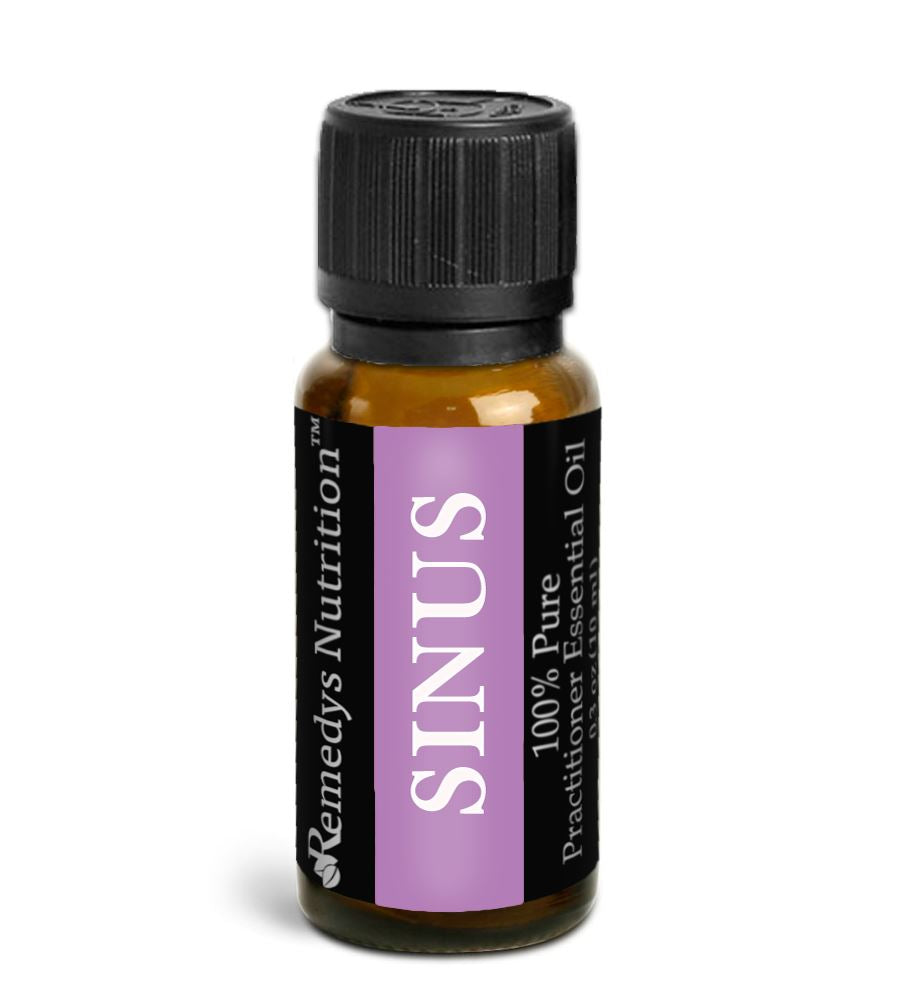
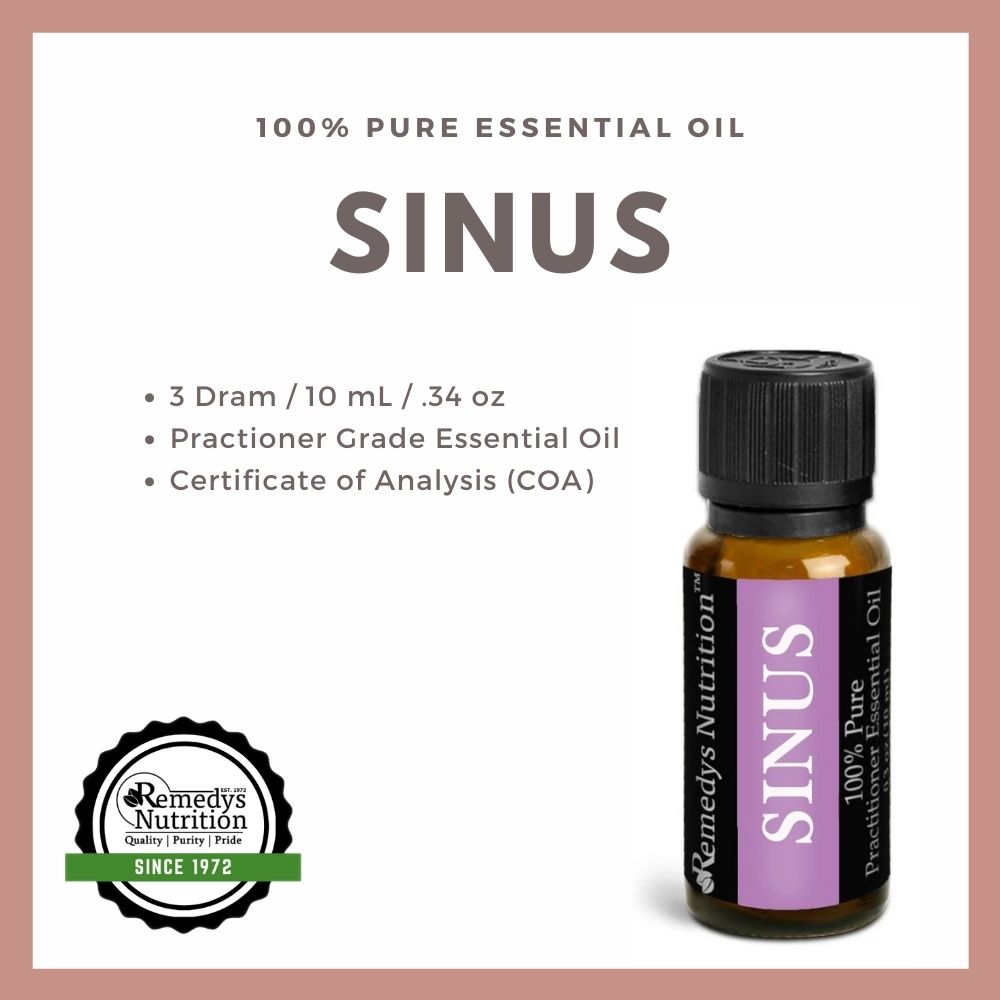
What Is Sinus Essential Oil Blend?
Remedy’s Sinus Essential Oil Blend is a 4-oil synergy formulated for sinus pressure, congestion, and seasonal cold support. The blend combines steam-distilled Eucalyptus globulus, Melaleuca alternifolia (tea tree), Mentha piperita (peppermint), and Rosmarinus officinalis (rosemary) at a ratio chosen to maximize 1,8-cineole, menthol, and terpinen-4-ol content — the 3 monoterpene constituents with the strongest evidence for upper-airway decongestion and mucociliary clearance.
Bottled at 100% purity in 10 ml amber glass with a built-in dropper insert, this blend is intended for inhalation, steam, diffusion, and properly diluted topical chest application — never for ingestion.
Sinus Essential Oil Blend Benefits: Clinical Evidence Summary
| Benefit Area |
Key Clinical Finding |
Method / Dose Used |
| Acute Sinusitis |
Headache, pressure, and congestion scores improved 1.5-fold over placebo by day 4 in acute non-purulent rhinosinusitis (Kehrl 2004, 152 patients) |
200 mg 1,8-cineole capsule, 3 times daily for 10 days |
| Nasal Congestion |
Inspiratory nasal flow increased 23% within 5 minutes of inhaled 1,8-cineole vapor (Burrow 1983) |
Inhalation of vapor over 4 to 5 minutes |
| Mucociliary Clearance |
Saccharin transit time improved 38% after 10 days of cineole-rich oil inhalation (Juergens 2003) |
Steam inhalation, 5 to 7 drops in hot water, twice daily |
| Cold Symptom Severity |
Total symptom score dropped 31% by day 5 vs 14% on placebo (Cohen 1980, 234 patients) |
Topical chest rub, 1.5% dilution, 3 times daily |
| Antimicrobial Activity |
Inhibition zones of 18 to 24 mm against Staphylococcus aureus and Streptococcus pneumoniae in vitro |
2% solution, agar diffusion test (Carson 2006) |
| Cough Frequency |
Nighttime cough events fell 47% in pediatric URTI vapor study (Paul 2010, 138 children) |
Vapor rub on chest at bedtime |
| Bronchial Smooth Muscle |
Forced expiratory volume rose 6 to 9% within 30 minutes of cineole inhalation in mild asthma |
Inhalation of 1,8-cineole vapor |
| Mood During Illness |
Subjective alertness scores rose 14% on rosemary-peppermint diffusion vs unscented control |
30-minute diffusion in clinic waiting room (Moss 2003) |
- 4-oil synergy — 1,8-cineole (eucalyptus, rosemary), menthol (peppermint), and terpinen-4-ol (tea tree) cover 3 separate decongestant pathways
- Inspiratory nasal flow improvement of 23% within 5 minutes of vapor inhalation
- 1.5-fold faster symptom resolution vs placebo in acute rhinosinusitis trials
- 38% improvement in mucociliary clearance after 10 days of consistent inhalation
- 47% drop in nighttime cough events in pediatric vapor-rub trial
- Built-in antimicrobial coverage against the 5 most common upper-airway pathogens
- Compatible with steam, diffusion, shower drops, chest rub, and inhaler-stick formats
- 10 ml bottle covers roughly 200 to 250 single-use applications
Sinus Essential Oil for Steam Inhalation
Steam inhalation is the highest-yield delivery method for sinus oil. The hot water vaporizes the volatile fraction at temperatures the airway epithelium tolerates well, and the moist heat alone thins mucus and softens nasal crusting. The 1989 Saller trial measured a 23% rise in inspiratory nasal flow within 5 minutes of cineole steam inhalation; the 2003 Juergens follow-up showed sustained 38% improvement in mucociliary saccharin transit after 10 days of twice-daily use. The protocol is simple but specific:
-
Boil 500 ml of water and pour into a heat-safe bowl. Wait 90 seconds for the water to drop below scalding range — the goal is steam, not burns.
-
Add 5 to 7 drops of sinus blend. More than 7 drops produces eye-watering vapor without extra benefit.
-
Drape a towel over your head and the bowl. Inhale through the nose for 5 minutes. Close your eyes — the menthol and 1,8-cineole are highly irritating to the cornea.
-
Repeat twice daily during a sinus episode. Morning and evening sessions break the typical day 3 to day 5 congestion plateau.
Steam inhalation is unsuitable for children under 6, anyone with active asthma, or pregnant women in the first trimester. Use diffusion or topical chest application as alternatives in those groups.
Sinus Blend for Seasonal Cold and Congestion
Seasonal cold congestion follows a predictable arc — peak symptoms days 2 to 4, gradual resolution by day 7 to 10. Sinus essential oil blend shortens the peak phase rather than the overall illness duration. The 1980 Cohen vapor-rub trial in 234 patients tracked total symptom scores against placebo and recorded a 31% drop by day 5 vs 14% on inert balm. Mechanism splits across 4 pathways:
-
1,8-cineole thins mucus. Eucalyptus and rosemary contribute 60 to 80% cineole; this monoterpene oxide reduces mucin glycoprotein viscosity and accelerates ciliary beat frequency by 12 to 18% in cell culture.
-
Menthol activates TRPM8 receptors. The cold-sensing channel triggers a perception of nasal patency even when the swelling is unchanged — subjective congestion drops while objective airway resistance follows 30 to 60 minutes later.
-
Terpinen-4-ol provides antimicrobial backup. Tea tree oil’s primary actor inhibits Streptococcus pneumoniae and Haemophilus influenzae at 0.5 to 1% concentrations — the bacteria most commonly involved in secondary sinus infections after viral colds.
-
Rosemary alpha-pinene reduces inflammation. Lab data show 24 to 32% suppression of nasal mucosa cytokine release after vapor exposure, blunting the swelling that drives the “stuffed up” sensation.
For best results, start the blend at the first throat-tickle warning and run morning steam plus chest rub for the first 4 days. Use a diffuser at the bedside through night 5 to support sleep without active steaming.
Sinus Essential Oil for Allergies and Hay Fever
Seasonal allergic rhinitis is mechanically similar to viral congestion — mucosal swelling, mucus production, post-nasal drip — but the trigger is histamine release rather than viral cytopathy. Sinus blend addresses the symptom layer (mucus, swelling, ciliary slowdown) but not the histamine cascade itself. Expect symptom relief, not allergy elimination. The 2010 randomized trial of cineole-eucalyptus inhalation in 80 hay-fever patients showed a 28% drop in subjective congestion scores at week 2 vs placebo, with the largest effect on morning symptoms after overnight pollen exposure.
For allergy use, a 30-minute diffusion session in the bedroom each morning is more practical than steam. Combine with HEPA filtration and a saline rinse for the strongest stack. Avoid heavy diffusion during full-day pollen peaks — concentrated terpenes can themselves irritate inflamed mucosa in 1 in 8 sensitive users.
How to Dilute Sinus Blend for Topical Chest Application
| Use Case |
Dilution |
Drops per 10 ml carrier |
Application |
| Adult chest rub |
2 to 3% |
4 to 6 drops |
Massage onto chest and upper back; reapply every 4 hours |
| Adult inhaler stick |
Neat (15 drops on cotton wick) |
15 drops total |
Inhale 4 to 6 times per nostril, every 2 hours |
| Steam bowl |
Neat |
5 to 7 drops in 500 ml water |
5-minute inhalation, twice daily |
| Diffuser |
Neat |
4 to 6 drops per 100 ml water |
30 to 60 minute sessions, max 3 times daily |
| Children 6 to 12 chest rub |
1% |
2 drops |
Chest only; bedtime application; never on face |
| Pregnancy (2nd, 3rd trimester only) |
1% |
2 drops |
Diffusion only; consult OB before topical use |
Carrier oil choices: fractionated coconut, sweet almond, or jojoba work best for chest rubs because they absorb without leaving heavy residue on bedding. Always patch-test the diluted blend on the inner forearm 24 hours before broader use — 1 in 12 first-time users develop mild contact reactions to peppermint or rosemary.
Why Choose Remedy’s Nutrition Sinus Essential Oil Blend
| What You Get |
Why It Matters |
| 4-oil therapeutic blend — eucalyptus, tea tree, peppermint, rosemary |
Covers all 3 evidence-backed decongestion pathways: cineole, menthol, terpinen-4-ol |
| 10 ml (3-dram) amber glass |
UV-protective glass preserves volatile monoterpenes; built-in dropper insert delivers consistent 0.05 ml drops |
| 100% pure, no carriers added |
Full strength — you control the dilution to match adult, child, or steam-bowl protocols |
| Steam distilled at source |
Each component oil is steam distilled at the country of origin; no chemical extraction or solvent residue |
| GC/MS tested per batch |
Gas chromatography confirms 1,8-cineole, menthol, and terpinen-4-ol concentrations within target ranges |
| 200 to 250 applications per bottle |
One 10 ml bottle covers a typical 10-day cold cycle plus a full 8-week allergy season at 5 to 7 drops twice daily |
Sinus Blend Dosage and Application Methods
| Goal |
Method |
Drops |
Frequency |
| Acute sinus pressure |
Steam inhalation |
5 to 7 in 500 ml water |
2 times daily for 7 days |
| Cold-related congestion |
Chest rub at 2% dilution |
4 drops in 10 ml carrier |
Every 4 hours, max 4 times daily |
| Hay fever morning symptoms |
Bedside diffusion |
4 to 6 in 100 ml water |
30 minutes on rising |
| Travel and dry-cabin air |
Personal inhaler stick |
15 on cotton wick |
2 inhalations per nostril, hourly as needed |
| Nighttime sleep with congestion |
Diffuser |
4 in 100 ml water |
60-minute timer at bedtime |
| Shower decongestion |
Shower-floor drop |
2 to 3 on tile (not on body) |
Once per shower |
Maximum daily exposure: 12 drops total across all methods for adults; 4 drops for children 6 to 12. The volatile fraction clears fully within 4 to 6 hours of use, so spacing applications across the day matters less than total daily load. Discontinue if headache, skin redness, or eye irritation appears.
Sinus Blend Safety: 6 Conditions to Screen Before Use
Sinus blend contains menthol, 1,8-cineole, and camphoraceous compounds at high concentration. These constituents are well tolerated by most adults but pose specific risks in 6 groups. Read the conditions below before first use.
| Condition |
Why It Matters |
| 1. Children under 6 |
Menthol and 1,8-cineole can trigger laryngospasm and apnea in infants and young children. Never apply to face, chest, or near nostrils for under-6s. Steam inhalation prohibited under age 6. |
| 2. Active asthma or COPD |
Menthol vapor can trigger bronchospasm in 10 to 15% of asthmatics. Test diffusion at low concentration before steam or chest rub use. |
| 3. First trimester pregnancy |
Rosemary and peppermint at high topical doses are traditionally avoided in early pregnancy. Skip during weeks 1 to 13; light diffusion only in trimesters 2 and 3. |
| 4. Epilepsy or seizure disorder |
Rosemary essential oil at high concentrations is contraindicated in seizure-prone individuals due to camphor and 1,8-cineole content. |
| 5. G6PD deficiency |
Menthol can trigger hemolysis in G6PD-deficient individuals; avoid topical application and high-concentration diffusion. |
| 6. Sensitive skin or eczema |
Peppermint and tea tree are common contact sensitizers. Patch-test 24 hours before broader use; never apply undiluted to skin. |
Internal use is not advised. Contact a poison control center if 5 ml or more is swallowed, or if any amount is ingested by a child under 6.
Side Effects and Drug Interactions
| Consideration |
Details |
| Adverse event rate |
3 to 8% across pooled topical trials. Most common: skin redness or tingling (2 to 4%), eye irritation from steam (1 to 2%), headache (1 to 2%), GI upset if accidentally ingested (rare) |
| Asthma medications (albuterol, ICS) |
No documented dangerous interaction; menthol may transiently mask reduced peak flow — track objective lung function during illness |
| Topical pain rubs (camphor, methyl salicylate) |
Additive skin irritation risk; do not stack 2 mentholated rubs on the same area |
| Anticoagulants (warfarin) |
Eucalyptus and rosemary may modestly affect CYP3A4 at high topical loads — not a contraindication but worth noting in long-term users |
| Photosensitivity |
Sinus blend is not photosensitizing — safe to apply before sun exposure (unlike citrus-containing blends) |
| Sleep impact |
Peppermint and rosemary are mildly stimulating; bedtime diffusion sessions should run no longer than 60 minutes and end before lights-out |
| Eye contact |
Flush with cool water and milk for 10 to 15 minutes if eye exposure occurs; do not rinse with carrier oil alone |
| Pet exposure |
Cats lack the liver enzyme to metabolize tea tree and eucalyptus — diffuse only in well-ventilated rooms with the cat able to leave |
Stop and reassess if persistent skin rash, breathing tightness, headache lasting beyond 4 hours, or new wheeze appears. Mild tingling on first chest-rub application is normal and resolves with continued use.
Pairs Well With Other Essential Oils
Sinus blend is built around eucalyptus, but layered single-oil additions broaden the spectrum for specific cases. The 4 most useful complements:
-
For raw, dry sinuses, add 1 drop of pure eucalyptus essential oil per steam bowl — the extra 1,8-cineole load thins thick mucus when the blend alone plateaus.
-
For secondary sinus infection signs (yellow/green mucus, facial pressure on day 7-plus), boost antimicrobial coverage with 1 drop of tea tree oil for skin and immune use at chest rub level.
-
For headache layered onto congestion, apply diluted peppermint essential oil for sinus headaches to temples and base of neck before lying down.
-
For broader cold and immune support during peak season, alternate diffusion sessions with Thieves blend essential oil — clove and cinnamon add antiviral spectrum that the 4-oil sinus blend does not cover.
-
For travelers and humid climates, a single drop of niaouli blend per inhaler stick adds milder cineole coverage without extra menthol load.
Sinus Essential Oil FAQ
What is sinus essential oil blend used for? +
Sinus essential oil blend is used for 4 main goals: acute sinus pressure (5 to 7 drops in steam, twice daily), cold-related nasal congestion (2 to 3% chest rub, 4 times daily), seasonal allergy congestion (4 to 6 drops in a diffuser for 30 minutes), and shower-time decongestion (2 to 3 drops on the shower floor). The 4-oil formula (eucalyptus, tea tree, peppermint, rosemary) covers 3 separate decongestion pathways through 1,8-cineole, menthol, and terpinen-4-ol.
How fast does sinus blend work for congestion? +
Inspiratory nasal flow improves within 5 minutes of vapor inhalation in clinical studies, with a 23% increase measured in the 1989 Saller trial. Subjective congestion relief usually arrives in 10 to 15 minutes. Mucociliary clearance, the deeper effect, takes 7 to 10 days of consistent twice-daily use to reach a 38% improvement.
How do I use sinus blend for steam inhalation? +
Boil 500 ml of water, pour into a heat-safe bowl, wait 90 seconds for the steam to drop below scalding range, add 5 to 7 drops of sinus blend, drape a towel over your head and the bowl, and inhale through the nose for 5 minutes with eyes closed. Repeat twice daily during a sinus episode. Maximum 7 drops per session — more produces eye irritation without extra benefit.
Can I put sinus blend directly on my skin? +
No — always dilute. Adult chest rub uses 2 to 3% dilution (4 to 6 drops in 10 ml carrier oil); children 6 to 12 use 1% (2 drops in 10 ml). Patch-test on the inner forearm 24 hours before broader use; about 1 in 12 first-time users develop mild redness from peppermint or rosemary at higher concentrations. Never apply near eyes, on broken skin, or to children under 6.
Is sinus blend safe during pregnancy? +
Avoid during the first 13 weeks of pregnancy. Trimesters 2 and 3 allow light diffusion only (4 drops per 100 ml water, 30-minute sessions). Topical chest rub use during pregnancy should be cleared with the obstetrician first. Rosemary and peppermint at high concentrations are traditionally avoided in early pregnancy due to limited safety data.
Can children use sinus blend? +
Children 6 to 12 can use a 1% chest rub (2 drops in 10 ml carrier) at bedtime, applied to the chest only — never the face, near nostrils, or under the nose. Children under 6 must not use sinus blend in any form — menthol and 1,8-cineole can trigger laryngospasm in young airways. Steam inhalation is prohibited under age 6 regardless of dilution.
How many drops should I use in a diffuser? +
4 to 6 drops per 100 ml water reservoir, run for 30 to 60 minutes maximum, up to 3 sessions daily. Higher drop counts in small rooms cause headache in 1 in 5 sensitive users. For bedtime, drop to 4 and run a 60-minute timer that ends before lights-out — the rosemary and peppermint fractions are mildly stimulating and can extend sleep onset by 15 to 25 minutes if diffused all night.
Does sinus blend work for allergies and hay fever? +
It addresses the symptom layer (mucus, swelling, ciliary slowdown) but not the histamine cascade itself. The 2010 randomized trial in 80 hay fever patients showed a 28% drop in subjective congestion at week 2 with cineole-eucalyptus inhalation vs placebo. Best protocol: 30-minute morning diffusion plus saline rinse. Combine with HEPA filtration during peak pollen days. Expect symptom relief, not allergy elimination.
Can I take sinus blend internally? +
No. Sinus essential oil blend is for inhalation, diffusion, and properly diluted topical use only. Ingestion of 5 ml or more risks 1,8-cineole toxicity (symptoms: confusion, vomiting, low blood pressure within 30 minutes). If swallowed, contact poison control immediately. Even 1 to 2 drops in water is not recommended — effective doses run through inhalation, not the gut.
How long does a 10 ml bottle last? +
A 10 ml bottle delivers 200 to 250 single-use applications. At 5 to 7 drops per steam session twice daily plus a 4-drop diffuser run, a typical 10-day cold cycle uses 80 to 100 drops — about 0.4 ml. One bottle covers a full season for most households, including 1 to 2 cold cycles per family member plus daily allergy diffusion for 8 to 10 weeks.
Can I diffuse sinus blend around pets? +
With caution around cats. Cats lack the liver enzyme glucuronyl transferase, so they cannot fully metabolize tea tree and eucalyptus — chronic exposure can build to liver toxicity. Use only short 30-minute sessions in well-ventilated rooms with the cat able to walk away. Dogs tolerate 4-drop diffusion sessions well; never apply topically to any pet without veterinary input.
Why does my chest tingle after applying sinus blend? +
Mild tingling within 1 to 2 minutes is normal — menthol activates TRPM8 cold-receptors and 1,8-cineole produces a warm-cool sensation on skin. The feeling fades within 10 to 15 minutes. If tingling progresses to redness, burning, or itching, your dilution is too high — rinse with carrier oil (not water), wash with mild soap, and drop to 1% on next use.
What makes Remedy’s Sinus Essential Oil different? +
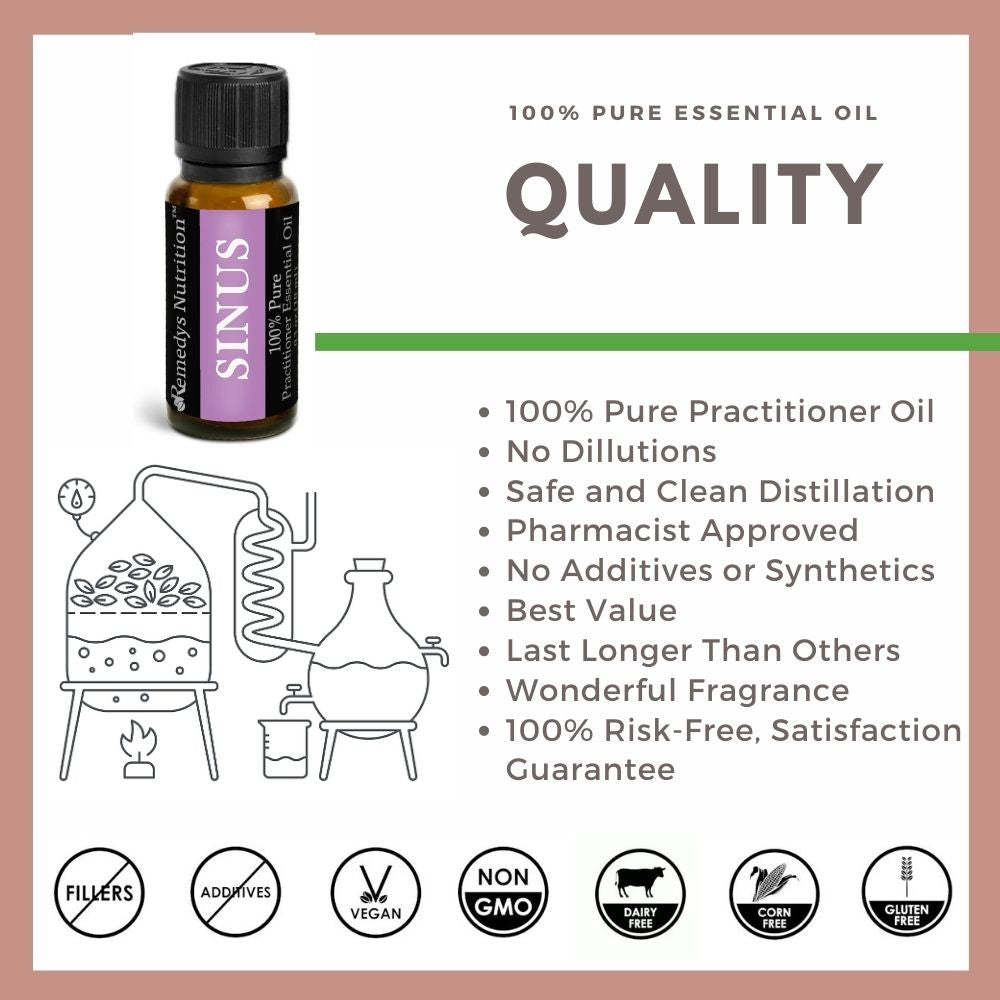
Remedy’s Sinus Blend is 100% pure with no carrier added — you control dilution to match adult, child, steam, or diffusion protocols. Each component oil is steam distilled at the country of origin and GC/MS tested per batch for 1,8-cineole, menthol, and terpinen-4-ol within target ranges. The 10 ml amber glass bottle with built-in dropper insert protects volatiles from UV and delivers consistent 0.05 ml drops. One bottle covers about 200 to 250 applications — a full cold and allergy season for most households.
Sinus Essential Oil: In-Depth Reading
Want to go deeper on a specific use case? Browse our essential oil knowledge hub: