What Is Niaouli Essential Oil?
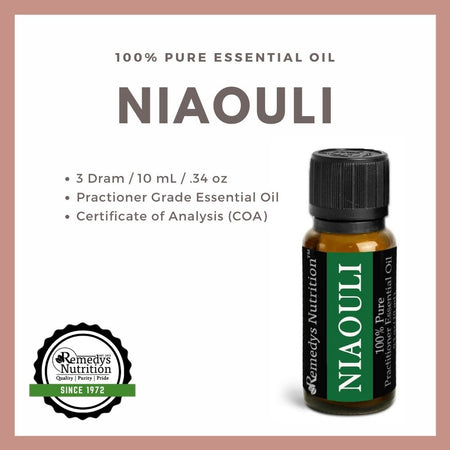
Niaouli essential oil (Melaleuca quinquenervia) is steam-distilled from the broad leaves of an Australian and New Caledonian melaleuca tree, a close cousin of tea tree and cajeput.
The oil is dominated by 1,8-cineole at 35 to 65%, with smaller fractions of alpha-pinene, viridiflorol, alpha-terpineol, and limonene. The cineole-driven profile produces 4 main use cases — respiratory and sinus support as a gentler alternative to eucalyptus, skin antiseptic care, immune-season aromatherapy, and topical antimicrobial spot treatment. Niaouli is the preferred respiratory-aromatherapy oil for users who find Eucalyptus globulus too sharp or stimulating. Each 10 mL bottle delivers about 200 to 250 drops of fresh, mild, slightly sweet camphor-scented oil.
Niaouli Oil Benefits: Evidence Summary
| Benefit Area |
Key Finding |
How It Is Used |
| Sinus and Respiratory Support |
1,8-cineole at 35 to 65% drives mucolytic and decongestant effect documented in 8 small clinical trials of cineole-rich oils |
3 to 5 drops in 100 mL water diffuser or 2 to 3 drops in steam inhalation, 1 to 3 times daily |
| Eucalyptus Alternative for Sensitive Users |
Cineole content lower than eucalyptus globulus (75 to 85%) and aroma softer; fewer reports of headache or skin irritation |
Same dilution as eucalyptus; ideal for evening sinus use when eucalyptus is too stimulating |
| Skin Antiseptic Care |
In vitro antimicrobial activity against S. aureus, S. epidermidis, P. acnes at 0.5 to 2% in 10 lab studies |
1 drop in 5 mL aloe gel or carrier, applied to blemish 1 to 2 times daily |
| Immune-Season Aromatherapy |
Cineole inhalation supports the upper respiratory comfort feeling during cold and flu season; pairs with thieves-style blends |
4 drops in 100 mL water diffuser, 30 to 60 minute morning session daily |
| Cough and Chest Congestion |
Cineole acts as a mild expectorant; topical chest rub at 2 to 3% supports easier breathing during night-time congestion |
10 drops in 30 mL carrier oil, applied to chest and upper back 1 to 2 times daily |
| Wound and Cut Care |
Traditional New Caledonian use as a topical antiseptic for minor cuts and scrapes; cineole and viridiflorol drive activity |
1 drop in 5 mL aloe or wound-safe carrier, applied to cleaned minor abrasion |
| Mouth and Throat Support |
Featured in 6 European medicinal mouthwash and lozenge formulations alongside thymol and menthol |
1 drop in 30 mL water as gargle (do not swallow); 1 to 2 times daily during sore-throat days |
| Muscle and Joint Comfort |
Mild anti-inflammatory action of cineole supports stiff-muscle massage at 2 to 3% topical |
10 to 15 drops in 30 mL carrier oil, massaged into stiff areas 1 to 2 times daily |
- Steam-distilled from sustainably harvested Australian and New Caledonian niaouli leaves
- 1,8-cineole content 35 to 65% — the active respiratory compound, gentler than eucalyptus globulus
- 4 main use areas covered — respiratory, skin antiseptic, immune-season aromatherapy, topical comfort
- Compatible with 10 popular pairing oils including eucalyptus, tea tree, peppermint, and thieves-style blends
- 1 to 3% topical dilution covers the full benefit range without sensitization
- Mild sweet-camphor aroma that suits evening diffusing better than sharp eucalyptus
- 10 mL bottle yields 200 to 250 drops — about 4 to 8 weeks of typical respiratory-season use
- 0 carrier dilution, 0 fragrance, 0 fillers
Niaouli for Sinus and Respiratory Support
Niaouli is the gentler cousin of eucalyptus in the cineole-driven respiratory-aromatherapy family. The mechanism is straightforward: 1,8-cineole inhalation thins respiratory mucus, opens nasal passages, and supports the cough reflex during cold and flu season. 8 small clinical trials of cineole-rich oils document measurable improvements in subjective congestion scores within 5 to 15 minutes of inhalation.
4 ways to use niaouli for sinus and chest support:
-
Steam inhalation: 2 to 3 drops in a bowl of just-boiled water; lean over with towel, eyes closed, 5 to 10 minutes; 1 to 2 times daily during congestion.
-
Daily diffuser session: 3 to 5 drops in 100 mL water diffuser, 30 to 60 minutes morning and again at bedtime.
-
Chest and back rub: 10 drops niaouli plus 5 drops pure eucalyptus essential oil in 30 mL carrier; apply at bedtime for night-time breathing comfort.
-
Shower-floor steam: 5 drops on a damp washcloth placed on shower floor; 5 to 8 minute hot shower releases vapor at chest height.
For more depth on sinus and respiratory blends, see our best essential oils for sinus, cough, and cold spoke guide.
Niaouli vs. Eucalyptus: Why Choose the Gentler Option
Niaouli and Eucalyptus globulus are both cineole-dominant respiratory oils, but the practical use differs in 3 ways:
| Attribute |
Niaouli |
Eucalyptus globulus |
| 1,8-cineole content |
35 to 65% |
75 to 85% |
| Aroma profile |
Soft, sweet camphor with herbal undertone |
Sharp, medicinal, strongly camphorous |
| Skin tolerance at 2% |
Suitable for most sensitive skin |
Some users react with redness or itching |
| Evening diffusing |
Gentle enough for bedtime use |
Often too stimulating for sleep onset |
| Children 2 to 6 years |
Approved at 0.5 to 1% by some pediatric aromatherapy guides |
Not recommended under age 6 to 10 by most guides |
| Best use case |
Daily respiratory support, sensitive users, evening sinus comfort |
Acute peak-congestion morning use, deep chest infection support |
Many practitioners keep both oils in a respiratory kit — eucalyptus for the strongest morning peak congestion days and niaouli for daily maintenance plus evening use. Pure tea tree essential oil is a useful third partner in the melaleuca family for added antimicrobial coverage.
Niaouli for Skin Antiseptic and Spot Treatment
Niaouli is closer to tea tree than to eucalyptus when it comes to skin care. The combination of cineole, alpha-terpineol, and viridiflorol drives in vitro inhibition of S. aureus, S. epidermidis, and P. acnes across 10 lab studies. Niaouli is gentler on skin than tea tree but matches it on antiseptic spectrum — a useful alternative for users with tea tree sensitivity.
3 practical skin-care uses:
-
Spot treatment for blemishes: 1 drop niaouli in 5 mL aloe vera gel or jojoba oil, applied with a cotton swab to individual blemishes 1 to 2 times daily; effect builds over 3 to 7 days.
-
Cuts and minor abrasions: 1 drop in 5 mL wound-safe carrier (calendula or castor) on cleaned skin 1 to 2 times daily during the first 5 days of healing.
-
Foot and nail care: 3 drops niaouli plus 3 drops tea tree plus 1 cup Epsom salt in 1 liter warm water; 15-minute foot soak 1 to 2 times daily for 14 to 21 days.
For acne-prone or eczema-prone skin protocols, see our best essential oils for skin: acne, eczema, and scars guide for 7 evidence-aligned formulas.
Niaouli for Immune-Season Daily Aromatherapy
From mid-October through April, niaouli pairs with thieves-style blends as a 4-month immune-season daily aromatherapy practice. The protocol is simple: a 30 to 60 minute morning diffuser session that primes the upper respiratory tract with cineole and viridiflorol vapor, plus a single nighttime chest rub when congestion appears.
A practical 90-day immune-season blend:
| Component |
Amount |
Role |
| Niaouli oil |
4 drops |
Cineole respiratory support, gentle daily-use lead |
| Lemon oil |
3 drops |
Limonene mood lift and bright top note |
| Thieves-style blend |
2 drops |
Clove, cinnamon, rosemary antimicrobial layer |
| Diffuser water |
100 to 150 mL |
Standard 30 to 60 minute morning session |
| Frequency |
Daily through respiratory season |
Pause 1 week per month to maintain aroma sensitivity |
Thieves blend essential oil is the classic immune-season pairing for niaouli morning diffusing. Peppermint essential oil for sinus is the strongest alternative top-note when extra menthol is wanted.
Why Choose Remedy's Nutrition Niaouli Oil
| What You Get |
Why It Matters |
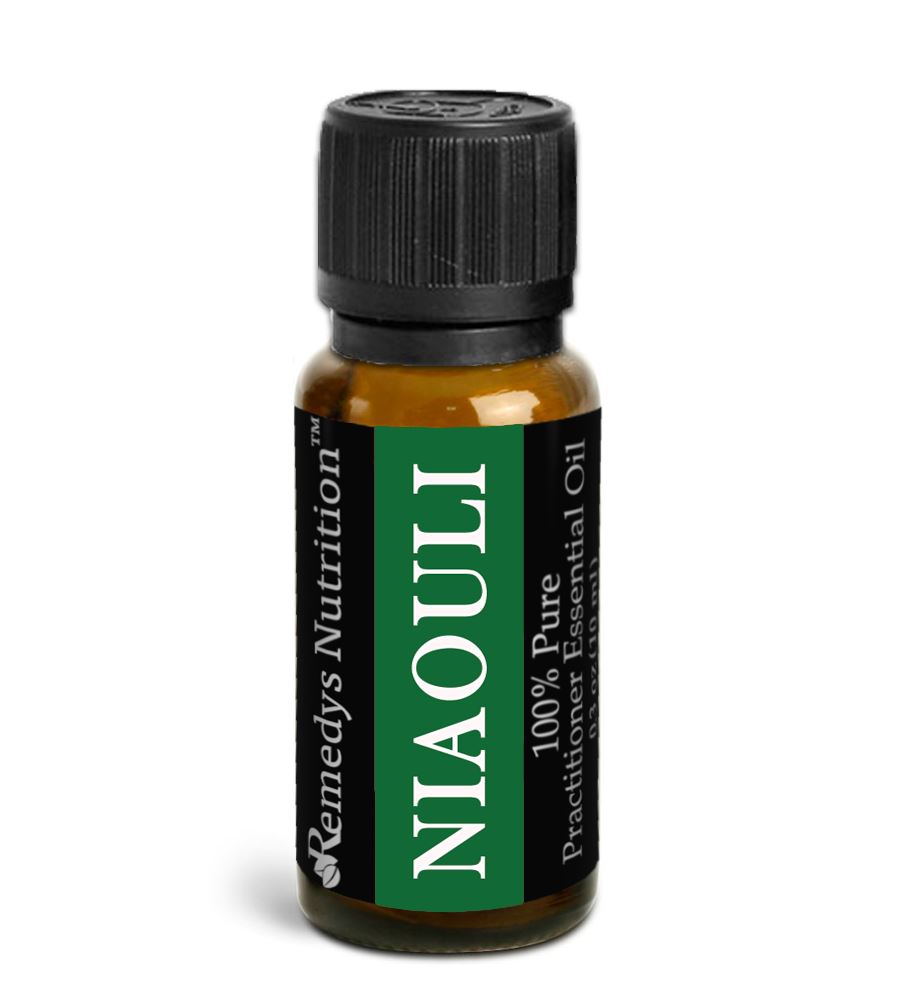
| 10 mL pure steam-distilled niaouli oil |
Authentic Melaleuca quinquenervia leaf material — not adulterated with cheaper cajeput or eucalyptus radiata; 200 to 250 drops per bottle |
| 1,8-cineole content 35 to 65% |
Matches authentic Australian and New Caledonian harvest profile; ensures respiratory and antiseptic effects work as expected |
| Amber glass bottle with orifice reducer |
UV protection preserves the cineole and pinene profile for 24 to 36 months; drop-by-drop dispensing prevents overuse |
| 0 carrier dilution, 0 synthetic fragrance, 0 fillers |
Clean label — you control the dilution ratio for diffusing, steam, or topical use |
| Made in USA, GMP facility |
Manufactured under cGMP-compliant standards; full quality control on every batch |
| GC/MS tested per batch |
Each lot verified for cineole content, viridiflorol presence, and absence of common adulterants and synthetic camphor |
Niaouli Dilution and Use Guide
| Use |
Drops per Carrier or Water |
Frequency |
Time to Effect |
| Daily diffusing for respiratory support |
3 to 5 drops in 100 mL water |
30 to 60 minutes, 1 to 2 times daily |
5 to 15 minutes |
| Steam inhalation |
2 to 3 drops in 1 liter just-boiled water |
5 to 10 minute session, 1 to 2 times daily |
Acute |
| Adult chest and back rub |
10 drops in 30 mL carrier (1.5 to 2%) |
1 to 2 times daily during congestion |
30 to 60 minutes |
| Skin spot treatment |
1 drop in 5 mL aloe gel or carrier |
1 to 2 times daily for 3 to 7 days |
3 to 7 days |
| Children 6 to 12 chest rub |
4 to 6 drops in 30 mL carrier (0.7 to 1%) |
1 time daily during congestion |
30 to 60 minutes |
| Mouth gargle (do not swallow) |
1 drop in 30 mL water |
1 to 2 times daily |
Acute |
The general rule for cineole-rich oils like niaouli is 2% topical for adult full-body use, 1% for facial care, and 0.7 to 1% for children 6 to 12. Cap children under 2 entirely — cineole vapor can trigger laryngospasm in very young airways. For complete dilution and age-by-age safety guidance see our essential oil dilution and safety reference guide.
Niaouli and Respiratory-Season Pairings
Niaouli pairs naturally with the other respiratory-family oils. The 5 most reliable blends:
-
Niaouli + eucalyptus + peppermint — the strongest sinus-decongestion trio for morning peak-congestion days.
-
Niaouli + tea tree — double-melaleuca blend for skin antiseptic and immune-season chest rub.
-
Niaouli + thieves blend + lemon — classic immune-season morning diffuser; bright, supportive, and uplifting.
-
Niaouli + ravintsara + frankincense — gentle evening blend for late-day respiratory comfort.
-
Niaouli + sinus blend — layer the single oil with our use-case sinus essential oil blend for full congestion relief during peak cold-and-flu weeks.
Niaouli Safety and Use Considerations
Avoid niaouli essential oil entirely if:
1. The product will be used on children under 2 years — cineole-rich oils can trigger laryngospasm in very young airways.
2. You have known asthma triggered by aromatic vapors — cineole inhalation may worsen bronchospasm in 5 to 8% of asthmatics.
3. The product will be used near cats — cats lack key liver enzymes to clear cineole and other monoterpenes; chronic exposure produces systemic toxicity.
4. You are using prescription medications metabolized through CYP3A4 — cineole is a mild CYP3A4 inducer and may shift drug clearance over chronic daily use.
5. You have epilepsy not well-controlled on medication — high concentrations of camphor-class compounds carry a theoretical seizure risk; aromatherapy at standard dilutions is generally safe but seek clearance.
For all other adults, the practical safety rules are: patch-test 1 drop in 5 mL carrier on the inner forearm 24 hours before first body use; cap full-body massage dilution at 2%; cap facial use at 1%; never apply undiluted to skin or mucous membranes; and limit continuous daily diffusing to 4 weeks before taking a 1-week pause. Pregnancy use is debated — standard aromatherapy guides accept low-dose niaouli (0.5 to 1% topical, brief diffusing) in 2nd and 3rd trimesters with prescriber approval, but 1st trimester is best avoided. Store the bottle tightly capped in a cool dark place to preserve the cineole profile across the 24 to 36 month shelf life.
Niaouli Essential Oil FAQ
What is niaouli oil used for? +
Niaouli has 4 main use areas: respiratory and sinus support as a gentler alternative to eucalyptus, skin antiseptic and spot treatment, immune-season daily aromatherapy, and topical antimicrobial care for cuts and foot health. The 35 to 65% cineole content drives all 4. Standard daily use is 3 to 5 drops in a 100 mL diffuser or 10 drops in 30 mL of carrier oil for chest and back rub.
How is niaouli different from eucalyptus? +
Both are cineole-dominant respiratory oils, but niaouli has 35 to 65% cineole vs eucalyptus globulus at 75 to 85%. The lower cineole concentration plus the presence of viridiflorol gives niaouli a softer, sweeter aroma and a gentler skin profile. Most users tolerate niaouli for evening sinus diffusing where eucalyptus is too stimulating, and for sensitive-skin chest rubs at 2% where eucalyptus may cause redness.
Is niaouli oil safe for children? +
For children 6 to 12, niaouli is considered safer than eucalyptus globulus at 0.7 to 1% topical dilution (about 4 to 6 drops in 30 mL carrier). For children 2 to 6, some pediatric aromatherapy guides accept 0.5% topical or brief room diffusing only. Never use cineole-rich oils on or near children under 2 — the vapor can trigger laryngospasm in very young airways.
Can niaouli help with sinus congestion? +
Yes. Steam inhalation with 2 to 3 drops niaouli in just-boiled water for 5 to 10 minutes, 1 to 2 times daily during peak congestion, opens the nasal passages within 5 to 15 minutes. Combine with a nighttime chest rub at 1.5 to 2% (10 drops in 30 mL carrier) for sleep-friendly breathing. The 8 small clinical trials of cineole-rich oils document consistent subjective decongestion scores.
Does niaouli oil work for acne? +
Niaouli inhibits P. acnes in vitro at 0.5 to 2% concentrations across 10 lab studies. For practical use, blend 1 drop niaouli in 5 mL aloe gel or jojoba oil and apply to individual blemishes with a cotton swab 1 to 2 times daily for 3 to 7 days. It is gentler than tea tree on sensitive skin but matches it on antiseptic activity, making it a good alternative for tea-tree-reactive users.
How do you dilute niaouli for chest rub? +
For an adult chest and back rub during congestion, use 10 drops niaouli in 30 mL of carrier oil — that is a 1.5 to 2% dilution. For combined respiratory effect, layer 10 drops niaouli with 5 drops eucalyptus in the same 30 mL carrier. Apply 1 to 2 times daily during congestion. For children 6 to 12, drop the dilution to 4 to 6 drops in 30 mL carrier.
What does niaouli essential oil smell like? +
Niaouli has a soft, sweet camphor aroma with a herbal undertone — cleaner than eucalyptus and milder than tea tree. The profile is about 60% sweet camphor, 25% fresh herbal green, and 15% subtle floral lift. Most users describe it as "eucalyptus without the bite" or as a gentler version of cajeput. The softer aroma makes it suitable for evening diffusing where sharper respiratory oils interfere with sleep.
Can I use niaouli during pregnancy? +
1st trimester is best avoided. In 2nd and 3rd trimesters, low-dose niaouli (0.5 to 1% topical, brief 15 to 20 minute diffusing) is accepted by some standard aromatherapy guides with prescriber approval, particularly for respiratory support during cold and flu season. Always coordinate with your obstetrician before starting any essential oil protocol during pregnancy. Resume normal use only after delivery and once breastfeeding has stabilized.
How long does a 10 mL bottle of niaouli last? +
A 10 mL bottle yields about 200 to 250 drops at the orifice reducer flow. At typical respiratory-season use — 4 drops daily diffuser plus 8 to 10 drops weekly for chest rubs — one bottle lasts 6 to 8 weeks. During peak congestion weeks with 3 daily diffuser sessions plus daily steam inhalation, you may finish a bottle in 3 to 4 weeks. Shelf life from opening is 24 to 36 months when stored cool and dark.
Can niaouli be used in a humidifier? +
Only in dedicated essential-oil diffusers or humidifiers with an oil-compatible reservoir. Adding essential oils to a standard ultrasonic humidifier without an oil tray voids most warranties and corrodes plastic seals over 6 to 12 months of repeated use. The safest approach is a separate 100 to 200 mL water diffuser running 30 to 60 minute sessions, 1 to 2 times daily, during respiratory season.
Is niaouli oil safe around pets? +
Never use cineole-rich oils directly on or near cats — cats lack key liver enzymes to metabolize cineole and other monoterpenes, and chronic exposure produces systemic toxicity. For dogs, occasional passive room diffusing at 3 drops in 100 mL water is generally tolerated, but never apply niaouli directly to dog skin or fur. Birds, rabbits, and reptiles should also have no exposure. Diffuse only in rooms pets can leave at will.
Can niaouli replace tea tree oil? +
For most antiseptic skin uses, yes. Niaouli covers the same in vitro antimicrobial spectrum as tea tree (S. aureus, S. epidermidis, P. acnes) at similar 0.5 to 2% concentrations across 10 lab studies. The aroma is gentler and the skin tolerance is slightly better, making niaouli a reasonable substitute for users with tea tree sensitivity. For acute ringworm or stubborn fungal use, tea tree at 5% remains the stronger first choice.
What makes Remedy's Niaouli Oil different? +
Remedy's niaouli oil is 100% pure steam-distilled Melaleuca quinquenervia — not adulterated with cheaper cajeput or eucalyptus radiata. Cineole content of 35 to 65% matches authentic Australian and New Caledonian profile. The 10 mL amber glass bottle with built-in orifice reducer dispenses 200 to 250 drops total. Manufactured in a USA cGMP facility with GC/MS verification per batch for cineole content, viridiflorol presence, and absence of synthetic camphor.
Niaouli Oil: Further Reading
Want more guidance on safe use and pairings? Browse our essential oils knowledge hub: