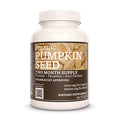


Pumpkin Seed 1000 mg, 60 Vegan Capsules
- Provides Essential Nutrients for Prostate Health*
- Helps Maintain Normal Bladder Function*
- Zinc & Fatty Acid-Rich Seeds for Prostate & Male Health*


Couldn't load pickup availability
*These statements have not been evaluated by the Food and Drug Administration. This product is not intended to diagnose, treat, cure, or prevent any disease.
What Is in Each Capsule
Remedy's Pumpkin Seed holds 1000 mg of ground organic pumpkin seed, Cucurbita pepo L., in each vegan capsule, with 60 capsules per bottle. It is the seed itself, ground and encapsulated. It is not pressed pumpkin seed oil, and it is not an ethanol extract, which are the 2 forms most other pumpkin seed capsules contain.
That distinction decides which research applies to this bottle, so we state it before anything else.
- 1000 mg per capsule: 1 g of ground seed.
- 60 capsules: 2 months at 1 capsule a day.
- Single ingredient: Organic pumpkin seed, with 0 other actives.
- Not oil, not extract: Nothing has been pressed out or concentrated.
Why the form matters is set out in pumpkin seed oil vs ground seed vs extract.
Supplement Facts
Serving size: 1 Vegan Capsule. Servings per container: 60.
| Amount Per Serving | Amount | % Daily Value |
|---|---|---|
| Organic Pumpkin Seed (Cucurbita pepo L.) | 1000 mg | * |
* Daily Value not established.
Other ingredients: Cellulose, Glycerin, Water (vegan capsule)
Directions: One capsule daily.
Organic, vegan, gluten free, no additives, no preservatives. Made in the USA.
Seed, Oil or Extract: Why It Matters
Three different products are sold as pumpkin seed, and the trials tested them separately. The European Medicines Agency gives each its own dose in its monograph on the seed.[1]Community Herbal Monograph on Cucurbita pepo L., semen (pumpkin seed) — European Medicines Agency View source Reading a study without checking the form is the most common way pumpkin seed claims go wrong.
| Form | What it is | What the trials used |
|---|---|---|
| Ground seed (this product) | The whole seed material, ground | GRANU seed arm: 10 g a day beat placebo |
| Seed extract | An ethanol concentrate, soft or dry | GRANU extract arm: 1 g a day, no difference |
| Pressed seed oil | The fat fraction, sold as softgels | 320 mg to 10 g a day in small trials |
The practical rule is simple: when you read a pumpkin seed claim, ask which of these 3 forms was tested and at what daily amount. Then compare that with what is in the bottle you are holding.
Ground seed is not oil-free. Hulled kernels are about 49% fat by USDA figures and whole roasted seeds about 19%, so 1 capsule carries roughly 0.2 to 0.5 g of the seed's own oil, depending on the hull. By weight that overlaps the 320 to 400 mg oil doses in small trials. It is still arithmetic rather than evidence, because no trial has tested oil delivered inside ground seed.
What the Evidence Shows
Pumpkin seed is an everyday food with a small clinical record. Rather than print a list of benefits, here is the shape of the literature, counted on PubMed on 8 October 2026. Anyone can rerun these counts.
| What PubMed holds on pumpkin seed | Count |
|---|---|
| Records on pumpkin seed or its oil | 680 |
| Records tagged as human | 163 |
| Records tagged as clinical trials | 16 |
| Placebo-controlled trials of pumpkin seed alone for urinary symptoms | 2 |
| Systematic reviews or meta-analyses (none on urinary symptoms) | 3 |
| Case reports (8 seed impaction, 6 allergy) | 24 |
Two things stand out. Case reports outnumber trial-tagged records, 24 to 16, and most of those reports concern seed impaction or allergy rather than any benefit. And none of the 3 systematic reviews pools the urinary trials. The full map is in our guide to pumpkin seed benefits.
Some popular claims have no human trial behind them at all. PubMed holds 0 human-only records pairing pumpkin seed with testosterone or sperm, and in the 24-week hair trial free testosterone was unchanged at 400 mg of oil a day. Weight loss, blood sugar control and immunity claims rest on food studies or none. Pumpkin seed was once used against tapeworms, but that is a historical use, not a reason to take a capsule today.
Prostate and Urinary Symptoms
This is the use with the best evidence. The German GRANU trial randomised 1,431 men aged 50 to 80 with prostate-related urinary symptoms for 12 months, comparing seed, a seed extract and placebo.[2]Effects of pumpkin seed in men with lower urinary tract symptoms due to benign prostatic hyperplasia in the one-year GRANU study — Urologia Internationalis (2015) View source
- Seed, 5 g twice daily: 58.5% responders against 47.3% on placebo.
- Extract, 500 mg twice daily: No difference from placebo.
- Response: A fall of 5 or more points on the IPSS symptom score.
- Tolerability: All study products were well tolerated.
The authors called the seed result descriptively significant and asked for confirmation. Smaller trials point the same way but add a boundary: in a 12-month trial of 320 mg of oil a day, prostate size did not change, and PSA did not fall on pumpkin oil alone.[3]Effects of pumpkin seed oil and saw palmetto oil in Korean men with symptomatic benign prostatic hyperplasia — Nutrition Research and Practice (2009) View source Pumpkin seed eases symptoms for some men; it does not shrink the prostate.
- Against tamsulosin: 720 mg of oil a day eased symptoms in 73 men, but less than the drug.
- Against prazosin: An oil product eased symptoms in 100 men, but less than the drug.
- Time frame: Trials judged results at 3 to 12 months, not days.
- Sexual function: Maintained over 24 months on a seed extract in 130 men.
The full trial breakdown is in pumpkin seed for prostate and BPH.
Overactive Bladder
Pumpkin seed is also marketed for urgency and night-time trips in women and men. The evidence here is thinner than for the prostate.
- Single-ingredient data: 1 study, 45 adults, 10 g of seed oil a day, no placebo.[4]Pumpkin seed oil extracted from Cucurbita maxima improves urinary disorder in human overactive bladder — Journal of Traditional and Complementary Medicine (2014) View source
- Women: 3 positive studies, all of blends with 2 or more other ingredients.
- Placebo-controlled: Only 1 blend, which also held pollen extract.
- Your own measure: A 3-day bladder diary before and after 12 weeks.
Because the bladder studies used oil doses 10 times the weight of this capsule, we make no bladder claim for it. The studies are listed in pumpkin seed for overactive bladder.
Hair
Pumpkin seed oil for hair growth is a popular search, and it rests on 1 oral trial. In 76 men with pattern hair loss, 400 mg of pressed oil a day for 24 weeks raised hair count 40% against 10% on placebo.[5]Effect of pumpkin seed oil on hair growth in men with androgenetic alopecia: a randomized, double-blind, placebo-controlled trial — Evidence-Based Complementary and Alternative Medicine (2014) View source
- Hair thickness: Unchanged in both groups.
- Funding: The capsule supplier funded the trial.
- DHT: Never measured, so the mechanism is untested.
- Form: Pressed oil, not ground seed.
We make no hair claim for this product. The trial and its limits are covered in pumpkin seed oil for hair loss.
Minerals and Sleep: The Honest Numbers
Pumpkin kernels are among the richest food sources of magnesium, but a capsule holds 1 g. Using USDA values for dried kernels, here is what 1 capsule gives next to a food portion.[6]Pumpkin and Squash Seed Kernels, Dried (FDC 170556) — USDA FoodData Central View source
| Nutrient (% Daily Value) | 1 capsule, 1 g | 1 oz of kernels, 28 g |
|---|---|---|
| Magnesium | 5.9 mg (1.4%) | 166 mg (40%) |
| Zinc | 0.08 mg (0.7%) | 2.2 mg (20%) |
| Iron | 0.09 mg (0.5%) | 2.5 mg (14%) |
| Tryptophan | 5.8 mg | 161 mg |
For minerals, the seeds win by a wide margin: matching 1 handful's magnesium would take about 28 capsules. The sleep claim rests on tryptophan, and 1 capsule holds about 5.8 mg; PubMed has 0 trial-tagged records pairing pumpkin seed with sleep. The arithmetic is laid out in pumpkin seeds for zinc, magnesium and sleep.
Safety and Who Should Be Careful
Pumpkin seed is well tolerated in trials, from 320 mg of oil to 10 g of seed a day. The EMA lists mild stomach complaints in about 4% of users and no reported drug interactions. The rare risks come from case reports.[7]Rectal bezoars due to pumpkin seeds — Tropical Doctor (2009) View source
| Situation | Position |
|---|---|
| Allergy to pumpkin seed, sesame or tree nuts | Do not take it |
| Pregnant, breastfeeding or under 18 | Medicinal use not recommended by the EMA |
| Blood in urine, fever, pain or retention | See a doctor before any supplement |
| Taking blood pressure or prostate medicines | Tell your prescriber first |
| Eating large amounts of whole seeds | Chew well; impaction is reported |
One 8-year-old boy who ate pumpkin flesh without trouble still reacted to the seed, so a seed or nut allergy is a reason to skip this product.[8]Medicinal bioactivities and allergenic properties of pumpkin seeds: review upon a pediatric anaphylaxis case — European Annals of Allergy and Clinical Immunology (2017) View source The full list is in pumpkin seed side effects and safety.
See a doctor first if you have blood in your urine, fever, painful urination or cannot pass urine. The EMA limits pumpkin seed to use after serious conditions have been excluded.
How to Take It
The label direction is 1 capsule daily, which is 1 g of seed. Trials used far more, so it helps to know where this amount sits before you start.
- Amount: 1 capsule a day, per the label.
- Trial seed dose: 10 g a day in GRANU; the EMA range is 5 to 15 g.
- With food: 0 trials compared timing, so take it at a meal you will not skip.
- Review: At 12 weeks, the shortest length of most trials.
Some people pair the capsule with pumpkin kernels as food, which is the simplest way to reach trial-sized seed amounts. Chew whole seeds well, because large amounts of unchewed seeds with hulls can cause impaction.
If you follow a kidney diet, note that pumpkin kernels are high in phosphorus: about 345 mg per 28 g ounce, against roughly 12 mg in 1 capsule. If you are trying it for urinary symptoms, keep a simple record of daytime and night-time trips for 3 days before you start and again at 12 weeks, so you judge the result on numbers rather than memory.
Why Choose Remedy's Pumpkin Seed
No trial makes one pumpkin seed capsule better than another, so the honest differentiators are what is in the bottle and what this page is willing to say about it.
- Ground organic seed: Cucurbita pepo, the species the EMA monograph covers.
- Single ingredient: 1000 mg of seed, with nothing blended in.
- The dose math, printed: 1 capsule is a tenth of the GRANU seed dose.
- No disease claims: No prostate-shrinking, hair, mineral or sleep promise.
What we will not claim matters as much as what we will. A 1 g capsule is a measured, convenient amount of seed, and the evidence for larger amounts is set out above so you can decide for yourself.
Frequently Asked Questions
Is this pumpkin seed oil or ground seed? +
Ground seed. Each capsule holds 1000 mg of organic Cucurbita pepo seed, with 0 oil pressed out and no extraction.
What are the benefits of pumpkin seed capsules? +
It depends on the form. In a 1,431-man trial, 10 g of seed a day eased urinary symptoms more often than placebo; a 1 g extract did not.
Is 1 capsule enough for the prostate? +
It is below the trial dose. GRANU used 10 g of seed a day, and the EMA range is 5 to 15 g a day.
Does pumpkin seed shrink the prostate? +
No trial showed it. In a 12-month trial of 320 mg of oil a day, prostate volume did not change.
Can women take pumpkin seed? +
Yes, outside pregnancy. Bladder studies in 117 and 86 women used pumpkin blends, and the EMA advises against medicinal use under 18.
Does pumpkin seed help hair growth? +
One trial of 400 mg of oil a day in 76 men raised hair count. That was oil, not ground seed, so we make no hair claim.
How much magnesium is in 1 capsule? +
About 5.9 mg, 1.4% of the 420 mg Daily Value. A 28 g handful of kernels gives about 166 mg.
Will pumpkin seed help me sleep? +
Not proven. PubMed has 0 trial-tagged pumpkin seed sleep records, and 1 capsule holds about 5.8 mg of tryptophan.
What are the side effects? +
Mild stomach upset in about 4% of users per the EMA. Rarely, allergy; 6 case reports describe it.
Can I take it with tamsulosin? +
0 trials tested the combination, and the EMA reports no interactions. Tell the prescriber of your tamsulosin first.
How long does 1 bottle last? +
Sixty capsules last 2 months at 1 capsule a day, the label direction.
When should I take it? +
0 trials compared morning with evening. Take 1 capsule with a meal you will not skip.
You May Also Like
- Saw Palmetto 1000 mg — the most-studied prostate herb, as a single ingredient
- Prostate Support 1000 mg — a multi-herb prostate formula for men over 45
- Magnesium Glycinate 1000 mg — a measured magnesium dose stated on the label