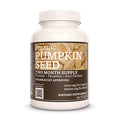

Pumpkin seed oil is marketed for urgency and night-time trips in both men and women, yet only 1 single-ingredient bladder study exists. It had 45 people and no placebo.
The rest of the bladder evidence comes from herbal blends, which makes the details worth reading.
Quick Answer: Does Pumpkin Seed Help an Overactive Bladder?
Possibly, but the evidence is weak. The only single-ingredient study gave 45 adults 10 g of seed oil a day for 12 weeks; symptom scores fell, with no placebo group. Positive studies in women used blends with 2 or more other ingredients. A 1 g seed capsule is far below the oil dose tested.
Key Takeaways
- Only 1 single-ingredient pumpkin bladder study exists, with 45 adults.
- That study used 10 g of seed oil daily, without placebo.
- 3 positive studies in women tested blends of 3 or more ingredients.
- 1 blend trial in 81 women beat placebo over 90 days.
- A 3-day bladder diary is the simplest way to measure change.
Related Products
Overactive Bladder Is Not a Prostate Problem
Overactive bladder means sudden urgency, often with frequent and night-time trips. It affects women and men, and it is not the same as a weak stream.
- Urgency: A sudden need to go that is hard to put off.
- Frequency: Many daytime trips, often small amounts.
- Nocturia: Waking at night to pass urine.
- Not included: Leaks on coughing, which is stress incontinence.
In men, these symptoms often overlap with prostate enlargement. How the seed performs across all uses is in the overview of pumpkin seed research.
The Bladder Studies
Here are the bladder studies with pumpkin seed in them, sorted so the blends are visible.
| Study | Who | Product | Length | Result |
|---|---|---|---|---|
| Oil-only study, 2014 | 45 adults with overactive bladder | Seed oil, 10 g a day | 12 weeks | Symptom score fell; no placebo |
| Oil blend study, 2019 | 117 women with overactive bladder | Seed oil plus 2 other herbs | 12 weeks | Trips fell; no control group |
| Extract blend study, 2019 | 86 women with stress leakage | Seed extract plus 2 other herbs | 12 weeks | Leaks fell 30% to 35%; no control |
| Pollen blend trial, 2020 | 81 women with incontinence | Pollen, seed extract, vitamin E | 90 days | Better than placebo; a blend |
The single-ingredient study used oil from Cucurbita maxima, a different species from most supplements.[1]Pumpkin seed oil extracted from Cucurbita maxima improves urinary disorder in human overactive bladder — Journal of Traditional and Complementary Medicine (2014) View source Its symptom score fell at 6 and 12 weeks.

Why Most of the Evidence Is Blends
Three of the 4 studies combined pumpkin seed with other active ingredients. That makes their results impossible to credit to pumpkin alone.
- Pollen blend: Beat placebo in 81 women, but it also held pollen extract.[2]Evaluation of Femaxeen for control of urinary incontinence in women: a randomized, placebo-controlled study — Maturitas (2020) View source
- Hops and sumach blend: 117 women, no control group.[3]Cucurbita pepo, Rhus aromatica and Humulus lupulus combination reduces overactive bladder symptoms in women — Planta Medica (2019) View source
- Horsetail and flax blend: 86 women with stress leakage, no control.[4]Cucurbita pepo seed extract, horsetail and flax in stress urinary incontinence in women — Journal of Traditional and Complementary Medicine (2019) View source
- Takeaway: Pumpkin alone has 0 placebo-controlled bladder trials.
The pollen blend improved incontinence scores against placebo by day 60. The hops blend reported fewer daytime and night-time trips within 1 week.
For men, the comparable data come from the men's prostate trials, which tracked night-time trips as a secondary outcome.
The 10-Gram Problem
The one single-ingredient study used a large amount of oil. Translated into everyday terms, it is far beyond a capsule.
- Study dose: 10 g of oil a day for 12 weeks.
- As softgels: 10 capsules of 1000 mg oil a day.
- As kernels: About 20 g of kernels holds 10 g of fat.
- One seed capsule: 1 g of seed, holding about 0.49 g of fat.
The kernel figure uses the USDA value of 49.05 g fat per 100 g.[5]Pumpkin and Squash Seed Kernels, Dried (FDC 170556) — USDA FoodData Central View source
If you want a simple starting point, a single-ingredient pumpkin seed capsule is 1 g of seed with nothing blended in, so you can judge it on its own.

What Pumpkin Seed Will Not Fix
Some urinary symptoms look like an overactive bladder but have other causes that need different care.
- Burning or fever: Possible infection; see a doctor.
- Blood in urine: Always needs assessment.
- Leaks on coughing: Stress incontinence, often helped by pelvic floor work.
- Sudden change: New symptoms deserve a check first.
The EMA monograph says to consult a doctor if fever, spasms, blood in the urine or retention occur.[6]Community Herbal Monograph on Cucurbita pepo L., semen (pumpkin seed) — European Medicines Agency View source
Before you start, read the side effects worth knowing, including the 2 rare risks the case reports describe.
Testing It on Yourself
Because the evidence is weak, your own record is the most useful measure. A bladder diary turns a vague impression into numbers.
- Record every trip, day and night, for 3 days.
- Note urgent trips and any leaks separately.
- Keep fluids and caffeine steady while you test.
- Repeat the 3-day diary after 12 weeks.
The oil-free extract pilot in men used exactly this kind of diary to track night-time trips.[7]Oil-free hydroethanolic pumpkin seed extract in men with benign prostatic hyperplasia: a pilot study — Journal of Medicinal Food (2019) View source
See a Doctor Before Using Pumpkin Seed If
- You see blood in your urine, or urination is painful
- You have a fever, cramping or cannot pass urine at all
- Your urinary symptoms are new and have not been checked by a doctor
- You are pregnant, breastfeeding, or under 18
- You have reacted to pumpkin seeds, sesame or tree nuts before

Frequently Asked Questions
Does pumpkin seed oil help with bladder control? +
Possibly. The only single-ingredient study, in 45 adults taking 10 g of oil daily, saw scores fall, but it had no placebo.
How long does pumpkin seed oil take to work for the bladder? +
The 2014 study measured at 6 and 12 weeks. One blend study in women reported changes within 1 week.
How much pumpkin seed oil should I take for bladder control? +
The single-ingredient study used 10 g a day. The EMA lists 3 to 4 g of oil a day for traditional use.
What calms down an overactive bladder? +
Bladder training and fluid timing are first steps; medicines exist too. Pumpkin seed has only 1 uncontrolled single-ingredient study.
What is a superfood for the bladder? +
No food has proven bladder effects. Pumpkin seed is the most studied, and its best bladder data come from 4 small studies.
What is the best supplement for bladder control? +
There is no clear winner. The only blend that beat placebo, in 81 women, combined pollen, pumpkin seed and vitamin E.
Does pumpkin seed help with nighttime urination? +
In a 60-man extract pilot, night-time trips fell over 12 weeks. There was no control group, so chance cannot be ruled out.
Does pumpkin seed help stress incontinence? +
One blend study in 86 women reported 30% to 35% fewer leaks. It held 2 other herbs and had no control group.
Is pumpkin seed safe for women with bladder symptoms? +
It is well tolerated in studies. The EMA does not recommend medicinal use in pregnancy or under 18.
Related Reading
- Pumpkin Seed Oil vs Ground Seed vs Extract
- Can Pumpkin Seed Oil Regrow Hair?
- How Much Zinc and Magnesium Pumpkin Seeds Give
Related Products