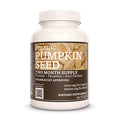

Pumpkin seed oil draws about 60,500 searches a month, and most capsules on the shelf are oil softgels. Yet seed, oil and extract were tested as 3 different products.
This page sorts them, so you can match the bottle in your hand to the study that tested it.
Quick Answer: Is Pumpkin Seed Oil the Same as Pumpkin Seed?
No. The oil is the pressed fat fraction; the seed also carries protein, fibre and minerals, and an extract is an ethanol concentrate. In the 1,431-man GRANU trial, 10 g of seed a day beat placebo and 1 g of extract did not. Oil trials used 320 mg to 10 g a day.
Key Takeaways
- Seed, oil and extract are 3 products with 3 separate dose ranges.
- In GRANU, 10 g of seed beat placebo; 1 g extract did not.
- Oil trials used between 320 mg and 10 g of oil a day.
- Hulled kernels are about 49% fat, so 1 g holds 0.49 g oil.
- Pressing leaves protein and tryptophan in the cake, about 60% protein.
Related Products
Three Products Share One Name
A label that says pumpkin seed can hold the seed, its oil, or an extract. The distinction changes what the evidence says about it.
| Form | What it is | What the trials used |
|---|---|---|
| Whole or ground seed | The seed itself, about 49% fat in hulled kernels | GRANU seed arm, 10 g a day: beat placebo |
| Ethanol seed extract | A concentrate, sold as soft or dry extract | GRANU extract arm, 1 g a day: no difference from placebo |
| Pressed seed oil | The fat fraction, with tocopherols and carotenoids | 320 mg to 10 g a day, all in small trials |
| Our capsule | Ground organic Cucurbita pepo seed, 1000 mg | No trial used this form at this dose |
The EMA monograph sets a separate dose for each of these preparations.[1]Community Herbal Monograph on Cucurbita pepo L., semen (pumpkin seed) — European Medicines Agency View source Where each fits overall is in the full pumpkin seed evidence map.
What Pressing Keeps and What It Leaves Behind
Pressing splits the seed in 2. The oil carries the fat-soluble parts, and the press cake keeps most of the rest.
- In the oil: Fatty acids, tocopherols (vitamin E) and carotenoids.
- In the press cake: About 60% protein by dry weight.
- Also in the cake: Tryptophan and inositol phosphates, an antinutrient.
- In ground seed: All of the above, in their natural proportions.
An analysis of 12 commercial oils confirmed high tocopherol and carotenoid content.[2]Chemical composition and functional characterisation of commercial pumpkin seed oil — Journal of the Science of Food and Agriculture (2013) View source A separate study measured the cake at 598 g of protein per kg of dry matter.[3]Chemical composition and nutritional value of pumpkin seed cake, soybean meal and casein — Die Nahrung (1999) View source

Which Form Each Trial Used
Sorted by form, the human studies stop contradicting each other.
- Seed: GRANU, 10 g a day for 12 months, the only placebo-beating seed result.
- Extract: GRANU's 1 g arm, plus 3 uncontrolled extract studies.
- Oil, urinary: 320 mg, 720 mg and 10 g a day in 3 small studies.
- Oil, other: 400 mg for hair, 2 g and 3 g for heart markers.
The GRANU authors reported that the extract arm did not differ from placebo at 12 months.[4]Effects of pumpkin seed in men with lower urinary tract symptoms due to benign prostatic hyperplasia in the one-year GRANU study — Urologia Internationalis (2015) View source The detail sits in the prostate trial that compared seed with extract.
How Much Oil Is Inside Ground Seed
Ground seed is not oil-free. It carries its own fat, and the amount depends on the hull.
- Hulled kernels: 49.05 g of fat per 100 g, so 1 g holds 0.49 g.
- Whole roasted seeds: 19.4 g of fat per 100 g, so 1 g holds 0.19 g.
- Oil trial doses: 320 mg for urinary symptoms, 400 mg for hair.
- The catch: No trial tested oil delivered inside ground seed.
Those fat values are USDA figures for kernels and for whole roasted seeds.[5]Pumpkin and Squash Seed Kernels, Dried (FDC 170556) — USDA FoodData Central View source[6]Pumpkin and Squash Seeds, Whole, Roasted (FDC 170188) — USDA FoodData Central View source By weight the overlap is real, but it is arithmetic, not evidence of the same effect.
That is why we describe our ground-seed capsules as 1 g of seed and make no oil-trial claim for them.

Extracts Are Their Own Category
Extract studies are often quoted as if they proved the seed or the oil. They did not.
- Soft extract: 500 mg twice daily in the EMA monograph.
- Dry extract: 105 mg 3 times daily, or 152 mg twice daily.
- Oil-free extract: 60 men, 12 weeks, symptom score down 30.1%.
- Limitation: That pilot had no control group.
The oil-free pilot also reported fewer night-time trips by bladder diary.[7]Oil-free hydroethanolic pumpkin seed extract in men with benign prostatic hyperplasia: a pilot study — Journal of Medicinal Food (2019) View source
Matching the Form to the Goal
No single form covers every claim, so start from what you want and work back to the form.
- Urinary symptoms in men: Seed at trial amounts, or a tested extract.
- Hair: Oral oil at 400 mg, on 1 small trial.
- Minerals: Food amounts of kernels, measured in grams.
- Anything else: Ask what form and dose the study used.
The oil claim with the most attention online rests on the 400 mg hair loss trial, which tested softgels, not ground seed.
See a Doctor Before Using Pumpkin Seed If
- You see blood in your urine, or urination is painful
- You have a fever, cramping or cannot pass urine at all
- Your urinary symptoms are new and have not been checked by a doctor
- You are pregnant, breastfeeding, or under 18
- You have reacted to pumpkin seeds, sesame or tree nuts before

Frequently Asked Questions
Are pumpkin seed oil and pumpkin seed extract the same? +
No. Oil is pressed fat; an extract is an ethanol concentrate. In GRANU, a 1 g daily extract did not beat placebo over 12 months.
What are the benefits of pumpkin seed oil capsules? +
Small trials link oral oil to urinary and hair outcomes, at 320 mg to 10 g a day. None was large or long enough to be decisive.
Is it better to take pumpkin seed oil in the morning or at night? +
0 trials compared timing. The hair trial split 4 capsules before breakfast and dinner, so take it with meals you will not skip.
How long does it take for pumpkin seed oil to start working? +
Trials measured at 12 weeks or later, and GRANU at 12 months. In the hair trial, self-ratings did not differ at 12 weeks.
Does pumpkin seed oil contain zinc? +
Oil is the fat fraction, and a 2013 analysis of 12 oils reported vitamin E and carotenoids, not minerals. For zinc, 28 g of kernels gives about 2.2 mg.
What is in a pumpkin seed capsule? +
It depends on the brand. Ours holds 1000 mg of ground organic Cucurbita pepo seed; oil softgels hold pressed oil only.
Is cold-pressed pumpkin seed oil better? +
No trial compared them for a health outcome. A 2013 analysis of 12 oils found roasting heat changed the aroma compounds.
Can I get the oil benefits from eating pumpkin seeds? +
By weight, 1 g of kernels holds about 0.49 g of fat. But 0 trials tested oil delivered inside the seed.
Why do some products combine pumpkin seed with saw palmetto? +
It is a common blend. In a 47-man trial, the 320 mg combination was not better than either oil alone.
Related Reading
- Bladder Urgency and Pumpkin Seed Oil
- Pumpkin Seed Nutrition at Capsule Size
- Pumpkin Seed Side Effects and Safety
Related Products