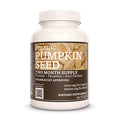

Pumpkin kernels are one of the richest food sources of magnesium, at 592 mg per 100 grams. A capsule holds 1 gram, and a handful holds about 28.
That gap decides whether seeds or capsules make sense for minerals, and it settles the sleep claim too.
Quick Answer: How Much Zinc and Magnesium Do Pumpkin Seeds Give?
A 28 g handful of kernels gives about 166 mg of magnesium (40% of the Daily Value) and 2.2 mg of zinc (20%). A 1 g capsule gives about 5.9 mg of magnesium and 0.08 mg of zinc, under 2%. For minerals, eat the seeds. The sleep claim rests on tryptophan, with 0 pumpkin seed sleep trials.
Key Takeaways
- A 28 g handful of kernels holds about 166 mg of magnesium.
- That handful also holds about 2.2 mg zinc, 20% of Daily Value.
- A 1 g capsule holds 5.9 mg magnesium, under 2% of Daily Value.
- Matching a handful's magnesium would take about 28 capsules a day.
- PubMed has 0 trial-tagged records pairing pumpkin seed with sleep outcomes.
Related Products
The Numbers per Gram
Every figure here comes from USDA values for dried kernels, scaled to 3 real-world amounts. The middle column is the GRANU seed dose; for the trials behind it, see what the pumpkin seed trials add up to.
| Nutrient (% Daily Value) | 1 capsule, 1 g | GRANU dose, 10 g | 1 oz handful, 28 g |
|---|---|---|---|
| Magnesium | 5.9 mg (1.4%) | 59 mg (14%) | 166 mg (40%) |
| Zinc | 0.08 mg (0.7%) | 0.78 mg (7%) | 2.2 mg (20%) |
| Iron | 0.09 mg (0.5%) | 0.88 mg (5%) | 2.5 mg (14%) |
| Protein | 0.3 g (0.6%) | 3 g (6%) | 8.5 g (17%) |
| Tryptophan | 5.8 mg | 58 mg | 161 mg |
| Calories | 6 kcal | 56 kcal | 157 kcal |
The USDA lists dried kernels at 592 mg magnesium, 7.81 mg zinc and 0.576 g tryptophan per 100 g.[1]Pumpkin and Squash Seed Kernels, Dried (FDC 170556) — USDA FoodData Central View source Percentages use the FDA Daily Values: 420 mg magnesium, 11 mg zinc and 18 mg iron.[2]Daily Value on the Nutrition and Supplement Facts Labels — U.S. Food and Drug Administration View source
Food or Capsule: The Honest Comparison
For minerals, the comparison is lopsided. A capsule is useful for other reasons, but not as a magnesium or zinc source.
- Magnesium: About 28 capsules to match 1 handful.
- Zinc: About 28 capsules to match 1 handful.
- Cost per day: A handful of kernels is usually cheaper.
- Where a capsule fits: A fixed seed amount for people who will not snack.
Stated plainly, our organic pumpkin seed capsules give 1 g of seed a day. They are not a mineral supplement, and we do not sell them as one.

Hulled Kernels or Whole Seeds
The hull changes the numbers. Whole roasted seeds, shell and all, hold less magnesium and more fibre per gram.
- Magnesium: 592 mg per 100 g in kernels, 262 mg in whole seeds.
- Zinc: 7.81 mg in kernels, 10.3 mg in whole seeds.
- Fibre: 6 g in kernels, 18.4 g in whole seeds.
- Fat: 49 g in kernels, 19.4 g in whole seeds.
Those whole-seed figures are for roasted seeds without salt.[3]Pumpkin and Squash Seeds, Whole, Roasted (FDC 170188) — USDA FoodData Central View source Eating large amounts with the hull on has a specific risk, described in the seed impaction case reports.
The Tryptophan and Sleep Claim
Pumpkin seeds are sold as a sleep food because they contain tryptophan, which the body uses to make serotonin and melatonin. The arithmetic is modest.
- 1 capsule: About 5.8 mg of tryptophan.
- 1 handful: About 161 mg of tryptophan.
- Pumpkin seed sleep trials: 0 tagged in PubMed.
- Closest trial: De-oiled gourd seed protein, given with glucose.
That 2005 trial enrolled 57 adults with insomnia, and 49 completed 3 weeks.[4]Protein source tryptophan versus pharmaceutical grade tryptophan as an efficacious treatment for chronic insomnia — Nutritional Neuroscience (2005) View source The seed protein was always given with glucose, which reduces competing amino acids.
A 7-person pilot used the same protein and glucose mix for social anxiety.[5]Protein-source tryptophan as an efficacious treatment for social anxiety disorder: a pilot study — Canadian Journal of Physiology and Pharmacology (2007) View source Neither study tested a bedtime handful of seeds.

Blood Sugar and Iron, as Food
Two small food studies show what pumpkin seed can do at meal-sized amounts. Both are far above capsule doses.
- Blood sugar: 65 g in a meal cut the glucose rise by about 35%.
- Who: 15 adults with normal blood sugar, single meals.
- Iron: 30 g of kernels daily, plus fortified cereal, in 8 women.
- Result: Serum iron rose, but the cereal also supplied iron.
The glucose study used a single meal, so it says nothing about long-term control.[6]Addition of pooled pumpkin seed to mixed meals reduced postprandial glycemia — Nutrition Research (2018) View source The iron study combined 2 sources and cannot isolate the seeds.[7]Iron fortified cereal and pumpkin seed kernels on serum iron in adult women — BioFactors (2007) View source
How Many Seeds a Day
No official target exists for pumpkin seeds. A sensible food portion follows from the numbers above.
- Common portion: 1 ounce, about 28 g of kernels.
- Calories: About 157 per ounce.
- Phosphorus: About 345 mg per ounce, relevant on kidney diets.
- Chew well: Especially with whole seeds and hulls.
Because protein and tryptophan stay in the press cake, the oil is no substitute here; see what a ground-seed capsule holds versus the oil.
See a Doctor Before Using Pumpkin Seed If
- You see blood in your urine, or urination is painful
- You have a fever, cramping or cannot pass urine at all
- Your urinary symptoms are new and have not been checked by a doctor
- You are pregnant, breastfeeding, or under 18
- You have reacted to pumpkin seeds, sesame or tree nuts before

Frequently Asked Questions
How many pumpkin seeds should you eat a day? +
A common portion is 1 ounce, about 28 g of kernels. That gives about 166 mg of magnesium and 157 calories.
How many pumpkin seeds do I need to eat to get my daily magnesium? +
About 71 g of kernels would reach the 420 mg Daily Value. Most people get the rest from other foods.
How many pumpkin seeds should I eat daily for zinc? +
A 28 g handful gives about 2.2 mg, 20% of the 11 mg Daily Value. Whole seeds hold slightly more per gram.
How much zinc is in 20g of pumpkin seeds? +
About 1.6 mg in 20 g of dried kernels, based on 7.81 mg per 100 g. That is about 14% of the Daily Value.
Do pumpkin seeds help in good sleep? +
Not proven. PubMed has 0 pumpkin seed sleep trials; 1 trial used gourd seed protein with glucose for 3 weeks.
Do pumpkin seeds have L-tryptophan? +
Yes. Dried kernels hold about 0.576 g per 100 g, so a 28 g handful gives about 161 mg.
Why eat pumpkin seeds before bed? +
The idea is tryptophan and magnesium. But 0 trials tested a bedtime handful, so treat it as a snack choice.
When should I eat pumpkin seeds, morning or night? +
0 studies compared timing. The nutrients are the same at 8 am or 8 pm, so pick what suits your meals.
Is a pumpkin seed capsule a good magnesium supplement? +
No. One 1 g capsule gives about 5.9 mg, under 2% of the Daily Value. A measured magnesium product is the better tool.
Why do I feel sleepy after eating pumpkin seeds? +
We found 0 studies on this. A large snack of 157 calories or more can make some people drowsy regardless of tryptophan.
Related Reading
- What the 1,431-Man Prostate Trial Found
- The Overactive Bladder Evidence
- What the 76-Man Hair Trial Showed
Related Products