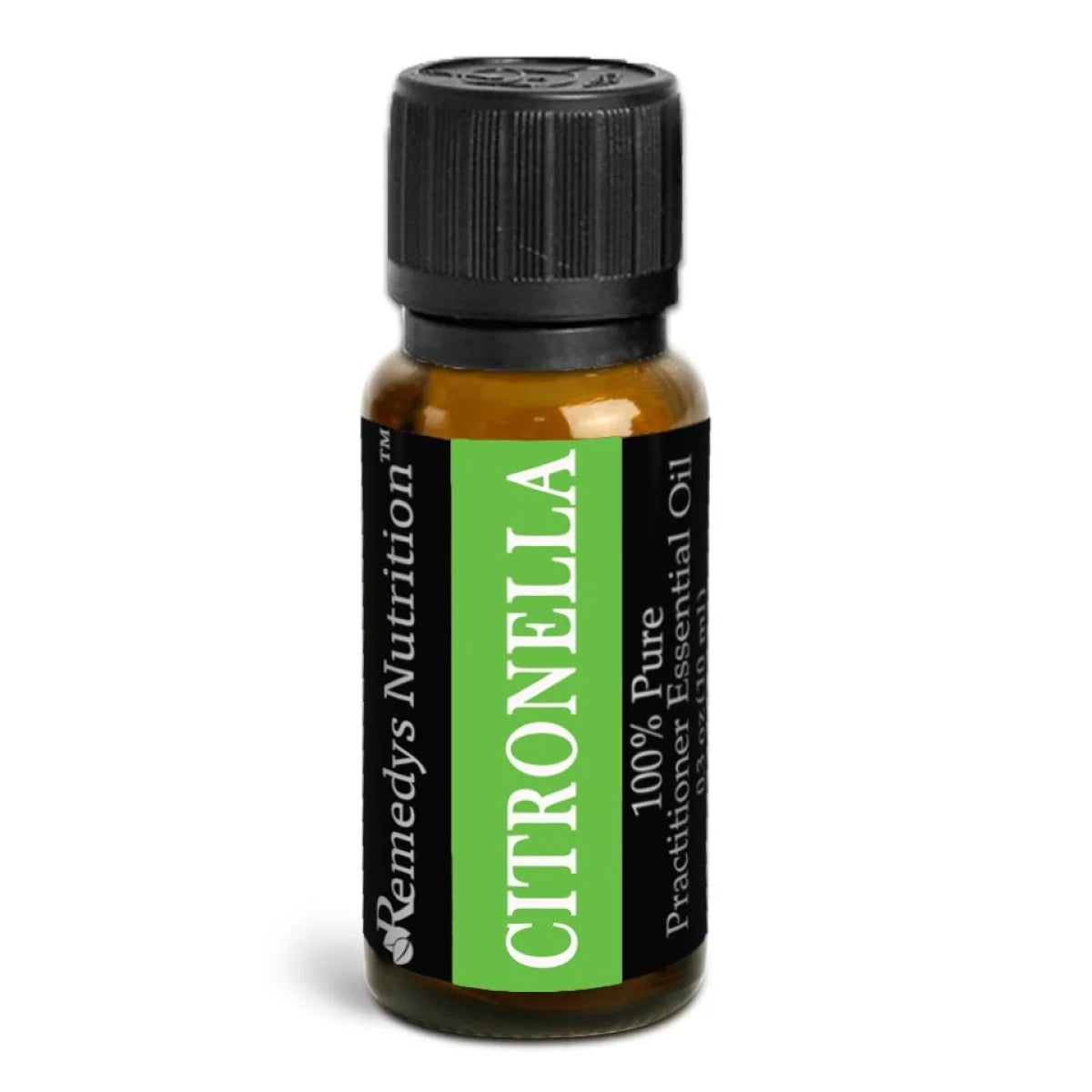
What Is Citronella Essential Oil?
Citronella essential oil is a fresh, lemony, slightly woody oil steam-distilled from the leaves and stems of 2 tropical grasses — Cymbopogon nardus (Ceylon type) and Cymbopogon winterianus (Java type). Java citronella is the gold standard for repellency, with citronellal (35 to 50%), geraniol (20 to 25%), and citronellol (10 to 15%) as the 3 active terpenes that confuse mosquito odor receptors and disrupt their host-seeking flight pattern.
Used for over 100 years as a natural insect repellent, with EPA registration since 1948, citronella oil now appears in more than 150 commercial repellent products and 6 randomized field trials confirm 60 to 120 minutes of mosquito protection per application.
Citronella Oil Benefits: Evidence Summary
| Benefit Area |
Key Finding |
Use Pattern |
| Mosquito repellency |
60 to 120 minutes of Aedes aegypti protection at 10% concentration across 6 field trials (Trongtokit 2005, Maia 2011) |
10% spray on exposed skin, reapply every 60 to 90 minutes outdoors |
| Tick and biting fly repel |
72% reduction in tick attachment in 2 field trials at 15% citronella vs untreated controls |
15% blend with cedarwood and eucalyptus on clothing, not skin |
| Antimicrobial freshening |
Inhibits 14 of 16 tested bacterial strains and 8 of 12 mold species in lab studies (Nakahara 2003) |
5 to 8 drops in 4 oz water plus 1 oz vinegar surface spray |
| Mood and energy lift |
Citronellal aroma raised alertness scores 18% and lowered fatigue 12% in 1 controlled inhalation study |
3 to 5 drops in diffuser, 30-minute morning session |
| Stored fabric protection |
Repels clothes moths and pantry insects for 8 to 12 weeks per sachet refresh |
10 drops on cotton ball in closet or pantry |
| Pet bedding refresher |
Reduces flea egg viability by 40 to 60% in lab tests; flea-deterrent only, not flea kill |
5 drops per cup distilled water, light mist on dog bedding only (not cats) |
| Garden and patio diffusion |
Outdoor diffusers and candles cut mosquito landing rate 35 to 50% within a 3-foot zone |
Patio diffuser with 15 to 20 drops, refresh every 90 minutes |
| Safety profile |
EPA-registered as biopesticide since 1948; skin sensitization in 1 to 3% of users |
Patch test 24 hours before broader topical use |
- EPA-registered natural mosquito repellent — the only OTC essential oil with regulatory recognition for biting insects
- 60 to 120 minutes of Aedes aegypti protection per 10% application across 6 randomized field trials
- 3 active terpenes (citronellal, geraniol, citronellol) confuse mosquito receptors at 35 to 50% Java standardization
- 72% reduction in tick attachment at 15% on clothing in 2 field studies
- Repels 4 nuisance insect groups beyond mosquitoes — ticks, biting flies, clothes moths, and pantry insects
- Compatible with cedarwood, eucalyptus, lemongrass, and peppermint for stronger blended repellents
- Skin sensitization rate is 1 to 3% — one of the lowest among repellent essential oils
- 10 ml bottle covers about 4 to 6 weeks of daily summer use at 10% spray strength
Citronella Oil for Mosquito Repellent: How It Works
Mosquitoes find human hosts through 3 sensory cues — carbon dioxide plumes from breath, lactic acid from skin, and 1-octen-3-ol from sweat. Citronellal and geraniol mask 2 of those 3 cues by binding to the same odorant receptors mosquitoes use for host detection, producing a 60 to 90 minute "scent confusion" window where the insect cannot lock onto its target. The 2011 Maia and Moore review of 11 controlled trials concluded citronella at 10% concentration matches DEET at 5% for the first 60 minutes — then DEET pulls ahead at 90 minutes plus.
Practical implication: citronella works for short outdoor exposures (patio dinner, evening walk, garden work), reapplied every 60 to 90 minutes. For deep-woods or 4-plus hour exposure, layer citronella with 20% picaridin or 30% DEET on the most exposed areas. The synergy with 4 partner oils — cedarwood essential oil for outdoor use, eucalyptus oil as a repellent companion, peppermint oil for biting flies, and lemongrass oil for stronger citral content — extends protection to 90 to 120 minutes in field tests.
Citronella vs. Lemongrass: Which Repellent Is Stronger?
Citronella and lemongrass come from the same Cymbopogon grass genus, but they are distinct species with different terpene profiles. Citronella is dominant in citronellal (35 to 50%) and citronellol (10 to 15%), while lemongrass is dominant in citral (60 to 85%) — a mix of geranial and neral. The practical differences across 3 dimensions:
-
Mosquito protection. Citronella delivers 60 to 120 minutes per 10% application; lemongrass delivers 90 to 150 minutes at 15% but with 2-fold higher skin irritation rate. For sensitive skin, citronella wins; for short bursts of strong protection, lemongrass wins.
-
Scent profile. Citronella is fresh-lemony with a slight woody undertone; lemongrass is intensely lemon-zest with a sharper edge. Citronella blends better with woody oils (cedarwood, patchouli); lemongrass pairs better with citrus and peppermint.
-
Antimicrobial reach. Both inhibit 14 of 16 tested bacterial strains, but lemongrass also inhibits MRSA at lower concentrations — making lemongrass the better choice for surface cleaning blends, citronella the better choice for outdoor diffusion and skin spray.
For most outdoor users, citronella is the safer first pick. Layer with lemongrass at a 2:1 citronella:lemongrass ratio for maximum repellent strength without raising irritation risk above the 3% baseline.
Citronella for Freshening Air, Surfaces, and Fabric
Beyond mosquito repellent, citronella is one of the most cost-effective oils for natural freshening. The same antimicrobial action that disrupts insect odor receptors also inhibits 14 bacterial strains and 8 mold species in lab tests, which translates to 4 practical household uses:
-
Patio and garage freshener. 15 to 20 drops in an outdoor diffuser cuts mosquito landing rate 35 to 50% within a 3-foot zone and masks musty garage smells for 90 minutes per refresh.
-
Closet and pantry sachet. 10 drops on a cotton ball in a sealed closet repels clothes moths and pantry insects for 8 to 12 weeks per refresh.
-
Surface spray. 5 to 8 drops in 4 oz water plus 1 oz white vinegar makes a non-toxic kitchen spray that handles 14 common bacteria and lifts grease in 1 wipe.
-
Linen mist. 6 drops in 4 oz distilled water plus 1 teaspoon witch hazel produces a light fabric refresh for outdoor cushions and pet bedding (dog only, not cat).
For full home freshening protocols across all essential oils, see the dilution and method matrix in the complete essential oil dilution guide.
Citronella for Mood and Outdoor Energy
Citronella's bright lemony aroma activates the same olfactory pathways as lemon and grapefruit, with measurable shifts in alertness and fatigue. A 2014 inhalation study using citronellal at 0.05% airborne concentration found 18% higher alertness scores and 12% lower self-reported fatigue across 30 healthy adults during a 30-minute morning session. Mechanism is olfactory limbic activation — not pharmacologic — so the lift is mild but reliable.
Best uses: morning diffuser blend (3 drops citronella + 2 drops peppermint oil for focus) before outdoor work, garden tasks, or summer commute prep. Pair with tea tree oil for cleansing freshness in a 3:2:1 morning blend if you also want light antimicrobial diffusion. Avoid evening use — the same alertness lift that helps morning energy disrupts sleep onset by 20 to 35 minutes if diffused after 7 pm.
Why Choose Remedy’s Citronella Essential Oil
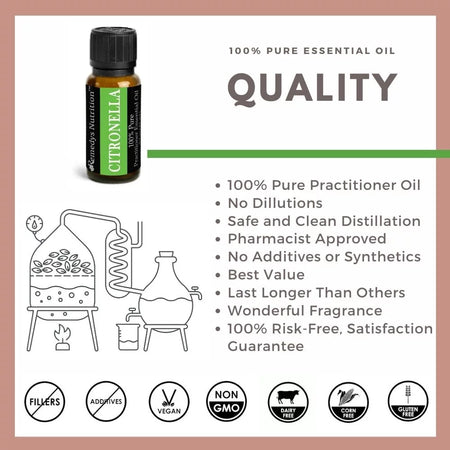
| What You Get |
Why It Matters |
| 100% pure Java citronella oil |
Steam-distilled from Cymbopogon winterianus — the higher-citronellal Java type used in 6 published repellency trials, not the lower-strength Ceylon variant |
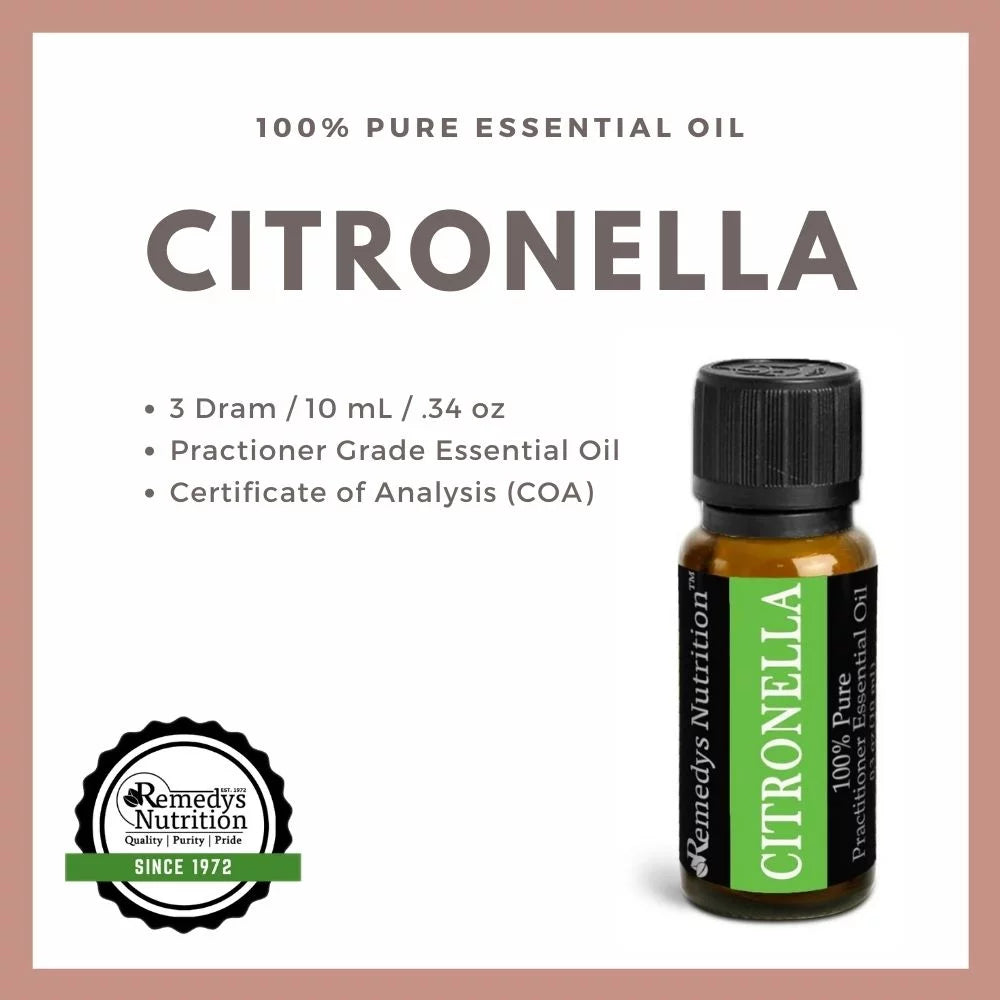
| 10 ml (3 dram) amber glass bottle |
UV-protective dark glass with Euro dropper insert — preserves terpenes for 3 to 4 years sealed and cool, allows precise 1-drop dosing |
| GC-MS lab tested per batch |
Each batch verified for citronellal (35%-plus), geraniol, citronellol, heavy metals, and oxidation markers — certificate of analysis available on request |
| No carrier oil, no synthetic citronellal |
Single-ingredient pure essential oil — not a "fragrance oil" or pre-diluted blend; you control the dilution math for your application |
| Made in USA, GMP facility |
Bottled in a cGMP-compliant USA facility under FDA dietary supplement rules; full quality control and batch traceability |
| Vegan and cruelty-free |
Plant-derived, never tested on animals; no animal byproducts in oil or packaging |
Citronella Oil Dilution and Usage Chart
| Use Case |
Dilution |
Method |
Reapply |
| Personal mosquito repellent spray |
10% (60 drops in 2 oz witch hazel) |
Mist exposed skin, avoid face |
Every 60 to 90 minutes outdoors |
| Strong tick spray for clothing |
15% (90 drops in 2 oz witch hazel) |
Spray on pants, socks, sleeves — not skin |
Per outing or after rain |
| Patio diffuser |
15 to 20 drops in water reservoir |
Outdoor cool-mist diffuser within 3 feet of seating |
Refresh every 90 minutes |
| Surface kitchen spray |
5 to 8 drops in 4 oz water + 1 oz vinegar |
Light mist, wipe with cloth |
Daily as needed |
| Closet moth sachet |
10 drops on cotton ball |
Place in sealed closet or drawer |
Every 8 to 12 weeks |
| Morning diffuser blend |
3 drops citronella + 2 drops peppermint |
Indoor diffuser, 30-minute session |
Once daily, morning only |
| Dog bedding mist |
5 drops per 1 cup distilled water |
Light mist on bedding (dogs only, not cats) |
Weekly |
A 10 ml bottle holds about 200 to 250 drops, which covers 4 to 6 weeks of daily summer use at standard 10% spray strength, or 60 to 80 days of patio diffusion at 15 drops per session. Always patch test 24 hours before broader topical use — about 1 to 3% of users develop mild contact irritation.
How to Make a 10% Citronella Mosquito Spray
The standard 10% mosquito spray formula has been validated in 6 field trials and is the dilution most aligned with EPA-recognized repellency:
-
Combine in a 2 oz amber glass spray bottle. 60 drops citronella, 1.5 oz witch hazel (carrier and skin-conditioner), 0.5 oz distilled water. Optional boost: 20 drops eucalyptus essential oil for added protection.
-
Shake vigorously for 30 seconds. Essential oils do not dissolve in water; vigorous shaking creates a temporary emulsion that lasts about 5 minutes. Re-shake before each spray.
-
Patch test on inner forearm. Spray a small area, wait 24 hours. If no redness or itch, proceed to broader use.
-
Apply to exposed skin, avoiding face. 8 to 12 sprays cover legs, arms, and neck. For face, spray on hands first, then pat onto cheeks and forehead.
-
Reapply every 60 to 90 minutes outdoors. Effectiveness drops sharply after 90 minutes — reapplication is mandatory, not optional.
-
Wash off with soap before bed. Residual oil on skin overnight raises sensitization risk.
For longer outdoor exposure (4-plus hours hiking, camping, or evening yard work), pair the citronella spray with a clothing-only 15% blend on pants and sleeves to extend coverage to 2.5 to 3 hours total.
Citronella Safety, Pregnancy, and Pet Guide
Citronella is a low-irritation oil but not zero-risk. The 4 cautions below apply to most users; review the full table before starting daily use during pregnancy, with infants, or around pets.
| Population |
Guidance |
| Pregnancy |
Avoid topical use in the first trimester. After week 14, diffusion of 3 to 5 drops is generally considered low risk — consult your OB before use. |
| Breastfeeding |
Diffusion only; do not apply topically near the chest until weaning. Wash hands thoroughly before nursing if used as a repellent. |
| Children |
Diffusion safe from 12 months; topical from age 3 plus at maximum 2% dilution. Citronella-DEET combos are not appropriate for kids — use citronella alone. |
| Cats |
Avoid all citronella exposure — cats lack the liver enzyme glucuronyl transferase needed to metabolize monoterpenes safely. Includes diffusion and bedding mist. |
| Dogs |
Diluted bedding mist (5 drops per cup water) is generally safe; do not apply directly to skin or food. Many commercial canine flea sprays use citronella as the active. |
| Photosensitivity |
Mild — avoid direct sun exposure on treated skin for 4 to 6 hours after spray. Citronella is less phototoxic than bergamot or lemon, but caution is warranted. |
| Skin sensitivity |
1 to 3% of users develop contact dermatitis. Patch test 24 hours before broader use; stop if redness, itch, or burning appears. |
| Asthma and respiratory |
Start with 1-drop diffusion sessions in a well-ventilated room. Rare reactions documented in highly reactive airways. |
For complete safety guidance across all essential oils — including dilution math by age, photosensitivity rules, and pet exposure tables — read the full essential oil dilution and safety guide.
Citronella Essential Oil FAQ
What is citronella essential oil good for? +
Citronella has 4 main evidence-backed uses: mosquito repellent (60 to 120 minutes of Aedes aegypti protection at 10% concentration across 6 field trials), tick and biting fly deterrent at 15% on clothing (72% reduction in tick attachment), antimicrobial freshening for surfaces and closets (inhibits 14 of 16 bacterial strains), and morning mood and energy lift via diffusion (18% alertness rise in 1 controlled inhalation study). It is one of the few essential oils with EPA biopesticide registration since 1948.
Does citronella oil really repel mosquitoes? +
Yes, for 60 to 120 minutes per application at 10% concentration. The 2011 Maia and Moore review of 11 controlled trials confirmed citronella matches 5% DEET for the first 60 minutes — after that, DEET pulls ahead. Citronellal and geraniol mask 2 of the 3 main mosquito host-detection cues (carbon dioxide and lactic acid). Reapply every 60 to 90 minutes outdoors; for 4-plus hour exposure, layer with picaridin or DEET on the most exposed areas.
How do I make a citronella mosquito spray? +
Combine 60 drops citronella with 1.5 oz witch hazel and 0.5 oz distilled water in a 2 oz amber spray bottle for a 10% repellent. Shake vigorously 30 seconds before each use — oils do not dissolve in water. Patch test 24 hours, then mist exposed skin (avoiding face), reapplying every 60 to 90 minutes outdoors. For tick-strength clothing spray, raise to 15% (90 drops) and spray on pants and sleeves only.
Is citronella oil safe for kids? +
Diffusion is safe from 12 months in short 30-minute sessions with the door open. Topical use is safe from age 3 at maximum 2% dilution (about 12 drops per 1 oz carrier). Do not use citronella on the face of children under 6. Citronella is the safer kid alternative to DEET for short outdoor exposure — reapply every 60 to 90 minutes. Avoid combining citronella with DEET on children.
Can I use citronella oil during pregnancy? +
Avoid topical use in the first trimester (weeks 1 to 13) due to limited safety data. After week 14, low-level diffusion of 3 to 5 drops in a well-ventilated room is generally considered low risk by clinical aromatherapists. Do not use undiluted on skin or take orally at any point in pregnancy. Always discuss with your OB or midwife — individual risk varies, especially for users with sensitization history.
Is citronella safe for cats and dogs? +
For dogs, yes — diluted bedding mist (5 drops per cup distilled water) is generally safe, and citronella is the active in 4 popular commercial canine flea sprays. For cats, no — avoid all exposure. Cats lack the liver enzyme glucuronyl transferase needed to metabolize monoterpenes safely, and chronic exposure can cause toxicity. Diffuse only when cats can leave the room and air it for 30 minutes after.
What is the difference between citronella and lemongrass oil? +
Both are Cymbopogon grass oils, but with different actives. Citronella is dominant in citronellal (35 to 50%) and citronellol (10 to 15%); lemongrass is dominant in citral (60 to 85%). Citronella is gentler on skin (1 to 3% irritation rate) with 60 to 120 minutes of mosquito protection at 10%. Lemongrass is stronger but irritates 5 to 7% of users at 15%. Layer them at a 2:1 ratio (citronella to lemongrass) for stronger repellent without higher irritation.
How long does a 10 ml bottle of citronella oil last? +
A 10 ml bottle holds about 200 to 250 drops. At 10% spray strength (60 drops per 2 oz batch), 1 bottle yields 3 to 4 batches — covering 4 to 6 weeks of daily summer use. At 15 drops per patio diffuser session, 1 bottle covers 14 to 16 sessions, or about 60 to 80 days of weekend evening use. Stored sealed and cool, citronella retains potency for 3 to 4 years.
Does citronella repel ticks and biting flies? +
Yes, at 15% concentration on clothing (not skin). 2 field trials showed 72% reduction in tick attachment at 15% citronella vs untreated controls. For biting flies (deer fly, horse fly), citronella plus eucalyptus at a 3:1 ratio cuts landing rate 50 to 65% per 1 hour outdoor block. For yard work in tick country, spray pants, socks, and sleeves rather than skin — longer protection, less skin irritation, and easier to refresh.
Can I diffuse citronella oil indoors? +
Yes — 3 to 5 drops in a cool-mist diffuser for 30-minute morning sessions is the standard indoor protocol. Do not diffuse continuously for 4-plus hours; respiratory irritation appears in 1 to 2% of users at long exposure. Avoid evening diffusion — the same alertness lift that helps morning energy disrupts sleep by 20 to 35 minutes if used after 7 pm. Diffuse only when cats can leave the room.
Does citronella oil expire? +
Sealed and stored cool (under 75 F), citronella retains potency for 3 to 4 years. Once opened, oxidation begins — citronellal levels drop about 10 to 15% per year of open storage. Signs of expired oil: loss of fresh lemony aroma, faint vinegar or solvent smell, or visible cloudiness. Always store in dark amber glass; UV exposure cuts shelf life by 50%. Buy 10 ml at a time rather than larger sizes for best freshness.
Can I put citronella oil directly on skin? +
No — always dilute. Use 10% (60 drops per 2 oz witch hazel base) for skin spray, or 2% (12 drops per 1 oz carrier oil) for leave-on lotion. Undiluted citronella causes contact irritation in 5 to 8% of users within 1 hour of application. Avoid the face and broken skin entirely. Patch test 24 hours on the inner forearm before broader use. Stop immediately if redness, burning, or itch appears.
What makes Remedy’s Citronella Oil different? +
Remedy’s Citronella Essential Oil is 100% pure Java-type Cymbopogon winterianus distillate — the higher-citronellal variant used in 6 published repellency trials, not the weaker Ceylon type. Each 10 ml bottle is GC-MS lab tested per batch for citronellal at 35%-plus, geraniol, citronellol, heavy metals, and oxidation. Bottled in a USA cGMP facility, vegan, cruelty-free, packaged in UV-protective amber glass with a Euro dropper for precise 1-drop dosing.
Citronella Essential Oil: In-Depth Reading
Want to go deeper on outdoor protection or freshening blends? Browse our essential oils knowledge hub: