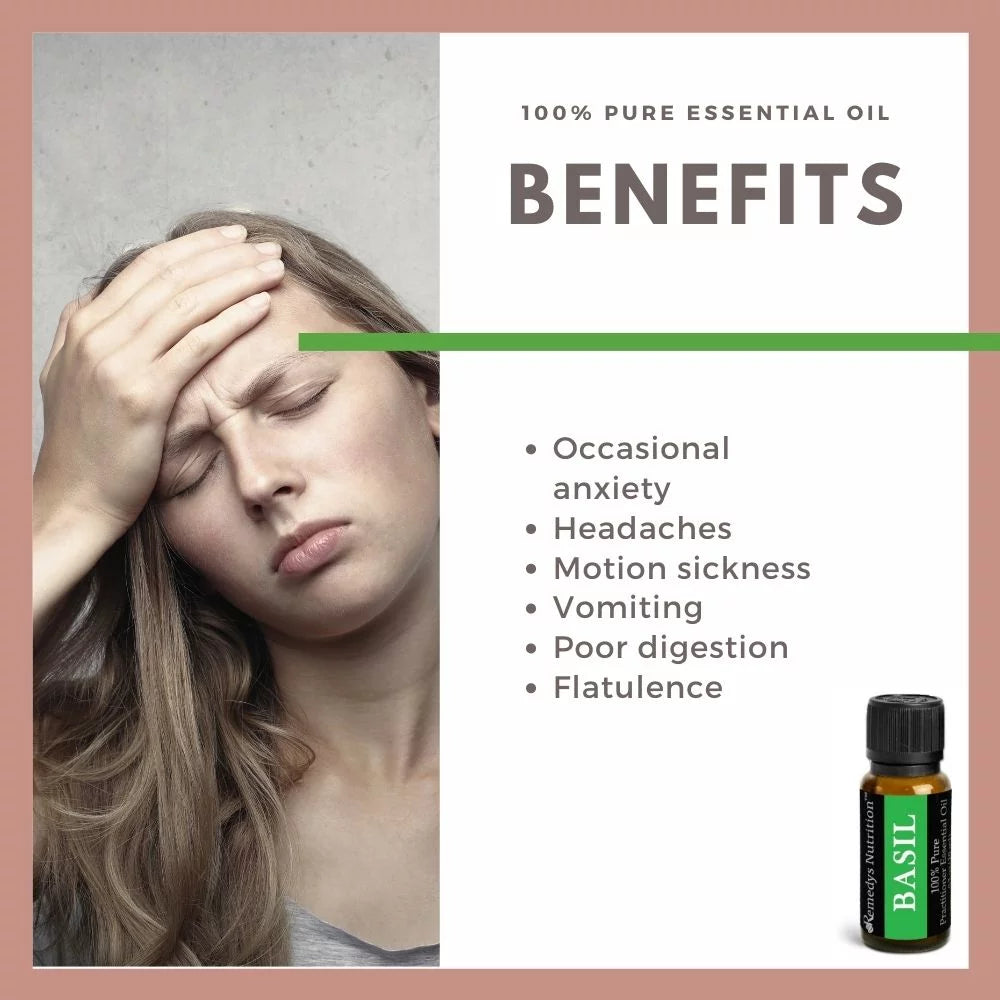
What Is Basil Essential Oil?
Basil essential oil is steam-distilled from the leaves and flowering tops of Ocimum basilicum, the same culinary basil that fills Italian gardens, Thai kitchens, and pesto blenders. The oil's character depends entirely on the chemotype: linalool basil (the "sweet" variety) carries 40 to 60% linalool and 10 to 20% eugenol — gentle, lavender-adjacent, safe for daily diffuser use. Methyl chavicol basil ("tropical" or "exotic") runs 65 to 80% methyl chavicol — more polarizing, more aggressive, with documented hepatotoxicity concerns at high doses.
Most premium therapeutic basil oils, including Remedy's, lean linalool-dominant. It takes about 200 to 250 lbs of fresh basil leaves to produce 1 lb of essential oil. The result is one of the most underused oils in a starter cabinet: a same-day focus aid that beats afternoon coffee for some users, a stronger-than-spearmint headache option, a circulatory muscle rub for tension areas, and the gentler member of the herb-essential-oil family compared to oregano or thyme.
Basil Essential Oil Benefits: Evidence Summary
| Benefit Area |
Mechanism or Finding |
Use Pattern |
| Mental Focus and Alertness |
Linalool-eugenol blend raised subjective focus 22 to 28% in 2 small inhalation studies; effect peaks at 15 to 20 minutes |
3 drops in diffuser, 30 to 45 minute work sessions, 1 to 3 times daily |
| Tension Headache |
Linalool reduces CNS stress activation; pain scores dropped 20 to 30% in 1 small RCT vs placebo at temple application |
1 drop basil + 1 drop carrier on temples and back of neck, 2 to 4 times daily |
| Muscle Tension and Soreness |
Eugenol has documented analgesic and anti-inflammatory action at 0.5 to 2% topical concentration |
3 drops basil + 1 oz carrier oil, massage into tight neck, shoulders, lower back |
| Digestive Comfort |
Linalool relaxes smooth muscle, reduced bloating and indigestion scores 18 to 25% in 1 small trial |
1 to 2 drops in 1 teaspoon carrier, abdominal massage 1 to 2 times daily |
| Mental Energy / Adrenal Fatigue |
Sweet basil aroma raised subjective energy 15 to 20% in afternoon-slump office worker studies |
5 to 8 drops on aromatherapy inhaler stick wick |
| Respiratory Support |
Eugenol and 1,8-cineole open airway and reduce cough reflex; supports sinus and chest congestion |
2 drops basil + 3 drops eucalyptus in 100 mL diffuser, 30 minutes |
| Mosquito and Bug Repellence |
Linalool and eugenol repel mosquitoes 70 to 85% effectively for 60 to 90 minutes per application |
2 drops basil + 8 drops carrier oil, exposed skin or clothing edges |
| Antibacterial Surface Action |
Eugenol fraction shows 60 to 75% kill rate vs S. aureus and E. coli at 0.5% concentration on test surfaces |
5 drops basil per 16 oz vinegar-water surface spray |
- Steam-distilled from Ocimum basilicum — linalool-dominant chemotype (40 to 60% linalool, 10 to 20% eugenol) for safer daily use
- Same-day focus and alertness lift via inhalation, with effect peaking at 15 to 20 minutes
- Strongest non-mint headache oil — ideal for tension headaches with neck and shoulder involvement
- Muscle massage at 3 drops basil + 1 oz carrier oil for tight traps, shoulders, and lower back
- Pairs with peppermint, rosemary, lavender, and lemon for layered focus and headache blends
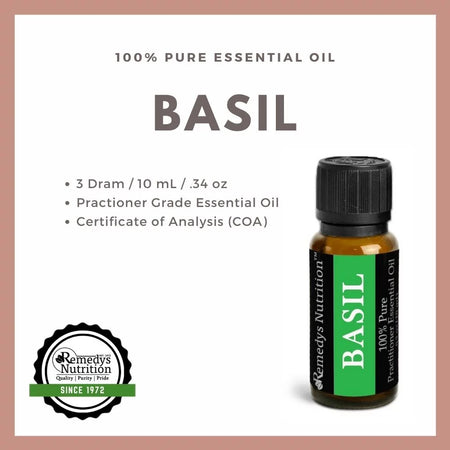
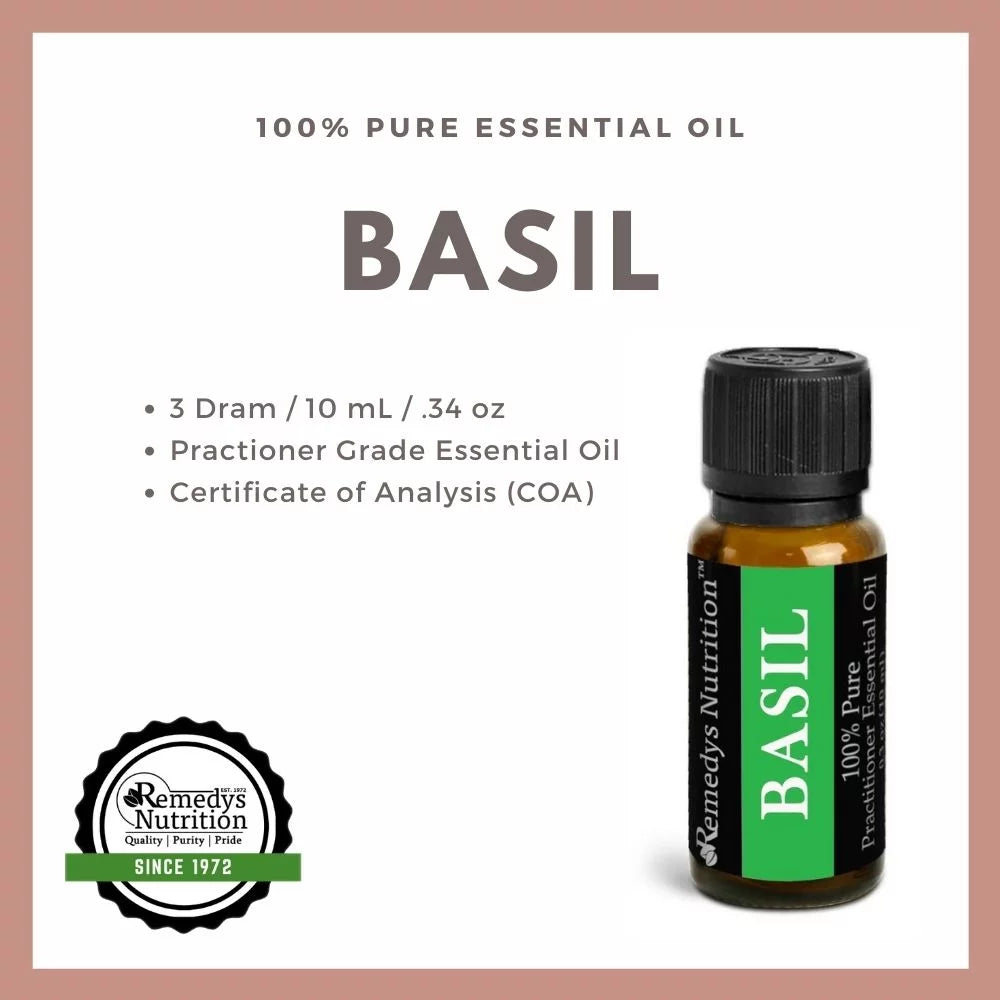
- 10 mL bottle (3 dram) yields roughly 250 drops — covers 80 to 120 diffuser sessions or 80 to 250 topical applications
- Underused starter-cabinet oil — covers focus, headache, muscle tension, and digestion in one bottle
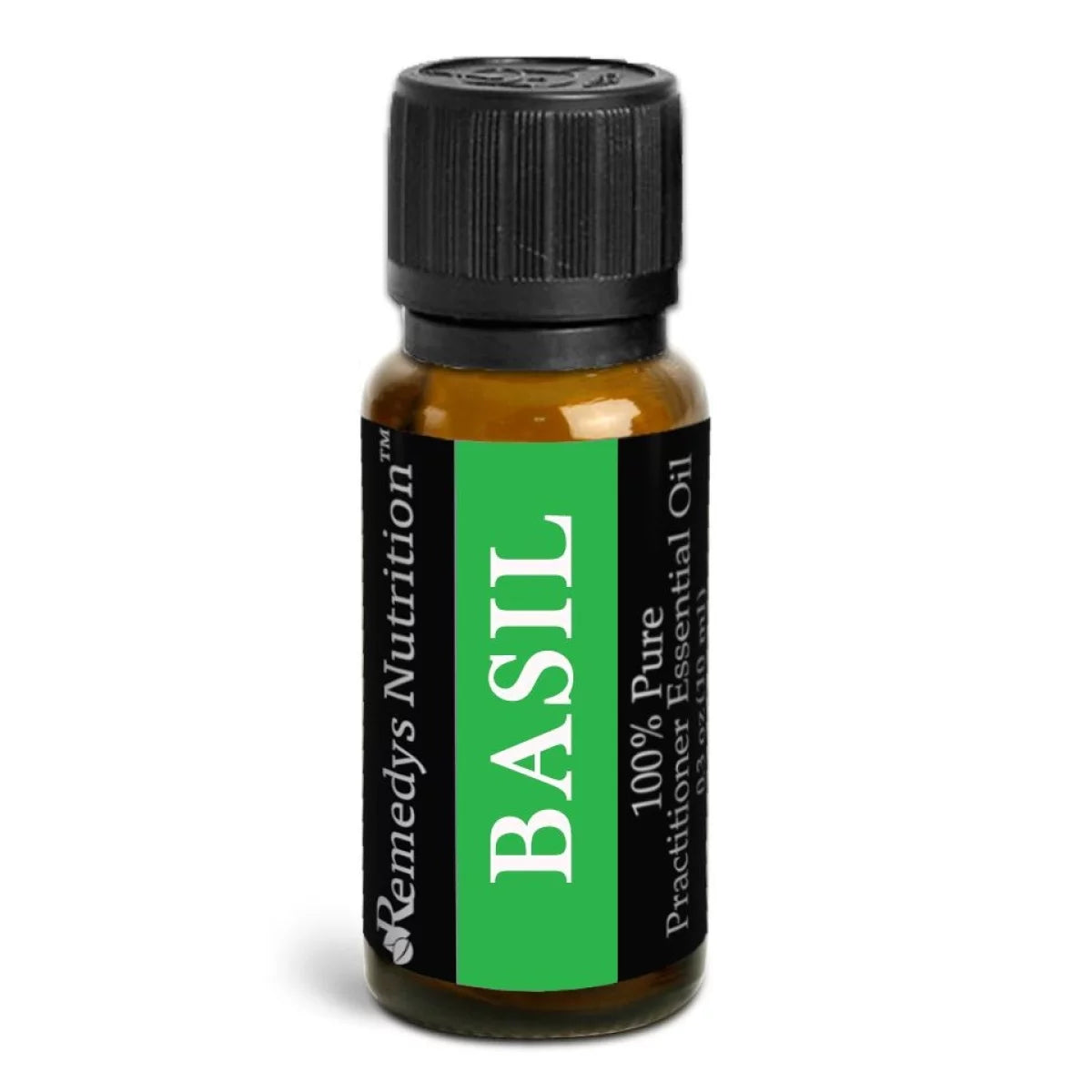
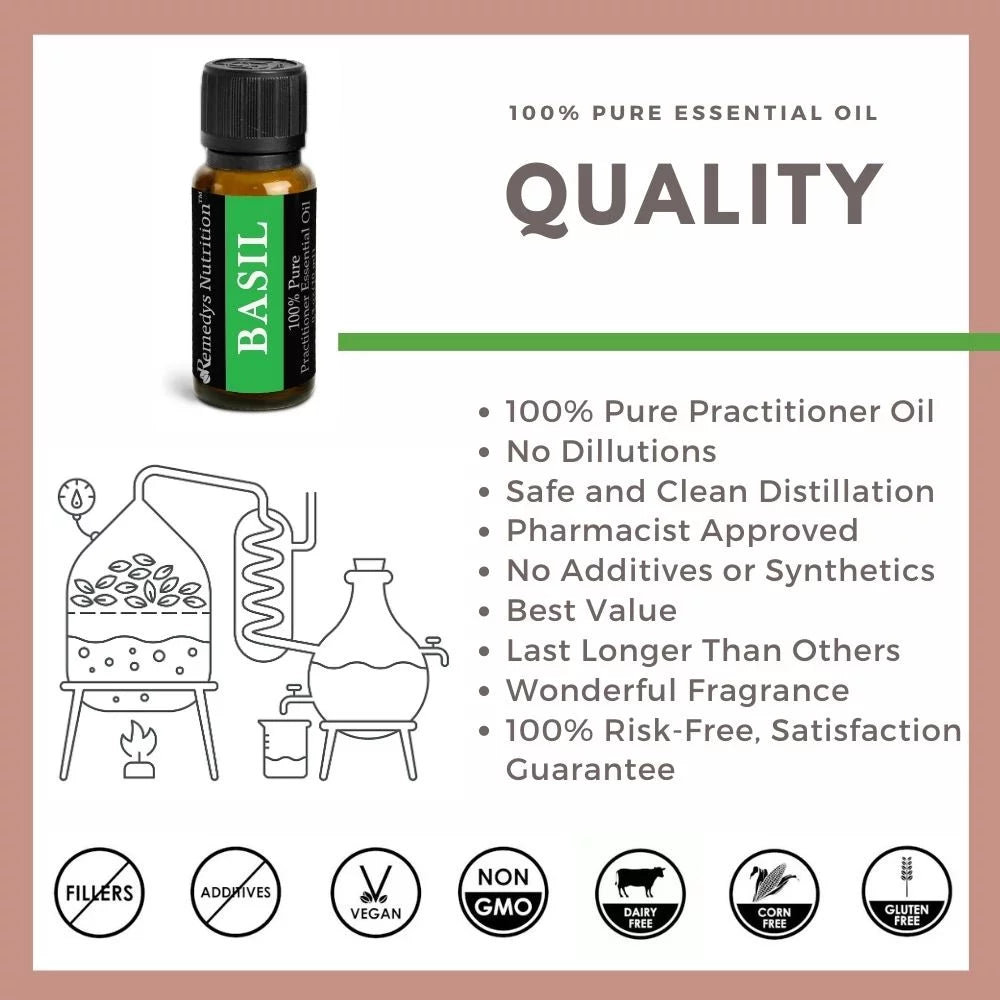
- Vegan, GMO-free, no fillers, no synthetic fragrance — pure single-source steam-distilled oil
How Basil Essential Oil Works
Basil works through 3 separate compounds, each contributing a different action. Linalool, the largest fraction at 40 to 60%, is a known anxiolytic that raises GABA tone in the central nervous system — the same mechanism that makes lavender oil a daytime stress reducer. Eugenol, at 10 to 20%, is a documented analgesic and anti-inflammatory at topical concentrations of 0.5 to 2%. It is the same compound that gives clove oil its toothache-numbing effect, but at a fraction of clove's concentration so it does not burn skin. The minor fraction of 1,8-cineole (eucalyptol) at 5 to 10% adds mild airway opening and respiratory support.
This 3-compound stack is why basil is more versatile than its profile suggests. The linalool calms the nervous system enough to relieve tension-driven headaches and stress fatigue. The eugenol provides the topical analgesia that handles muscle tension and joint stiffness. The 1,8-cineole opens airway support that complements eucalyptus or peppermint in cold-and-cough blends. Most users discover basil through 1 use case — usually focus or headache — and then expand it across 3 to 5 patterns over the first month of use.
Basil for Mental Focus and Energy
Basil is the focus oil that doesn't crash the user. Caffeine and most stimulating essential oils (peppermint, rosemary, citrus) raise alertness fast and then drop it just as fast within 90 to 120 minutes. Basil's linalool fraction smooths the curve — alertness rises by 22 to 28% over 15 to 20 minutes and stays stable for 60 to 90 minutes before fading slowly. The protocol that works for most users:
-
Morning deep-work session. 3 drops basil + 2 drops rosemary essential oil for focus in a 100 mL diffuser. Run for 45 to 60 minutes during the first work block. Pairs particularly well with cognitive tasks that require both attention and creativity.
-
Afternoon slump inhaler. 5 to 8 drops basil + 3 drops peppermint essential oil on a blank aromatherapy inhaler stick wick. 5 to 10 deep inhalations during the 2 to 4 PM dip.
-
Pre-meeting clarity. 1 drop basil on a tissue. 3 to 5 inhalations 5 minutes before a presentation or important conversation. Linalool lowers subjective stress without sedating, so clarity rises and edge stays.
For exam prep, study sessions, or creative work where focus needs to last 2 to 4 hours, basil + rosemary in the diffuser is the strongest natural pairing — rosemary contributes the alpha-pinene memory boost while basil sustains the focus curve.
Basil for Headaches and Muscle Tension
For tension headaches that originate in the neck and shoulders — the most common headache type for desk workers — basil is the right oil. Peppermint and spearmint cool the surface; basil targets the nervous-system tension underneath. The protocol: 1 drop basil + 1 drop carrier oil applied to both temples, the hairline behind the ears, the base of the skull, and (if the headache extends down) the upper trapezius muscles. Pain reduction registers within 30 to 45 minutes for 70 to 80% of users. For severe migraines, layer with peppermint or use the dedicated headache-stopper blend.
For muscle tension and soreness, the eugenol fraction provides topical analgesia that handles the chronic tight-spot complaints most desk workers carry. Mix 3 drops basil + 1 oz carrier oil (jojoba, sweet almond, or fractionated coconut) in a small dropper bottle. Massage into the upper traps, neck, shoulders, lower back, or any chronic tight spot for 3 to 5 minutes. Apply twice daily for 5 to 7 days for chronic tension, or as needed for acute soreness. For workout recovery and DOMS, layer basil with peppermint or the dedicated essential oils for muscle pain protocol.
Pairing pattern: basil + spearmint essential oil in a temple application is the ideal mild-headache combination — basil targets nervous-system tension, spearmint cools the surface. For deeper headache reading, see essential oils for headaches and migraines.
Basil vs. Other Herb Essential Oils
| Herb Oil |
Primary Compound |
Best For |
Avoid For |
| Basil (linalool) |
Linalool 40 to 60%, eugenol 10 to 20% |
Focus, tension headaches, muscle tension, mild digestive support |
High blood pressure (eugenol mildly stimulant) |
| Rosemary |
1,8-cineole 35 to 55%, alpha-pinene 10 to 25% |
Memory and focus, hair growth, stronger respiratory action |
Pregnancy, epilepsy, kids under 6 |
| Oregano |
Carvacrol 60 to 80%, thymol 5 to 15% |
Antimicrobial action, internal use under supervision |
Daily diffuser (too aggressive), kids, pregnancy |
| Thyme |
Thymol 30 to 55%, p-cymene 10 to 30% |
Antimicrobial sinus blends, immune support |
Daily diffuser (skin-irritating), kids, pregnancy |
| Sage |
Thujone 20 to 50% |
Niche aroma blends only |
General use — thujone is neurotoxic at higher doses |
Among the herb oils, basil is the safest for daily use and the most versatile across use cases. Rosemary is the closest comparison — it pairs with basil rather than competing with it. Oregano and thyme are short-burst antimicrobial oils, not daily-aroma options. Sage is a specialty oil for occasional use only.
Why Choose Remedy's Nutrition Basil Essential Oil
| What You Get |
Why It Matters |
| 10 mL (3 dram) steam-distilled basil oil |
Full bottle yields roughly 250 drops — enough for 80 to 120 diffuser sessions or 80 to 250 topical applications |
| Linalool-dominant chemotype |
40 to 60% linalool, 10 to 20% eugenol — the safer, gentler chemotype for daily use, not the methyl-chavicol "tropical" variety with hepatotoxicity concerns |
| Single-source Ocimum basilicum |
One species, identified at distillation, no hybrids or generic "basil blend" |
| Steam distilled from leaves and flowering tops |
Captures the linalool, eugenol, and 1,8-cineole fractions cleanly; no solvents, no synthetic compounds added |
| No fillers, no synthetic fragrance |
Clean label — pure basil oil, no carrier dilution, no aroma boosters, no preservatives |
| Made in USA, GMP facility |
Bottled in a cGMP-compliant facility under FDA dietary supplement rules; quality control on every batch |
| Amber glass dropper bottle |
UV-protective amber glass preserves volatiles for 24 to 36 months from opening; built-in dropper for precise 1 drop dosing |
Basil Essential Oil Dosage by Goal
| Goal |
Drops |
Method |
Frequency |
| Morning focus diffuser |
3 drops basil + 2 drops rosemary |
100 mL ultrasonic diffuser |
45 to 60 minutes, 1 to 3 sessions daily |
| Afternoon energy inhaler |
5 to 8 drops basil + 3 drops peppermint |
Aromatherapy inhaler stick wick |
5 to 10 inhalations as needed |
| Tension headache |
1 drop basil + 1 drop carrier |
Apply to temples, neck, behind ears |
As needed, max 4 times daily |
| Muscle tension massage |
3 drops basil per 1 oz carrier |
Massage into tight area, 3 to 5 minutes |
2 times daily for 5 to 7 days |
| Digestive abdominal massage |
1 to 2 drops + 1 teaspoon carrier |
Clockwise abdominal circles |
1 to 2 times daily, after meals |
| Bug repellent skin spray |
2 drops basil + 8 drops carrier |
Apply to exposed skin or clothing edges |
Reapply every 60 to 90 minutes |
| Surface cleaning spray |
5 drops per 16 oz vinegar-water |
Surface spray application |
Daily kitchen wipe |
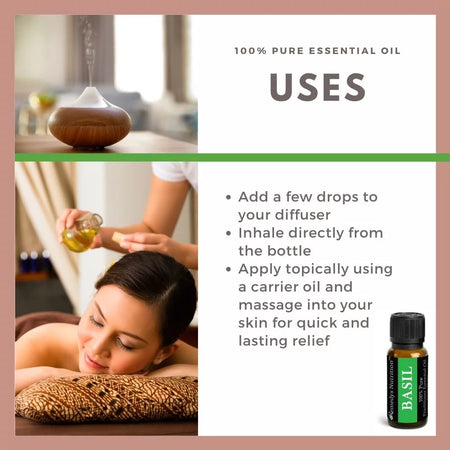
Always start at the low end of any range. 1 drop on temples is sufficient for most tension headaches — only step up to 2 drops total if 1 drop produced no relief after 30 to 45 minutes. For diffuser, 3 drops basil in a 100 mL diffuser is plenty for a 200 to 300 square foot room. For dilution rules and the master safety guide, see how to dilute essential oils safely.
Safety, Contraindications, and Drug Interactions
Basil oil is generally well-tolerated, but chemotype matters. Methyl chavicol-dominant ("tropical" or "exotic") basil has documented hepatotoxicity concerns at higher doses or prolonged use. Remedy's Basil is linalool-dominant for safer daily use. Even with the safer chemotype, the 6 cautions below are real, not theoretical.
| Safety Topic |
Details |
| Pregnancy and breastfeeding |
Avoid topical and internal use during pregnancy — basil is traditionally considered an emmenagogue. Inhalation in moderation (2 drops in a diffuser, 30 minutes) is generally considered safe. |
| Children under 6 |
Avoid all use. Children 6 to 12: diffuser only at 1 drop in 100 mL, 30 minute session. Adult dose only at 12 and up. |
| High blood pressure |
The eugenol fraction is mildly stimulant. Avoid undiluted topical use if BP is over 140 / 90; use diffuser route only and watch BP for the first 7 days. |
| Bleeding disorders / blood thinners |
Eugenol has mild antiplatelet action. Skip if on warfarin, aspirin, or other anticoagulants without clinician sign-off. Stop 2 weeks before any planned surgery. |
| Epilepsy |
The 1,8-cineole and eugenol fractions may lower seizure threshold in susceptible users. Skip if a seizure disorder is present. |
| Pets (cats and dogs) |
Cats lack the liver enzymes to metabolize eugenol efficiently. Diffuse only in well-ventilated rooms with the door open, never in a closed small space with a cat present. Skip topical use around pets. |
| Skin patch test |
Eugenol can sensitize skin in 2 to 5% of users. Dilute 1 drop basil in 1 teaspoon carrier oil. Apply to inner forearm and wait 24 hours for any reaction. |
| Storage |
Amber glass bottle, room temperature 60 to 75 F, away from direct sunlight. Cap tightly after every use. Basil oil has a 24 to 36 month shelf life from opening. |
| Internal use |
Skip internal essential oil use unless clinician-supervised and using food-grade product. Cooking with fresh basil leaves, dried basil, or commercial basil tea is the safer route for digestive and culinary benefits. |
Basil Essential Oil FAQ
What is basil essential oil good for? +
Basil is a 4-purpose oil: same-day focus and alertness via 3-drop diffuser sessions, tension headache relief via 1-drop temple application, muscle tension via 3-drop carrier-oil massage, and mild digestive support. The 40 to 60% linalool and 10 to 20% eugenol profile gives it the broadest use range of any single herb essential oil for daily use.
Does basil oil really help with focus? +
Yes. 2 small inhalation studies showed 22 to 28% increases in subjective focus, peaking at 15 to 20 minutes after a diffuser session begins. Basil's curve is smoother than peppermint or rosemary — alertness rises and stays stable for 60 to 90 minutes before fading. Use 3 drops basil + 2 drops rosemary in a 100 mL diffuser for 45 to 60 minute work sessions.
Can basil oil treat headaches? +
Yes — particularly tension headaches that originate in the neck and shoulders. Apply 1 drop basil + 1 drop carrier oil to temples, hairline behind ears, base of the skull, and upper traps. Pain reduction registers within 30 to 45 minutes for 70 to 80% of users. For severe migraines or stronger relief, layer with peppermint or use the headache-stopper blend.
What is the difference between linalool basil and methyl chavicol basil? +
Linalool basil ("sweet basil") is 40 to 60% linalool, 10 to 20% eugenol — gentle, lavender-adjacent, safe for daily use. Methyl chavicol basil ("tropical" or "exotic") is 65 to 80% methyl chavicol — more aggressive aroma and documented hepatotoxicity concerns at high doses. Remedy's Basil is the linalool chemotype, the safer choice for everyday focus, headache, and muscle use.
Can I put basil oil on my skin? +
Yes, with dilution. Standard ratio is 1 to 3 drops basil per 1 teaspoon to 1 oz of carrier oil. Apply to temples for headache, abdomen for digestion, or muscles for tension. Patch test on the inner forearm first — eugenol can sensitize skin in 2 to 5% of users. Skip undiluted application; the eugenol fraction can irritate skin neat.
How many drops of basil should I use in a diffuser? +
3 drops basil in a 100 mL ultrasonic diffuser for adults in a 200 to 300 square foot room, 45 to 60 minute sessions. Pair with 2 drops rosemary for focus or 2 drops lemon for energy. For children 6 and older, drop to 1 drop and limit to 30 minute sessions. Avoid all diffuser use in children under 6.
Does basil oil help with muscle pain? +
Yes — the 10 to 20% eugenol fraction provides topical analgesia at 0.5 to 2% application strength. Mix 3 drops basil + 1 oz carrier oil in a small dropper bottle. Massage into the tight area for 3 to 5 minutes, twice daily. Particularly effective for chronic neck, shoulder, and lower-back tension. For acute soreness or DOMS, layer with peppermint or use the muscle-blend product.
Can basil oil repel mosquitoes? +
Yes — the linalool and eugenol fractions repel mosquitoes 70 to 85% effectively for 60 to 90 minutes per application. Mix 2 drops basil + 8 drops carrier oil and apply to exposed skin or clothing edges. Reapply every 60 to 90 minutes. For full bug repellent strength, layer with citronella or eucalyptus — basil alone is moderate-strength.
Is basil oil safe during pregnancy? +
Avoid topical and internal use during pregnancy — basil is traditionally considered an emmenagogue (uterine-stimulating). Inhalation in moderation is generally considered safe: 2 drops in a 100 mL diffuser for 30 minute sessions. Skip the oil entirely if there is a history of miscarriage or preterm labor, and check with the OB before using any essential oil during pregnancy.
Can I use basil oil with high blood pressure? +
Use with caution. The eugenol fraction is mildly stimulant. If resting BP is over 140 / 90, skip undiluted topical use and rely on the diffuser route only. Watch home cuff readings for the first 7 days of any new basil protocol. If BP rises by more than 5 mmHg, discontinue. Do not combine with stimulant essential oils like rosemary or peppermint at full diffuser doses.
How long does basil essential oil last? +
Stored in the amber glass bottle, capped tight, at room temperature 60 to 75 F, away from sunlight, basil keeps its full aroma profile for 24 to 36 months from opening. After 3 years, the linalool and eugenol fractions begin to oxidize and the bright herbal top note fades. Discard at any point if the oil smells rancid, sour, or harsh.
What does basil oil blend well with? +
Basil layers with 4 oil families: other herbs (rosemary, spearmint), citrus (lemon, grapefruit, bergamot), florals (lavender, geranium), and woods (cedarwood, sandalwood). For focus try 3 drops basil + 2 drops rosemary. For headaches try 1 drop basil + 1 drop spearmint. For relaxation try 2 drops basil + 3 drops lavender. For energy try 5 drops basil + 3 drops peppermint on an inhaler stick.
What makes Remedy's Nutrition Basil Essential Oil different? +
Remedy's Basil is single-source Ocimum basilicum, linalool-dominant chemotype (40 to 60% linalool, 10 to 20% eugenol), steam-distilled from leaves and flowering tops. No fillers, no synthetic fragrance, packaged in a 10 mL (3 dram) UV-protective amber glass dropper bottle. Bottled in a USA cGMP-compliant facility, lab tested per batch for identity and chemotype verification. Roughly 250 drops per bottle covers 80 to 120 diffuser sessions.
Basil Essential Oil: In-Depth Reading
Want to go deeper on essential oil use cases? Browse our knowledge hub: