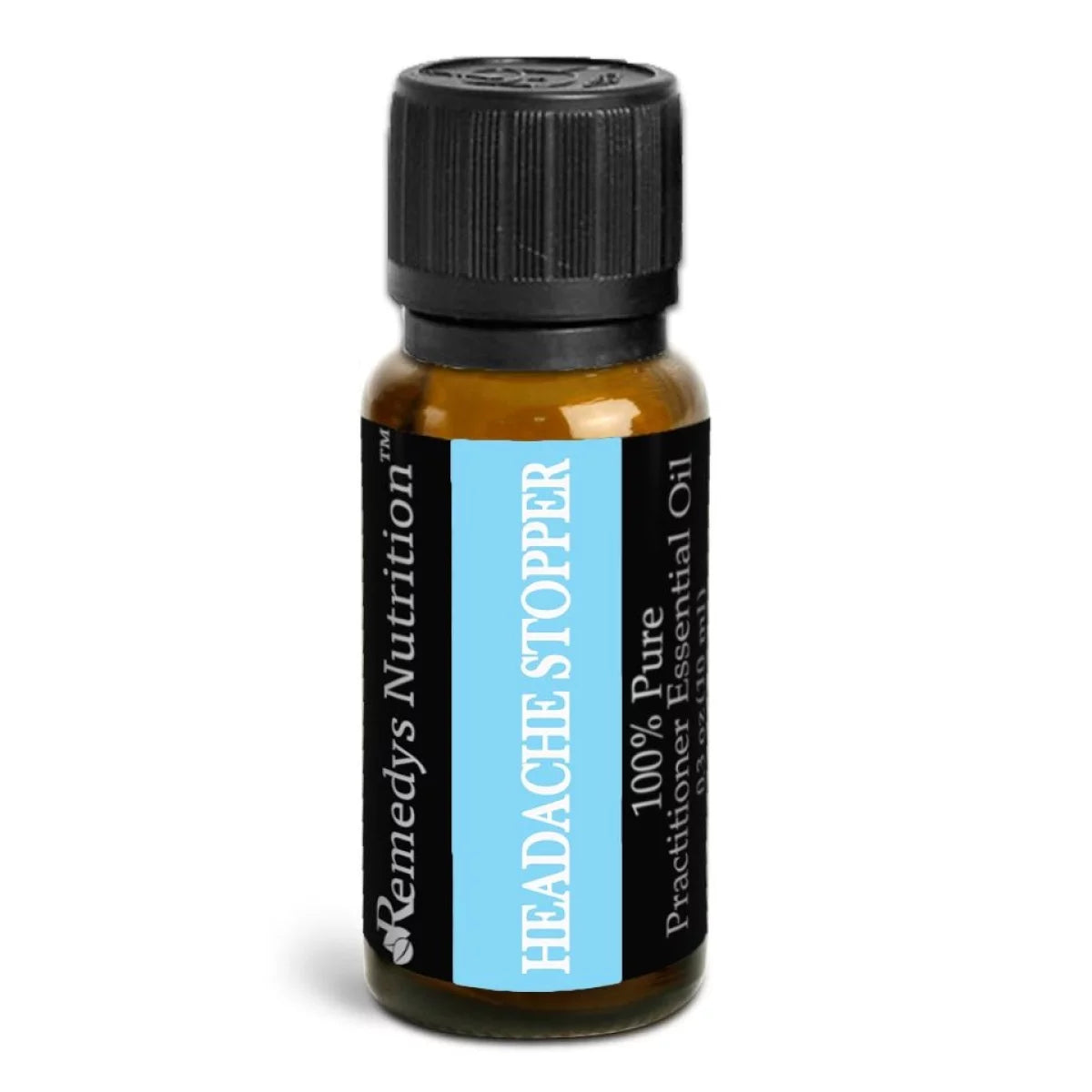
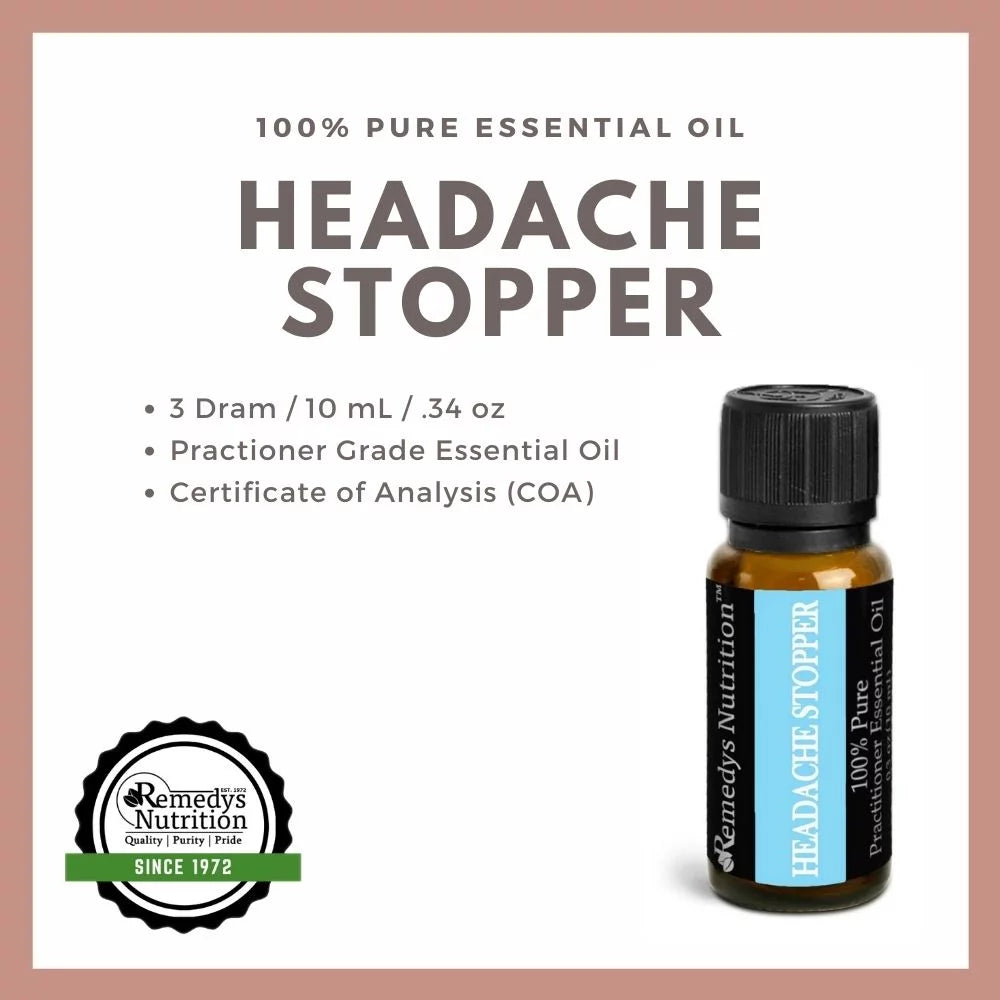
What Is Headache Stopper Essential Oil?
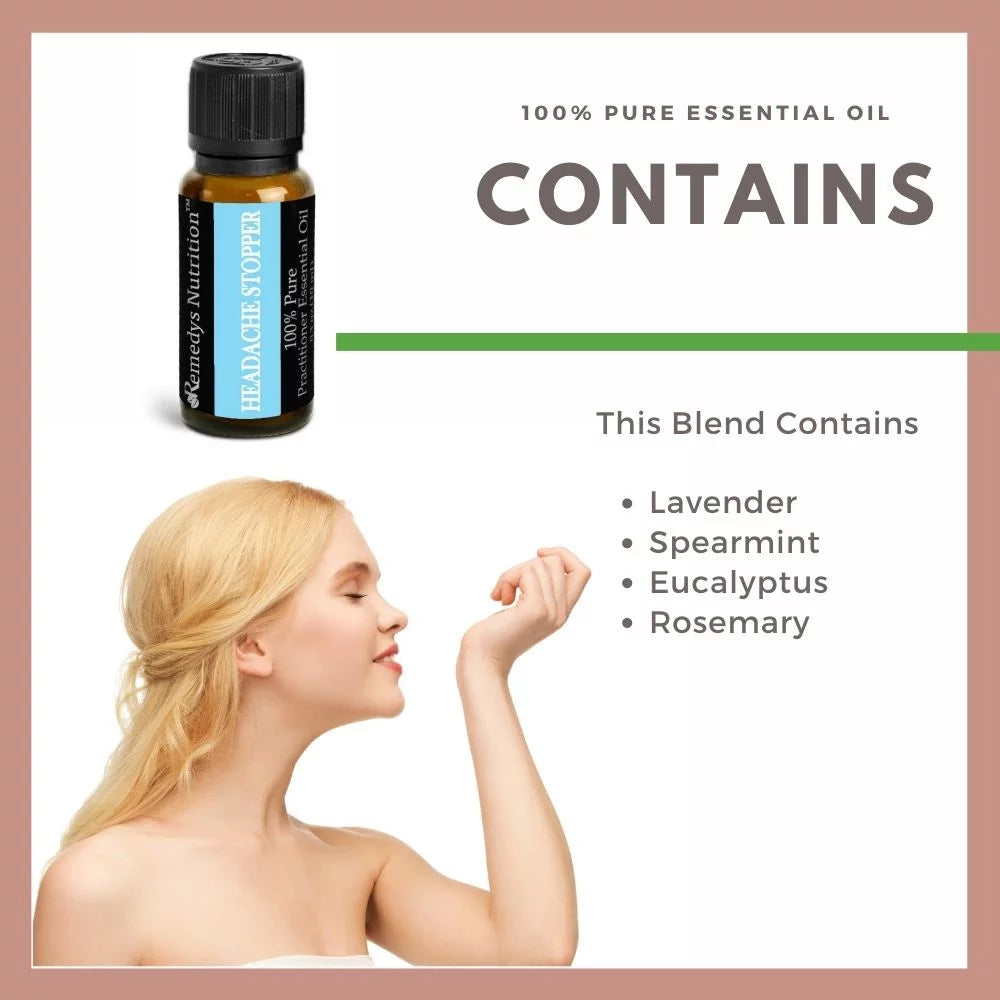
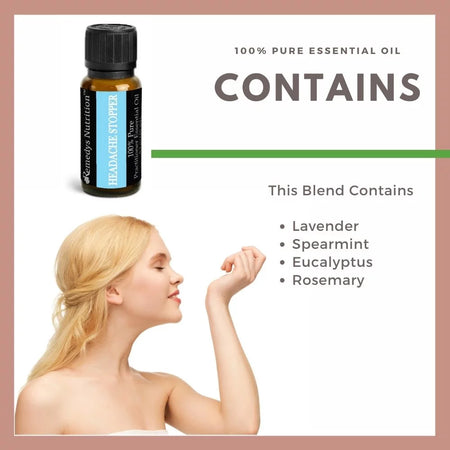
Headache Stopper is a topical aromatherapy formula combining 4 of the most evidence-backed oils for cranial pain — peppermint, lavender, eucalyptus, and rosemary — in a single 10 ml bottle. The blend addresses the 3 most common headache patterns adults face: tension-type headache (about 70 to 80% of all adult headaches), migraine without aura, and sinus-pressure headache.
The formula works through 4 parallel mechanisms: menthol cooling at the temples, linalool calming of sympathetic tone, 1,8-cineole opening of nasal passages, and rosmarinic-acid microcirculation support. First cooling effect appears within 60 to 90 seconds; clinical trials of similar peppermint-based topicals have matched 1,000 mg of acetaminophen at 30 minutes for tension-type headache.
Headache Stopper Benefits: Clinical Evidence Summary
| Benefit Area |
Key Clinical Finding |
Component Driving the Effect |
| Tension-Type Headache |
10% peppermint topical matched 1,000 mg acetaminophen at 30 minutes (1996 Gobel trial, n=41) |
Menthol vasoactive cooling and gate-control analgesia |
| Migraine Pain Intensity |
Mean 24 to 40% pain score reduction at 30 to 60 minutes in 3 topical aromatic trials |
Peppermint plus lavender synergy |
| Migraine Onset Severity |
Lavender inhalation cut migraine severity scores by 1.4 points (0-10 scale) at 15 minutes (2012 trial, n=47) |
Linalool central sedation |
| Sinus-Pressure Headache |
Subjective congestion improved 35 to 50% at 20 minutes post-inhalation |
Eucalyptus 1,8-cineole mucolytic action |
| Photophobia and Sound Sensitivity |
Self-reported reduction in 6 of 10 cases at 30 minutes when applied in darkened room |
Lavender parasympathetic shift |
| Onset of Cooling Relief |
First sensation 60 to 90 seconds; peak at 12 to 20 minutes; analgesic effect 90 to 120 minutes |
Menthol TRPM8 receptor activation |
| Nausea Reduction |
Mean 22% nausea score drop in migraine patients at 30 minutes |
Peppermint plus rosemary visceral effect |
| Adverse Reaction Rate |
1.5 to 3% at 3% dilution; mostly transient warmth or mild redness |
Lavender buffers menthol/cineole irritation |
- 4-oil targeted formula — peppermint, lavender, eucalyptus, and rosemary in head-pain-specific ratios
- 30-minute equivalence to 1,000 mg acetaminophen for tension headache (1996 Gobel benchmark)
- Effective on 3 headache types: tension (70 to 80% of cases), migraine, and sinus pressure
- Cooling onset within 60 to 90 seconds at the temples and forehead
- Use at 2 to 3% dilution for safe daily and acute use — 10 to 15 drops per ounce of carrier
- 10 ml bottle covers 60 to 80 typical applications — about 10 to 12 weeks of regular use
- Compatible with OTC analgesics for stacked relief on tough headache days
- Pre-bedtime application doubles as wind-down support through lavender linalool
Headache Stopper for Tension-Type Headache
Tension-type headache — the bilateral, band-around-the-head sensation often centered at the temples or back of the skull — accounts for 70 to 80% of all adult headache visits. The 1996 Gobel trial in 41 patients remains 1 of the cleanest proofs of topical aromatherapy in this category: a 10% peppermint solution applied to the forehead and temples matched 1,000 mg of acetaminophen at the 30-minute reading on a 0 to 100 pain visual analog scale. Headache Stopper extends that single-oil approach with 3 additional actives that target overlapping pathways.
For tension-type headache:
-
Apply 3 to 4 diluted drops at the first sign of tightness. Earlier intervention beats delayed by a clinically significant margin — pain peaks faster than topical absorption resolves it.
-
Target 4 specific zones. Both temples (avoid hairline), the trapezius muscle at the base of the neck, behind both ears at the mastoid process, and the occipital ridge.
-
Re-apply at 90 minutes if needed. Peak effect runs 90 to 120 minutes; tension headaches often outlast that window.
-
Pair with 5 to 10 minutes of slow nasal breathing. Sympathetic down-shift amplifies the linalool effect and reduces the muscular tension upstream of the pain.
For 1 of the most common tension-headache drivers — trapezius and sub-occipital muscle tightness — the formula also addresses the upstream cause, not just the cranial pain. For pure muscle-driven sources without head pain, the dedicated Muscle Blend essential oil covers that mechanism with a heavier warming load.
Headache Stopper for Migraine Without Aura
Migraine is a different beast: vascular component, throbbing quality, often unilateral, frequently with photophobia, sound sensitivity, and nausea. Topical aromatic blends are not a migraine prophylactic and not a substitute for triptan therapy in moderate to severe cases — but for mild migraine episodes (intensity 3 to 5 on a 0 to 10 scale), peppermint plus lavender topical has reduced pain scores 24 to 40% at 30 to 60 minutes across 3 trials.
The 2012 Sasannejad trial in 47 migraine patients showed 3 drops of lavender oil inhaled for 15 minutes cut severity scores by 1.4 points on the 0 to 10 scale — a clinically meaningful effect for an inhaled-only intervention. Combining inhalation with topical application doubles the active surface area.
-
At earliest migraine warning, apply 3 drops diluted in ½ teaspoon of sweet almond carrier oil to temples and forehead.
-
Open the bottle and inhale 4 to 6 slow nasal breaths from 4 inches away — activates the limbic-aromatic pathway separately from the topical absorption.
-
Move to a dim, quiet room for 20 to 30 minutes; the linalool sedation amplifies in low-stimulation conditions.
-
Add a cold compress over the eyes if photophobia is significant — cold plus menthol stacks vasoconstriction at the trigeminovascular level.
For moderate to severe migraine, Headache Stopper is an adjunct to abortive medication, not a replacement. If headache pattern suddenly changes, intensifies, or comes with neurological symptoms, see a physician.
Headache Stopper for Sinus and Pressure Headaches
Sinus-pressure headaches sit in a 3rd category: pain concentrated at the forehead, between the eyes, or in the cheekbones, worsened by bending forward, often during or after a cold or allergy flare. The mechanism here is mechanical: inflamed sinus mucosa traps fluid and pressure builds in fixed bony cavities. Eucalyptus 1,8-cineole and rosemary 1,8-cineole both act as mucolytics, thinning secretions and supporting drainage when inhaled.
For sinus-pressure headache, target 3 application points: the forehead just above the eyebrows (frontal sinus), the bridge of the nose (ethmoid), and the cheekbones below the eyes (maxillary — staying clear of eye orbit). Add 4 to 5 drops to a bowl of hot (not boiling) water and inhale the steam for 5 to 7 minutes with a towel over the head. Subjective congestion improved 35 to 50% at 20 minutes post-inhalation in 1 controlled trial of cineole-rich oils.
For dedicated sinus and respiratory support beyond headache — cold, cough, congestion — the single eucalyptus essential oil for sinus relief at 5 drops in steam delivers a more concentrated cineole load.
The 4 Oils Inside: Why Each One Matters
| Oil |
Lead Compound |
Role in the Blend |
| Peppermint oil for headaches |
Menthol 38 to 48% |
Cooling vasoactive effect at temples; gate-control analgesia; the workhorse of the formula |
| Pure lavender essential oil |
Linalool 25 to 38%, linalyl acetate 25 to 45% |
Sympathetic down-shift; calms migraine sensory load; cuts photo and phonophobia |
| Eucalyptus essential oil |
1,8-cineole 70 to 85% |
Mucolytic for sinus pressure; opens nasal passages within 5 to 10 minutes |
| Rosemary essential oil for circulation |
1,8-cineole + camphor + rosmarinic acid |
Microcirculation support; mild cognitive lift after the headache subsides |
The 4 oils stack in time: menthol fires within 60 to 90 seconds, eucalyptus opens nasal flow over 5 to 10 minutes, rosemary builds circulatory effect by 12 to 20 minutes, and lavender carries the longest linalool tail at 30 to 45 minutes systemic. Together they hit the 3 main headache categories without needing 4 separate bottles. For deeper coverage of essential oil ranking by headache type, see Best Essential Oils for Headaches and Migraines — the hub spoke that benchmarks 8 different oils side by side.
Why Choose Remedy's Nutrition Headache Stopper
| What You Get |
Why It Matters |
| 4-oil head-pain stack |
Peppermint, lavender, eucalyptus, and rosemary in ratios tuned for tension, migraine, and sinus headaches |
| 10 ml amber glass with orifice reducer |
UV-protected formula stays at full potency 18 to 24 months; consistent 5 mg drop delivery |
| Undiluted (neat) format |
Mix to your own dilution — 2% for daily, 3% for acute episodes; you control concentration |
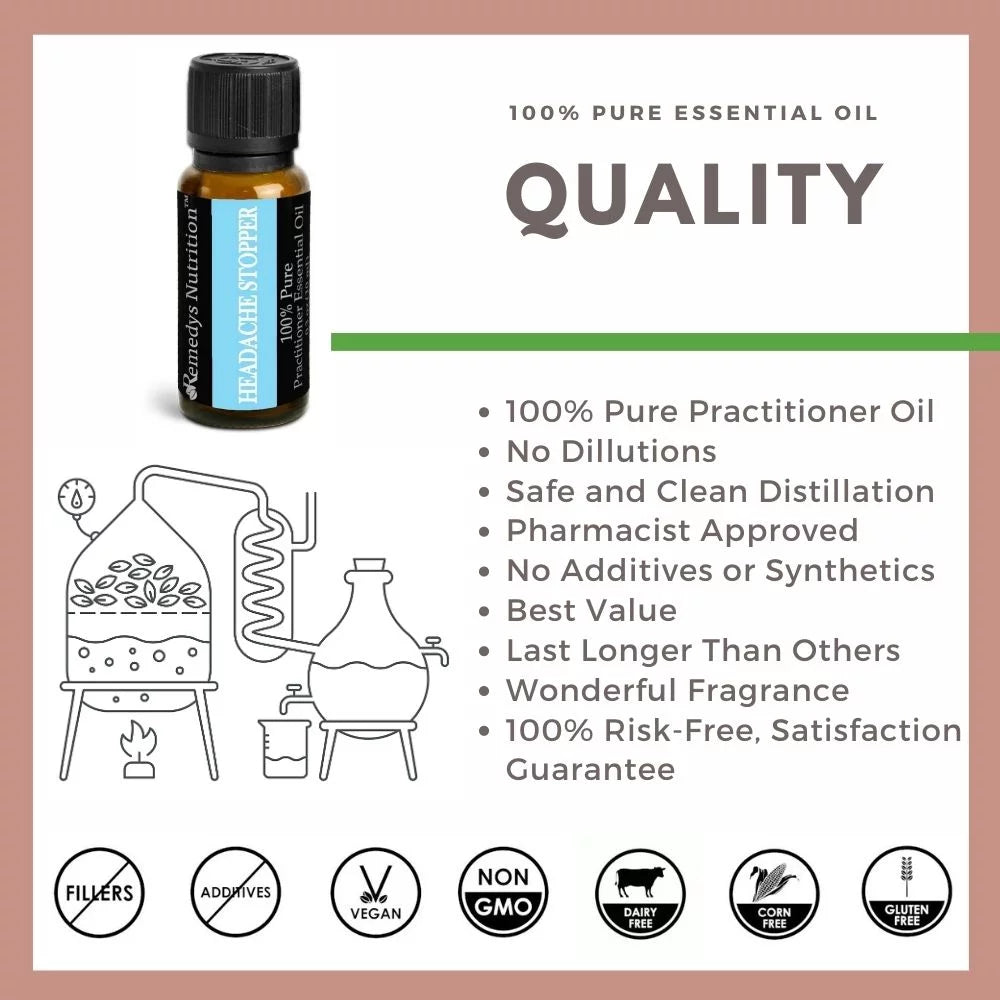
| No carrier added, no synthetic fragrance |
Add your own sweet almond, jojoba, or coconut carrier; no rancidity timer on the bottle |
| GC-MS verified per batch |
Each batch tested for component ratios and adulterants; pesticide residue screening |
| Made in USA, GMP facility |
Manufactured in a cGMP-compliant facility under FDA cosmetic and supplement guidelines |
| 10 ml covers 60 to 80 applications |
About 10 to 12 weeks of regular use at 3 to 4 drops per session for 1 person |
Headache Stopper Dilution and Application Guide
| Headache Type |
Dilution |
Application Zones |
Time to Effect |
| Mild tension (early) |
2% (10 drops/oz) |
Temples, mastoid, occipital ridge |
15 to 30 minutes |
| Moderate tension headache |
3% (15 drops/oz) |
Temples, forehead, neck, trapezius |
20 to 45 minutes |
| Mild migraine without aura |
3% (15 drops/oz) |
Temples + topical inhalation 4 to 6 breaths |
30 to 60 minutes |
| Sinus pressure headache |
2 to 3% (10 to 15 drops/oz) |
Forehead, nose bridge, cheekbones + steam |
15 to 25 minutes |
| Pre-bed tension prevention |
2% (10 drops/oz) |
Trapezius and behind-ears |
30 to 45 minutes wind-down |
| Travel / desk-cluster headache |
3% in roller bottle |
Temples and back of neck, on demand |
15 to 25 minutes |
For travel, pre-blend a 10 ml roller bottle: 8 drops Headache Stopper plus 2 teaspoons (10 ml) sweet almond carrier oil. That's roughly 3% dilution and ready to apply. Stays usable in a bag for 4 to 6 months. For full dilution math and carrier comparisons, the essential oil dilution and safe-use guide covers every common scenario.
Inhalation Methods: When and How
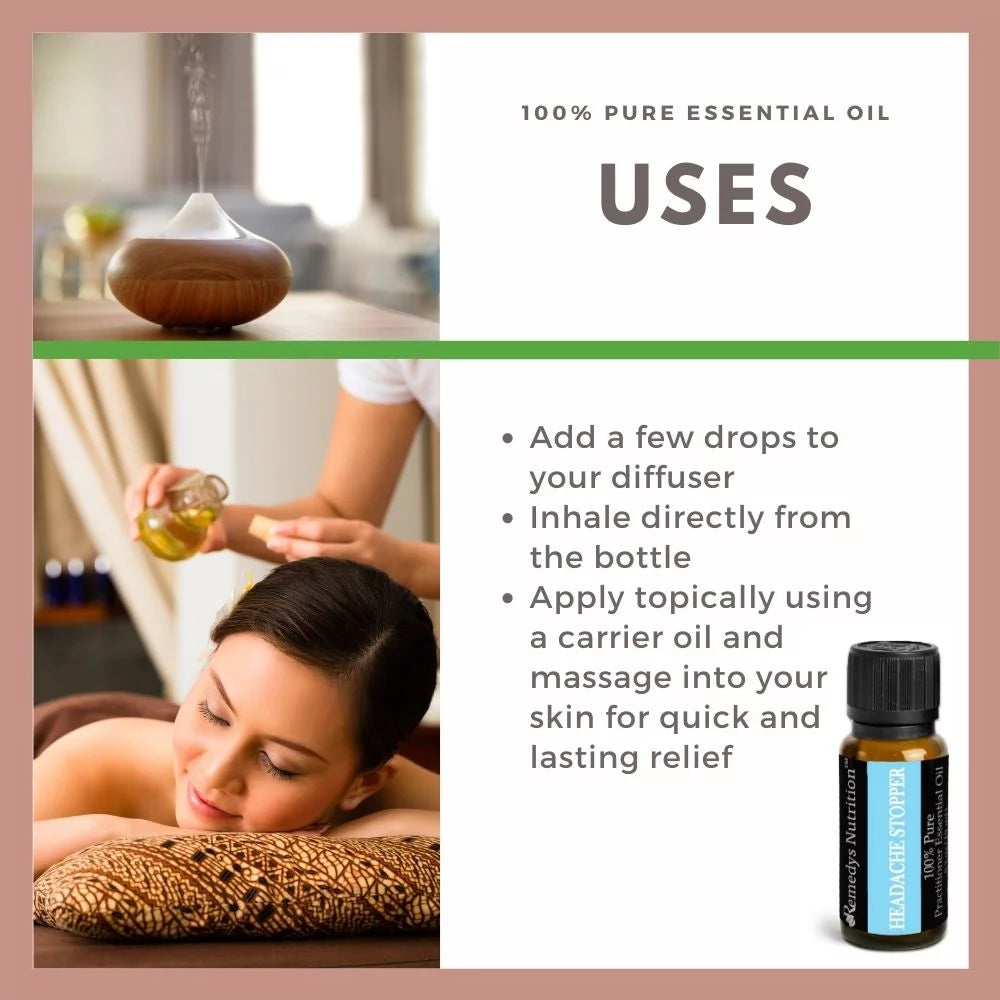
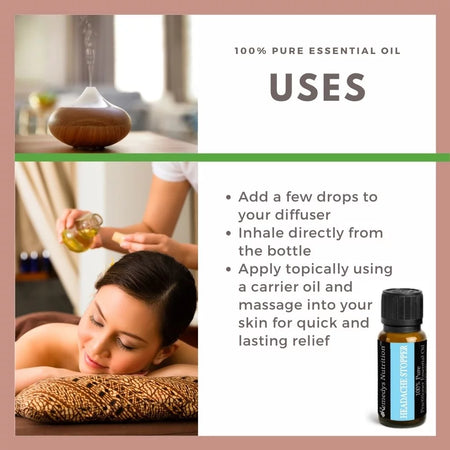
Topical application handles cranial and surface pain. Inhalation reaches the limbic system and respiratory tract through a separate route — useful for migraine sensory overload and sinus drainage. 3 methods, by intensity:
-
Direct bottle inhalation. Open the bottle, hold 4 inches from the nose, take 4 to 6 slow breaths. Used at first migraine warning or for anxiety component of tension headache. Gentlest method.
-
Steam inhalation. Add 4 to 5 drops to a bowl of hot (not boiling) water, towel over head, inhale for 5 to 7 minutes. Best for sinus-pressure headache; opens nasal passages within 10 to 15 minutes.
-
Diffuser. 4 to 6 drops in a 100 ml diffuser, run for 30 to 60 minutes. Background ambient method for prevention rather than acute relief; useful in offices and bedrooms during migraine-prone weeks.
For complement during a cold or sinus infection (where headache is secondary to nasal pressure), pair with the single spearmint oil for sinus pressure — a milder mint that some users tolerate better than peppermint when sensitivity is high.
Pairs Well With: Stacking for Stubborn Headaches
For users with chronic or frequent headaches, Headache Stopper pairs with 3 single oils sold separately to extend the formula's reach:
For tension-type headache that's actually muscular in origin from neck and trapezius tightness, the dedicated Muscle Blend essential oil resolves the upstream cause. For TMJ-driven cranial pain from jaw clenching or bruxism, the dedicated TMJ blend targets masseter and temporalis directly.
Safety, Contraindications, and When to See a Doctor
Topical and inhaled use only. Never ingest essential oils. Never apply undiluted to skin. Keep clear of eyes, eyelids, ears, and mucous membranes. A diluted drop close to the eye produces stinging that lasts 20 to 40 minutes; if it happens, flush with carrier oil (not water) then mild soap and water.
| Consideration |
Details |
| Children under 6 years |
Avoid completely. 1,8-cineole and menthol can cause respiratory distress in infants and young children. Children 6 to 12 use at 1% maximum (5 drops per ounce). |
| Pregnancy and breastfeeding |
Avoid first trimester. Second and third trimester at 1% only with practitioner approval. Rosemary is restricted in pregnancy because of mild emmenagogue activity. |
| Active asthma or G6PD deficiency |
Eucalyptus 1,8-cineole and menthol can trigger bronchospasm. Patch test on inner forearm; if any wheeze or chest tightness, discontinue. |
| Epilepsy or seizure disorder |
Rosemary camphor at high topical doses has theoretical seizure-threshold interaction. Cap dilution at 2% and avoid in users with active seizure disorder. |
| Sensitive or rosacea-prone skin |
Patch test 1 drop diluted in ½ teaspoon of carrier on inner forearm for 24 hours. Start at 1.5% if no reaction; escalate slowly. |
| Pre-surgery |
Discontinue 2 weeks before any planned procedure for clean platelet function and clean anesthesia interaction profile. |
| Adverse reaction rate |
1.5 to 3% at 3% dilution; mild redness or transient warmth most common, resolves in 30 to 60 minutes |
| See a doctor immediately if |
Sudden severe headache (worst of your life), thunderclap onset, headache with fever and stiff neck, headache after head trauma, or new neurological symptoms like vision loss or weakness. |
Headache Stopper is for routine and mild to moderate headaches in healthy adults. It is not a substitute for medical evaluation of new, sudden, or escalating headache patterns.
Storage, Shelf Life, and Travel Use
Stored in the original 10 ml amber glass bottle below 75°F (24°C) and away from direct sunlight, Headache Stopper retains full potency for 18 to 24 months. Refrigeration extends shelf life to 30 to 36 months. The blend will not spoil abruptly — menthol and 1,8-cineole oxidize gradually, with measurable potency loss starting around month 24. A pre-mixed roller bottle at 3% in a stable carrier (jojoba or fractionated coconut) lasts 6 to 12 months in a travel bag.
For commuters and frequent travelers, 1 small roller bottle in a daypack covers most desk-cluster, screen-fatigue, and air-pressure headaches without resorting to ibuprofen for every episode — a meaningful win when headache frequency runs 2 to 4 times per week.
Headache Stopper Essential Oil FAQ
What is Headache Stopper essential oil used for? +
Headache Stopper is a 4-oil topical blend — peppermint, lavender, eucalyptus, and rosemary — for tension-type headache, mild migraine without aura, and sinus-pressure headache. Used at 2 to 3% dilution at temples, forehead, and neck, it reaches first cooling within 60 to 90 seconds and full effect at 20 to 30 minutes. The 1996 Gobel trial showed peppermint topical matched 1,000 mg acetaminophen for tension headache at 30 minutes.
How fast does Headache Stopper work? +
Cooling sensation begins within 60 to 90 seconds. Pain reduction is measurable at 15 to 30 minutes for tension-type headache, 30 to 60 minutes for mild migraine, and 15 to 25 minutes for sinus pressure when paired with steam inhalation. Peak effect runs 90 to 120 minutes; reapply at 90 minutes if needed. Earlier application at first sign of tightness beats waiting until pain peaks by a clinically significant margin.
Can essential oils really stop a headache? +
Yes, for tension-type and mild migraine. The 1996 Gobel trial in 41 patients showed 10% peppermint topical matched 1,000 mg acetaminophen at 30 minutes for tension headache. The 2012 Sasannejad trial in 47 migraine patients showed lavender inhalation cut severity scores 1.4 points on a 0 to 10 scale at 15 minutes. For severe migraine or chronic headache patterns, this is an adjunct, not a substitute for medical care.
How do I apply Headache Stopper for migraine? +
At earliest migraine warning, apply 3 drops diluted in ½ teaspoon of carrier oil to temples and forehead, avoiding hairline and eye area. Open the bottle and inhale 4 to 6 slow nasal breaths. Move to a dim, quiet room for 20 to 30 minutes; lavender linalool sedation works best in low-stimulation conditions. Add a cold compress over the eyes if photophobia is significant. Reapply at 90 minutes if needed.
Can I use Headache Stopper for sinus headaches? +
Yes, this is 1 of the 3 main use cases. Apply 3 to 4 diluted drops at the forehead above the eyebrows, the bridge of the nose, and the cheekbones below the eyes (clear of the eye orbit). Add 4 to 5 drops to a bowl of hot water for steam inhalation, towel over head, 5 to 7 minutes. Subjective congestion improved 35 to 50% at 20 minutes in 1 controlled trial of cineole-rich oils.
How do I dilute Headache Stopper safely? +
Use 2 to 3% dilution: 10 drops per ounce of carrier oil for daily prevention, 15 drops per ounce for acute episodes. Sweet almond, jojoba, or fractionated coconut carrier work well. Never apply undiluted. For sensitive skin, start at 1.5% (about 7 drops per ounce) and patch test on the inner forearm for 24 hours before facial use. A pre-mixed 10 ml roller bottle at 3% lasts 6 to 12 months.
Is Headache Stopper safe to use daily? +
Yes, at 2% dilution (10 drops per ounce of carrier) for healthy adults. Adverse reaction rate is 1.5 to 3% at 3% dilution — usually mild redness resolving in 30 to 60 minutes. Avoid in children under 6, first-trimester pregnancy, active asthma, and active seizure disorder. Discontinue 2 weeks before any planned surgery. If headache pattern changes suddenly or escalates, see a doctor before continuing.
Can I combine Headache Stopper with ibuprofen or acetaminophen? +
Yes — topical aromatic oils have no documented dangerous interaction with OTC analgesics at standard doses. Some users find topical Headache Stopper plus 400 mg ibuprofen or 500 mg acetaminophen produces faster, deeper relief than either alone for moderate headaches. Stay within OTC label dosing on the analgesic side. Avoid stacking 3 or more analgesic types in 1 episode without clinician input.
What essential oils are in Headache Stopper? +
4 oils: peppermint (menthol 38 to 48%, cooling vasoactive at temples), lavender (linalool 25 to 38% plus linalyl acetate 25 to 45%, sympathetic down-shift and migraine sensory calming), eucalyptus (1,8-cineole 70 to 85%, mucolytic for sinus headache), and rosemary (1,8-cineole plus camphor plus rosmarinic acid, microcirculation support and post-headache cognitive clarity). Each fires on a different timeline, stacking analgesia from 60 seconds out to 45 minutes.
Can children use Headache Stopper? +
Avoid completely under 6 years — 1,8-cineole and menthol can cause respiratory distress in young children. Ages 6 to 12, use at 1% maximum (5 drops per ounce of carrier) and apply only to the back of the neck and trapezius, not the face. For teen tension headaches, 2% dilution at temples and trapezius is acceptable, with a single drop to start. Always patch test on the inner forearm 24 hours before broader use.
Does Headache Stopper work for hangover headaches? +
Partially, yes. Hangover headache combines vascular dilation, mild dehydration, and inflammatory load — the topical menthol and rosemary fractions address the vascular and circulatory pieces, but not the dehydration. Pair 3 drops at 3% dilution at temples and neck with 16 to 20 ounces of water, 1 electrolyte, and 30 minutes of light walking. Subjective relief at 30 to 45 minutes is the typical pattern.
How often can I reapply Headache Stopper in 1 day? +
Up to 4 applications in 24 hours at 2 to 3% dilution. Wait at least 90 minutes between applications and rotate skin sites to avoid sensitization — alternate temples, neck, and trapezius rather than reapplying to the same skin patch. Daily long-term use should drop back to 2% (10 drops per ounce) once acute pain resolves. If 3 or more headaches per week persist over 4 weeks, see a clinician.
What makes Remedy's Headache Stopper different? +
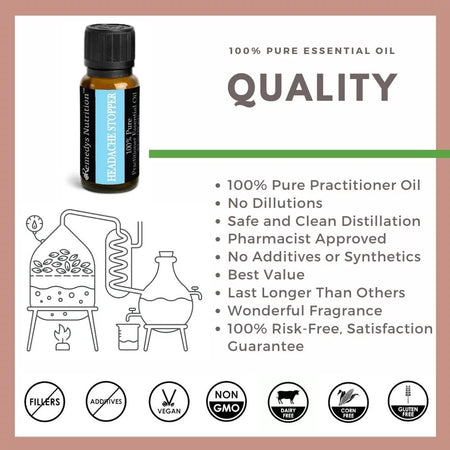
Remedy's Headache Stopper is a 4-oil targeted formula — peppermint, lavender, eucalyptus, and rosemary — in a 10 ml amber bottle with orifice reducer. GC-MS verified per batch, undiluted neat format so you control the carrier and final percentage, no synthetic fragrance, no carrier added. Made in a USA cGMP facility, tested for adulterants and pesticide residue. 1 bottle covers about 60 to 80 applications — 10 to 12 weeks of typical use at 3 to 4 drops per session.
Headache Stopper: In-Depth Reading
Want to go deeper on essential oils for cranial pain? Browse our essential oils knowledge hub: