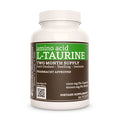

Taurine is best known from energy drink cans and a 2023 study in which it extended the lives of mice by 10 to 12%. Neither fact tells you much about a capsule.
PubMed holds 17,241 records on taurine. This page sorts them into what has been shown in people, what has not, and what a 1000 mg capsule can reasonably do.
Quick Answer: What Is Taurine Good For?
Taurine is an amino sulfonic acid your body makes and gets from meat and seafood. It is not a stimulant: an energy drink's lift is caffeine. In people, the best evidence is a modest blood pressure drop, about 4 mmHg systolic across 34 pooled trials. Lifespan gains were seen in mice and worms; no human lifespan trial exists.
Key Takeaways
- PubMed holds 17,241 taurine records, and 367 are tagged as trials.
- One 1000 mg capsule matches the taurine in 1 energy drink.
- 34 trials pooled in 2026 lowered systolic pressure by 4.38 mmHg.
- Mouse lifespan rose 10 to 12% at about 5 g human-equivalent.
- A 2025 Science study found blood taurine does not fall with age.
Related Products
What Taurine Is, and What It Is Not
Taurine is a small sulfur-containing molecule found in almost every tissue, most richly in the heart, brain, retina and muscle. It is called an amino acid, but it is an unusual one, and that difference explains why it behaves unlike the amino acids in protein powder.
- Chemical name: 2-aminoethanesulfonic acid, with 0 stereocenters.
- Structure: A sulfonate group where other amino acids carry a carboxyl group.
- Not in protein: 1 of the few amino acids never built into proteins.
- Made in the body: From cysteine and methionine, and also eaten in meat and fish.
- Name: From ox bile, Bos taurus, where it was first isolated.
Because there is no mirror-image form, "taurine" and "L-taurine" on a label are the same molecule.[1]Taurine, Compound Summary (2-aminoethanesulfonic acid) — National Library of Medicine, PubChem View source The ox-bile origin of the name, and the structure that sets it apart, are described in a 2012 review.[2]Taurine: a very essential amino acid — Molecular Vision (2012) View source
Not a Stimulant: The Energy Drink Question
Most people meet taurine on an energy drink can and assume it supplies the energy. Trials that separated the ingredients, set out in what taurine actually does in an energy drink, point the other way: the alertness comes from caffeine.
- Typical 250 mL can: About 80 mg caffeine and 1000 mg taurine.
- 48-person trial: Caffeine, not 2000 mg of taurine, improved attention and memory.
- Fatigue and vigor: Taurine reversed some of caffeine's effects.
- One capsule: The same 1000 mg of taurine, with 0 mg caffeine.
The 2012 trial concluded that caffeine, not taurine or glucose, was likely responsible for the changes people report after an energy drink.[3]Differential cognitive effects of energy drink ingredients: caffeine, taurine, and glucose — Pharmacology Biochemistry and Behavior (2012) View source Taurine on its own did not reproduce the effect.

The Size of the Evidence
Taurine is heavily researched, but most of that research is not about supplements in people. Counted on PubMed in October 2026, more records describe animals than humans, and only a small slice are trials.
| What PubMed holds on taurine | Count |
|---|---|
| Records mentioning taurine | 17,241 |
| Records tagged as human | 5,406 |
| Animal records with no human tag | 9,121 |
| Records tagged as clinical trials | 367 |
| Systematic reviews or meta-analyses | 74 |
| Records on lifespan or longevity | 85 |
| Of those 85, tagged as trials | 2 |
The last 2 rows matter most for the headline claim. Of 85 records on taurine and lifespan, 2 are tagged as trials, and neither tested whether taurine lengthens human life. Another 730 records concern cats and dogs, a pet-food question rather than a supplement one.
What the Human Trials Actually Show
Sorted by claim, the human evidence is uneven. Blood pressure has the most trials behind it, blood sugar has smaller and mixed trials, and exercise effects are small. Lifespan and energy are the 2 claims people know best, and they have the least human support.
| Claim | What the human data show | Verdict |
|---|---|---|
| Blood pressure | 34 RCTs pooled in 2026; systolic down 4.38 mmHg | Best supported |
| Blood sugar | Fasting glucose down 5.90 mg/dL in the same pooling | Modest, mixed trials |
| Endurance exercise | 23 single-dose trials; small effect, low certainty | Small and uncertain |
| Lifespan | Mice and worms only; 0 human lifespan trials | Not shown in people |
| Energy from drinks | Caffeine, not taurine, drove the effects | Not a stimulant |
The 2026 pooling of 34 randomized trials also found lower fasting glucose, triglycerides and cholesterol, with doses of 1.5 to 3.0 g a day looking most effective.[4]Effects of Oral Taurine Supplementation on Cardiometabolic Risk Factors: A Meta-analysis of Randomized Clinical Trials — Nutrition Reviews (2026) View source Each effect is modest, measured in single-digit units.
On those terms, a 1000 mg taurine capsule is a measured way to add the amount found in 1 energy drink, without the caffeine and sugar.

The Ageing Study, Stated Precisely
The 2023 Science paper is why taurine became a longevity supplement. It is a careful study, and its own abstract separates what was shown in animals from what was only an association in people. Most coverage did not keep that separation.
- Mice: Median lifespan rose 10 to 12% at 1000 mg/kg a day.
- Worms: Lifespan rose; yeast showed 0 change.
- Monkeys: 6 months of better health markers; lifespan not measured.
- Humans: Lower blood taurine was associated with age-related disease.
The authors wrote that human trials seem warranted, which means none had been done.[5]Taurine deficiency as a driver of aging — Science (2023) View source In 2025, the same journal published 3 human cohorts in which blood taurine rose or held steady with age.[6]Is taurine an aging biomarker? — Science (2025) View source The numbers are unpacked in what the 2023 ageing study showed in mice and monkeys.
Safety and a Sensible Amount
Taurine has one of the cleaner safety records among supplements. A formal risk assessment found strong evidence of no adverse effects up to 3 g a day in healthy adults, and pooled trials report no significant adverse effects against placebo.
- Diet: A typical diet supplies about 40 to 400 mg a day.
- Observed safe level: 3 g a day for healthy adults.
- Trial doses: Mostly 1.5 to 3 g a day, for up to 12 weeks.
- Label dose: 1 capsule, 1000 mg, a day.
The 3 g figure comes from the observed safe level method, used because no adverse-effect dose could be found.[7]Risk assessment for the amino acids taurine, L-glutamine and L-arginine — Regulatory Toxicology and Pharmacology (2008) View source Who should be careful, and why, is in who should not take taurine and at what dose.
Speak to a Clinician Before Taking Taurine If
- You take blood pressure medicine, or your blood pressure runs low
- You take insulin, metformin or another glucose-lowering medicine
- You are pregnant, breastfeeding, or buying for a child or teenager
- You have kidney disease, or are being treated for a blood cancer
- You plan to take more than 3 g a day, the observed safe level

Frequently Asked Questions
What happens if you take taurine every day? +
In trials of up to 12 weeks, 1.6 to 3 g a day lowered blood pressure slightly. Pooled analyses found no significant adverse effects against placebo.
Is taurine good or bad for you? +
For healthy adults, intakes up to 3 g a day have a strong safety record. The benefits are modest and best supported for blood pressure.
Why do I feel so good after taking taurine? +
No trial shows a mood lift from taurine alone. In a 48-person trial, 2000 mg of taurine did not reproduce caffeine's effects, so caffeine or expectation is likelier.
What is the best form of taurine? +
Taurine exists in 1 chemical form, so capsules and powder deliver the same molecule. Capsules give a fixed 1000 mg, which makes the dose easy to count.
What depletes taurine in the body? +
A diet with no meat or fish is the best documented factor. In 1 study vegans excreted 266 versus 903 micromoles a day, while plasma fell less.
Is taurine good for liver health? +
In a 2026 pooling of 34 trials, the liver enzymes AST and ALT fell by about 9.65 and 8.26 U/L. That is a marker change, not a liver treatment.
How many studies are there on taurine? +
PubMed holds 17,241 records. Only 367 are tagged as clinical trials, and 9,121 are animal records with no human tag.
Is taurine an amino acid? +
Yes, but an unusual one. It carries a sulfonate group instead of a carboxyl group, and it is 1 of the few amino acids not built into proteins.
Can taurine make you live longer? +
Not shown in people. It extended median lifespan by 10 to 12% in mice, and 0 human lifespan trials exist.
Does taurine help with weight loss? +
Not in the pooled trials. A 2020 meta-analysis of 12 studies found no significant change in body weight, at -0.47 kg.
Related Reading
- Taurine, Blood Pressure and Blood Sugar
- Taurine Before Exercise: What Trials Found
- Taurine vs L-Taurine and Where It Comes From
Related Products