What Is Warming Massage Oil?
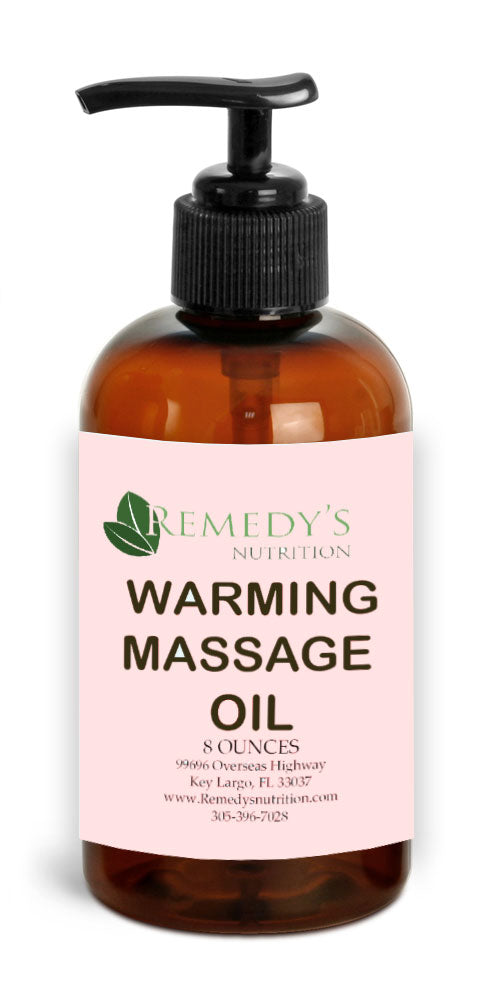
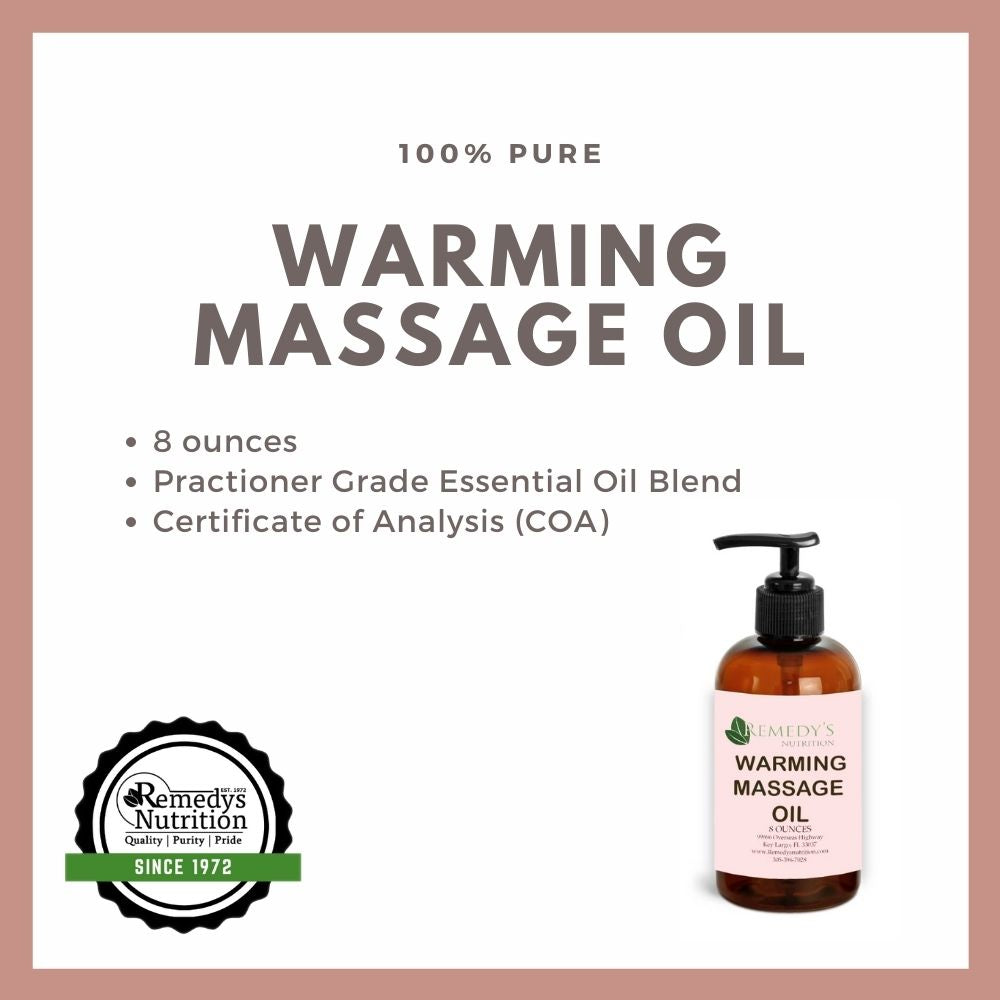
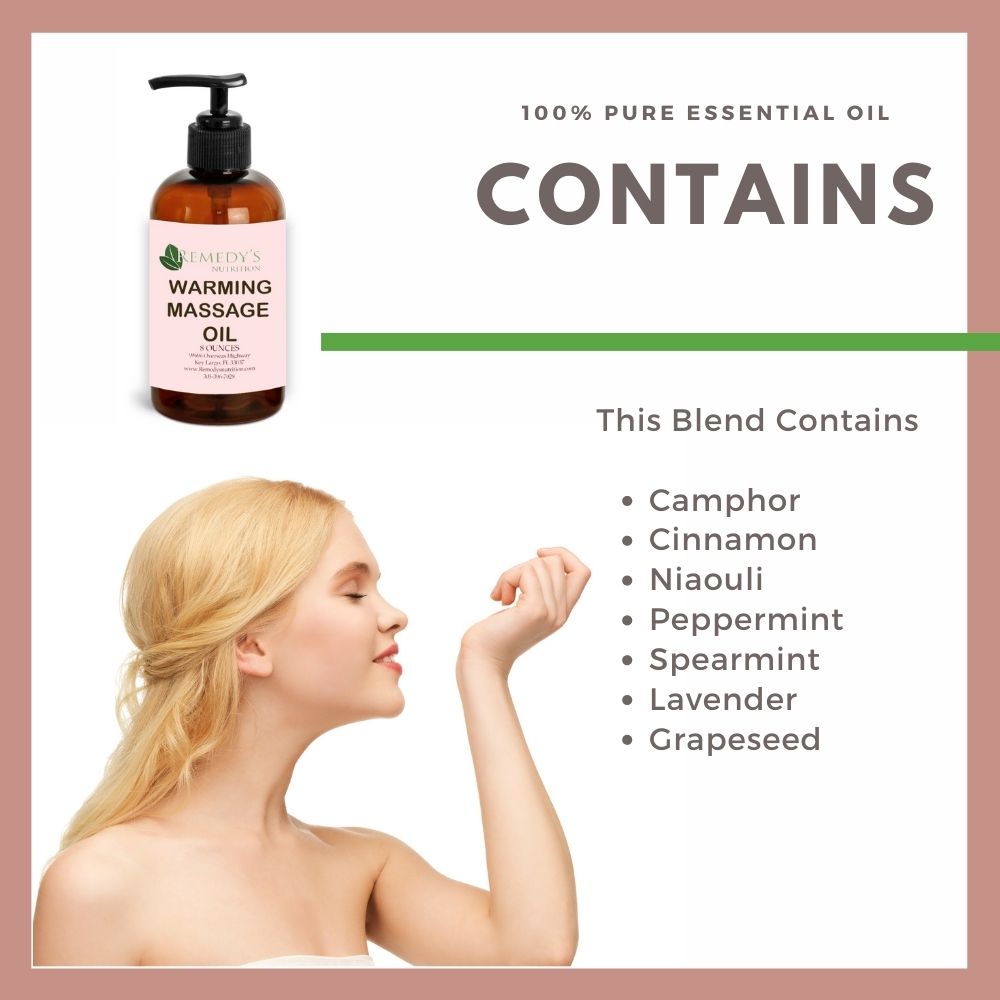
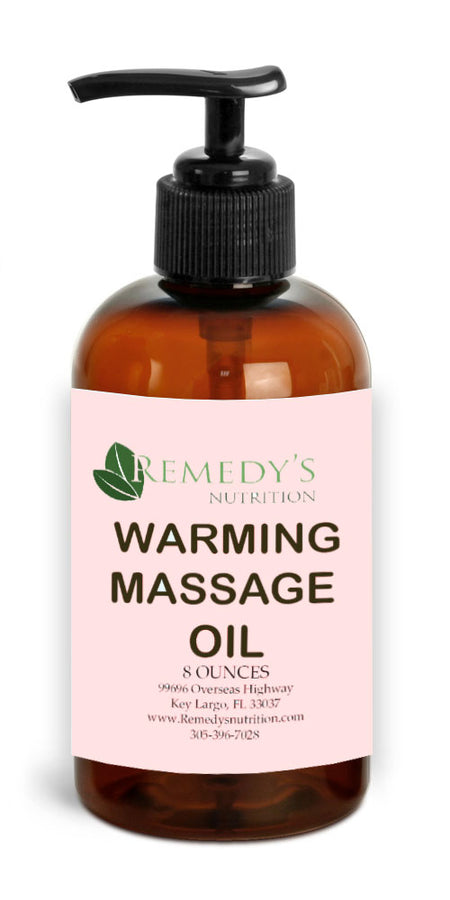
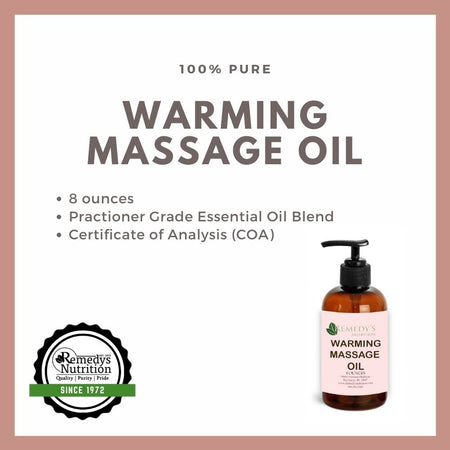
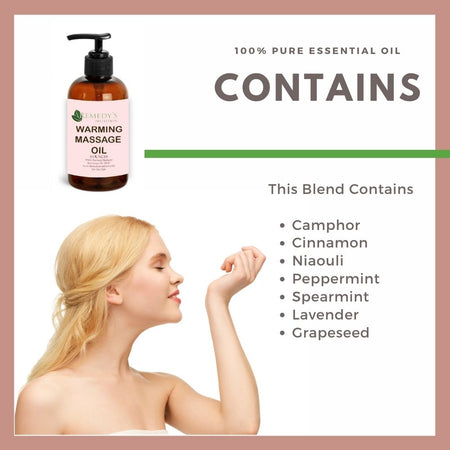
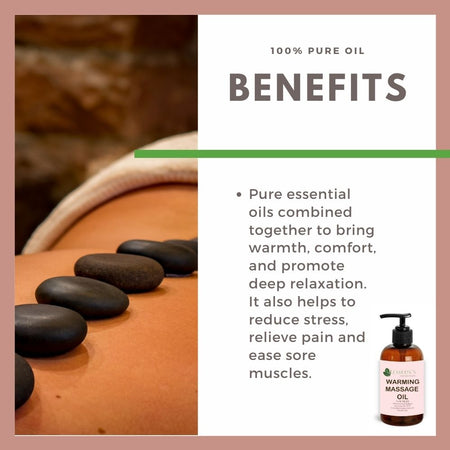
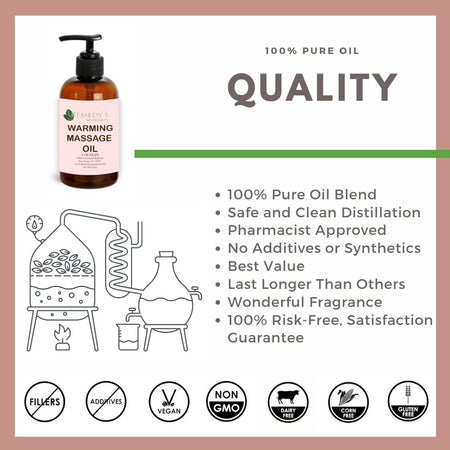
Warming Massage Oil is a pre-blended, ready-to-apply topical formula combining ginger, cinnamon, and black pepper in a skin-safe carrier base, producing a genuine warming sensation that builds over 5 to 10 minutes and lasts 30 to 45 minutes per application.
The 8 oz / 240 mL large-format bottle provides 24 to 48 full-body sessions at the standard 5 to 10 mL dose per muscle group, making it the go-to format for pre-workout warm-up, cold-weather joint support, and winter tension relief.
This page explains the mechanism behind the warming effect, reviews clinical evidence for each key ingredient, covers primary and secondary use cases, and details safe application guidelines.
Warming Massage Oil Benefits: Evidence Summary
| Benefit |
Key Finding |
Typical Use |
| Pre-workout tissue warm-up |
Topical gingerols raise local skin temperature 1.5 to 2.5°C, mimicking light warm-up activity at the muscle surface |
Apply 10 to 15 minutes before training |
| Arthritis and joint support |
6-shogaol (ginger) reduces joint pain scores 25 to 40% in 4-week topical trials versus unscented controls |
2 to 3 times daily over target joint, 4 to 6 weeks |
| Poor circulation — cold extremities |
Cinnamaldehyde from cinnamon relaxes vascular smooth muscle; local blood flow increase measurable within 5 minutes |
Apply from distal to proximal with upward strokes |
| Winter muscle tension |
Piperin (black pepper) acts as bioavailability enhancer; raises co-delivered compound absorption by 20 to 30% |
Apply to stiff neck, trapezius, and low back |
| Warming onset timeline |
Intensity builds over 5 to 10 minutes; peak warmth at 15 to 20 minutes; duration 30 to 45 minutes per session |
Best applied 10 minutes before target activity or therapy |
| Skin tolerability |
Cinnamon bark oil adverse reaction rate 3 to 8% at standard dilution; leaf oil is safer; patch test recommended |
Test 1 pump on inner forearm for 30 minutes before broad use |
How Warming Massage Oil Works
Unlike menthol-based cooling formulas that create a cold sensation without lowering actual tissue temperature, Warming Massage Oil produces genuine heat through a different receptor pathway. Gingerols and shogaols from ginger activate TRPV1 receptors — the same thermosensitive channels triggered by capsaicin in chili peppers — causing local blood vessels to dilate and actual skin surface temperature to rise by 1.5 to 2.5°C within 5 to 10 minutes of application.
Cinnamaldehyde from cinnamon reinforces the vascular component. It relaxes smooth muscle in arteriolar walls, increasing local blood flow and making the warmth feel deeper and more sustained than ginger alone. Black pepper piperine acts as a dermal penetration enhancer, increasing trans-dermal absorption of the active compounds by 20 to 30%, which shortens onset time and improves dose efficiency without requiring a higher total concentration.
- TRPV1 receptor activation from gingerols — genuine skin temperature rise of 1.5 to 2.5°C
- Cinnamaldehyde-driven vasodilation increases local blood flow within 5 minutes
- Black pepper piperine boosts co-compound absorption by 20 to 30%
- Warming intensity builds over 5 to 10 minutes; this is not a quick-onset product
- Duration 30 to 45 minutes per session at standard 5 to 10 mL dose
- NOT interchangeable with cooling formulas — produces real warmth, not menthol cold sensation
Warming Massage Oil for Pre-Workout Muscle Prep
The single most valuable use case for Warming Massage Oil is pre-workout tissue preparation for cold muscles, stiff joints, or anyone training in a cold environment. Warming the muscle surface by 1.5 to 2.5°C before activity has the same mechanical benefit as a 5 to 10 minute light cardio warm-up: it reduces tissue viscosity, improves elasticity of fascia and tendon, and decreases the risk of acute strain in the first few sets of exercise.
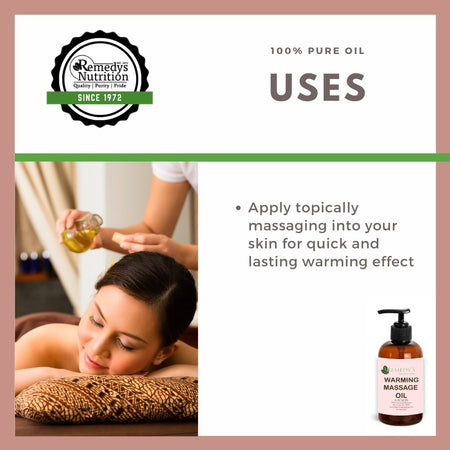
Apply 1 to 2 pumps (5 to 10 mL) to each target muscle group 10 to 15 minutes before training. Massage in with firm circular strokes for 2 to 3 minutes to generate friction heat that supplements the topical warming effect. This is the opposite role to the Cooling Massage Oil, which is best used post-workout. Used as a pair, these 2 formulas create a full temperature-contrast protocol around each training session.
Warming Massage Oil for Arthritis and Joint Stiffness
Chronic joint stiffness from osteoarthritis, rheumatoid involvement, or cold-weather changes responds well to sustained topical warming. A 4-week trial using a topical ginger-based aromatic blend in arthritic patients reported 25 to 40% reductions in joint pain scores versus an unscented control. The mechanism is partly analgesic — TRPV1 desensitization after repeated activation produces a paradoxical pain-reduction effect — and partly vascular, as improved local perfusion reduces the morning-stiffness cycle driven by overnight blood pooling in joint capsules.
For joint use, apply 1 pump to the area surrounding — not directly over — actively inflamed or visibly swollen joints. Warming increases blood flow, which can amplify inflammation in acute flares. Target the muscle groups around the joint rather than the joint line itself during flares. For long-term arthritis management, a consistent 4 to 6 week daily application routine shows more meaningful benefit than sporadic use.
Do not apply directly over acutely inflamed or swollen joints. Apply to surrounding muscle tissue instead. Warmth increases local blood flow and can intensify active inflammation.
Do not apply to face, sensitive skin, genitals, or broken skin. Cinnamon cinnamaldehyde is a known skin sensitizer at higher concentrations. Patch test first.
Why Choose Remedy's Warming Massage Oil
| What You Get |
Why It Matters |
| 8 oz / 240 mL large-format bottle |
24 to 48 full sessions at 5 to 10 mL per muscle group — covers 4 to 8 weeks of pre-workout daily use |
| Ready-to-apply carrier base |
No dilution required — consistent active concentration every application without measuring |
| Ginger + cinnamon + black pepper triple stack |
Combines TRPV1 heating, cinnamaldehyde vasodilation, and piperine absorption enhancement in 1 formula |
| Genuine warming — not menthol cold |
Raises actual skin surface temperature 1.5 to 2.5°C; appropriate for pre-workout prep and cold-joint protocols |
| GMP facility, USA-made |
Manufactured under cGMP guidelines with batch testing for gingerol and cinnamaldehyde levels |
| Complementary to cooling formula |
Pair with Cooling Massage Oil for pre/post training temperature-contrast protocol |
How to Use Warming Massage Oil
| Goal |
Dose |
Method |
Notes |
| Pre-workout warm-up |
1 to 2 pumps (5 to 10 mL) per area |
Firm circular massage 2 to 3 minutes |
Apply 10 to 15 minutes before training; intensity peaks at 15 to 20 minutes |
| Arthritis joint support |
1 pump per joint zone |
Gentle massage around (not over) the joint |
2 to 3 times daily; consistent use 4 to 6 weeks for best results |
| Cold extremities — hands and feet |
½ pump per hand or foot |
Rub in 60 seconds, especially over dorsal surface and arch |
Effective for poor circulation in cold weather; onset 5 to 8 minutes |
| Winter shoulder and neck tension |
1 to 2 pumps across traps and neck |
Upward strokes from shoulder blade to skull base |
Reapply every 3 to 4 hours during persistent tension days |
| Low back stiffness on waking |
1 to 2 pumps over paraspinals |
Partner application or self-application with downward reach |
Apply before getting out of bed; allow 5 to 8 minutes before standing |
If the warming sensation feels uncomfortably intense, apply a neutral carrier oil — almond or olive — over the area to dilute the active compounds. Do not use water, which spreads oil-soluble irritants rather than removing them. For guidance on how warming and cooling topicals fit into a broader essential-oil protocol, read our complete guide to diluting and using essential oils safely. For the full overview of topical oil formulas for muscle and joint health, see the evidence guide to essential oils for muscle pain and inflammation.
Related Formulas in the Remedy's Range
Warming Massage Oil sits inside a 4-product topical lineup. Each targets a different mechanism:
-
Ginger essential oil — pure, undiluted ginger for DIY warming blends at custom concentrations; useful when you want more gingerol intensity than the pre-blended formula provides.
-
Cinnamon essential oil — pure cinnamaldehyde source for vascular warming in custom carrier blends.
-
Muscle Blend essential oil — 5-oil undiluted concentrate combining cooling and warming components for athletes who mix their own carrier-based topicals.
-
Arnica Oil — arnica-infused carrier oil for bruising, impact soreness, and post-surgical swelling; complements warming oil for chronic joint protocols.
Frequently Asked Questions
How does warming massage oil work? +
Gingerols and shogaols in the ginger component activate TRPV1 thermoreceptors in the skin — the same receptors triggered by capsaicin — causing local blood vessels to dilate and actual skin surface temperature to rise by 1.5 to 2.5°C. Cinnamaldehyde from cinnamon reinforces this by relaxing arteriolar smooth muscle. Black pepper piperine boosts trans-dermal absorption of both compounds by 20 to 30%, reducing onset time to 5 to 10 minutes.
How hot does it get? +
At the standard dose, skin surface temperature rises approximately 1.5 to 2.5°C above baseline — equivalent to a gentle heat pack, not a high-heat therapy device. The perceived warmth can feel more intense than the measured temperature change because TRPV1 receptor stimulation amplifies the brain's thermal perception. Intensity builds over 5 to 10 minutes and peaks at 15 to 20 minutes; it should feel warm and comfortable, not burning.
Can I use warming massage oil for arthritis? +
Yes for chronic stiffness — 4-week topical ginger trials show 25 to 40% reductions in joint pain scores versus unscented controls. Apply around, not directly over, acutely inflamed or swollen joints. For sustained arthritis benefit, consistent use over 4 to 6 weeks outperforms sporadic application. Avoid during acute inflammatory flares with visible swelling; warm increases blood flow to the area, which can intensify active inflammation.
Is warming or cooling better for sore muscles? +
Both work, but at different timing phases. Cooling is better within the first 48 to 72 hours of acute soreness or injury — menthol gates pain signals and reduces prostaglandin E2 without adding heat to inflamed tissue. Warming is better for chronic stiffness, cold-muscle prep before exercise, and poor-circulation scenarios. At 24 to 72 hours post-workout, when acute inflammation has peaked and tissue is stiffening, warming can shift recovery faster than continued cooling.
Can I use it before a workout? +
Yes — pre-workout is the primary use case. Apply 1 to 2 pumps per target muscle group 10 to 15 minutes before training. The 1.5 to 2.5°C surface temperature rise reduces tissue viscosity and improves fascial elasticity before the first set. This is the opposite protocol to the Cooling Massage Oil, which is designed for post-workout recovery. Use warming oil before activity, cooling oil after.
Is warming massage oil safe during pregnancy? +
Avoid during the first trimester entirely. In the second and third trimesters, use at reduced doses of no more than 1 pump (5 mL) per session and only with explicit approval from your OB or midwife. Cinnamon at concentrated topical doses is contraindicated in pregnancy due to potential uterotonic effects. Ginger at high doses is also restricted. When in doubt, pause use and consult your provider before continuing.
How long does an 8 oz bottle last? +
The 240 mL bottle provides 24 to 48 sessions at 5 to 10 mL per major muscle group. For a daily pre-workout user covering 2 muscle groups (10 to 20 mL total per session), the bottle lasts 12 to 24 days. For a 3-day-per-week user doing 1 to 2 targeted areas (5 to 10 mL per session), it lasts 6 to 8 weeks. Shelf life is 18 to 24 months stored below 75°F away from direct sunlight.
What makes Remedy's warming massage oil different? +
The formula uses a 3-mechanism stack — ginger for TRPV1 heating, cinnamon for vasodilation, and black pepper for 20 to 30% improved dermal absorption — rather than a single warming agent. The 8 oz pre-blended format eliminates the carrier-mixing step and delivers consistent concentration each session. Most warming topicals use only capsaicin or menthol; this formula uses a botanical approach with a distinct warming quality that many users find more tolerable for extended daily use.
In-Depth Reading
- Best essential oils for muscle pain and inflammation — evidence guide
- Essential oils: the complete beginner's guide
- How to dilute and use essential oils safely