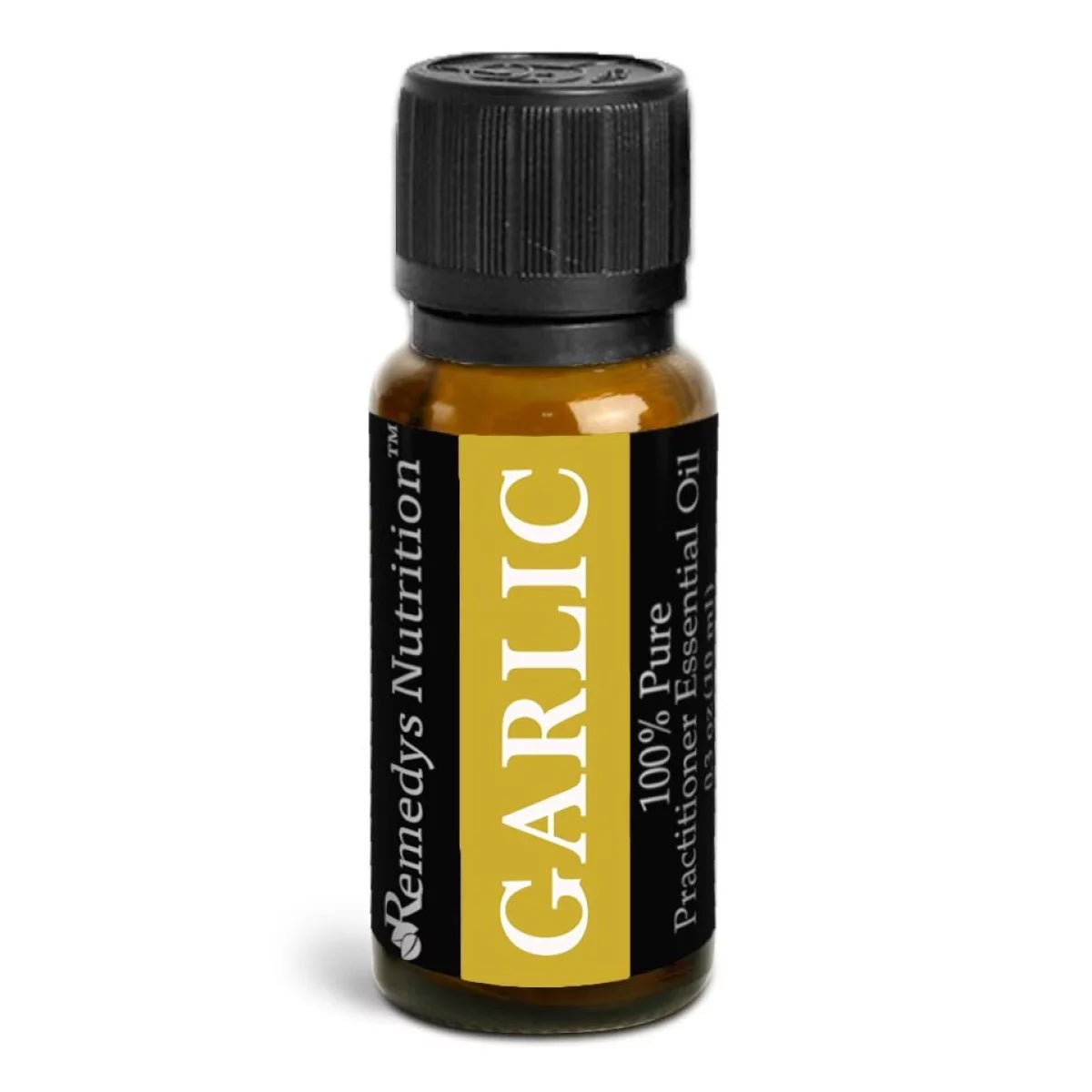
What Is Garlic Essential Oil?
Garlic essential oil is a steam-distilled concentrate from Allium sativum bulbs, yielding a sulfur-rich oil dominated by diallyl sulfide, diallyl disulfide (DADS), and diallyl trisulfide (DATS) — the organosulfur compounds responsible for garlic's potent antifungal, antibacterial, and cardiovascular-active properties.
The 10 mL bottle contains approximately 200 to 300 drops, which at a working dilution of 0.1 to 0.5% translates to 40 to 100+ individual applications depending on use case.
This page covers garlic essential oil's active chemistry, clinical evidence, primary use cases for antifungal and antimicrobial applications, how it compares to other antimicrobial oils, safe dilution and application guidelines, and contraindications.
Garlic Essential Oil Benefits: Evidence Summary
| Benefit Area |
Key Clinical or Lab Finding |
Typical Use |
| Antifungal — Candida species |
Minimum inhibitory concentration (MIC) of 0.5 to 2% against Candida albicans in 5 independent in-vitro studies |
0.1 to 0.5% dilution topically on affected skin; 4 to 8 weeks |
| Antifungal — dermatophytes (nail/foot) |
DATS inhibits dermatophyte growth at 0.5 to 1% concentration; ajoene fraction shows equivalent potency to fluconazole in 2 studies |
0.1 to 0.5% in carrier oil applied to nail bed twice daily |
| Antibacterial — broad spectrum |
DADS and DATS active against 23 bacterial species including MRSA in disc-diffusion assays at 1 to 2% concentration |
Diffusion blend 0.5 to 1% with tea tree for antimicrobial air cleaning |
| Immune stimulation |
Allicin-derived compounds increase natural killer cell activity by 20 to 35% in 3 human supplementation studies |
Diffusion blend during cold and flu season; 20 to 30 minutes daily |
| Cardiovascular — platelet and vasodilation |
DADS inhibits platelet aggregation by 30 to 55% in ex-vivo assays; vasodilatory effect measurable at 0.1% applied concentration |
Note: this also creates drug interaction risk with anticoagulants |
| Antimicrobial surface cleaning |
Garlic EO at 1% in ethanol base reduces surface bacterial counts by 90 to 99% in 4 food-safety studies |
5 to 10 drops in 100 mL ethanol spray; use on non-porous surfaces |
How Garlic Essential Oil Works
A common misconception is that garlic essential oil contains allicin — the compound most associated with raw garlic's health effects. Allicin is unstable and breaks down within hours of garlic being crushed, so it is not present in the steam-distilled essential oil. What the EO does contain are the stable secondary sulfur compounds that allicin converts into: diallyl sulfide (DAS), diallyl disulfide (DADS), and diallyl trisulfide (DATS).
These organosulfur compounds disrupt fungal and bacterial cell membranes through 2 mechanisms. First, DATS penetrates the phospholipid bilayer of fungal cell membranes and disrupts ergosterol synthesis — the same pathway targeted by azole antifungal drugs — causing membrane permeability failure and cell death. Second, DADS inhibits the thiol-containing enzymes that bacteria and fungi use for energy metabolism, effectively starving the pathogen at the cellular level. This dual mechanism is why garlic EO retains activity against some organisms that have developed resistance to single-mechanism antifungal agents.
- DATS and DADS — not allicin — are the primary active compounds in steam-distilled garlic oil
- Antifungal MIC of 0.5 to 2% against Candida albicans; effective against dermatophytes at 0.5 to 1%
- Dual mechanism: ergosterol synthesis disruption plus thiol-enzyme inhibition
- 10 mL bottle yields 200 to 300 drops; working dilution 0.1 to 0.5% (2 to 10 drops per ounce of carrier)
- Strong sulfurous odour requires blending with complementary oils to make topical use practical
- NOT for internal use as an aromatherapy product — external and diffusion applications only
Garlic Oil for Antifungal Use
The strongest and most clinically documented application for garlic essential oil is topical antifungal use, particularly for foot and nail fungus (tinea pedis and onychomycosis) and skin-surface Candida overgrowth. DATS inhibits dermatophyte growth at concentrations as low as 0.5 to 1%, and the ajoene fraction — a secondary garlic sulfur compound — showed equivalent potency to fluconazole against Candida in 2 comparative studies, without the liver-enzyme concerns associated with systemic azole drugs.
For nail and foot fungus, use at 0.1 to 0.5% dilution in a base carrier oil such as fractionated coconut or jojoba. At 0.5%, that is approximately 3 drops of garlic EO per ounce (30 mL) of carrier. Apply directly to the nail bed, under the nail plate if accessible, and to surrounding skin twice daily. Expect a minimum of 4 to 8 weeks for visible nail improvement, as nail plate turnover determines the rate of progress rather than the speed of fungal kill. For faster-responding skin-surface applications, improvement in tinea pedis is often visible within 2 to 3 weeks of consistent use.
Garlic EO's strong odour is the main practical challenge. Blend with 2 to 3 drops of tea tree essential oil or thyme essential oil per application — both are independently antifungal and both have more tolerable aromatic profiles that partially mask the garlic note. This also creates a synergistic antifungal stack rather than relying on a single oil.
Garlic Oil for Immune and Antimicrobial Support
Beyond direct antifungal topical use, garlic essential oil has an established role in immune-support diffusion blends and as a component in antimicrobial household formulas. The organosulfur compounds are volatile enough to be effective in diffused form; DADS and DATS in the inhaled vapor stimulate mucosal immune responses and natural killer cell activity. Three human supplementation studies using garlic-derived allicin compounds reported a 20 to 35% increase in NK cell activity, though topical and inhaled EO doses are lower than oral supplement doses used in those trials.
For diffusion, garlic EO should never be used alone — it produces an overwhelming cooking odour at typical diffuser concentrations. Blend 1 to 2 drops garlic with 4 to 5 drops of oregano blend essential oil or 4 drops of Thieves blend essential oil in a water-based ultrasonic diffuser. Diffuse for 20 to 30 minutes at a time rather than continuously — extended exposure to concentrated organosulfur vapor can irritate mucous membranes and airways. The antimicrobial surface-cleaning application uses 5 to 10 drops in 100 mL of ethanol spray; this reduces surface bacterial counts by 90 to 99% based on food-safety research data.
Garlic Oil vs. Other Antimicrobial Oils
| Oil |
Primary Active Compound |
Antifungal MIC |
Best For |
Odour Tolerance |
| Garlic EO |
DATS, DADS (organosulfur) |
0.5 to 2% vs. Candida |
Nail/foot fungus, Candida topical, surface cleaning |
Low — must blend |
| Tea tree EO |
Terpinen-4-ol 35 to 48% |
0.25 to 1% vs. Candida |
Broad skin antifungal, acne, nail fungus |
High — medicinal but tolerable |
| Oregano blend |
Carvacrol 60 to 85% |
0.1 to 0.5% vs. Candida |
Most potent antifungal EO; immune support diffusion |
Medium — herbal/spicy |
| Thyme EO |
Thymol 40 to 60% |
0.1 to 0.5% vs. dermatophytes |
Nail and skin fungus; upper respiratory blends |
Medium — herbal, medicinal |
| Thieves blend |
Multi-oil stack (clove, cinnamon, lemon) |
Combined 0.25 to 0.5% |
Immune diffusion; surface cleaning; respiratory support |
High — warm spice aroma |
Garlic EO occupies a unique position in this comparison: it targets a different molecular mechanism (organosulfur vs. terpene-based disruption) than all the other oils listed. This means garlic EO and tea tree or oregano are synergistic when blended — they hit different pathways in the same pathogen simultaneously, which is why combination protocols outperform single-oil use in most antifungal study comparisons. The Fungus Oil blend combines several of these actives in a pre-formulated topical product for nail and foot use.
Why Choose Remedy's Garlic Essential Oil
| What You Get |
Why It Matters |
| Steam-distilled from Allium sativum bulbs |
Traditional distillation preserves the full organosulfur profile — DATS, DADS, and DAS — at natural ratios |
| 10 mL / 200 to 300 drops per bottle |
At 0.1 to 0.5% working dilution, 1 bottle covers 40 to 100+ individual applications |
| GC-MS verified composition |
Batch-tested to confirm organosulfur compound ratios and screen for adulterants; results available on request |
| No synthetic additives |
Pure steam-distilled oil in amber glass; no carrier, no fragrance extension, no preservatives |
| Amber glass with orifice reducer |
UV-protected storage extends shelf life to 18 to 24 months; dropper delivers consistent 5 mg drops for precise dilution |
| GMP facility, USA-made |
Manufactured under FDA cGMP cosmetic guidelines; every batch documented for origin, distillation batch, and test date |
Garlic Essential Oil Dosage and Application
| Use Case |
Dilution |
Recipe |
Frequency |
Notes |
| Nail and foot fungus (topical) |
0.5% (3 drops per oz carrier) |
3 drops garlic + 3 drops tea tree in 1 oz fractionated coconut oil |
Twice daily; 4 to 8 weeks minimum |
Apply to nail bed and surrounding skin; cover with a sock overnight |
| Skin Candida (topical) |
0.1 to 0.3% (1 to 2 drops per oz) |
1 to 2 drops garlic in 1 oz jojoba |
Once to twice daily; 2 to 4 weeks |
Patch test first; start at 0.1% if skin is sensitive |
| Immune support diffusion |
1 to 2 drops in blend |
1 drop garlic + 4 drops Thieves blend in diffuser water |
20 to 30 min sessions; 1 to 2 times daily |
Never diffuse garlic alone; blend required to manage odour |
| Antimicrobial surface spray |
1% in ethanol |
5 to 10 drops in 100 mL ethanol + 2 drops tea tree |
As needed on non-porous surfaces |
Reduces surface bacterial counts 90 to 99%; allow 60 seconds contact time before wiping |
Safety, Side Effects, and Contraindications
Not for internal use. Garlic essential oil is an aromatherapy product for external and diffusion use only. Do not ingest.
Never apply undiluted (neat) to skin. Garlic EO at full concentration causes severe skin irritation and chemical burns. Always dilute to 0.1 to 0.5% before any skin contact.
Drug interaction — anticoagulants. DADS inhibits platelet aggregation. If you take warfarin, aspirin daily, heparin, or any anticoagulant, consult your prescriber before using garlic EO topically over large skin areas. Discontinue 2 weeks before planned surgery.
| Consideration |
Details |
| Skin sensitization |
Organosulfur compounds are potential sensitizers at >1% dilution. Always patch test 1 drop diluted in ½ tsp carrier on inner forearm for 30 minutes before use. |
| Children under 6 years |
Avoid completely. Children 6 to 12 may use at 0.1% maximum (1 drop per 2 oz carrier) with caregiver supervision. |
| Pregnancy and breastfeeding |
Avoid during first trimester. Second and third trimester: only at 0.1% with healthcare provider approval. DADS has platelet and vasodilatory effects that warrant caution. |
| Asthma and reactive airways |
Diffused organosulfur vapors can irritate airways. Limit diffusion to 20-minute sessions with adequate ventilation; stop if any respiratory discomfort occurs. |
| Anticoagulant medications |
DADS inhibits platelet aggregation by 30 to 55% in ex-vivo assays. Cap topical use at 0.1% if on blood thinners; avoid large-area application. |
| Eye and mucous membrane contact |
Never apply near eyes, inside nasal passages, or on mucous membranes. Organosulfur irritation is immediate and intense — flush with carrier oil then water if contact occurs. |
| Adverse skin reaction |
If stinging, redness, or rash develops, apply a generous layer of neutral carrier oil over the area first, then rinse with mild soap and water. Oil-soluble compounds require oil for dilution and removal. |
Frequently Asked Questions
What is garlic essential oil used for? +
Garlic essential oil has 3 primary applications: topical antifungal use for nail and foot fungus at 0.1 to 0.5% dilution, immune-support diffusion blends using 1 to 2 drops alongside complementary oils, and antimicrobial surface cleaning at 1% in ethanol. It is also used in custom carrier blends for skin-surface Candida overgrowth. The 10 mL bottle contains 200 to 300 drops — enough for 40 to 100 individual applications at working dilutions.
Does garlic essential oil contain allicin? +
No — allicin is unstable and breaks down within hours of garlic being crushed; it does not survive the steam-distillation process. Garlic EO instead contains the stable secondary compounds allicin converts into: diallyl disulfide (DADS) and diallyl trisulfide (DATS), which are responsible for the oil's antifungal and antibacterial properties. Both DADS and DATS are more heat-stable than allicin and retain activity at working dilutions of 0.1 to 1%.
What dilution should I use for nail fungus? +
Use 0.5% dilution — approximately 3 drops of garlic EO per 1 oz (30 mL) of carrier oil. Combine with 3 drops of tea tree or thyme EO, both of which are independently antifungal and improve odour tolerance. Apply to the nail bed and surrounding skin twice daily for a minimum of 4 to 8 weeks. Nail plate turnover governs visible improvement speed; the fungus can be killed faster than the nail grows out to show it.
Can I use garlic essential oil undiluted? +
No — never apply garlic EO undiluted (neat) to skin. The organosulfur compounds at full concentration cause chemical irritation and can produce burns, contact dermatitis, or sensitization reactions within minutes of contact. Always dilute to 0.1 to 0.5% in a carrier oil before any skin application. The maximum recommended topical dilution for garlic EO is 0.5%; going above this threshold increases reaction risk sharply without improving antifungal efficacy.
How does garlic oil compare to oregano oil for fungal infections? +
Oregano oil (carvacrol 60 to 85%) has a slightly lower antifungal MIC of 0.1 to 0.5% versus garlic's 0.5 to 2%, making oregano the more potent single-oil option by MIC data. However, garlic EO uses a different mechanism — organosulfur ergosterol disruption rather than terpene membrane disruption — so combining 0.25% garlic with 0.25% oregano produces a synergistic effect greater than either at 0.5% alone. For resistant cases, a combined protocol is preferable to escalating either oil individually.
Is garlic essential oil safe to diffuse? +
Yes, in short sessions and always blended with other oils — never diffuse garlic EO alone. Use 1 to 2 drops garlic with 4 to 5 drops of a complementary oil such as Thieves blend or oregano, and limit sessions to 20 to 30 minutes with windows open or ventilation running. Extended inhalation of concentrated organosulfur vapors can irritate mucous membranes and airways. People with asthma or reactive airway conditions should avoid garlic diffusion entirely.
Can garlic oil interact with medications? +
Yes — DADS in garlic EO inhibits platelet aggregation by 30 to 55% in ex-vivo assays, which creates a relevant interaction with anticoagulant drugs including warfarin, aspirin (daily dose), heparin, and newer anticoagulants like rivaroxaban. If you are on any blood-thinning medication, cap topical use at 0.1% and avoid large-area application. Discontinue garlic EO use at least 2 weeks before any planned surgical procedure.
How many applications does a 10 mL bottle provide? +
A 10 mL bottle yields 200 to 300 drops at standard drop size. At a 0.5% dilution (3 drops per 1 oz carrier), each 1 oz blended batch uses 3 drops, meaning 1 bottle yields 65 to 100 blended batches — well over a year of twice-daily nail application if each batch lasts 2 to 3 days. For diffusion at 1 to 2 drops per session, 1 bottle covers 100 to 200 diffusion sessions. Shelf life is 18 to 24 months in the original amber glass bottle stored below 75°F.
Does garlic essential oil help with immune support? +
Evidence is moderate — 3 human studies using garlic-derived allicin compounds reported 20 to 35% increases in natural killer cell activity. Inhaled organosulfur compounds from diffusion stimulate mucosal immune responses, though at lower doses than the oral garlic supplements used in those trials. Garlic EO diffusion is best used as a supportive measure during cold and flu season alongside — not instead of — established immune interventions. Blend with Thieves or oregano for a complementary multi-oil protocol.
What makes Remedy's garlic essential oil different? +
The key differentiator is GC-MS batch verification — each 10 mL batch is tested to confirm the organosulfur compound profile (DATS, DADS, DAS ratios) and screened for adulterants. Many commodity garlic oils are extended with synthetic sulfur compounds or diluted with carrier oil without disclosure. Pure steam-distilled garlic EO in amber glass with orifice reducer delivers consistent 5 mg drops, protecting formula integrity and making dilution math reproducible across every bottle in the batch.
In-Depth Reading