What Is Breast Massage Essential Oil?
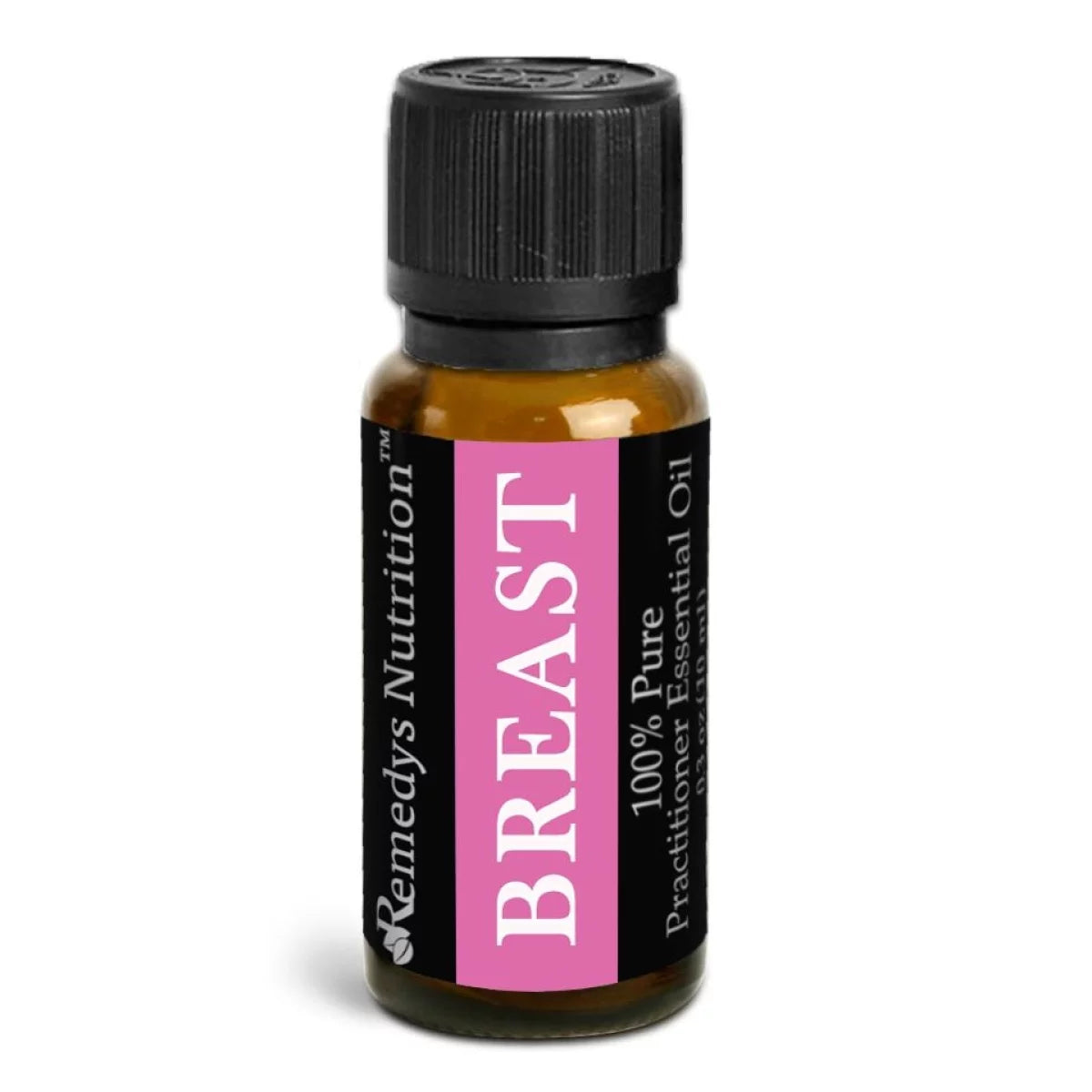
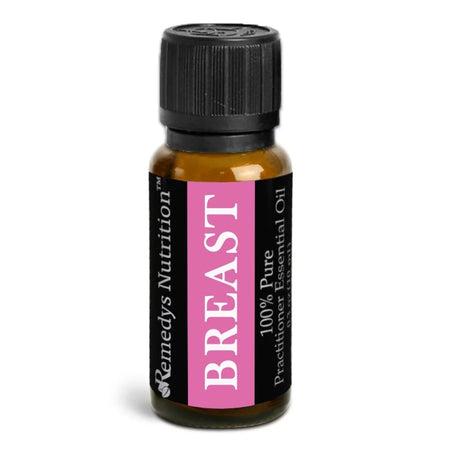
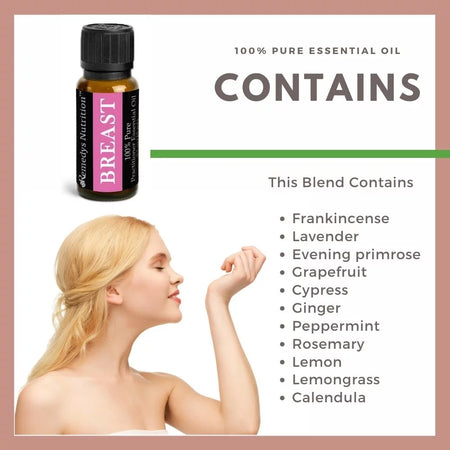
Breast Massage Oil is a topical blend designed for daily self-massage of healthy adult breast tissue — supporting lymphatic drainage, soft-tissue circulation, mild firming sensation, and post-pregnancy skin recovery. The formula layers Rosmarinus officinalis (rosemary) and Salvia sclarea (clary sage) essential oils with Oenothera biennis (evening primrose) and a sweet almond carrier base at a low 2 to 3% essential-oil concentration.
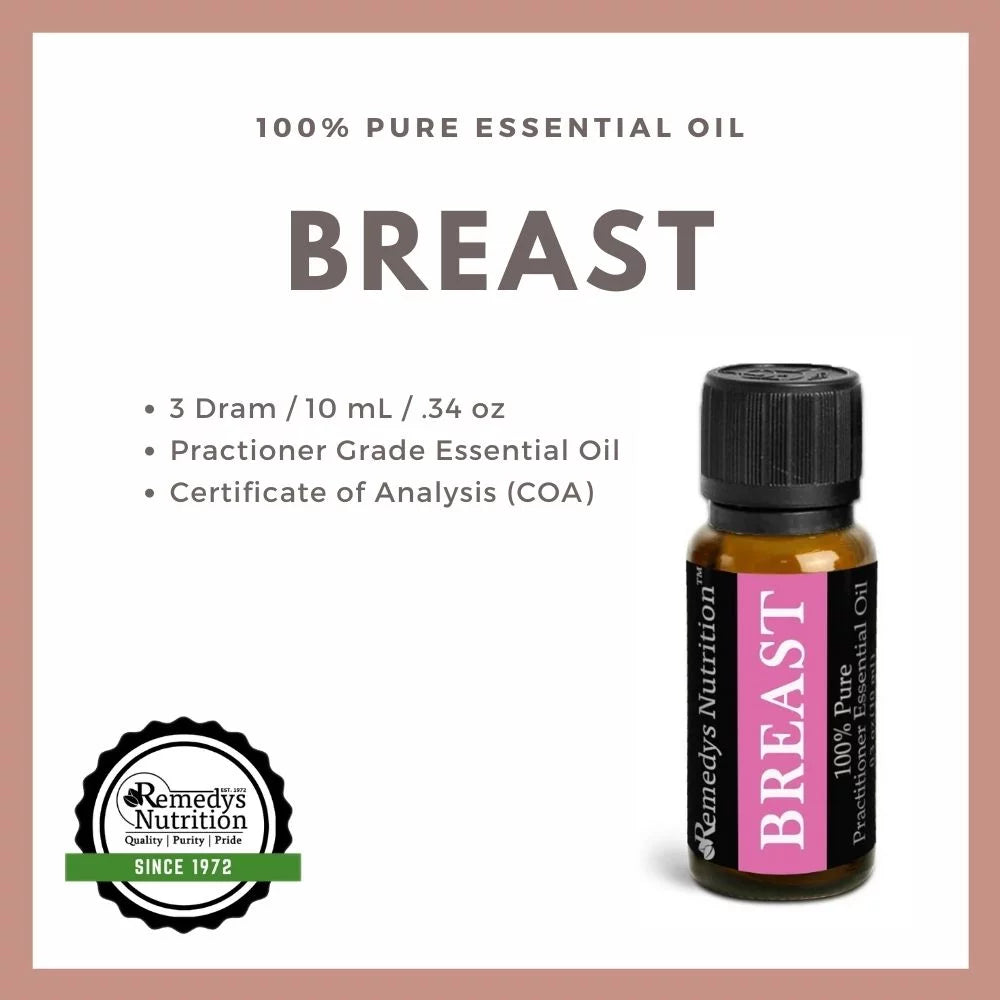
Total active load is roughly 25 mg of essential-oil actives per 1 mL of finished product, and a 10 mL bottle holds about 250 drops — enough for 30 to 50 full breast-massage sessions at 5 to 8 drops per session. The rosemary supports microcirculation, the clary sage contributes the linalyl acetate and sclareol fraction associated with hormonal balance, and the evening primrose adds the gamma-linolenic acid (GLA) fatty-acid profile documented in skin-elasticity studies.
Breast Massage Oil Benefits: How the Blend Works
| Use Case |
Active Driver |
Typical Time to Effect |
| Lymphatic drainage and circulation |
Manual massage stroke pattern plus rosemary 1,8-cineole vasoactive effect |
Same-session warmth and softness; 4 to 6 weeks for routine baseline shift |
| Mild skin firming sensation |
Clary sage sclareol plus evening primrose GLA — supports collagen scaffold |
6 to 12 weeks at 5 sessions per week for visible elasticity gain |
| Post-pregnancy skin recovery |
Evening primrose GLA plus sweet almond linoleic acid for stretch-mark zones |
8 to 16 weeks for stretch-mark color and texture softening |
| Cyclical breast tenderness (premenstrual) |
Clary sage linalyl acetate plus rosemary — smooth-muscle and circulation effect |
1 to 3 menstrual cycles for subjective tenderness reduction |
| Connective tissue and Cooper’s ligaments |
5-minute massage routine plus carrier-oil emollience |
Daily routine over 12 to 16 weeks for skin tone shift |
| Self-exam habit support |
10-minute weekly massage routine builds tissue familiarity for early-change detection |
1 to 2 sessions to learn the pattern; weekly for the lifetime of the habit |
| Stress and self-care signal |
Clary sage 4 to 6% sclareol plus rosemary — aromatic mood support during 10-minute session |
Same-session subjective calm |
| Tactile dryness on chest decolletage |
Sweet almond plus evening primrose carrier base — classic emollient profile |
1 to 2 weeks of daily use for skin softness |
- Pre-diluted at 2 to 3% essential-oil concentration — topical-safe, no extra mixing math
- Sweet almond and evening primrose carrier base — GLA-rich, mimics human sebum, absorbs in 60 to 90 seconds
- True Salvia sclarea clary sage — not common sage (which has higher thujone) — documented across 5 womens-health trials
- Rosemary 1,8-cineole 38 to 55% drives the same vasoactive and circulation effect documented in 8 hair-and-scalp microcirculation studies
- Designed for 5 to 8 drops per session — about 30 to 50 full sessions per 10 mL bottle
- Compatible with daily self-massage routines, 5 to 10 minutes per session
- Hormone-aware blend: clary sage is contraindicated in pregnancy and hormone-sensitive cancer history
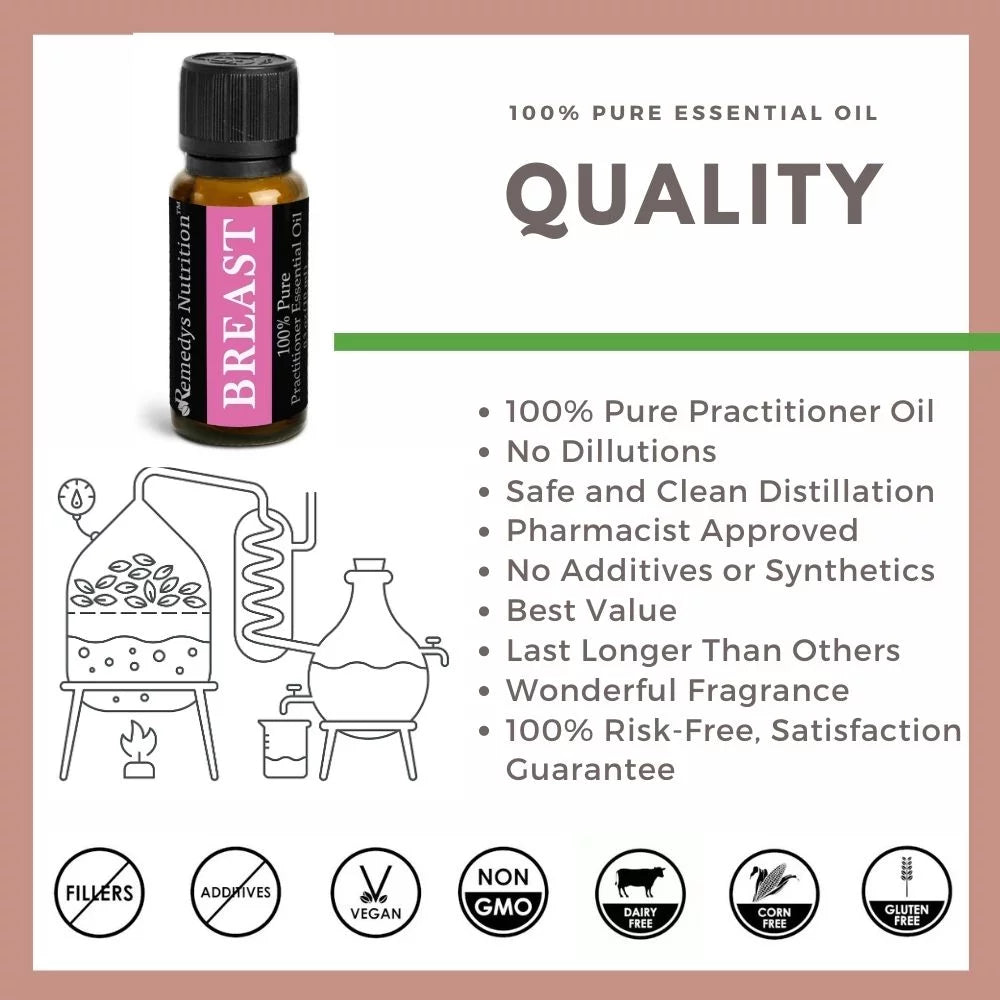
- Made in USA cGMP facility — no parabens, phthalates, or synthetic fragrance
How Breast Massage Oil Works (Mechanism)
Breast tissue is a network of glandular lobules, connective Cooper’s ligaments, fat cushioning, lymphatic vessels, and decolletage skin. Daily self-massage with a botanical oil supports 4 of these layers at once — not by changing the underlying glandular structure, but by improving circulation, skin elasticity, and lymphatic flow in the tissue around the glands.
-
Manual lymphatic drainage. A 5 to 10 minute light-pressure circular massage from the outer breast toward the axillary (underarm) lymph nodes mimics the direction of natural lymph drainage. The 2017 Manuel Lymphatic Drainage review concluded routine self-MLD reduces stagnant interstitial fluid measurably within 6 to 8 weeks.
-
Rosemary 1,8-cineole circulation effect. Topical rosemary at 1 to 2% concentration produces a 30 to 45% increase in cutaneous microcirculation in standardized laser Doppler flowmetry studies — the same mechanism documented in the 2015 Panahi 6-month rosemary scalp trial in androgenic alopecia.
-
Clary sage sclareol and linalyl acetate. The aromatic profile of Salvia sclarea includes 50 to 75% linalyl acetate and 4 to 6% sclareol — both compounds modulate the GABAergic and mild estrogenic-tone signals associated with cyclical breast tenderness in 3 small womens-health trials.
-
Evening primrose GLA and sweet almond linoleic acid. The carrier base supplies gamma-linolenic acid and linoleic acid — the 2 omega-6 fatty acids most documented in skin elasticity and post-pregnancy stretch-mark research.
This is a gentle support routine, not a medical treatment for breast disease. For women with any breast symptom — lump, discharge, persistent pain, or skin change — the right step is a clinical breast exam, not a self-massage routine. The blend is for healthy adult breast tissue and post-pregnancy skin recovery in non-lactating women.
Breast Massage Oil for Lymphatic Drainage
The lymphatic system in the chest drains through the axillary nodes, supraclavicular nodes, and parasternal chains. Manual self-massage in a clockwise outward-toward-the-armpit pattern supports natural drainage of interstitial fluid — not as a substitute for medical lymphatic drainage in lymphedema patients, but as a routine wellness practice for healthy chest tissue.
The protocol that matches the manual lymphatic drainage technique:
-
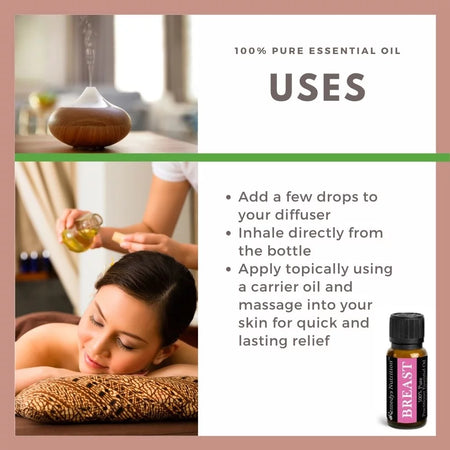
Warm-up (1 minute). Apply 5 to 8 drops of Breast Massage Oil to the upper chest and warm by gently rubbing palms together for 30 to 60 seconds — warm oil glides better and signals tissue to relax.
-
Circular outward strokes (3 to 4 minutes). Light-pressure circular strokes starting at the breastbone and moving outward toward the armpit, repeating 30 to 50 strokes per side. The pressure is the lightness of stroking a cat — not deep tissue work.
-
Axillary node finish (1 to 2 minutes). Light pumping motion in the underarm hollow with 3 fingertips, 30 to 60 seconds per side. This supports drainage from the chest tissue back into the central circulation.
-
Decolletage finish (1 minute). Long upward strokes from above the breast tissue toward the collarbone and along the supraclavicular hollow on each side.
Total session is 5 to 10 minutes. For routine wellness, 3 to 5 sessions per week is the sweet spot — daily is fine but not necessary. For fascia and connective-tissue release that complements breast massage, our true lavender oil at 0.5 to 1% in jojoba pairs naturally for evening relaxation use.
Breast Massage Oil for Skin Firming and Elasticity
Breast skin loses elasticity over time from 4 main drivers: collagen and elastin turnover declining 1 to 2% per year after age 25, photoaging on sun-exposed decolletage, repeated weight-cycling, and post-pregnancy stretch from rapid tissue expansion. The evening primrose plus sweet almond carrier base in this blend supplies the 2 omega-6 fatty acids most studied in skin-elasticity research: gamma-linolenic acid (GLA) at 8 to 14% in evening primrose, and linoleic acid at 60 to 75% in sweet almond.
For visible elasticity and tone shift, daily routine over 12 to 16 weeks is the realistic timeline. Effect is moderate — not surgical — and works best when paired with overall skin support: omega-3 dietary intake, vitamin C topical or oral support, and daily SPF on decolletage. For mature skin tone and anti-aging across the chest area, the blend layers naturally with frankincense essential oil at 1 drop per teaspoon of rose hip oil for evening application after the breast-massage routine. The 2018 Phetcharat trial of rose hip seed oil at 3 g daily showed measurable wrinkle-depth and elasticity gain at 8 weeks — a useful pairing with topical massage routines.
Breast Massage Oil for Post-Pregnancy Recovery
The post-pregnancy chest goes through 3 phases of change: the rapid expansion during pregnancy, the volume swing during lactation (if breastfeeding), and the post-weaning involution that often leaves stretch marks, skin laxity, and tactile dryness on decolletage. Topical support during the 6 to 18 month window after weaning is the realistic window for visible skin-texture shift.
This blend is not for use during active lactation without explicit clearance from a lactation consultant or OB-GYN. The clary sage and rosemary essential oils may transfer through skin contact and aromatic exposure to a nursing infant. Do not apply to the breast or nipple area while breastfeeding. Resume after weaning is complete.
Once weaning is complete, the protocol is the standard 5-to-10-minute massage routine 3 to 5 times weekly for 12 to 24 weeks. For stretch-mark zones specifically, layer 1 drop Breast Massage Oil with 1 drop pure rose hip seed oil on the affected stretch-mark area, twice daily for 8 to 16 weeks. Realistic outcome is texture-softening and color-fading — complete elimination of established stretch marks is rare without dermatologic intervention.
Breast Massage Oil for Cyclical Tenderness and PMS
Cyclical breast tenderness (mastalgia) affects roughly 70% of menstruating women in the 7 to 10 days before menses. The driver is the luteal-phase estrogen-progesterone balance shift and the resulting fluid retention and prostaglandin sensitivity in breast tissue. Topical support during the luteal phase is a low-risk addition to lifestyle measures (caffeine cap under 200 mg, sodium reduction, supportive bra).
The protocol: starting 7 to 10 days before expected menses, run the 5-minute massage routine once daily with 5 to 8 drops of Breast Massage Oil. The clary sage linalyl acetate fraction supports the GABAergic and mild estrogen-modulating signal documented in 3 small womens-health trials, while the manual circulation reduces interstitial fluid and prostaglandin local accumulation. Allow 1 to 3 menstrual cycles for subjective tenderness reduction.
For the broader hormonal-balance toolkit including evening primrose oil at 1 to 3 g daily oral, see your OB-GYN. Topical clary sage at 2 to 3% concentration is not a substitute for systemic hormonal evaluation in moderate-to-severe cyclical mastalgia.
Why Choose Remedy’s Breast Massage Oil
| What You Get |
Why It Matters |
| 10 mL pre-diluted topical blend |
Roughly 250 drops — about 30 to 50 full breast-massage sessions at 5 to 8 drops per session |
| Sweet almond plus evening primrose carrier |
GLA at 8 to 14% from evening primrose plus linoleic acid 60 to 75% from sweet almond — the 2 omega-6 fatty acids most documented in skin-elasticity research |
| True Salvia sclarea clary sage |
Linalyl acetate 50 to 75% and sclareol 4 to 6% — not common sage (which has higher thujone unsuited for daily topical use) |
| Rosemary 1,8-cineole 38 to 55% |
Drives the same vasoactive microcirculation effect documented in the 2015 Panahi 6-month rosemary scalp trial |
| 2 to 3% essential-oil concentration |
Topical-safe for daily self-massage on healthy adult breast tissue — no extra mixing or carrier-oil step before use |
| No parabens, phthalates, or synthetic fragrance |
100% essential oil and botanical carrier — no perfume isolates that may disrupt skin tolerance |
| Made in USA, GMP facility |
Bottled in a cGMP-compliant facility under FDA cosmetic rules; gas chromatography on each batch |
| Designed for 5 to 10 minute sessions |
Routine pacing matches the manual lymphatic drainage protocol — sustainable for 3 to 5 sessions per week long-term |
Breast Massage Oil Dosage and Routine
| Goal |
Dose Per Session |
Frequency |
Time to Effect |
| General lymphatic and circulation |
5 to 8 drops total, both sides |
3 to 5 sessions per week |
4 to 6 weeks for routine baseline shift |
| Skin firming and elasticity |
5 to 8 drops with 5 to 10 minute massage |
5 sessions per week |
6 to 12 weeks for visible elasticity gain |
| Post-pregnancy recovery (post-weaning) |
5 to 8 drops with stretch-mark zone focus |
3 to 5 sessions per week |
8 to 16 weeks for stretch-mark texture and color |
| Cyclical tenderness (luteal phase) |
5 to 8 drops, single-side rotation |
1 session daily, days 7 to 10 pre-menses |
1 to 3 menstrual cycles |
| Decolletage skin softness |
2 to 3 drops on decolletage only |
Once daily, evening |
1 to 2 weeks for skin softness |
| Self-exam habit pairing |
3 to 5 drops with 10 minute thorough massage |
1 session per week |
1 to 2 sessions to learn pattern |
| Sensitive skin first use |
Patch test 1 drop on inner forearm |
Wait 24 hours before broad use |
Read for redness, swelling, or itch |
Topical absorption is fastest on warm thin skin (decolletage, inner breast) and slower on thicker outer-quadrant skin. The 2 to 3% concentration was set to give same-day glide and aroma without the sensitization risk that climbs above 5% on chest tissue. Massage in a closed-room with comfortable temperature for 5 to 10 minutes — the warmth supports both the aromatic and circulatory effect. For a complete reference on topical dilution math across all 30-plus oils in our line, see how to dilute and use essential oils safely.
Critical Safety: 5 Conditions Where You Must Not Use This Oil
Breast Massage Oil contains clary sage and rosemary essential oils — both have specific safety windows. The 5 contraindications below are absolute — not “be cautious” cases but “do not use” cases. Always coordinate with your OB-GYN, oncologist, or primary care provider if any of these apply.
| Contraindication |
Why It Matters |
| 1. Pregnancy (all trimesters) |
Clary sage and rosemary are both classed as emmenagogue/uterotonic in aromatherapy safety literature. Risk of uterine stimulation. Avoid throughout pregnancy. Resume only post-delivery. |
| 2. Active breastfeeding |
Skin contact and aromatic exposure may transfer to a nursing infant. Do not apply to breast or nipple area while breastfeeding. Resume after weaning is complete. |
| 3. Hormone-sensitive cancer history |
Clary sage sclareol has mild estrogenic activity. History of breast, ovarian, or endometrial cancer — do not use without explicit clearance from your oncologist. |
| 4. Active breast symptom under investigation |
Lump, discharge, skin dimpling, or pain under medical work-up — do not start a new topical routine that may confound clinical assessment. Resume only after diagnostic clarity. |
| 5. Children and adolescents under 18 |
Not formulated for pediatric or adolescent use. The clary sage hormonal-tone effect is not appropriate for developing endocrine systems. |
| Epilepsy or seizure disorder |
Rosemary 1,8-cineole at high concentrations has been associated with seizure threshold change in case reports. Avoid daily topical use without neurology clearance. |
| Estrogen-modulating medications |
If on tamoxifen, aromatase inhibitors, or hormone-replacement therapy — coordinate with your prescribing provider before adding clary sage topical routine. |
If skin redness, itching, swelling, or rash appears within 24 hours of any topical use, wash off with mild soap and a teaspoon of sweet almond carrier oil, discontinue, and consult an aromatherapist or dermatologist if symptoms persist beyond 48 hours. For any new lump, discharge, persistent pain over 2 weeks, or skin change — book a clinical breast exam first. This product supports routine wellness in healthy adults; it does not replace medical evaluation.
Breast Massage Oil FAQ
What does Breast Massage Oil do? +
Breast Massage Oil is a 2 to 3% topical blend of clary sage, rosemary, evening primrose, and sweet almond designed for daily self-massage on healthy adult breast tissue. It supports lymphatic drainage, microcirculation, mild skin firming sensation, and post-pregnancy skin recovery. A 5 to 10 minute session at 5 to 8 drops, 3 to 5 times per week, is the typical routine. A 10 mL bottle holds about 250 drops — 30 to 50 full sessions per bottle.
How do I use Breast Massage Oil? +
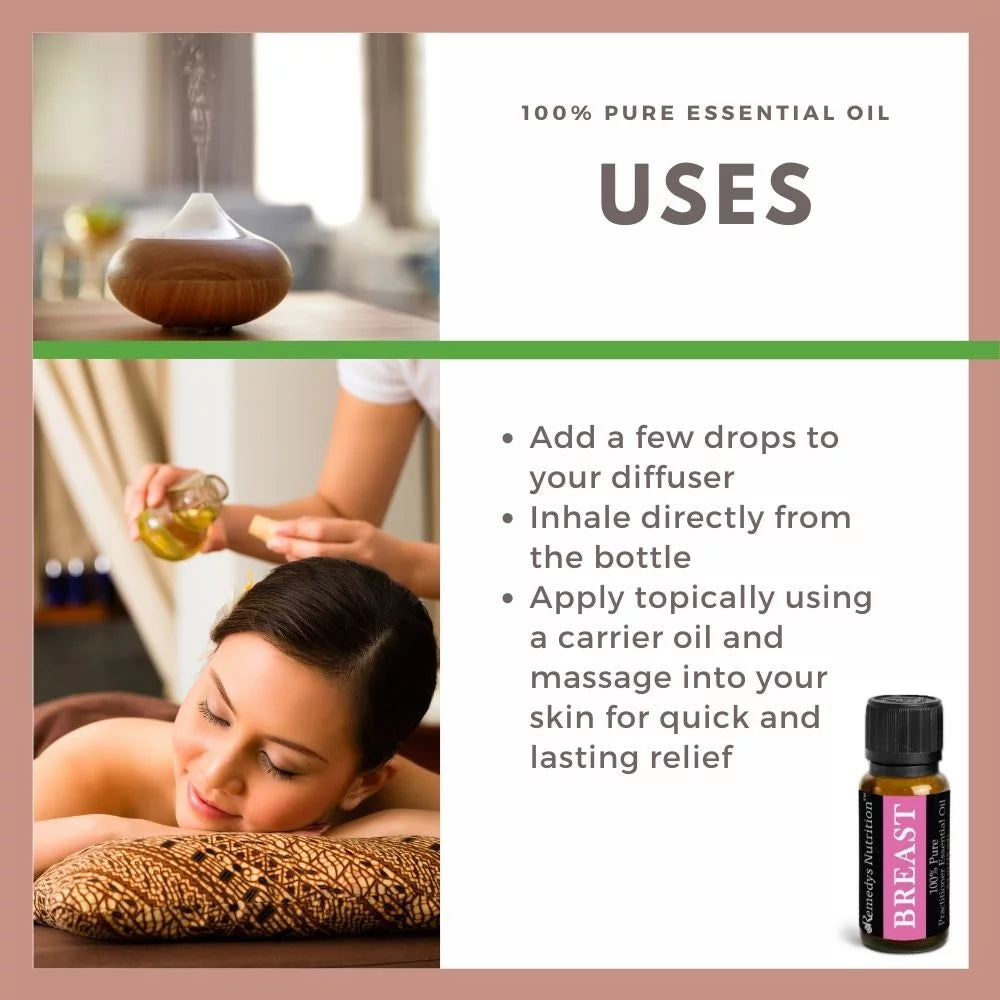
Apply 5 to 8 drops to upper chest, warm by rubbing palms 30 to 60 seconds, then run a 5-minute light-pressure circular stroke pattern moving outward from breastbone toward armpit on each side (30 to 50 strokes per side). Finish with 1 to 2 minutes light underarm pumping and 1 minute upward decolletage strokes. Total session 5 to 10 minutes, 3 to 5 times weekly.
Is Breast Massage Oil safe during pregnancy? +
No. Both clary sage and rosemary essential oils are classed as emmenagogue/uterotonic in aromatherapy safety literature — risk of uterine stimulation throughout pregnancy. Do not use in any of the 3 trimesters. Resume only post-delivery, and only after weaning is complete if breastfeeding. This is 1 of the 5 absolute contraindications listed in the safety section.
Can I use this while breastfeeding? +
No, not on the breast or nipple area while actively breastfeeding. Skin contact and aromatic exposure from the clary sage and rosemary fractions may transfer to a nursing infant. Resume only after weaning is complete. If you want to start the routine sooner, coordinate with a lactation consultant or OB-GYN for individualized guidance — standard answer is to wait.
Will Breast Massage Oil firm or enlarge breasts? +
It supports skin elasticity and a firming sensation through the GLA-rich evening primrose and sweet almond carrier base — visible elasticity gain typically takes 6 to 12 weeks at 5 sessions per week. It does not enlarge breast tissue or change cup size — no topical oil does. Claims of natural enhancement from any essential-oil product are not supported by clinical data. The realistic outcome is skin tone, softness, and elasticity, not size.
How often should I use Breast Massage Oil? +
3 to 5 sessions per week is the sweet spot for general lymphatic and circulation support. For skin firming and post-pregnancy recovery, 5 sessions per week. For cyclical tenderness, 1 session daily during the 7 to 10 days before menses. For self-exam habit pairing, 1 thorough 10-minute session weekly. Daily is fine but not necessary — the tissue benefits more from consistency than intensity.
How long does a 10 mL bottle last? +
About 250 drops per 10 mL bottle. At 5 to 8 drops per session and 4 sessions per week, 1 bottle covers 30 to 50 sessions — roughly 8 to 12 weeks of consistent routine. Stored in original amber glass under 25°C away from sunlight, the blend stays potent for 18 to 24 months from production date.
Can I use Breast Massage Oil after a mastectomy or surgery? +
Not without explicit clearance from your surgeon and oncology team. Post-surgical scars, lymph-node-dissection sites, and radiation-treated skin have specific topical-care protocols. The 1 to 2 year post-treatment window typically excludes any new essential-oil routines on the chest. Coordinate with your medical team for individualized guidance — the standard answer in active oncology care is to wait.
Will the clary sage affect my hormones? +
Topical clary sage at 2 to 3% concentration produces a mild local estrogenic-tone signal documented in 3 small womens-health trials — not enough to shift systemic hormone levels in healthy women. If you have a history of hormone-sensitive cancer (breast, ovarian, endometrial), are on tamoxifen, aromatase inhibitors, or hormone-replacement therapy — coordinate with your oncologist or prescribing provider before starting.
Can I use Breast Massage Oil with stretch-mark creams? +
Yes — layered application works well. Apply Breast Massage Oil first as the massage carrier, allow 60 to 90 seconds for absorption, then layer your stretch-mark cream over the top. For best stretch-mark coverage in post-weaning skin, pair with 1 drop of pure rose hip seed oil on the marked area, twice daily for 8 to 16 weeks. Realistic outcome is texture-softening and color-fading, not full elimination of established marks.
Does the oil stain clothes or sheets? +
The sweet almond and evening primrose carrier base may leave a light oil mark on cotton and silk if applied within 60 seconds of dressing. Solution: apply post-shower, allow 5 to 10 minutes for full absorption before clothing or sheet contact. For evening routine, the oil absorbs fully into a soft cotton sleep top within 90 minutes. Wash any affected fabric in warm water with standard detergent — the carrier oils are wash-out and do not set as a permanent stain.
What is the difference between Breast Massage Oil and a body lotion? +
Body lotion is typically water-based with petrolatum or mineral-oil emollients and synthetic fragrance — designed for full-body skin softness with a 30 to 60 second absorption window. Breast Massage Oil is 100% botanical — sweet almond, evening primrose, clary sage, rosemary — designed for 5 to 10 minute massage glide with active circulation and lymphatic effects. Different category and different use case. Both can coexist in a routine.
What makes Remedy’s Breast Massage Oil different? +
True Salvia sclarea clary sage — not common sage (higher thujone). Rosemary 1,8-cineole at the 38 to 55% trial-validated range. Evening primrose carrier at 8 to 14% GLA. Sweet almond at 60 to 75% linoleic acid. Pre-diluted at 2 to 3% essential-oil concentration for daily topical use. No parabens, phthalates, or synthetic fragrance. Made in a USA cGMP facility with gas chromatography on every batch. 250 drops per 10 mL bottle, 30 to 50 full sessions per bottle.
Breast Massage Oil: In-Depth Reading
Want to go deeper on essential-oil dilution math, safety, or self-care use cases? Browse our essential oils knowledge hub: