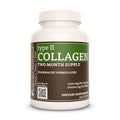

Collagen supplements range from 40 mg to 20 grams per serving, and the type sets what each is for. On our labels, a 560 g tub of unflavored hydrolyzed peptides costs $0.075 per gram, or $1.50 per 20 g serving.
Full disclosure: Remedy's Nutrition sells the collagen products featured below, so we are not a neutral third party. This guide covers the types, sources, and label checks that apply to any brand. Then it shows our own numbers so you can compare.
Quick Answer: How to Choose a Collagen Supplement
Choose by type first. Hydrolyzed Types I and III peptides, usually a powder, are the form studied for skin hydration and elasticity*. Type II is a cartilage-specific collagen sold in small capsule doses. Then compare grams per serving (our peptides list 20 g) and price per gram. Research is still developing, and effects are modest.
Key Takeaways
- Hydrolyzed peptides list 20 g per serving on our unflavored label.
- Type II collagen comes in 1,000 mg capsules, not powder scoops.
- Compare price per 20 g serving: $1.50 for our 560 g tub.
- A 2021 review pooled 19 trials with 1,125 people in total.
- Check 4 things on any label: type, grams, additives, and testing.
Which Type of Collagen Is Best?
No single type is best, because the types do different jobs. Hydrolyzed Types I and III peptides are the form studied for skin. Type II is cartilage-specific and sold in capsules, from 40 mg undenatured doses up to 1,000 mg. Match the type to your goal before comparing prices.
For a deeper breakdown of every type, see our guide to what each collagen type does.
| Form | Type | Typical serving | How you take it | Studied for |
|---|---|---|---|---|
| Hydrolyzed peptides (powder) | Types I and III | Our label: 20 g per serving | Stirred into water, coffee, or a smoothie | Skin hydration and elasticity* |
| Type II capsules | Type II | Our label: 1,000 mg per capsule; some brands sell 40 mg | Swallowed with water | Joint comfort in smaller trials* |
| Liquid blends | Varies; our Rejuvame label lists Types I, II, III, IV and X | Our page: 1 tablespoon (15 ml) | Taken straight or mixed into a drink | Blends add vitamin C and hyaluronic acid |
Undenatured Type II works differently from peptides. A small intact dose is thought to act on the gut immune system rather than supply building blocks. One 2026 trial gave 40 mg a day for 180 days to 74 healthy adults. Its authors are affiliated with the ingredient maker.[1]Undenatured Type II Collagen in Healthy Adults — PubMed View source
Our Type II capsule is the building-block approach: 1,000 mg of Type II collagen from chicken sternal cartilage per capsule. It is not a 40 mg undenatured dose, so the two are not interchangeable.
Bovine, Marine or Chicken Collagen?
Source mostly changes allergens and taste, not the basic job. Bovine collagen comes from cattle hide or bone, marine from fish skin or scales, and chicken from cartilage. A 2023 review of 26 trials found no clear difference by source for skin elasticity, though hydration results varied.[2]Oral Collagen for Skin: 26-Trial Review — PubMed View source
- Bovine: the most common source for Types I and III powders. Avoid it if you do not eat beef.
- Marine: mainly Type I. Avoid it with a fish allergy, and check which species the label names.
- Chicken: the usual source of Type II, from sternum cartilage. Avoid it with a poultry allergy.
Our Rejuvame label names bovine collagen. Our unflavored peptides are labeled grass-fed. Ask us to confirm the species if you avoid beef or have an allergy.

Powder, Capsules or Liquid: Which Form?
The best form is the one you will take every day, but the doses differ sharply. Powder delivers 20 g per serving on our label. Our Type II capsule delivers 1 g, and liquids vary by brand. Matching a 10 g powder dose with 1,000 mg capsules would take ten of them.
- Powder: highest grams per serving and the lowest cost per gram. It needs mixing, and flavored versions add other ingredients.
- Capsules: portable and tasteless, but each holds about 1 g, so they suit small doses such as Type II.
- Liquid: pre-dissolved and often blended with vitamin C or hyaluronic acid. Check storage directions and grams per serving.
If joint-focused Type II is what you want, our 1,000 mg Type II collagen capsules are the capsule option. For skin-focused peptides, powder is the practical format.
How to Read a Collagen Label
A collagen label should tell you 4 things: type, grams of collagen per serving, other ingredients, and testing. If one is missing, you cannot compare it fairly with another brand, so ask the seller before you buy. Use the checklist below on any product, including ours.
- The type is named: Types I and III, or Type II, not just "collagen" or "collagen complex".
- Grams of collagen per serving are listed, not only the scoop weight, which can include flavors and sweeteners.
- The label says hydrolyzed or undenatured, so you know the form.
- Other ingredients are short. An unflavored powder should list little besides collagen.
- The source animal is named, so you can check allergens.
- The brand can supply a certificate of analysis for heavy metals such as lead, arsenic, and cadmium.
Quality claims are only as good as the paperwork behind them. The NIH cautions that a label may not match the product, so ask for test results.[3]Using Dietary Supplements Wisely — NCCIH View source
- Hydrolyzed collagen
- Collagen broken into small peptides so it dissolves in liquid. Most powders are this form.
- Undenatured collagen
- Collagen kept in its native structure and taken in milligram doses, usually Type II.
- Gelatin
- Cooked, partly broken-down collagen that sets into a gel when cooled. It is not the same as peptides.
Collagen Price Per Gram, From Our Labels
Price per serving is the fair comparison within one type. Our 560 g peptide tub costs $42.00 for 28 servings of 20 g. That is $1.50 a serving and $0.075 per gram. The 280 g size costs $24.00 for 14 servings, about $1.71 each if it uses the same 20 g serving.
| Product and size | Price | Label serving | Servings | Cost per serving | Cost per gram |
|---|---|---|---|---|---|
| Collagen Peptides, 560 g | $42.00 | 20 g | 28 | $1.50 | $0.075 |
| Collagen Peptides, 280 g | $24.00 | 20 g (assumed same as 560 g) | 14 | $1.71 | $0.086 |
| Type II Collagen, 60 capsules | $21.99 | 1 capsule (1,000 mg) | 60 | $0.37 | $0.37 of Type II |
| Rejuvame with vitamin C and hyaluronic acid, 6 oz | $43.00 | 1 tablespoon (15 ml) per product page | Grams per serving not stated | Not calculated | Not calculated |
| Hyaluronic Acid with Type II Collagen, 60 capsules | $34.00 | 1 to 2 capsules (50 mg hyaluronic acid each) | 30 to 60 | $0.57 to $1.13 | Type II amount not split out |
Only compare per-gram figures inside one type. A gram of Type II and a gram of hydrolyzed peptides are different products at very different doses. For the powder, see our unflavored hydrolyzed collagen peptides.

Do Vitamin C and Hyaluronic Acid Matter?
Vitamin C is needed for your body to make its own collagen. That is a reason it is added to blends, not proof that a blend works better. Skin normally holds high vitamin C levels, and the vitamin stimulates collagen synthesis.[4]The Roles of Vitamin C in Skin Health — PubMed View source
- Vitamin C: most people get it from fruit and vegetables. Check your total from food, blends, and supplements, and stay under the 2,000 mg adult upper limit.
- Hyaluronic acid: a water-binding molecule studied separately from collagen, often added to skin-focused blends.
- Sweeteners and flavors: common in flavored powders and can dilute the collagen in each scoop.
Our Rejuvame collagen blend with vitamin C and hyaluronic acid combines all 3 in a daily tablespoon. Our product page does not give grams of collagen per tablespoon, so read the bottle before comparing it per gram.
What Does the Evidence Actually Show?
Oral collagen has real but modest evidence for skin. A 2023 review of 26 trials flagged biases in the included studies. A 2021 meta-analysis of 19 trials with 1,125 participants favored hydrolyzed collagen over placebo for hydration, elasticity, and wrinkles.[5]Hydrolyzed Collagen and Skin Aging, Meta-Analysis — PubMed View source
- About 95% of participants in the 2021 meta-analysis were women, so results may not apply equally to everyone.
- Many trials test branded blends. One 12-week trial of 72 women used a drink with 2.5 g of collagen plus vitamin C, zinc, and biotin, so the effect cannot be credited to collagen alone.[6]Collagen Blend and Skin Hydration, 72 Women — PubMed View source
- Joint and cartilage research is smaller, and some of it comes from groups tied to the ingredient maker.
So treat collagen as a modest, long-term addition for skin hydration and elasticity support*, not a quick fix. Research is still developing.
*These statements have not been evaluated by the Food and Drug Administration. This product is not intended to diagnose, treat, cure, or prevent any disease.
Safety, Interactions and Who Should Ask First
Collagen is animal-derived protein and is generally well tolerated, so the main questions are allergies, kidneys, pregnancy, and added ingredients. The 5 situations below are where to talk to a clinician or pharmacist first. Tell them about everything you take, blends included.
| Situation | What to know | What to do |
|---|---|---|
| Fish, beef, or poultry allergy | Collagen is made from animal tissue, and the species varies by product. | Read the source on the label and avoid the animal you react to. |
| Kidney disease or protein limits | Collagen counts as dietary protein. | Ask your clinician before adding 20 g a day. |
| Pregnancy or breastfeeding | Controlled safety data are limited. | Ask your provider first. |
| Prescription medicines | We know of no well-documented interactions for plain collagen, but blends add vitamin C and other ingredients. | Show the full label to your pharmacist. |
| Planned surgery | Providers should know every supplement you take. | Tell your care team before the procedure. |

Frequently Asked Questions
What is the best form of collagen to take? +
The best form matches your goal and is one you will take daily. Hydrolyzed Types I and III powder is the form behind the skin reviews, at 20 g per serving on our label. Type II comes in capsules, 1,000 mg on our label. Capsules need many pills to match a powder serving.
Which type of collagen is best? +
For skin goals, hydrolyzed Types I and III is the form studied in a 2021 review of 19 trials. Type II is cartilage-specific and used for joint comfort goals*. The best type is the one that matches your goal, so decide that before you compare brands or prices.
Is bovine or marine collagen better? +
Neither is clearly better. A 2023 review of 26 trials found no significant difference by source for skin elasticity, and hydration results varied. Choose by allergies, diet, and taste: marine for a beef-free diet, bovine for a fish-free diet. Confirm the species on the label.
How much collagen should I take per day? +
Doses vary widely, from 40 mg for undenatured Type II to 20 g for powders. Follow the serving on your product label: ours lists 20 g of peptides per serving or 1 capsule (1,000 mg) of Type II. Ask a clinician first if you have kidney disease or take medication.
What is the best time of day to take collagen? +
Any time works for most products. Nothing in the reviews we cite ties results to the hour. Take 1 serving daily at a time you will remember, and take it with food if it upsets your stomach.
Can I mix collagen with coffee? +
Yes. Hydrolyzed peptides are already broken down, so stirring a 20 g serving into a hot drink is common practice, and we know of no study showing coffee reduces results. If it clumps, stir the powder into a little cool water first.
Does collagen need vitamin C? +
Your body needs vitamin C to make collagen, but you do not need a special product. A diet with fruit and vegetables supplies it. Blends add vitamin C for convenience, so check your total from all sources and stay under the 2,000 mg daily upper limit.
Is flavored or unflavored collagen better? +
Unflavored is simpler to compare because the label lists mostly collagen. Flavored powders often add sweeteners, acids, or flavors, so a 20 g scoop may hold less than 20 g of collagen. Read the grams of collagen line, not the serving weight. Our peptides are unflavored.
Is collagen powder or capsules cheaper per gram? +
Powder, by a wide margin. On our labels the 560 g peptide tub costs $0.075 per gram, while 1,000 mg Type II capsules cost about $0.37 per gram. They are different types, so compare within a type before buying on price alone.
Who should ask a clinician before taking collagen? +
Ask first if any of these 5 apply: pregnancy or breastfeeding, kidney disease, prescription medicines, a fish, beef, or poultry allergy, or planned surgery. Collagen is protein, and blends add other ingredients that your clinician or pharmacist should see.
Related Reading
- Collagen Dosage by Goal
- The Complete Collagen Peptides Guide
- Hyaluronic Acid vs Collagen: How to Stack Them
- Collagen Side Effects to Know About
Related Products