What Is Type II Collagen?
Type II collagen is the specific collagen that builds cartilage — the cushioning tissue in your knees, hips, spine, and other joints. It is a different protein from the Type I and Type III collagen in typical skin-and-beauty powders, and it targets a different job: joint comfort and cartilage support rather than wrinkles.[5]Biochemistry, Collagen Synthesis (28 collagen types) — StatPearls (2026) View source
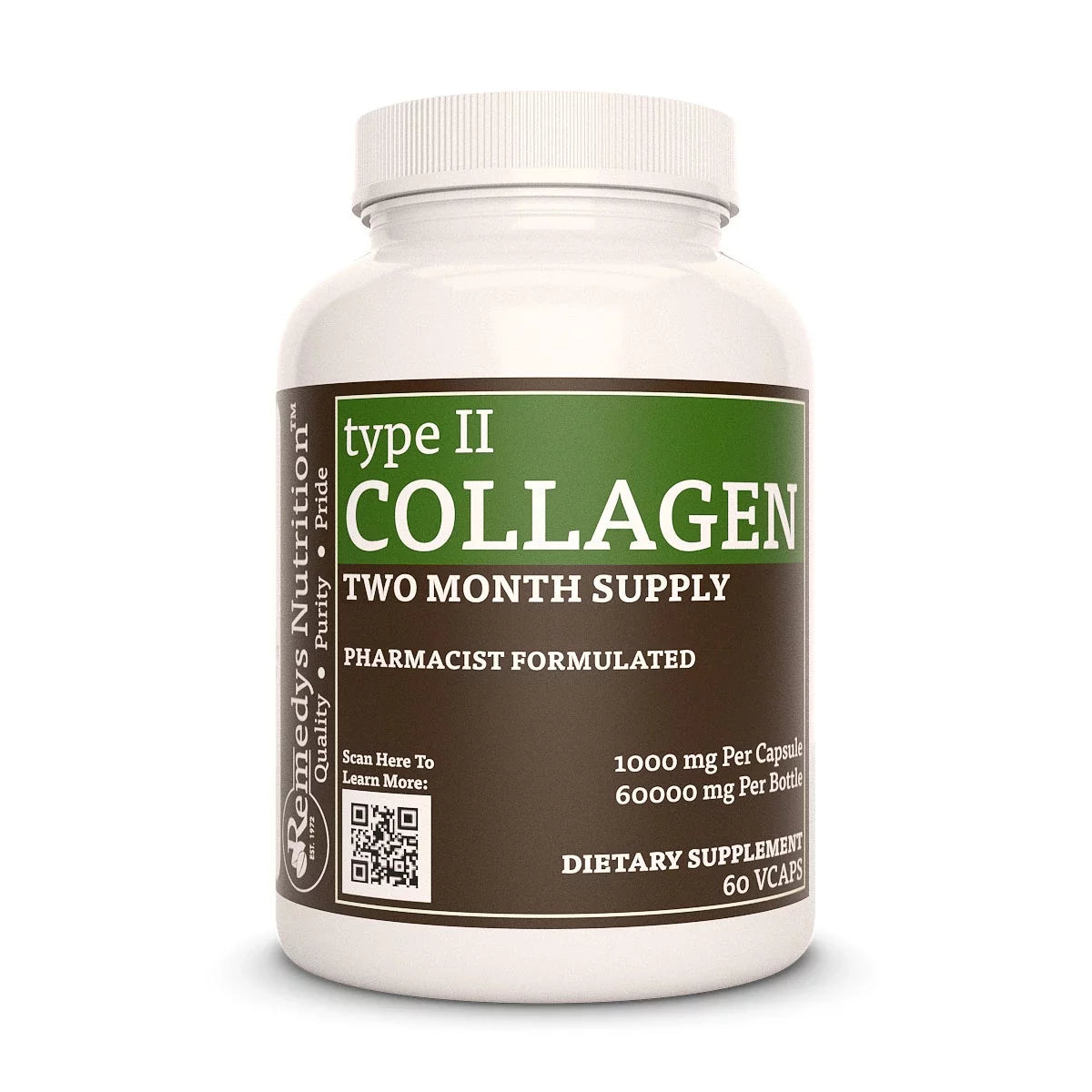
This supplement delivers 1000 mg of Type II collagen per capsule, sourced from chicken sternal cartilage, in a vegan capsule shell. One capsule daily means the 60-count bottle is a 2-month supply — a higher per-capsule dose than the small 40 mg undenatured (UC-II) tablets most joint brands sell.
Quick Answer
Type II collagen is the cartilage-specific collagen used for joint and connective-tissue support, not skin. This product supplies 1000 mg per capsule from chicken cartilage, taken once daily. For skin, hair, and nails you want Type I and III collagen instead — see the difference in our types of collagen guide.
Type II vs Type I and III Collagen
The single most important decision with collagen is matching the type to your goal. Type I and III support skin, hair, nails, and bone; Type II supports cartilage and joints. Choosing the wrong type is the most common reason people feel a collagen supplement "did nothing."
| Collagen Type |
Found In |
Best For |
| Type I & III |
Skin, hair, nails, bone, tendon |
Anti-aging skin, hair thickness, nail strength |
| Type II (this product) |
Joint cartilage, spinal discs, rib cartilage |
Joint comfort, cartilage and connective-tissue support |
| All-in-one blends |
Mixed sources |
Convenience, but a lower dose of each type |
If your main goal is skin and hair rather than joints, a hydrolyzed Type I and III formula is the better match — compare the options in our types of collagen guide.
Type II Collagen for Joints and Cartilage
Type II collagen is the most-studied collagen for joints. A 2025 review of undenatured Type II collagen for knee osteoarthritis reported reduced pain and improved joint function versus placebo, and a 2025 randomized trial found combining undenatured and hydrolysed Type II collagen improved knee osteoarthritis outcomes over 3 to 6 months.[1]Undenatured Type II Collagen for Knee Osteoarthritis — Ann Med (2025) View source[2]Combined Undenatured + Hydrolysed Type II Collagen in Knee OA RCT — Sci Rep (2025) View source
| Joint Goal |
What the Research Shows |
Typical Timeframe |
| Knee comfort |
Reduced activity-related and osteoarthritis knee pain vs placebo |
8 to 24 weeks |
| Joint flexibility |
Improved range of motion and function scores in trials |
12 weeks |
| Cartilage support |
Collagen supplies the amino acids cartilage is built from |
3 to 6 months |
| Active-adult joint stress |
Less joint pain in athletes over 24 weeks of daily use |
24 weeks |
A 24-week trial in athletes with activity-related joint pain found daily collagen reduced joint discomfort during activity, and a 2023 review confirmed collagen's role in overall joint health.[3]Collagen Supplementation for Joint Health Review — Nutrients (2023) View source[4]Collagen Hydrolysate in Athletes with Activity-Related Joint Pain, 24 weeks — Curr Med Res Opin (2008) View source For a fuller breakdown see our collagen for hair, nails, and joints guide.
Undenatured vs High-Dose Type II Collagen
There are 2 ways Type II collagen is used, and they work at very different doses. Knowing which is which prevents overpaying or under-dosing.
| Form |
How It Works |
Typical Dose |
| Undenatured (UC-II) |
A small intact dose acts on gut immune cells to calm the joint immune response |
40 mg/day |
| Higher-dose Type II |
Supplies cartilage-specific amino acids as building material |
1000 mg or more/day |
This product provides 1000 mg of Type II collagen per capsule from chicken sternal cartilage — the building-block approach rather than a 40 mg immune-modulating micro-dose. Both approaches have research support, and some people take both for layered joint support.
Where to Get Type II Collagen
Standalone Type II collagen is harder to find than ordinary Type I and III beauty powders, because it comes specifically from cartilage — usually chicken sternum or bovine trachea. Most drugstore "collagen" is Type I and III and will not deliver cartilage-specific Type II.
-
This product: 1000 mg Type II per capsule in a vegan shell, chicken sternal cartilage, made in Key Largo, FL
-
Read the label: look for the words "Type II" specifically — not just "collagen" or "multi-collagen"
-
Vegan Type II: true collagen is animal-derived, so there is no plant Type II collagen (only the capsule shell here is vegan)
Why Choose Remedy's Type II Collagen
| What You Get |
Why It Matters |
| 1000 mg Type II per capsule |
A meaningful cartilage-specific dose in a single daily capsule |
| Chicken sternal cartilage source |
The natural, traditional source of dietary Type II collagen |
| Vegan capsule shell |
A plant-based capsule with no animal gelatin coating |
| 60 capsules = 2-month supply |
One capsule daily lasts 60 days per bottle |
| No fillers or additives |
0 gluten, yeast, corn, dairy, or preservatives; Non-GMO |
| Made in Key Largo, FL, USA |
Handmade and pharmacist-reviewed for quality and potency |
Type II Collagen Dosage
Take 1 capsule (1000 mg) once daily, with or without food. Type II collagen does not need to be taken on an empty stomach, and consistency over 8 to 12 weeks matters more than timing.
| Goal |
Suggested Use |
Timeframe |
| General joint support |
1 capsule daily |
Ongoing daily use |
| Knee or cartilage focus |
1 capsule daily, consistent |
8 to 24 weeks to assess |
| Active adults |
1 capsule daily, any time |
24 weeks in athlete trials |
Safety and Side Effects
Type II collagen has a strong safety record. Reported side effects are mild and uncommon, and it is essentially a cartilage-derived protein your body already recognizes.
| Consideration |
Details |
| Mild GI effects |
Occasional nausea, heartburn, or loose stools; usually resolves within 1 to 2 weeks |
| Allergies |
Sourced from chicken; avoid if you have a poultry allergy |
| Pregnancy & breastfeeding |
Not recommended without provider guidance |
| Surgery |
Tell your physician if you are scheduled for surgery |
| Medications |
Consult your physician about potential interactions before use |
For a complete review of collagen side effects and interactions see our collagen side effects guide.
Frequently Asked Questions
What is Type II collagen used for? +
Type II collagen supports joint cartilage and connective tissue, not skin. It is the main structural protein in the cartilage of your knees, hips, and spine. Studies show 8 to 24 weeks of daily use can reduce joint pain and improve flexibility. For skin, hair, and nails, use Type I and III collagen instead.
What is the difference between Type II and Type I collagen? +
Type I (with Type III) is the collagen in skin, hair, nails, and bone, and is what most beauty powders contain. Type II is the cartilage-specific collagen used for joints. They are different proteins for different goals. This product is 1000 mg of Type II per capsule, aimed at joint and cartilage support rather than anti-aging skin.
Where can I get Type II collagen? +
Standalone Type II collagen is less common than Type I and III beauty powders. Look for a label that says "Type II" specifically, usually sourced from chicken sternum or bovine cartilage. This product supplies 1000 mg of Type II collagen per capsule from chicken sternal cartilage, made in Key Largo, FL, and taken as 1 capsule daily.
Is there a vegan Type II collagen? +
No true vegan Type II collagen exists, because all collagen is an animal protein — there is no plant that makes it. Products labeled "vegan collagen" are usually amino-acid or nutrient blends that support your own collagen production. In this product, only the capsule shell is vegan; the Type II collagen inside comes from chicken cartilage.
How much Type II collagen should I take per day? +
This product is 1 capsule (1000 mg) once daily. Higher-dose Type II collagen is typically used at 1000 mg or more per day, while undenatured UC-II products use about 40 mg per day through a different immune mechanism. Take it consistently for 8 to 12 weeks before judging results; timing with food does not matter.
Does Type II collagen help joint pain? +
Yes, modestly. A 2025 review and a 2025 randomized trial found Type II collagen reduced knee osteoarthritis pain and improved function versus placebo over 3 to 6 months. A separate 24-week study in athletes found less activity-related joint pain. Results build gradually, so give it at least 8 to 12 weeks of daily use.
What is undenatured (UC-II) Type II collagen? +
Undenatured Type II collagen (UC-II) is an intact form used at a small 40 mg daily dose. It works through gut immune cells to calm the joint immune response rather than by supplying building material. This product uses a higher 1000 mg dose of Type II collagen as cartilage building blocks. Both approaches have research support and some people combine them.
Where does this Type II collagen come from? +
Remedy's Type II collagen is sourced from chicken sternal cartilage, the traditional dietary source of Type II collagen. Each capsule provides 1000 mg. If you have a poultry allergy, avoid this product. The capsule shell itself is plant-based (vegan), while the collagen inside is animal-derived.
Can I take Type II collagen with skin collagen peptides? +
Yes. Type II (joints) and Type I and III peptides (skin, hair, nails) serve different goals and can be taken together. Many people pair 1000 mg Type II daily for joints with 10 grams of hydrolyzed Type I and III peptides for skin. They do not compete, since each supplies different tissue-specific collagen.
How long does Type II collagen take to work? +
Most joint studies run 8 to 24 weeks, with gradual improvement in pain and flexibility over that period. Athlete trials used 24 weeks of daily use. Expect a slow build rather than an overnight change. Take 1 capsule daily and reassess at the 12-week mark, since cartilage support develops over months.
Are there side effects of Type II collagen? +
Side effects are mild and uncommon, affecting under 5% of users, and may include brief nausea, heartburn, or loose stools in the first 1 to 2 weeks. Avoid it if you have a chicken allergy, and skip it during pregnancy or breastfeeding without provider guidance. Ask your physician about drug interactions before starting.
Is Type II collagen the same as glucosamine? +
No. Glucosamine is a sugar-based building block of cartilage, while Type II collagen is the structural protein of cartilage. They act on joints through different routes and are often stacked together. If you want both mechanisms, pair 1000 mg Type II collagen daily with a glucosamine-chondroitin-MSM formula for layered joint support.
Is this Type II collagen vegan? +
No. The capsule shell is vegan, made from plant cellulose rather than gelatin, but the Type II collagen inside is sourced from chicken sternal cartilage. Collagen is an animal protein and no true vegan source of Type II exists. Each of the 60 capsules delivers 1000 mg.
You May Also Like