
Vitamin D3 supplements range from 400 to 5,000 IU per serving, so the right pick depends on dose, form and ingredients. Adults need 600 IU a day (800 IU after age 70), and 4,000 IU a day is the usual safe upper limit.
This guide compares D3 with D2, capsules with drops, and how to read a label, then covers safety checks. Disclosure: Remedy's Nutrition sells the vitamin D3 products shown here, so we are not a neutral third party.
Quick Answer: Choosing Vitamin D3
Choose vitamin D3 by the IU per serving, the form (capsule or drops) and what else is in the capsule. Most adults need between 600 and 2,000 IU a day, taken with a meal that contains fat. Stay at or below 4,000 IU a day unless a clinician advises more and checks your blood levels.
Key Takeaways
- D3 raised blood vitamin D more than D2 in a 2012 meta-analysis.
- 1 mcg equals 40 IU, so a 50 mcg serving is 2,000 IU.
- Adults need 600 IU daily, and the safe upper limit is 4,000 IU.
- Taking D3 with a fat-containing meal raised peak absorption by 32%.
- Remedy's 1,000 and 2,000 IU capsules also list magnesium, calcium and turmeric.
Vitamin D3 vs D2: Which Form Is Better?
Vitamin D3 (cholecalciferol) and vitamin D2 (ergocalciferol) are both sold as vitamin D, and 1 mcg of either equals 40 IU. A 2012 meta-analysis of randomized trials found that D3 raised blood 25(OH)D more than D2 overall. The gap disappeared when people took the vitamin daily instead of as one large dose.[1]D2 vs D3 meta-analysis — Am J Clin Nutr View source
Most D3 comes from lanolin, lichen-derived D3 is the vegan option, and D2 is usually yeast-derived. For the study-by-study detail, see our vitamin D2 vs D3 comparison.
- Pick D3 if you take a daily supplement and want the form most studies favor
- D2 can fit if a prescription is written for ergocalciferol or you avoid animal-derived ingredients
- Check the source of D3 on the label or with the maker if you follow a vegan diet
IU, mcg and How Much You Need
Vitamin D labels show IU, mcg or both, and 1 mcg equals 40 IU. The recommended allowance is 600 IU (15 mcg) for adults up to age 70 and 800 IU (20 mcg) after that. The safe upper limit for adults is 4,000 IU (100 mcg) a day.[2]Vitamin D fact sheet — NIH ODS View source[3]Vitamin D safe upper amounts — NHS View source
| Amount | IU | mcg | Where it fits |
|---|---|---|---|
| Recommended allowance, adults 19 to 70 | 600 | 15 | Typical daily need |
| Recommended allowance, adults over 70 | 800 | 20 | Typical daily need |
| Common capsule strength | 1,000 | 25 | Maintenance or a modest top-up |
| Common capsule or drops strength | 2,000 | 50 | Everyday strength for limited sun exposure |
| Safe upper limit, adults | 4,000 | 100 | Ceiling without clinician guidance |
| High-strength capsule | 5,000 | 125 | Above the ceiling; clinician-directed plans only |
| Prescription-style dose | 50,000 | 1,250 | Short clinician-set schedules only |
Doses above 4,000 IU are not wrong for everyone. They belong in a plan your clinician sets and checks with blood tests. We do not recommend 50,000 IU products for self-directed daily use.

Capsules vs Drops: Which Format Fits You?
Capsules give a fixed dose per serving, while drops let you measure the amount with a dropper. Both deliver the same cholecalciferol, and 1 daily serving taken with a fatty meal absorbs well. Choose the format you will actually take every day, because consistency matters more than the format.
| Factor | Capsules | Drops |
|---|---|---|
| Dose control | Fixed amount per capsule (1,000, 2,000 or 5,000 IU) | Adjustable within the labeled serving |
| Swallowing | Must be swallowed whole | No pill; can be mixed into food or a drink |
| Carrier | Varies by brand: oil, powder or a blend inside a shell | Liquid carrier in a dropper bottle |
| Travel | Easy to carry and count | Keep upright, closed and away from heat |
| Main risk | Doubling up by mistake | Misreading how many drops make a serving |
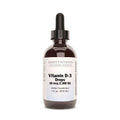
Our 2,000 IU vitamin D3 drops come in a 1 fl oz (29.6 mL) bottle labeled 50 mcg (2,000 IU). The product page does not publish a Supplement Facts panel, so check the bottle for the exact serving size.
How to Read a Vitamin D3 Label
A good label states the D3 amount in IU and mcg per serving, the serving size, and every other ingredient with its amount. Two products labeled 2,000 IU can differ in the carrier, the extras and the testing behind them. Check these 7 points before you buy.
- Strength per serving in IU or mcg, and how many capsules or drops make 1 serving
- Form: D3 (cholecalciferol) or D2 (ergocalciferol)
- Source: lanolin-derived or lichen-derived D3, if you avoid animal products
- Other ingredients: the oil carrier, capsule shell and any fillers
- Added nutrients: K2, magnesium or calcium, which add to what you already take
- Percent Daily Value: the Daily Value for vitamin D is 20 mcg (800 IU), so 2,000 IU should read about 250%
- Testing and expiry: a third-party seal or a certificate of analysis for your lot, plus an expiry date
A front label that says “proprietary blend” does not tell you what is inside. Read the Supplement Facts panel for named ingredients and amounts, and ask the seller if the panel is missing.
Remedy's Vitamin D3 Options Compared
Remedy's Nutrition sells four vitamin D3 products: three 60-capsule strengths and one liquid. The table lists label facts and price per serving, so you can compare cost per 1,000 IU as well as bottle price. Every row uses cholecalciferol (D3).
| Product | D3 per serving | Servings | Price | Per serving | Per 1,000 IU | Other ingredients on the label |
|---|---|---|---|---|---|---|
| 1,000 IU capsule | 1,000 IU (25 mcg) | 60 | $19.99 | $0.33 | $0.33 | Magnesium glycinate 500 mg, calcium citrate 100 mg, vitamin K2 (MK-7) 50 mcg, turmeric 385 mg |
| 2,000 IU capsule | 2,000 IU (50 mcg) | 60 | $20.99 | $0.35 | $0.17 | Magnesium glycinate 500 mg, calcium citrate 100 mg, turmeric 375 mg |
| 5,000 IU capsule | 5,000 IU (125 mcg) | 60 | $22.99 | $0.38 | $0.08 | Panel not published on the page; the front label reads “Improved with Minerals+” |
| 2,000 IU drops | 2,000 IU (50 mcg) | About 30, per the page | $23.99 | About $0.80 | About $0.40 | Panel not published on the page |
Cost per 1,000 IU falls as strength rises, but a lower unit price is no reason to take more than you need. Match the strength to your plan first. Our 2,000 IU vitamin D3 capsules are the middle option and fit the everyday range.
- Magnesium glycinate 500 mg and calcium citrate 100 mg are compound weights, so the elemental magnesium and calcium are lower and not listed separately
- Vitamin K2 (MK-7) 50 mcg appears only on the 1,000 IU label; vitamin K can change how warfarin works
- The 5,000 IU strength is above the 4,000 IU upper limit, so use it only in a clinician-directed plan
The 1,000 and 2,000 IU panels print an asterisk in the percent Daily Value column. Vitamin D does have a Daily Value of 20 mcg, so 2,000 IU works out to about 250%.

Timing, Food and Common Pairings
Take vitamin D3 with a meal that contains fat. In a 50-person study, peak blood vitamin D3 was 32% higher after a fat-containing meal than after a fat-free one.[4]Fat and vitamin D3 absorption — J Acad Nutr Diet View source Another trial found 25(OH)D at 90 days did not differ by meal type, so routine matters most.[5]Meal type and 25(OH)D response — J Bone Miner Res View source
- Time of day: any time works if it is the same meal every day
- With K2: often paired with D3, but research on the pairing is still developing
- With magnesium: check how much your capsule already supplies before adding another source
- With calcium: add up every source, because 3 or more products may each contain some
Testing: When to Ask for a 25(OH)D Blood Test
A 25(OH)D blood test shows how much vitamin D is circulating. It is the only way to know whether a dose works for you. Levels shift gradually, so clinicians often recheck 2 to 3 months after a dose change. Our guide to reading your vitamin D blood test explains the numbers.
- Before you start any strength above 4,000 IU a day
- If you have kidney stones, kidney disease, sarcoidosis or a parathyroid condition
- If you take a medicine that affects calcium, such as a thiazide diuretic
- About 2 to 3 months after you change your dose
Safety, Interactions and Who Should Ask First
Vitamin D is fat-soluble, so excess is stored rather than passed out quickly. Amounts well above 4,000 IU a day can raise blood calcium, causing nausea, weakness and kidney problems.[6]Vitamin D intake and risks — MedlinePlus View source Ask a clinician or pharmacist first if any row below applies to you.
| Medicine or situation | Why it matters | What to do |
|---|---|---|
| Thiazide diuretics | They reduce calcium loss in urine, so blood calcium can rise with extra vitamin D | Ask your prescriber about monitoring |
| Digoxin | High blood calcium can affect heart rhythm in people taking digoxin | Ask before starting vitamin D |
| Calcium channel blockers such as diltiazem | Raised blood calcium may work against the medicine, mainly at high vitamin D doses | Ask your pharmacist to check your exact dose |
| Corticosteroids | They can reduce calcium absorption and change vitamin D handling | Ask your prescriber |
| Orlistat or cholestyramine | They can reduce absorption of fat-soluble vitamins | Ask your pharmacist about spacing |
| Anticonvulsants such as phenytoin | They can speed up vitamin D breakdown | Ask about testing |
| Warfarin | Our 1,000 IU capsule lists vitamin K2, and vitamin K can change warfarin effects | Ask before choosing that strength |
Children and pregnant or nursing women need amounts set by a clinician. The adult strengths here are not for children. Do not change a prescription dose on your own.
* These statements have not been evaluated by the Food and Drug Administration. This product is not intended to diagnose, treat, cure or prevent any disease.

Frequently Asked Questions
Is vitamin D3 safe to take daily? +
Yes for most adults at 600 to 4,000 IU a day, the range from the recommended allowance to the safe upper limit. Higher amounts can raise blood calcium, so use them only with clinician guidance and blood tests every 3 to 6 months.
What is the best time of day to take vitamin D3? +
Any time works if you take it every day with a meal that contains fat. One study of 50 people found 32% higher peak absorption with a fat-containing meal than a fat-free one. Pick the meal you eat most reliably, such as breakfast or dinner.
What is the #1 mistake when taking vitamin D? +
Taking a high strength without knowing your starting level is the most common one. Others are skipping fat with the dose and stacking 3 or more products that all contain vitamin D. Add up your total daily IU across every supplement you take.
Which vitamin D3 supplement is the best? +
The best one matches your dose and lists IU, mcg and every ingredient with amounts. It should name the D3 source and carrier, show an expiry date and ideally a third-party seal. Compare cost per 1,000 IU, not bottle price. These 7 checks work on any brand.
What should you avoid when taking D3? +
Avoid more than 4,000 IU a day without clinician guidance, stacking several products that contain D, and skipping a meal with the dose. Ask a pharmacist first if you use thiazide diuretics, digoxin, steroids or anticonvulsants. Skip 50,000 IU products unless prescribed.
Can vitamin D be taken with diltiazem? +
Ask your pharmacist. Diltiazem is a calcium channel blocker, and high vitamin D intake can raise blood calcium, which may work against it. The concern is mainly with high doses, such as 4,000 IU a day or more, and your pharmacist can check your exact amount. Do not change a prescription on your own.
Is 1,000 IU of vitamin D3 enough? +
It can be: 1,000 IU is above the 600 to 800 IU allowance and suits maintenance for many adults. Whether it is enough for you depends on sun exposure, skin tone, body weight and your blood level. A 25(OH)D test is the only way to know.
Is 50,000 IU of vitamin D3 safe? +
50,000 IU is a prescription-style strength, more than 12 times the 4,000 IU upper limit if taken daily. It is used in short, clinician-directed schedules with blood tests. We do not recommend it for self-directed use.
How many IU are in 50 mcg of vitamin D3? +
50 mcg equals 2,000 IU, because 1 mcg of vitamin D equals 40 IU. A 25 mcg dose is 1,000 IU and 125 mcg is 5,000 IU. Labels may show either unit, so convert before comparing products.
Are vitamin D3 drops better than capsules? +
Not for absorption, since both work when taken with a meal that contains fat. Drops suit people who cannot swallow capsules or want to adjust by dropper, while capsules give a fixed 1,000 to 5,000 IU with no measuring. Pick the format you will take daily.
Related Reading
- Vitamin D drops vs pills compared
- How much vitamin D to take daily
- Vitamin D upper limits and safety