How to Choose a Vitamin A Supplement: Retinol, Beta-Carotene and Safe Limits

Vitamin A supplements fall into 2 families, preformed retinol and beta-carotene, and only preformed vitamin A has a 3,000 mcg RAE upper limit. That limit equals 10,000 IU, so the form, the IU count and your other sources matter more than the bottle's headline milligrams.
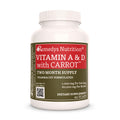
This guide explains how to read a vitamin A label, compares retinol, retinyl esters, beta-carotene and cod liver oil, and covers who should be cautious. Remedy's Nutrition sells the vitamin A and D capsule featured below, so we are not a neutral third party.
Quick Answer: How to choose a vitamin A supplement
Check the form first. Preformed vitamin A, such as retinol or retinyl palmitate, counts toward the 3,000 mcg RAE (10,000 IU) daily upper limit, while beta-carotene does not. Adults need 700 to 900 mcg RAE a day, mostly from food. Smokers, pregnant women and people on retinoid medicines should ask a clinician first.
Key Takeaways
- Adults need 900 mcg RAE (men) or 700 mcg (women) daily.
- Preformed vitamin A has a 3,000 mcg RAE (10,000 IU) daily upper limit.
- A trial of 18,314 smokers found possible harm from beta-carotene plus retinyl palmitate.
- Remedy's capsule lists 7,600 IU vitamin A but does not name the form.
- Cod liver oil may hold 900 to 3,750 mcg vitamin A per teaspoon.
Vitamin A Forms: Retinol, Esters and Beta-Carotene
Vitamin A comes as preformed vitamin A (retinol and esters such as retinyl palmitate) or as provitamin A carotenoids such as beta-carotene. One mcg RAE equals 1 mcg of retinol or 12 mcg of dietary beta-carotene, so label units and sources must be converted before you compare doses[1]Vitamin A and Carotenoids Fact Sheet for Health Professionals — NIH Office of Dietary Supplements View source.
| Form | Type | Counts toward the 3,000 mcg RAE limit? | Notes |
|---|---|---|---|
| Retinyl palmitate or acetate | Preformed (ester) | Yes | The usual supplement forms[2]Vitamin A: MedlinePlus Medical Encyclopedia — U.S. National Library of Medicine View source; vitamin A is stored in the liver |
| Retinol (also in liver and fish liver oil) | Preformed | Yes | The active form; liver and cod liver oil can be very concentrated |
| Beta-carotene | Provitamin A | No (the limit applies to preformed vitamin A) | Converted as needed; large amounts can turn skin yellow-orange; supplements are not advised for smokers |
| Whole-food carotenoids (such as carrot powder) | Provitamin A | No | The beta-carotene amount is often not stated on the label |
| Multivitamin vitamin A | Often a mix of both | Only the preformed part | Read the label for the split between retinol and beta-carotene |
Conversion from beta-carotene varies widely: a review reported 3.6 to 28 mcg of dietary beta-carotene per 1 mcg of retinol[3]Bioconversion of Dietary Provitamin A Carotenoids in Humans — PubMed View source. A beta-carotene label therefore cannot be turned into an exact vitamin A dose.
For a deeper comparison of the 2 families, see our guide to retinol versus beta-carotene supplements.
How Much Vitamin A Is Safe: RDA and Upper Limit
Adult men need 900 mcg RAE of vitamin A a day and women need 700 mcg, rising to 770 mcg in pregnancy. The tolerable upper limit for preformed vitamin A is 3,000 mcg RAE, or 10,000 IU, a day from all sources. The limit does not apply to beta-carotene from food.
To convert preformed vitamin A, multiply IU by 0.3 to get mcg RAE. A 7,600 IU dose of retinol is therefore 2,280 mcg RAE.
| Intake level | mcg RAE per day | IU of preformed vitamin A |
|---|---|---|
| Adult women, RDA | 700 | About 2,333 |
| Adult men, RDA | 900 | About 3,000 |
| Pregnancy, RDA (ages 19 to 50) | 770 | About 2,567 |
| Upper limit, adults (preformed vitamin A) | 3,000 | 10,000 |
| UK long-term bone caution for older adults | 1,500 | About 5,000 |
Long-term high intake matters too. In the Nurses' Health Study of 72,337 postmenopausal women, total intake of 3,000 mcg RE or more carried a 48% higher hip fracture risk, mostly from retinol[4]Vitamin A Intake and Hip Fractures Among Postmenopausal Women — PubMed View source. That is observational evidence, not proof of cause.
UK guidance advises older adults to stay under 1,500 mcg a day from food and supplements combined[5]Vitamin A and Your Health — NHS (UK) View source. Our guide to how much vitamin A per day is safe covers the limits by life stage.

Reading Our Vitamin A and D Capsule Label
Remedy's Vitamin A & D with Carrot capsule lists, per 1 vegan capsule, 7,600 i.u. of vitamin A, 2,000 i.u. of vitamin D and 970 mg of carrot inside a 1,000 mg proprietary formula. The label does not name the vitamin A form, so the limit math below uses the worst case.
| Label line | What it says | What it means |
|---|---|---|
| Serving | 1 vegan capsule; 60 per container | A 60-day supply at 1 capsule a day |
| Vitamin A | 7,600 i.u. | If all preformed retinol, 2,280 mcg RAE: about 76% of the 3,000 mcg limit and about 2.5 times a man's RDA. Any beta-carotene share lowers the RAE value. |
| Vitamin D | 2,000 i.u. | 50 mcg, which is half of the 4,000 IU adult upper limit[6]Vitamin D Fact Sheet for Health Professionals — NIH Office of Dietary Supplements View source. Count other vitamin D sources. |
| Carrot | 970 mg | A whole-food carotenoid source; the beta-carotene amount is not stated |
| Price | $19.99 | About $0.33 a capsule |
That worst case is why stacking matters. A multivitamin, a cod liver oil capsule or weekly liver can each add retinol, and the 3,000 mcg limit counts every source. Our vitamin A and D with carrot capsule is a once-daily option, not one to double up on.
- Does the label name the form: retinyl palmitate, retinyl acetate or beta-carotene?
- Is the amount in mcg RAE or IU, and is it per capsule or per full serving?
- How much of the vitamin A is beta-carotene?
- What else in your day supplies vitamin A or vitamin D?
Cod Liver Oil, Liver and Food Sources
Food and fish liver oil can supply more vitamin A than most capsules. A review cites 18 to 75 mg of vitamin A per 100 g of cod liver oil, so a 5 g teaspoon holds roughly 900 to 3,750 mcg, which can exceed the whole 3,000 mcg upper limit[7]Vitamin A Update: Forms, Sources, Function and Toxicity — PubMed View source.
- Preformed (retinol): beef liver and other organ meats, eggs, cheese, fortified milk, oily fish such as herring and salmon, and cod liver oil.
- Provitamin A (carotenoids): carrots, sweet potatoes, red peppers, spinach, and fruit such as mango, papaya, apricots and cantaloupe.
Liver is the richest source: livestock liver can contain tens of milligrams of retinol and its esters per 100 g. UK guidance advises eating liver or liver products no more than once a week and avoiding it in pregnancy. Plant sources are safer to eat freely, because the body converts carotenoids as needed.

Safety, Interactions and Who Should Be Cautious
Vitamin A is a supplement where more is not better: preformed vitamin A is stored in the liver, so intakes above the 3,000 mcg RAE limit can build up over time. MedlinePlus places chronic poisoning in adults at regular intakes above 33,000 IU a day, but the lower limit leaves a margin for people at higher risk.
Pregnancy: ask your prenatal clinician before taking any vitamin A supplement. A study of 22,748 pregnancies found more birth defects above about 10,000 IU a day of supplemental vitamin A[8]Teratogenicity of High Vitamin A Intake — PubMed View source.
| Group or situation | Concern | What to do |
|---|---|---|
| Smokers, former smokers, asbestos exposure | In the CARET trial, 30 mg of beta-carotene plus 25,000 IU of retinyl palmitate daily raised lung cancer risk by 28% and the trial stopped early[9]Beta Carotene and Vitamin A Trial in Smokers (CARET) — PubMed View source | Avoid beta-carotene supplements and high-dose vitamin A unless a clinician advises it |
| Pregnancy or planning pregnancy | Birth defects were more frequent above about 10,000 IU a day of supplemental vitamin A | Stay at your prenatal vitamin amount and ask your clinician |
| Heavy alcohol use or kidney failure | Toxicity thresholds are lower in these groups | Ask a clinician before any vitamin A supplement |
| Older adults, especially postmenopausal women | High retinol intake was linked with more hip fractures | Keep total intake under 1,500 mcg a day unless advised |
| Prescription retinoids such as isotretinoin or acitretin | These drugs are vitamin A relatives, so supplements can add to their effects | Do not combine unless your prescriber says so |
| Orlistat or fat-absorption problems | Fat-soluble vitamin uptake can fall; in a 17-person pilot, vitamin D and E dropped but vitamin A absorption did not change significantly[10]Effects of Orlistat on Fat-Soluble Vitamins in Obese Adolescents — PubMed View source | Ask a pharmacist how to space a multivitamin |
| Blood thinners such as warfarin | Any new supplement should be reviewed with your medicines | Ask your pharmacist before starting |
| Children | Babies and children are more sensitive to vitamin A | Do not give adult capsules |
The table is a prompt to ask, not a complete list. Bring the bottle and your medicine list to a pharmacist before you start.
A Five-Step Checklist Before You Buy
Use this order when comparing any 2 vitamin A products. It puts the form and the total from all sources ahead of price, which is where most vitamin A mistakes start. Keep a note of everything you already take, including multivitamins, fish oils and fortified foods, and read each label before you compare.
- Identify the form: preformed (retinol, retinyl palmitate or acetate) or beta-carotene.
- Convert the label to mcg RAE, using IU × 0.3 for preformed vitamin A.
- Add every source: multivitamin, cod liver oil, fortified foods and weekly liver.
- Check your situation: smoking, pregnancy, alcohol use, age, retinoid medicines.
- Match the dose to your gap, not to the headline milligrams on the bottle.
*These statements have not been evaluated by the Food and Drug Administration. These products are not intended to diagnose, treat, cure, or prevent any disease.

Frequently Asked Questions
What does vitamin A do in the body? +
Vitamin A supports vision in low light, normal immune function and healthy skin and mucous membranes.* Adults need 900 mcg RAE (men) or 700 mcg (women) a day, mostly from food. Deficiency is very rare in the United States, so a supplement is not automatically needed.
What is the best form of vitamin A to take? +
No single form is best. Preformed vitamin A (retinyl palmitate or acetate) raises vitamin A directly and counts toward the 3,000 mcg RAE limit, while beta-carotene is converted as needed and is not advised as a supplement for smokers. Choose a label that names the form and gives mcg RAE.
Is vitamin A basically retinol? +
Retinol is the main preformed, active form of vitamin A, but vitamin A is a family of 2 types: preformed vitamin A (retinol and its esters) and provitamin A carotenoids such as beta-carotene. "Vitamin A" on a label can mean either, so check which one it is.
Which food is highest in vitamin A? +
Liver is the richest source: livestock liver can hold tens of milligrams of retinol per 100 g. Cod liver oil, eggs, cheese and fortified milk follow. Because liver is so concentrated, UK guidance advises eating it no more than once a week and avoiding it in pregnancy.
Which fruits are rich in vitamin A? +
Orange and yellow fruits rich in beta-carotene include mango, papaya, apricots and cantaloupe. The body converts about 12 mcg of dietary beta-carotene into 1 mcg RAE, so fruit gives less vitamin A than its color suggests. Eating them with a little fat improves absorption.
What can lower vitamin A levels in the body? +
Heavy alcohol use interferes with vitamin A metabolism, and conditions that impair fat absorption can reduce uptake. Orlistat can lower absorption of some fat-soluble vitamins, though a pilot in 17 adolescents found vitamin A absorption not significantly changed. Ask a pharmacist before spacing vitamins around medicines.
Is it safe to take vitamin A every day? +
Yes within limits: stay under 3,000 mcg RAE (10,000 IU) of preformed vitamin A a day from all sources, and under 1,500 mcg if you are an older adult at risk of fractures. Count multivitamins, cod liver oil and liver. Our capsule lists 7,600 IU, so do not add other vitamin A products without checking.
Can I take vitamin A during pregnancy? +
Ask your prenatal clinician first. A study of 22,748 pregnancies found more birth defects above about 10,000 IU a day of supplemental vitamin A, and the pregnancy RDA is 770 mcg RAE. Stay at the amount in your prenatal vitamin unless your clinician says otherwise, and avoid liver.
Should smokers take beta-carotene supplements? +
Not without clinician advice. In a trial of 18,314 smokers, former smokers and asbestos-exposed workers, 30 mg of beta-carotene plus 25,000 IU of retinyl palmitate a day was linked to 28% higher lung cancer risk, and the trial stopped early. That effect was seen with supplements, not with food.
Does vitamin A interact with medicines? +
Yes, mainly 3 groups: prescription retinoids such as isotretinoin and acitretin, which are vitamin A relatives; medicines that cut fat absorption, such as orlistat; and blood thinners, which need review with any new supplement. Bring your medicine list to a pharmacist before starting vitamin A.
Related Products


Looking for More Options?
 Letter Vitamins A–K
Single-letter vitamins from A to K — foundational nutrients, clinician-curated.
 Vitamins & Supplements
Our full vitamins and supplements library — every formula in one place.
 Daily Essentials
Foundational everyday supplements that cover the nutritional basics.