What Is Beet Root?
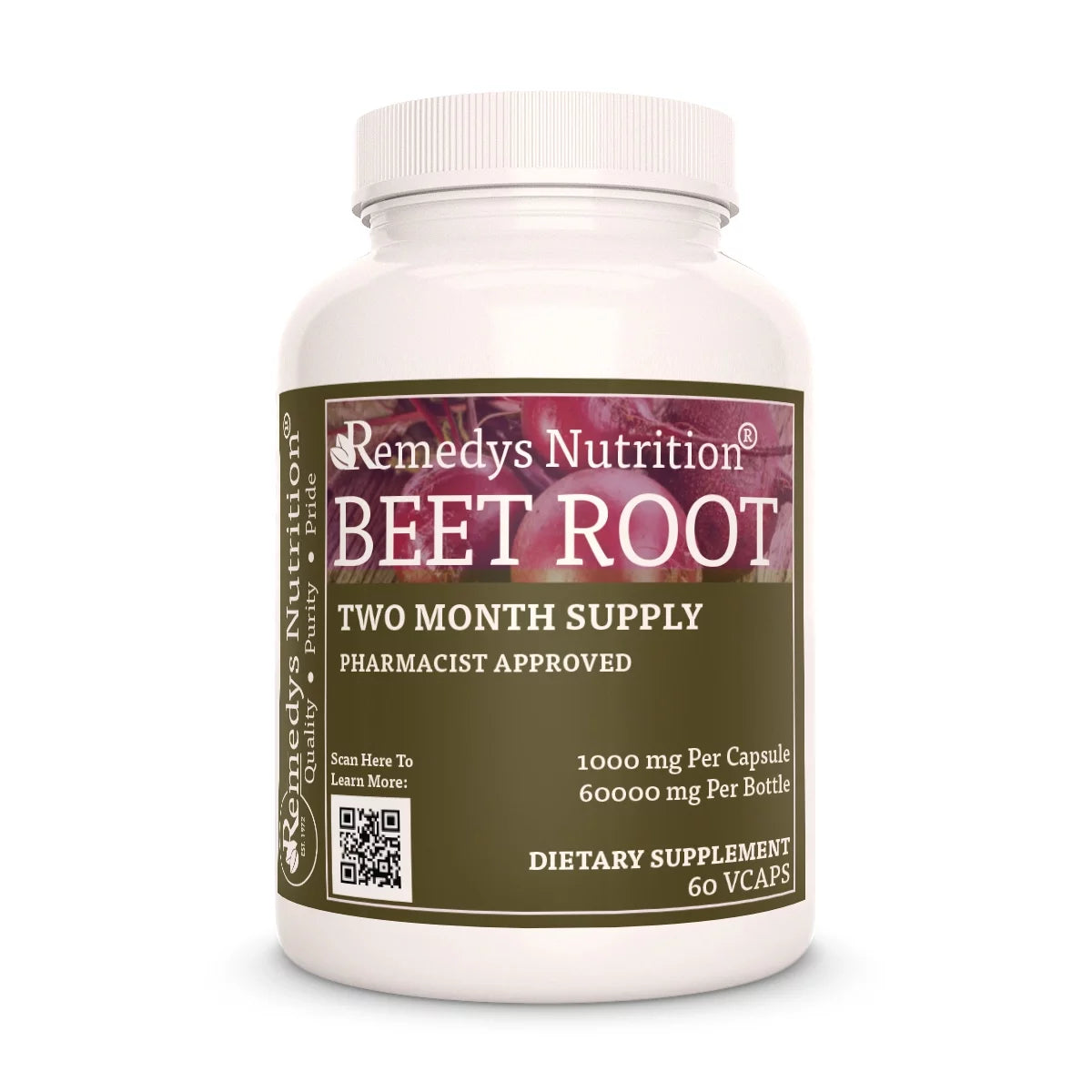
Beet root (Beta vulgaris) is the deep-red taproot of the beet plant, valued as a concentrated food source of dietary nitrate, betalain antioxidants, and minerals. Remedy's Beet Root delivers 1,000 mg of beet root per serving in 60 vegan capsules, giving you the circulation and stamina benefits of beets without the sugar, prep, or stained countertops of fresh juice.
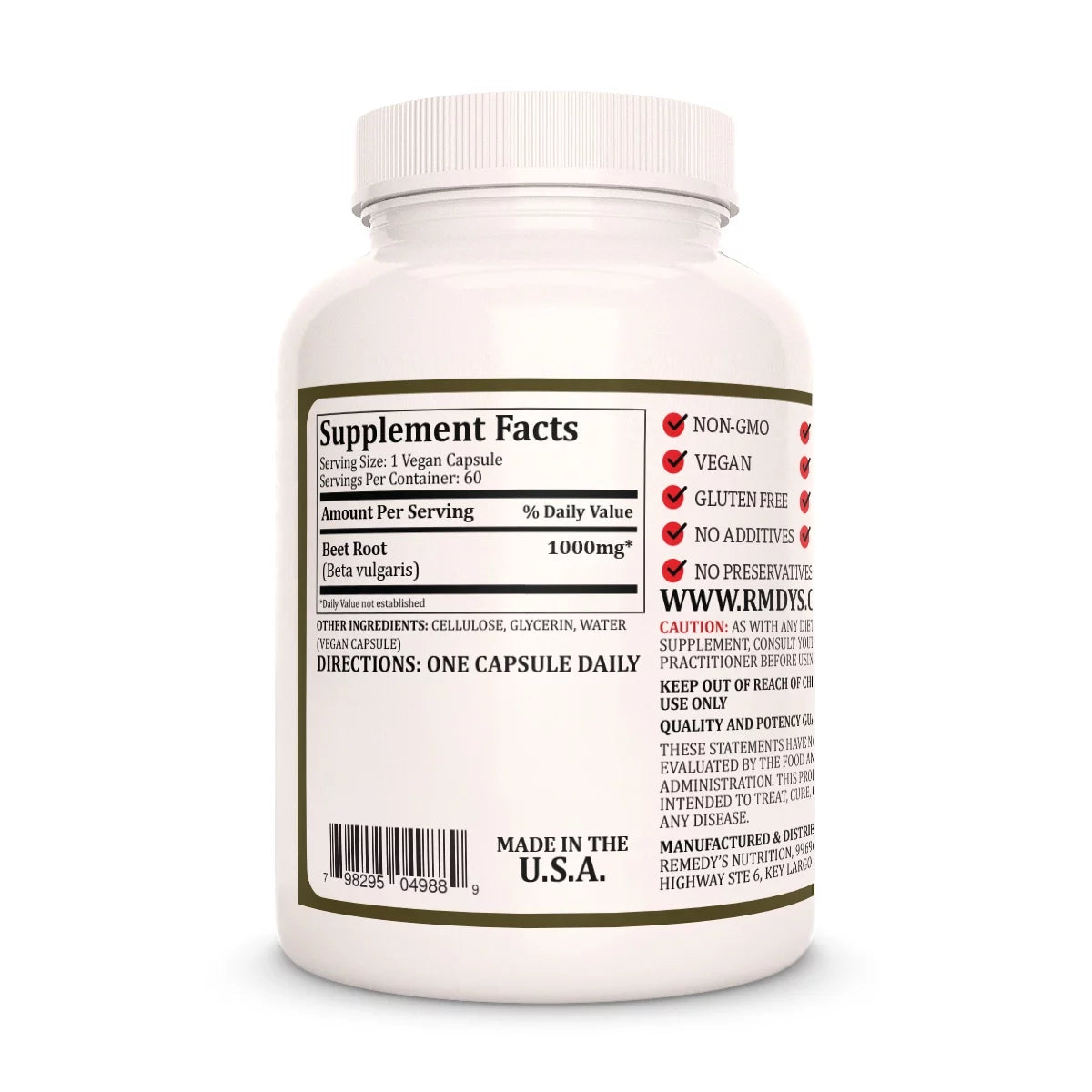
Supplement Facts
Serving size: 1 Vegan Capsule. Servings per container: 60.
| Amount Per Serving |
Amount |
% Daily Value |
| Beet Root (Beta vulgaris) |
1000 mg |
* |
* Daily Value not established.
Other ingredients: Cellulose, Glycerin, Water (vegan capsule)
Directions: One capsule daily.
Non-GMO, vegan, gluten free, no additives, no preservatives. Made in the USA.
The active story behind beet root is nitrate. Your body converts the nitrate naturally present in beets into nitrite and then into nitric oxide, a signaling molecule that relaxes and widens blood vessels. This nitrate-nitrite-nitric oxide pathway is why beet root is studied so heavily for blood pressure and endurance. Our deep-dive beet root supplements guide walks through the full science.
-
Dietary nitrate — the precursor to vessel-relaxing nitric oxide
-
Betalains — 2 pigment families with antioxidant activity
-
Folate, potassium, manganese — supporting minerals naturally present in beets
-
0 grams of added sugar — unlike a typical glass of beet juice
How Beet Root Works: Nitrate to Nitric Oxide
Beet root works mainly through a 3-step pathway. Bacteria on your tongue reduce nitrate to nitrite, your body converts nitrite into nitric oxide, and nitric oxide signals blood vessels to relax. A landmark study showed beetroot nitrate acutely lowered blood pressure and produced vasoprotective, antiplatelet effects[1]Beetroot Juice Lowers Blood Pressure — Hypertension (2008) View source.
| Step |
What Happens |
What Can Break It |
| 1. Nitrate intake |
Beet root delivers naturally occurring dietary nitrate |
Skipping days — the reserve is not stored long |
| 2. Nitrate to nitrite |
Oral bacteria on the tongue reduce nitrate to nitrite |
Antibacterial mouthwash kills those bacteria |
| 3. Nitrite to nitric oxide |
Tissues convert nitrite to nitric oxide, mostly where oxygen is low |
Nothing practical — this step is automatic |
| 4. Vasodilation |
Nitric oxide relaxes vessel walls, easing pressure and improving flow |
Expecting drug-sized effects from a food nitrate |
Plasma nitrite typically peaks around 2 to 3 hours after intake, which is why timing matters for performance[2]Beetroot Juice Nitrate Dose-Response — J Appl Physiol (2013) View source.
Top Beet Root Benefits
Beet root is best known for supporting healthy blood pressure, circulation, energy, and exercise performance, and nearly every benefit traces back to nitric oxide. In a meta-analysis of adult trials, beetroot juice and inorganic nitrate significantly reduced systolic blood pressure[3]Beetroot Juice and Blood Pressure Meta-Analysis — Journal of Nutrition (2013) View source, and a 4-week randomized trial found sustained reductions of roughly 8/4 mmHg in hypertensive patients[4]Sustained BP Lowering in Hypertensive Patients — Hypertension (2015) View source.
| Benefit Area |
What Research Suggests |
Evidence Strength |
| Blood pressure |
Dietary nitrate lowered systolic BP across pooled trials and in hypertensive patients |
Strong — RCTs and meta-analysis |
| Endurance and stamina |
Nitrate reduced the oxygen cost of exercise and extended time to exhaustion |
Strong — repeated RCTs |
| Circulation and blood flow |
Nitric oxide relaxes and widens blood vessels, improving perfusion |
Moderate |
| Brain blood flow |
High-nitrate intake increased cerebral blood flow in controlled studies |
Emerging |
| Antioxidant support |
Betalain pigments contribute antioxidant activity |
Emerging — mostly lab data |
A 2015 review of red beetroot in health and disease reached the same split: cardiovascular and exercise effects are the best supported, while antioxidant and metabolic claims remain early[5]Red Beetroot Supplementation in Health — Nutrients (2015) View source. For the study-by-study rundown, see our beet root benefits guide.
How Much Nitrate Is Actually in a Beet Root Capsule?
This is the question most beet root labels avoid, so here is the honest answer. 1,000 mg of beet root is not 1,000 mg of nitrate. Nitrate is a small fraction of whole beet root by weight, which means a capsule builds a steady daily nitrate baseline rather than replicating the single large nitrate load used in acute performance trials.
That distinction changes what you should expect, and it is why we do not claim a capsule beats a research-grade beet shot on race day. What a capsule does better is the thing that actually drives cardiovascular results: showing up every single day for 4 or more weeks without sugar, prep, or measuring.
-
Daily baseline: capsules keep nitrate intake consistent, which is what blood pressure trials rely on
-
Acute nitrate load: a concentrated 70 mL shot delivers far more nitrate in 1 sitting
-
Label literacy: if a product lists no nitrate figure, assume it is a whole-root dose, not a nitrate dose
-
Practical read: use capsules for the daily habit, and time a bigger nitrate source before a key event
Our how much beet root to take daily guide breaks down how each form maps onto the 300 to 600 mg nitrate range used in research.
Beet Root for Blood Pressure and Heart Health
Beet root is most studied for supporting healthy blood pressure through nitric-oxide-driven vasodilation, and the effect is largest in people who start with elevated readings. It behaves like a habit, not a pill: benefits accumulate over weeks of consistent use and fade if you stop.
| Timeframe |
What Typically Happens |
What to Do |
| Hours 2 to 3 |
Plasma nitrite peaks; an acute, temporary BP dip is possible |
Note any lightheadedness, especially on BP medication |
| Week 1 |
Beeturia may appear; no reliable change in readings yet |
Log a baseline of home readings before judging |
| Weeks 2 to 4 |
Sustained systolic changes begin to show in trials |
Keep the same daily time and dose |
| Week 4 and beyond |
Trials report sustained systolic reductions near 4 to 8 mmHg |
Compare a 7-day average against your baseline |
Beet root is a supportive adjunct, never a replacement for prescribed medication. Our guide to beet root for high blood pressure covers who benefits most and how to monitor safely.
Beet Root for Athletic Performance
Beet root is one of the most researched legal ergogenic aids, valued for improving exercise efficiency rather than raising your aerobic ceiling. Dietary nitrate reduced the oxygen cost of submaximal exercise and enhanced tolerance to high-intensity work[6]Dietary Nitrate Improves Exercise Efficiency — J Appl Physiol (2009) View source, and a follow-up trial found the same reduction in the oxygen cost of walking and running[7]Nitrate Reduces O2 Cost of Running — J Appl Physiol (2011) View source.
-
Daily loading: 3 to 6 days of consistent intake before a target event
-
Event-day timing: take your dose 2 to 3 hours before the start
-
Best fit: efforts lasting 5 to 30 minutes — running, cycling, rowing, team sports
-
Honest expectation: recreational athletes gain more than elites, and not every trial shows a benefit
A 2018 review in Annual Review of Nutrition reaches the same conclusion about dose timing and responder variability[8]Dietary Nitrate and Physical Performance — Annu Rev Nutr (2018) View source. Dig into the protocols in our beet root as a pre-workout breakdown.
Beet Root for Men: Blood Flow and Vitality
For men, beet root's appeal centers on circulation. Nitric oxide is the same molecule behind healthy vascular function, so beet root may support blood flow, workout stamina, and everyday energy. Controlled work on high-nitrate intake shows measurable changes in blood flow parameters[9]Dietary Nitrate, Blood Flow and Cognition — Physiology & Behavior (2015) View source.
-
What it supports: circulation, workout stamina, steady non-stimulant energy
-
What it does not do: raise testosterone — 0 human trials show a hormonal effect
-
Not a treatment: beet root is not therapy for erectile dysfunction
-
Interaction flag: ED drugs are vasodilators too — stacking can drop pressure too far
For the myth-checked version, read our benefits of beet root for men guide.
Beet Root Capsules vs Powder, Juice and Nitric Oxide Blends
Every form feeds the same nitrate pathway, so at an equal nitrate dose no form is more effective. The real trade-offs are sugar, cost, prep, and whether you will still be taking it in week 4.
| Form |
Convenience |
Added Sugar |
Best For |
| Capsules (1,000 mg) |
High — no prep, portable, fixed dose |
0 grams |
Daily blood pressure and circulation |
| Powder |
Medium — needs mixing and scooping |
Varies by brand |
Smoothies and adjustable dosing |
| Juice |
Low — refrigerate, messy, perishable |
13 to 15 g per 8 oz glass |
Acute pre-event nitrate load |
| Concentrated shots |
Medium — single-serve, higher cost |
Varies by brand |
Race-day nitrate loading |
| Nitric oxide blends |
Medium — multi-ingredient, priciest |
Varies by brand |
Stacking the amino-acid route as well |
Blends usually add L-arginine or L-citrulline, which target a second route to nitric oxide rather than a better one. If you want that comparison in full, see our guide to nitric oxide supplements, or the direct beet root powder vs capsules comparison.
Is Beet Root Right for You?
Most supplement pages only describe who should buy. Here is both sides, so you can decide in under a minute whether a daily beet root capsule earns its place in your routine.
| Good Fit If |
Probably Not If |
| You want daily support for healthy blood pressure and circulation |
You expect a drug-sized drop instead of roughly 4 to 8 mmHg |
| You dislike the taste, sugar, or prep of beet juice |
You want 1 acute race-day nitrate load and nothing else |
| You train for endurance events lasting 5 to 30 minutes |
You compete in pure power or 1-rep-max strength sports |
| You want a single-ingredient formula you can track |
You have a history of calcium-oxalate kidney stones |
| You can commit to 4 weeks of consistent daily use |
You already run naturally low blood pressure |
If the right column describes you, talk with your clinician before starting. Our beet root capsules side effects guide walks through each caution in detail.
How Much Beet Root to Take
A practical daily dose of Remedy's Beet Root is 2 capsules (1,000 mg) per day, taken at the same time each day with water. For cardiovascular goals, consistency across 4 or more weeks matters far more than any single large dose.
| Goal |
Suggested Use |
Timing |
Duration |
| Blood pressure and circulation |
2 capsules (1,000 mg) daily |
Same time each day, with or without food |
4+ weeks for cumulative effect |
| Endurance performance |
Daily dose plus a larger nitrate source pre-event |
2 to 3 hours before the effort |
3 to 6 day load before a target event |
| General wellness |
2 capsules daily |
Morning routine |
Ongoing |
Give it at least 4 weeks before judging the effect, and pair it with regular movement and a vegetable-rich plate.
What Can Blunt Beet Root's Effect
When beet root disappoints, the cause is usually the routine rather than the supplement. These 4 factors account for most of it, and every one is fixable in a day.
-
Antibacterial mouthwash: it kills the tongue bacteria that perform step 2 of the pathway, which can blunt the whole effect
-
Inconsistency: the sustained blood pressure response needs daily intake across 1 to 4 weeks, not occasional doses
-
Bad timing for sport: a dose 20 minutes before a workout misses the 2 to 3 hour nitrite peak entirely
-
Wrong expectation: a whole-root capsule is a daily nitrate baseline, not a research-grade acute nitrate load
Fix those 4 and you have given beet root a fair trial. A 2017 systematic review in older adults reached a similar conclusion about dose consistency and individual variation in response[10]Nitrate Benefits in Older Adults — Nutrients (2017) View source.
Why Choose Remedy's Beet Root
A 1,000 mg vegan beet root capsule gives you a precise, repeatable daily dose with no measuring, no mess, and no sugar spike. Each bottle is manufactured in the USA in a GMP facility and lab-tested for purity, so what is on the label is what is in the capsule.
| What You Get |
Why It Matters |
| 1,000 mg beet root per serving |
A consistent daily dose in 2 capsules — no scooping, no guesswork |
| 60 vegan capsules, 30-day supply |
Plant-based and gelatin-free at the 2-capsule serving |
| Single ingredient, 0 added sugar |
Avoids the 13 to 15 g of sugar in a typical 8 oz glass of beet juice |
| Made in the USA, GMP facility |
Manufactured to quality standards with third-party lab testing |
| No staining, no prep, no taste |
None of the earthy flavor or pink countertops of fresh beets |
Because it is a single-ingredient formula, you can add or remove it cleanly and see what it actually does for your readings.
Beeturia: Why Beet Root Turns Urine Pink
Pink or red urine after beets is called beeturia, it affects an estimated 10 to 14% of people, and it is completely harmless. It comes from betalain pigments passing through, not from bleeding, and it fades on its own within a day or two of stopping.
| Sign |
Harmless Beeturia |
Worth a Doctor Visit |
| Timing |
Starts within 24 hours of a beet dose |
Appears with 0 recent beet intake |
| Duration |
Clears 1 to 2 days after you stop |
Persists after several beet-free days |
| Other symptoms |
None — no pain, no clots |
Pain, burning, clots, or fever |
| Color pattern |
Pink to magenta, sometimes in stool too |
Brown, tea-colored, or smoky |
Beeturia is more common in people with low iron stores, so if it is new and persistent it can be a reasonable prompt to check iron status.
Beet Root Side Effects and Safety
Beet root is well tolerated by most healthy adults, and its most common effect is the harmless color change above. The more meaningful caution is oxalates: beets are a high-oxalate food, and lowering dietary oxalate is a recognized strategy for people prone to calcium-oxalate kidney stones[11]Dietary Oxalate and Kidney Stone Prevention — Actas Urol Esp (2025) View source.
-
Beeturia: harmless pink urine in 10 to 14% of people — no action needed
-
Oxalates: limit if you have a history of calcium-oxalate kidney stones
-
Low blood pressure: may add to the effect of antihypertensive medication
-
Digestive comfort: large doses can cause mild stomach upset in some people
Drug Interactions and Who Should Not Take It
Because beet root supports nitric oxide and vasodilation, it can amplify blood-pressure-lowering drugs. A systematic review found dietary supplements can interact with cardiovascular medications, underscoring the need to monitor when combining them[12]Supplement Interactions With Cardiovascular Drugs — Systematic Reviews (2012) View source. Talk with your clinician before starting if any situation below applies.
| Group |
Why Caution Is Needed |
| On blood pressure medication |
Additive effect may lower BP too far — monitor and consult your doctor |
| Nitrate or ED medication users |
Combining vasodilators can cause an excessive drop in blood pressure |
| History of kidney stones |
Beets are high in oxalates — limit intake and seek medical advice |
| Pregnant or breastfeeding |
Food amounts are fine; consult before a concentrated supplement |
Do not stop any prescribed medication to take a supplement. Beet root is intended to complement, not replace, medical care.
Frequently Asked Questions
How much beet root is in each serving? +
Each 2-capsule serving delivers 1,000 mg of beet root, and the bottle holds 60 vegan capsules for a 30-day supply. That gives you a precise, repeatable daily dose with 0 grams of added sugar and none of the mess of fresh juice.
Is 1,000 mg of beet root the same as 1,000 mg of nitrate? +
No. Nitrate is only a small fraction of whole beet root by weight, so a 1,000 mg capsule builds a daily nitrate baseline rather than matching the single large load used in acute performance trials. That is why consistency over 4 weeks matters more than one big dose.
How long does beet root take to work? +
For acute effects, plasma nitrite peaks around 2 to 3 hours after a dose, which is why athletes time it pre-exercise. For blood pressure, allow at least 4 weeks of daily use, since the sustained response builds gradually with consistent intake.
Is beet root good for blood pressure? +
Yes. In randomized trials, dietary nitrate from beets lowered systolic blood pressure, with sustained reductions of about 8/4 mmHg over 4 weeks in hypertensive patients. It works as a daily adjunct, never a replacement for prescribed medication.
Does beet root really improve athletic performance? +
For many people, yes. Studies show dietary nitrate cuts the oxygen cost of exercise and can extend time to exhaustion, with the clearest gains in efforts lasting 5 to 30 minutes. Recreational athletes benefit more than elites. Take it 2 to 3 hours before training.
Why does beet root turn urine red? +
This harmless effect is called beeturia and affects an estimated 10 to 14% of people. It comes from betalain pigments passing through and clears 1 to 2 days after you stop. Red urine with no recent beet intake is different and worth a medical check.
Can antibacterial mouthwash stop beet root from working? +
It can blunt it. Step 2 of the 3-step nitrate pathway depends on bacteria living on your tongue, and antibacterial rinses kill them. If you take beet root for blood pressure, avoid antibacterial mouthwash around the time of your daily dose.
Are beet root capsules better than beet juice? +
For daily use, capsules are more convenient and carry 0 grams of added sugar, versus 13 to 15 g in a typical 8 oz glass of juice. Juice delivers a larger acute nitrate load for race day, but capsules win for consistent everyday support.
Can I take beet root every day? +
Yes. The suggested use is 2 capsules (1,000 mg) once daily, and consistent intake across 4 or more weeks is exactly how the cardiovascular benefits accumulate. Beet root is well tolerated for long-term daily use in most healthy adults.
Does beet root help with circulation in men? +
Beet root supports blood flow through nitric oxide, the same molecule behind healthy vascular function. It is not a treatment for erectile dysfunction, and 0 human trials show it raises testosterone. The circulation support can still help energy and stamina at 2 capsules daily.
Who should not take beet root? +
Use caution in 4 situations: taking blood pressure or nitrate medication, since beet root can lower BP further; a history of calcium-oxalate kidney stones, as beets are high in oxalates; pregnancy; and breastfeeding. Consult a clinician before starting in any of these cases.
Is beet root high in oxalates? +
Yes, beets are a high-oxalate food. Reducing dietary oxalate is a recognized prevention strategy for the roughly 70 to 80% of kidney stones that are calcium-oxalate. If you have a stone history, limit beet root and ask your clinician about safe intake.
Are these capsules vegan? +
Yes. All 60 capsules per bottle are plant-based and gelatin-free, with no animal-derived ingredients. They are made in the USA in a GMP facility and lab-tested for purity, delivering 1,000 mg of beet root per 2-capsule serving.
You May Also Like
-
L-Arginine 1000 mg — the amino-acid route to nitric oxide, a natural pairing with beet root's dietary nitrate pathway
-
Hawthorn Berry Extract — traditional cardiovascular herb that complements beet root for circulation support
-
CoQ10 200 mg — cellular energy and antioxidant support often stacked with beet root for heart health