
Quercetin supplements often supply 500 to 1,000 mg a day, yet the form used can change absorption 20-fold. In a 2025 review of 31 human studies, a lecithin phytosome raised absorption 20.1 times over plain quercetin, and dietary fat with fibre roughly doubled absorption.
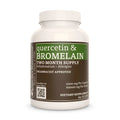
This article covers quercetin forms, bromelain and vitamin C add-ins, cost per 500 mg, and safety with common medicines. Remedy's Nutrition sells the 2 quercetin products featured here. That means we are not a neutral third party. Every label figure comes from our own product pages and bottle photos.
Quick Answer: How to Choose a Quercetin Supplement
Choose a quercetin supplement by form, dose and added ingredients. Plain quercetin absorbs variably, and a lecithin phytosome raised absorption 20-fold in one review. Labels commonly give 500 to 1,000 mg daily. Bromelain adds a pineapple-allergy and blood-thinner caution. Take it with a meal.
Key Takeaways
- Supplements often supply 500 to 1,000 mg of quercetin per day.
- Lecithin phytosome raised quercetin absorption 20.1-fold versus plain quercetin in one review.
- Both Remedy quercetin products list 500 mg of quercetin and 50 mg bromelain.
- Safety data beyond 12 weeks at 1,000 mg or more are lacking.
- A 50 mg bromelain dose adds pineapple-allergy and warfarin cautions.
Quercetin Forms Compared: Aglycone, Phytosome and More
Quercetin comes in forms that the body absorbs very differently. A 2025 review of 31 human studies found a lecithin phytosome raised absorption 20.1-fold over plain quercetin. Glucoside forms did better too, and dietary fat with fibre roughly doubled absorption.[1]Improving Quercetin Bioavailability, Systematic Review — PubMed View source Check which form your bottle contains.
| Form | What the research reports | Main trade-off |
|---|---|---|
| Plain quercetin (aglycone) | Free quercetin, often labeled quercetin or quercetin dihydrate. Absorption after oral doses ranged from 0 to over 50% across studies.[2]Quercetin Pharmacokinetics and Bioavailability in Humans — PubMed View source | Simple and widely sold, but absorption varies from person to person. |
| Glucosides (including isoquercitrin) | Quercetin oligoglucosides showed about 20-fold higher bioavailability than the aglycone in the 2025 review. | Fewer products, and the label must name the glucoside form. |
| Lecithin phytosome | 20.1-fold higher absorption than the aglycone in the same review. | A specialty form; check the milligrams of quercetin it actually supplies. |
| Cyclodextrin complex | A glucoside-cyclodextrin complex showed 10.8-fold higher bioavailability. | Rare in retail products. |
| Added bromelain | The review's summary does not list bromelain among the methods it measured. | Adds a pineapple-allergy and bleeding caution; treat the absorption claim as unproven. |
Form matters as much as dose, so compare what each label names. For a closer look at why the two ingredients are paired, read why quercetin and bromelain are combined.
What Is in a Quercetin and Bromelain Capsule
A quercetin and bromelain product pairs a flavonoid with a pineapple enzyme, often with vitamin C and turmeric. Our capsule lists 500 mg of quercetin, 50 mg of bromelain, 400 mg of turmeric and 48 mg of vitamin C per serving. The label does not name a quercetin form.
- Quercetin
- A flavonoid found in onions, apples and tea. Supplements deliver it at doses far above food levels.
- Bromelain
- A group of protein-digesting enzymes from pineapple. People with a pineapple allergy should avoid it.
- Phytosome
- Quercetin bound to lecithin, a fat-like carrier, to improve absorption.
- Activity units (GDU or MCU)
- Measures of bromelain enzyme strength. A figure in mg alone does not show how active the enzyme is.
| Per serving | Quercetin & Bromelain (capsule) | Quercetin 500 Plus (tablet) |
|---|---|---|
| Quercetin | 500 mg | 500 mg |
| Bromelain | 50 mg | 50 mg (product page) |
| Vitamin C | 48 mg | 250 mg (product page) |
| Turmeric | 400 mg | 50 mg with manganese (product page) |
| Other | 2 mg hibiscus | None listed in the page text |
| Quercetin form named | No | No |
| Directions | 1 vegan capsule daily (label) | 1 tablet twice daily with meals (page) |
| Count | 60 capsules | 50 or 100 tablets |
Amounts marked "product page" come from that page's Q&A, so confirm them on the bottle's Supplement Facts panel. Our Quercetin & Bromelain 1000 mg capsules are the one with bromelain, hibiscus and turmeric in the capsule.

Cost per 500 mg of Quercetin
Price per 500 mg of quercetin ranges from $0.41 to $0.52 across our labels. The cheapest option depends on bottle size, and daily cost depends on the directions. Price per milligram is only one factor, since the added ingredients and the form differ between products.
| Product | Price | Cost per 500 mg quercetin | Directions and cost per day |
|---|---|---|---|
| Quercetin & Bromelain, 60 capsules | $24.99 | $0.42 | 1 capsule daily; $0.42 per day, 60 days per bottle |
| Quercetin 500 Plus, 50 tablets | $26.00 | $0.52 | 1 tablet twice daily; $1.04 per day, 25 days per bottle |
| Quercetin 500 Plus, 100 tablets | $41.00 | $0.41 | 1 tablet twice daily; $0.82 per day, 50 days per bottle |
The directions differ because the products do. Follow the bottle you buy rather than the other product's directions. If you prefer the tablet, Quercetin 500 Plus tablets are available in 2 bottle sizes.
How Much Quercetin and for How Long
Labels commonly list 500 to 1,000 mg of quercetin per day. A 2018 safety review found side effects rare and mild, with no adequate data past 12 weeks at 1,000 mg or more.[3]Safety Aspects of Quercetin as a Dietary Supplement — PubMed View source Take it with a meal.
- With food: fat and fibre roughly doubled absorption in the 2025 review.
- Follow the label: 1 capsule daily for Quercetin & Bromelain, and 1 tablet twice daily for Quercetin 500 Plus.
- Duration: no standard course exists, and many people reassess with a clinician after 8 to 12 weeks.
- Onset: no onset time is established, so judge it over weeks and not after 1 or 2 days.
For more on doses, see our quercetin dosage guide.
Foods High in Quercetin Versus a 500 mg Tablet
Onions, tea and apples were the richest flavonol sources in a US food analysis. Average intake of flavonols and flavones was 20 to 22 mg per day, about 75% of it quercetin.[4]Flavonol and Flavone Intakes in US Health Professionals — PubMed View source A 500 mg tablet is roughly 30 times typical food intake.
- Food: onions, apples and tea supply the most quercetin in a typical diet.
- A diet-level intake near 15 mg a day is a different dose from 500 mg in a tablet.
- Food brings fibre and fat with it, which the 2025 review linked to better absorption.

Immune Support and What the Research Shows
Research on quercetin and immune function is still limited. A 2016 review reported mostly lab and animal findings and called for further studies.[5]Quercetin, Inflammation and Immunity — PubMed View source We describe quercetin only as flavonoid support for immune and seasonal wellness.*
- Quercetin is an antioxidant flavonoid found in many plant foods.
- Labels may say it supports immune and seasonal wellness, using careful language.*
- This guide makes no treatment claims for any condition.
- Persistent symptoms need a clinician, not a supplement trial.
Safety, Interactions and Contraindications
Quercetin may change the blood levels of some medicines, and bromelain is among the herbs listed as possibly raising bleeding risk with warfarin.[6]Herbal Interactions With Warfarin — PubMed View source Ask a pharmacist before combining either with blood thinners, quinolone antibiotics, cyclosporine or other drugs with a narrow safe range.
| Medicine or condition | Concern | What to do |
|---|---|---|
| Warfarin and other blood thinners | Bromelain may raise bleeding risk; the evidence is mostly case reports and lab data | Ask your prescriber before starting |
| Quinolone and some other antibiotics | Our capsule page advises spacing doses by 2 to 3 hours, and the 2018 review reports altered drug levels | Ask a pharmacist to set the timing |
| Cyclosporine and other narrow-range drugs | Lab studies show quercetin can affect the CYP3A4 and P-gp proteins that handle many drugs[7]Herbal Compounds and CYP3A4 and P-gp Drug Interactions — PubMed View source | Ask a pharmacist before combining |
| Kidney disease | Our pages advise against use, and animal data suggest risk in already damaged kidneys | Do not use without clinician approval |
| Pineapple allergy | Bromelain comes from pineapple | Avoid bromelain products and choose plain quercetin |
| Pregnancy and breastfeeding | Our pages state that safety data are insufficient | Do not use without your provider's approval |
| Scheduled surgery | Bromelain may affect bleeding | Our capsule page advises stopping 2 weeks before; ask your surgeon |
In a meta-analysis of 54 articles, the reported bromelain side effects were flatulence, nausea and headache, and no major health risks were reported.[8]Bromelain Efficacy and Safety, Meta-Analysis — PubMed View source We do not formulate for children.
Quality Checks Before You Buy
Six checks make quercetin labels comparable across brands. Each takes about 1 minute, and the first 3 matter most because form, dose and bromelain activity change what a milligram means. Apply all 6 to every bottle, including ours, before you compare prices.
- Amount: mg of quercetin per capsule or tablet, plus the serving size.
- Form: aglycone, dihydrate, glucoside or phytosome named on the label. Ours do not name one.
- Bromelain: the amount and the activity units, or choose plain quercetin if you have a pineapple allergy.
- Added ingredients: vitamin C, turmeric and herbs listed with amounts, not hidden in a blend.
- Lot testing: ask any brand, including us, for a certificate of analysis for your lot.
- Directions: follow the bottle, and ask a clinician before going above it.
*These statements have not been evaluated by the Food and Drug Administration. This product is not intended to diagnose, treat, cure, or prevent any disease.

Frequently Asked Questions
Can quercetin cause constipation? +
Constipation is not a commonly reported effect of quercetin, and a 2018 safety review found side effects rare and mild. Our product pages list headache, tingling and mild stomach upset at high doses, and bromelain trials report flatulence and nausea. If constipation starts after a new supplement, stop it and ask a pharmacist.
What foods are high in quercetin? +
Onions, apples and tea were the richest sources in a US food analysis. Typical intake of flavonols and flavones is about 20 to 22 mg a day, so a 500 mg tablet is roughly 30 times what food usually supplies. Food also brings fibre and fat, which help absorption.
What happens if I take quercetin every day? +
At typical doses, studies report side effects as rare and mild. Data beyond 12 weeks at 1,000 mg or more are lacking, and people with kidney disease or on narrow-range medicines should ask first. Keep to the bottle directions: 1 capsule daily for our Quercetin & Bromelain.
What should I not mix quercetin with? +
Ask a pharmacist before combining quercetin with warfarin or other blood thinners, quinolone antibiotics such as ciprofloxacin, cyclosporine, or any drug with a narrow safe range. Our Quercetin & Bromelain page advises spacing antibiotics by 2 to 3 hours. Bromelain adds a pineapple-allergy caution.
How long should you take quercetin? +
No standard course exists. Adequate safety data beyond 12 weeks at 1,000 mg or more are lacking, so many people reassess with a clinician after 8 to 12 weeks. Stop 2 weeks before scheduled surgery, as our Quercetin & Bromelain page advises, and ask about any medicines you take.
How long does it take for quercetin to work? +
No onset time is established, and quercetin is not a fast-acting supplement. Judging it after 1 or 2 days tells you little. Taking it with a meal helps absorption, which roughly doubled with fat and fibre in a 2025 review of 31 human studies.
Can I take quercetin with vitamin D? +
We found no established interaction, and many people take them together. Take vitamin D with a meal that contains fat. Quercetin 500 Plus also lists 250 mg of vitamin C and Quercetin & Bromelain lists 48 mg, so count those if you stack products. Ask a pharmacist if you take other medicines.
Does quercetin support immune health? +
Quercetin is an antioxidant flavonoid studied for immune and seasonal wellness support*, but human evidence is still limited. A 2016 review reported mostly lab and animal findings and called for more studies. We make no claim that it treats any condition.
Is quercetin with bromelain better than plain quercetin? +
It is not proven. Bromelain is often added on the premise that it improves absorption, but the 2025 review's summary did not list it among the methods it measured. Bromelain adds a pineapple-allergy caution and a bleeding caution with warfarin. Both our labels pair 500 mg of quercetin with 50 mg of bromelain.
Who should not take quercetin with bromelain? +
People with a pineapple allergy, kidney disease, or who are pregnant or breastfeeding should not use it without clinician approval. Ask first if you take warfarin, quinolone antibiotics or cyclosporine, and stop 2 weeks before surgery as our product page advises. We do not formulate it for children.
Which quercetin form absorbs best? +
In a 2025 review, a lecithin phytosome gave 20.1 times the absorption of plain quercetin, and quercetin oligoglucosides about 20 times. Check that the label names the form, because 500 mg of plain quercetin and 500 mg of a phytosome are not equal doses.
Related Reading
- What to Know About Quercetin Side Effects
- Can You Take Too Much Quercetin?
- Best Time of Day to Take Quercetin
Related Products