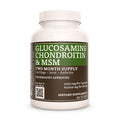

Glucosamine chondroitin capsules often list 1,000 mg per capsule, but that can hide how much of each ingredient you get. The best-known US trial, GAIT, used 1,500 mg of glucosamine and 1,200 mg of chondroitin sulfate daily for 24 weeks.
Full disclosure: Remedy's Nutrition sells the glucosamine and chondroitin products featured below, so we are not a neutral third party. This guide covers forms, label math, sources, and safety that apply to any brand. Then it shows our own numbers so you can compare.
Quick Answer: How to Choose Glucosamine Chondroitin
Choose glucosamine chondroitin by reading mg per ingredient, not mg per capsule. Our 2 combination capsules list 1,000 mg total with no per-ingredient split, so reaching the 1,500 mg of glucosamine used in trials takes more capsules. Evidence is mixed, and warfarin, diabetes, and shellfish allergy need a clinician's input first.
Key Takeaways
- Our combination capsules list 1,000 mg total, not per ingredient.
- A 1,000 mg HCl capsule holds roughly 830 mg of glucosamine.
- Trials used 1,500 mg glucosamine and 1,200 mg chondroitin sulfate daily.
- Cost runs $0.32 to $0.43 per capsule across our 3 labels.
- Evidence is mixed across 10 large trials pooled in a 2010 analysis.
Glucosamine HCl vs Sulfate: Which Form?
Glucosamine comes mainly as hydrochloride (HCl) or sulfate, and the trade-off is concentration versus research history. HCl is about 83% glucosamine by weight, so 1,000 mg supplies roughly 830 mg. Sulfate salts carry less glucosamine per milligram, but the best trial results come from one branded sulfate product.
Our deeper comparison of glucosamine HCl versus sulfate covers absorption and dosing.
| Form | Glucosamine by weight | On our labels | Evidence note |
|---|---|---|---|
| Glucosamine HCl | About 83% | Glucosamine HCl 1000 mg: 1,000 mg of HCl per capsule | An 8-week trial missed its primary pain goal |
| Glucosamine sulfate | Lower per milligram; stabilized with a salt | Our combination product pages describe sulfate, but the 2-in-1 label panel names no salt | Benefit concentrated in trials of one branded sulfate |
A Cochrane review found glucosamine beat placebo for pain in 10 trials of one branded sulfate preparation. Products from other makers pooled without a significant effect.[1]Glucosamine Therapy Cochrane Review — PubMed View source
An 8-week trial of the hydrochloride salt missed its primary pain endpoint, though it showed positive trends on some measures.[2]Glucosamine Hydrochloride 8-Week Trial — PubMed View source
What Chondroitin and MSM Add
Chondroitin sulfate is the usual second ingredient, and MSM (methylsulfonylmethane) is a common third. Research doses for chondroitin run 800 to 1,200 mg a day. MSM is a sulfur compound that some formulas add, and our 3-in-1 capsule includes it at $25.99 a bottle.
- Glucosamine alone: the simplest label. Our single-ingredient HCl capsule is $19.99.
- Plus chondroitin: our 2-in-1 capsule is $18.99 and prints one combined 1,000 mg figure.
- Plus MSM: our 3-in-1 capsule adds a third ingredient and costs $7.00 more than the 2-in-1.
Our glucosamine, chondroitin and MSM 3-in-1 capsules also print one combined number. The extra $7.00 therefore cannot be tied to an MSM dose. Whatever you pick, look for mg per ingredient.

Reading mg per Capsule on the Label
A label that says 1,000 mg of glucosamine chondroitin shows a combined weight, not 1,000 mg of glucosamine. Even if every milligram were glucosamine, 1 capsule falls 500 mg short of the 1,500 mg used in the GAIT trial.[3]GAIT Glucosamine and Chondroitin Trial, 1,583 People with Knee Pain — PubMed View source
| Product | Label per capsule | Split printed? | At 1 capsule a day | Capsules to reach 1,500 mg |
|---|---|---|---|---|
| Glucosamine HCl | 1,000 mg glucosamine HCl | Single ingredient | 1,000 mg HCl, about 830 mg glucosamine | 1.5 (use 2 in practice) |
| Glucosamine Chondroitin | 1,000 mg combined | No | Under 1,000 mg glucosamine; amount not printed | More than 1.5; split unknown |
| Glucosamine Chondroitin & MSM | 1,000 mg combined, 3 ingredients | No | Under 1,000 mg glucosamine; amount not printed | More than 1.5; split unknown |
For illustration only: if a 2-ingredient capsule were split evenly, 1 capsule would give 500 mg of glucosamine, one-third of 1,500 mg. Reaching both 1,500 mg of glucosamine and 1,200 mg of chondroitin would take at least 3 combined capsules a day. That holds only if the split were favorable.
Only our single-ingredient glucosamine HCl capsules print one clear number: 1,000 mg of HCl, or about 830 mg of glucosamine.
Cost Per Daily Dose, Worked Out
Cost per day depends on how many capsules you need. At the label direction of 1 capsule a day, our 3 products cost $0.32 to $0.43 a day. At 2 a day they cost $0.63 to $0.87, and a 60-capsule bottle lasts 30 days.
| Product | Price | Per capsule | 1 a day | 2 a day | 3 a day |
|---|---|---|---|---|---|
| Glucosamine Chondroitin | $18.99 | $0.32 | $0.32 | $0.63 | $0.95 |
| Glucosamine Chondroitin & MSM | $25.99 | $0.43 | $0.43 | $0.87 | $1.30 |
| Glucosamine HCl | $19.99 | $0.33 | $0.33 | $0.67 | $1.00 |
A 60-capsule bottle lasts 60 days at 1 a day, 30 days at 2, and 20 days at 3. Reaching 1,500 mg of HCl with 1.5 capsules a day costs $0.50 and lasts 40 days.
Our glucosamine chondroitin 2-in-1 capsules have the lowest price per capsule at $0.32, but the glucosamine and chondroitin split is not printed.
Shellfish, Vegan and Source Questions
Most glucosamine is made from shellfish shells, and chondroitin usually comes from bovine, shark, or chicken cartilage. Our capsule shells are plant cellulose, but our 3-in-1 and HCl product pages state that the glucosamine inside is shellfish-derived. If you have a shellfish allergy, ask before buying.
- Shellfish allergy: ask your allergist before trying any glucosamine, and ask the seller which source is used.
- Vegetarian glucosamine: some brands use fermented corn and say so on the label. If the label is silent, assume shellfish.
- Vegan shell is not vegan contents: a cellulose capsule says nothing about the glucosamine or chondroitin inside.
- Chondroitin source: our 2-in-1 label panel does not name the animal, so ask if it matters to you.

What the Evidence Shows: Mixed Results
Evidence for glucosamine and chondroitin is mixed. The 2006 GAIT trial of 1,583 people with painful knees found no significant pain benefit overall for either ingredient or the pair. A 2010 analysis of 10 large trials found no clinically meaningful change in pain.[4]Glucosamine and Chondroitin Network Meta-Analysis — PubMed View source
- In GAIT, a 354-person subgroup with moderate-to-severe pain responded better to the combination (79.2% vs 54.3% on placebo). That was an exploratory analysis.
- A 2007 meta-analysis of 20 chondroitin trials found small trials favored it and large, well-designed trials showed a minimal effect.[5]Chondroitin Meta-Analysis of 20 Trials — PubMed View source
- Industry-independent trials showed smaller effects than commercially funded trials in the 2010 analysis.
- Guidelines disagree. The 2019 ACR/AF and OARSI guidelines recommend against both, while a 2021 AAOS guideline lists them as possibly helpful.[6]Glucosamine and Chondroitin Overview — NCCIH View source
Safety signals were reassuring: adverse events in GAIT were mild, infrequent, and evenly spread across groups. If you try them for joint comfort and mobility support*, treat it as a personal trial, not a promise.
*These statements have not been evaluated by the Food and Drug Administration. This product is not intended to diagnose, treat, cure, or prevent any disease.
How Long to Try Before Deciding
Plan a trial of 8 to 12 weeks. These products are not fast-acting, and the studies we cite ran for months. Our labels direct 1 capsule daily, and our product pages suggest taking it with food. Note your baseline first so you can tell whether anything changed.
- Write down your baseline: which movements are hardest, and a 0 to 10 comfort score.
- Take the same serving at the same time daily, with food.
- Compare your notes after 8 to 12 weeks.
- If nothing has changed, stop rather than raise the dose.
- Tell your clinician or pharmacist what you take.
Safety, Interactions and Who Should Ask First
Glucosamine and chondroitin are generally well tolerated in large studies. Still, 4 groups need a clinician first: people on warfarin, people managing blood sugar, people with shellfish allergy, and anyone pregnant or breastfeeding. Tell your care team about every supplement before surgery.
| Situation | What to know | What to do |
|---|---|---|
| Warfarin or other blood thinners | The FDA MedWatch database held 20 reports of altered clotting with glucosamine and warfarin.[7]Glucosamine and Warfarin INR Case Report — PubMed View source NCCIH also links both ingredients with raised bleeding risk. | Ask your prescriber before starting; INR may need checking. |
| Diabetes medicines or blood sugar concerns | NCCIH notes glucosamine may raise blood glucose in some people. | Monitor your numbers and ask your clinician. |
| Shellfish allergy | Most glucosamine is shellfish-derived. | Ask your allergist and the seller first. |
| Pregnancy or breastfeeding | NCCIH says little is known about safety. | Ask your provider first. |
| Planned surgery | Providers should know every supplement you take.[8]Using Dietary Supplements Wisely — NCCIH View source | Tell your care team before the procedure. |

Frequently Asked Questions
Which brand of glucosamine and chondroitin is the most effective? +
We know of no head-to-head trial proving one brand superior. Judge any brand by 5 checks: named glucosamine form, mg per ingredient, source disclosure, third-party test results, and a short other-ingredients list. Ours list 1,000 mg combined per capsule with no split, so compare mg per ingredient before you choose.
Can you take too much glucosamine? +
Yes, more is not better. Trials used about 1,500 mg of glucosamine daily, and large studies found no major safety problems at those doses. Higher amounts can upset the stomach, and glucosamine may raise blood sugar in some people. Stay within the label directions (ours: 1 capsule daily) and ask a clinician before going above them.
Does glucosamine HCl with MSM work better than HCl alone? +
This guide cites no trial showing that adding MSM improves results over glucosamine alone. MSM is a separate sulfur compound with its own research. Our 3-in-1 capsule adds chondroitin and MSM within 1,000 mg total, so it may carry less glucosamine per capsule than our 1,000 mg HCl capsule.
What is glucosamine chondroitin used for? +
People take it for joint comfort and mobility support*. The evidence is mixed: the 2006 GAIT trial of 1,583 people found no significant pain benefit overall, and a 2010 analysis of 10 trials found no clinically meaningful change. Some people still try it for 8 to 12 weeks and judge for themselves.
What do the studies on glucosamine and chondroitin show? +
Results disagree. GAIT (1,583 people) found no overall benefit but a possible response in a moderate-to-severe pain subgroup, 79.2% versus 54.3% on placebo. A 2007 analysis of 20 chondroitin trials found minimal effects in large trials. Industry-independent trials showed smaller effects than commercially funded ones.
When is the best time to take glucosamine chondroitin MSM? +
Nothing in the research we cite ties results to a time of day. Our product pages suggest 1 capsule daily with food, which can ease stomach upset. Pick a consistent time, such as breakfast, and keep it for the full 8 to 12 weeks of your trial.
Is it safe to take glucosamine chondroitin daily? +
For most healthy adults, large studies have found no major safety problems, and adverse events in the 24-week GAIT trial were mild, infrequent, and evenly spread across groups. Skip it or ask first if you take warfarin, manage blood sugar, have a shellfish allergy, or are pregnant or breastfeeding.
What are the side effects of glucosamine chondroitin? +
Reported side effects are usually mild digestive complaints such as an upset stomach. In GAIT, adverse events were mild and infrequent over 24 weeks. The more serious concerns are interactions: warfarin (20 FDA reports of altered clotting) and blood sugar. Call a clinician if you notice unusual bruising or bleeding.
How many capsules do I need to reach 1,500 mg of glucosamine? +
With our single-ingredient HCl capsule, 1.5 capsules gives 1,500 mg of the HCl salt, so most people use 2. With our combination capsules the label does not split the 1,000 mg, so we cannot give a reliable number. Reaching both trial doses from combined capsules would take at least 3 a day.
Is glucosamine HCl or sulfate better? +
Neither is proven better for everyone. HCl is about 83% glucosamine by weight, while sulfate is lower per milligram. A Cochrane review found the clearest benefit in 10 trials of one branded sulfate, and an 8-week HCl trial missed its primary goal. Choose by evidence priority, label clarity, and price.
Can I take glucosamine chondroitin with a shellfish allergy? +
Ask your allergist first. Most glucosamine is made from shellfish shells, and our 3-in-1 and HCl pages state that the glucosamine is shellfish-derived. Our capsule shells are plant cellulose, but that does not change the source inside. Some brands sell corn-fermented glucosamine and label it clearly.
Related Reading
- Glucosamine Dosage by Form
- What the Research Shows on Glucosamine
- Which Formula: Chondroitin or MSM?
- Glucosamine Side Effects to Know
Related Products