What Is Ultimate Omega-3 Fish Oil?
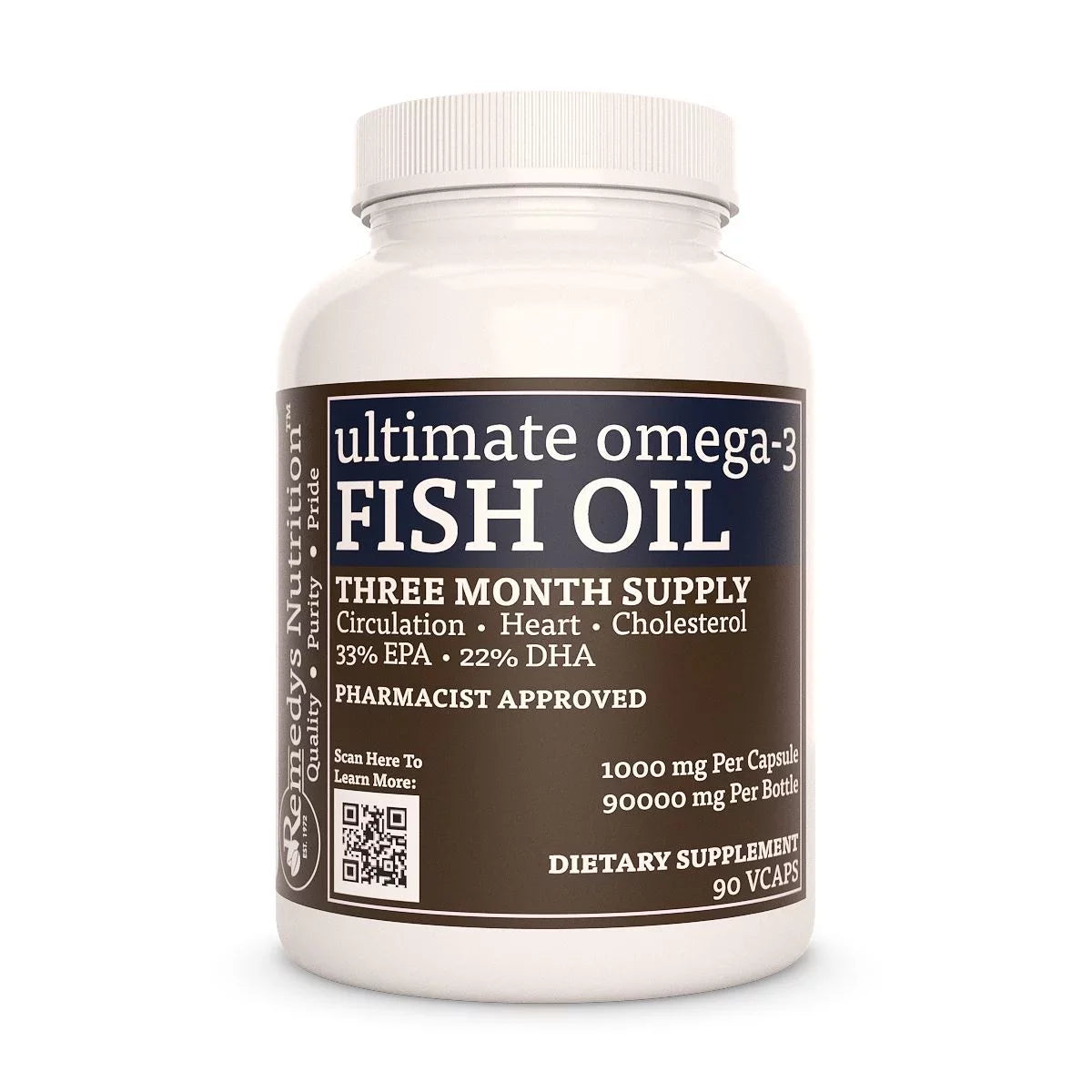
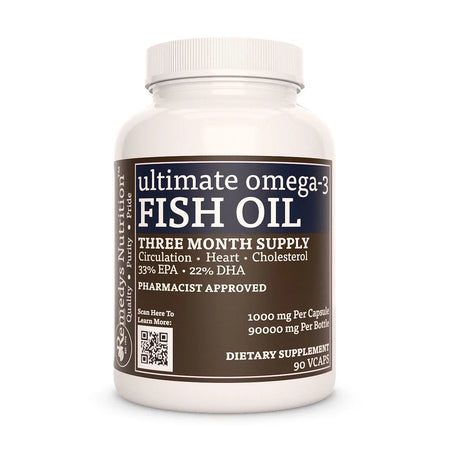
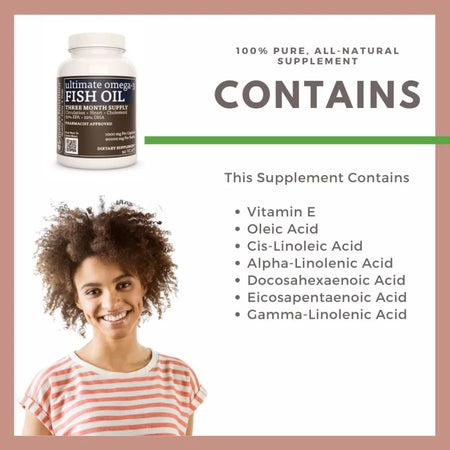
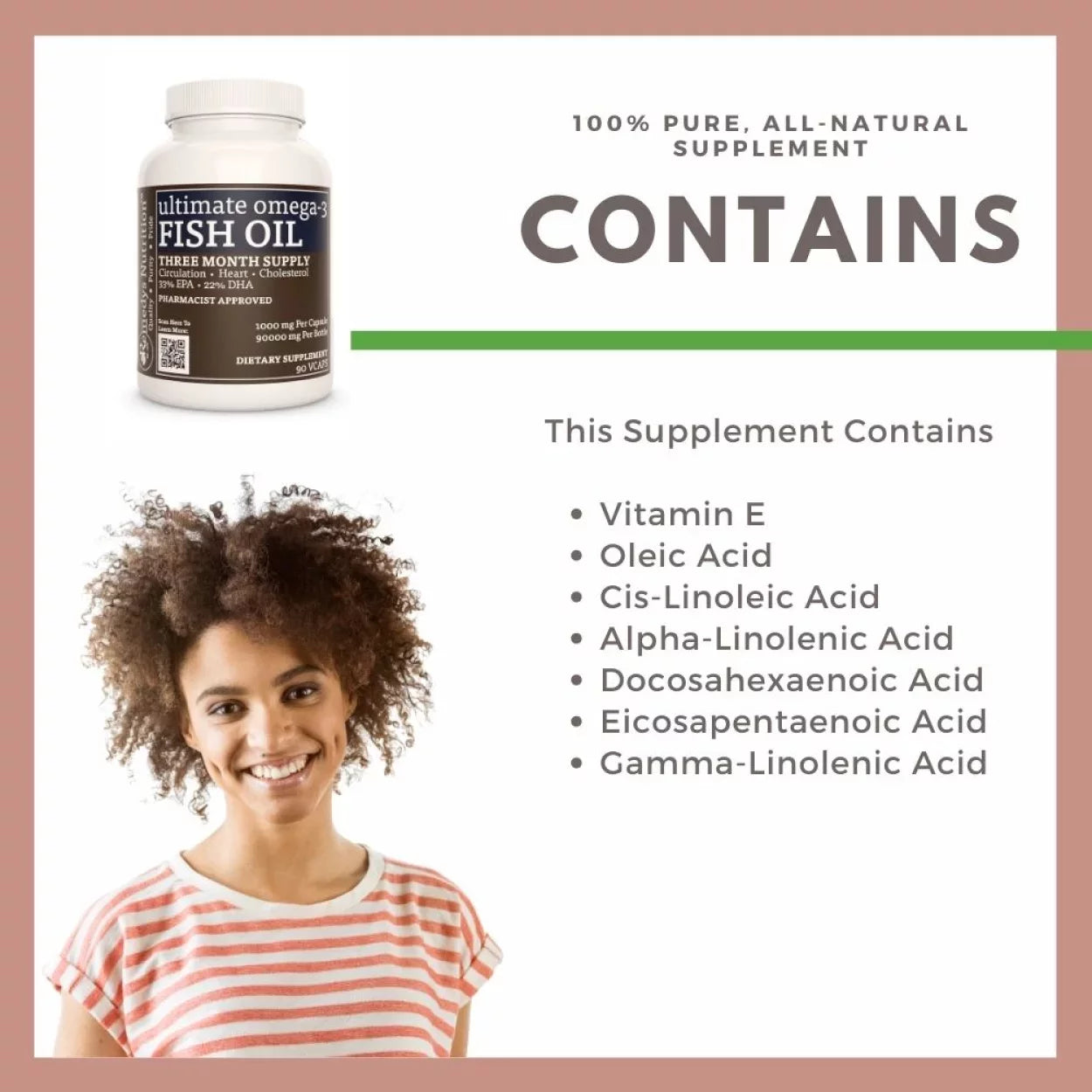
Remedy's Nutrition Ultimate Omega-3 Fish Oil delivers 1000 mg of molecularly distilled fish oil per softgel, standardized to a minimum 33% EPA and 22% DHA. That works out to roughly 550 mg of combined EPA and DHA in every single softgel — the two long-chain omega-3 fatty acids that carry nearly all of fish oil's documented benefits.
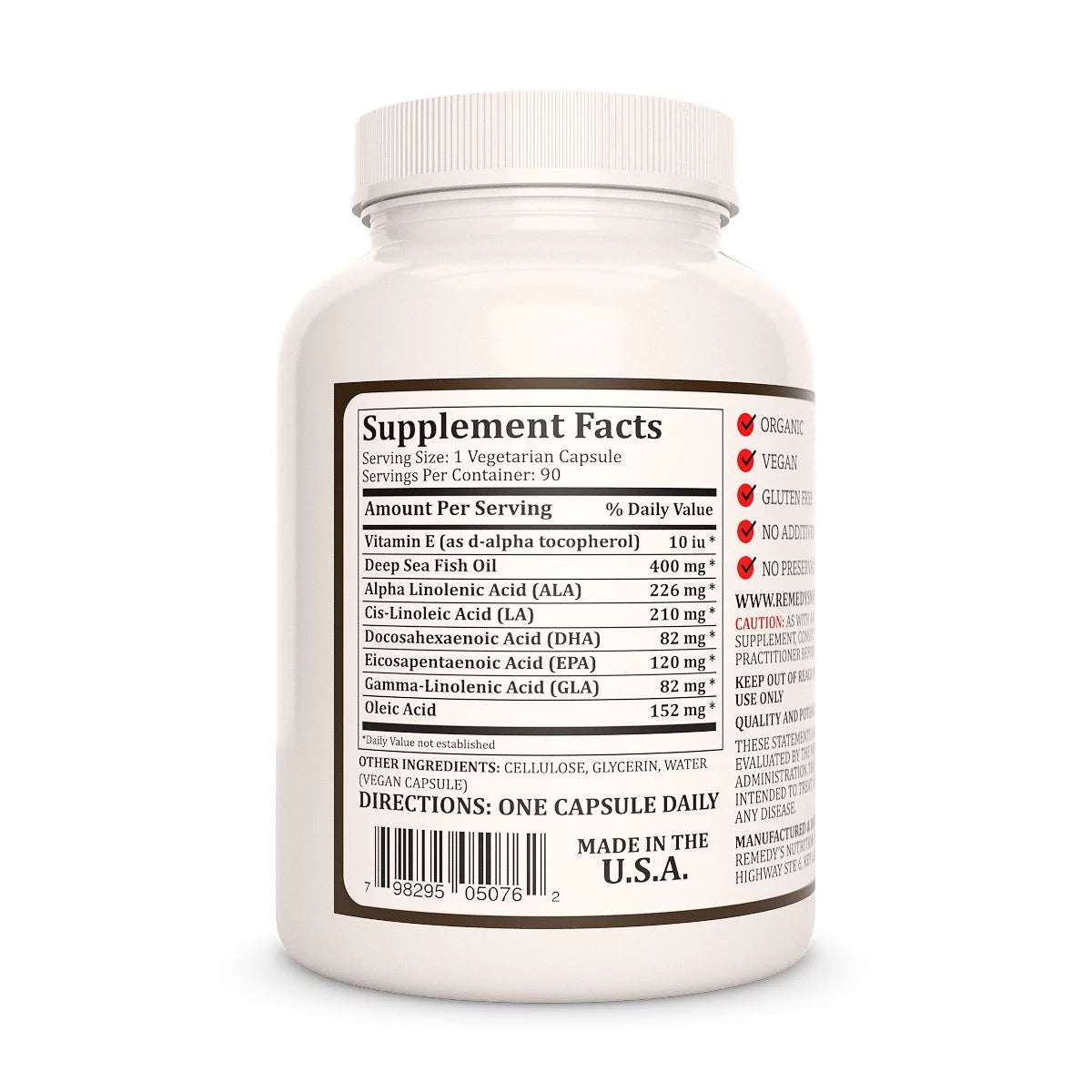
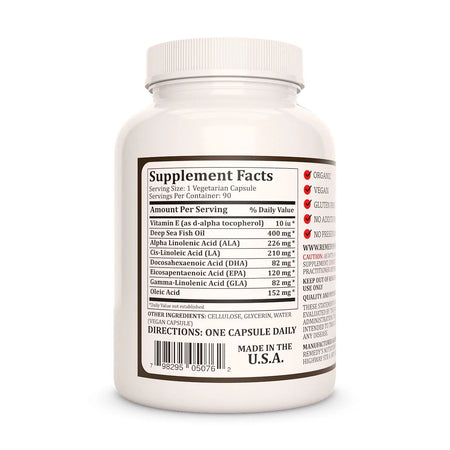
Supplement Facts
Serving size: 1 Vegetarian Capsule. Servings per container: 90.
| Amount Per Serving |
Amount |
% Daily Value |
| Vitamin E (as d-alpha tocopherol) |
10 IU |
* |
| Deep Sea Fish Oil |
400 mg |
* |
| Alpha Linolenic Acid (ALA) |
226 mg |
* |
| Cis-Linoleic Acid (LA) |
210 mg |
* |
| Docosahexaenoic Acid (DHA) |
82 mg |
* |
| Eicosapentaenoic Acid (EPA) |
120 mg |
* |
| Gamma-Linolenic Acid (GLA) |
82 mg |
* |
| Oleic Acid |
152 mg |
* |
* Daily Value not established.
Other ingredients: Cellulose, Glycerin, Water (vegan capsule)
Directions: One capsule daily.
Made in the USA.
EPA (eicosapentaenoic acid) and DHA (docosahexaenoic acid) are the active forms your body uses to regulate inflammation, build cell membranes, and support heart and brain function.[1]EPA and DHA Across the Lifespan — Advances in Nutrition (2012) View source Most Western diets fall short on both, which is why a concentrated softgel is a practical way to close the gap. For the full picture, our guide on what fish oil and omega-3 actually are breaks down the science in plain language.
-
1000 mg fish oil per softgel, 90 softgels (three-month supply)
-
Minimum 33% EPA / 22% DHA — about 550 mg EPA+DHA per softgel
-
Molecularly distilled for purity, free of fillers and additives
- Non-GMO, kosher, pharmacist reviewed
Ultimate Omega-3 Fish Oil Benefits
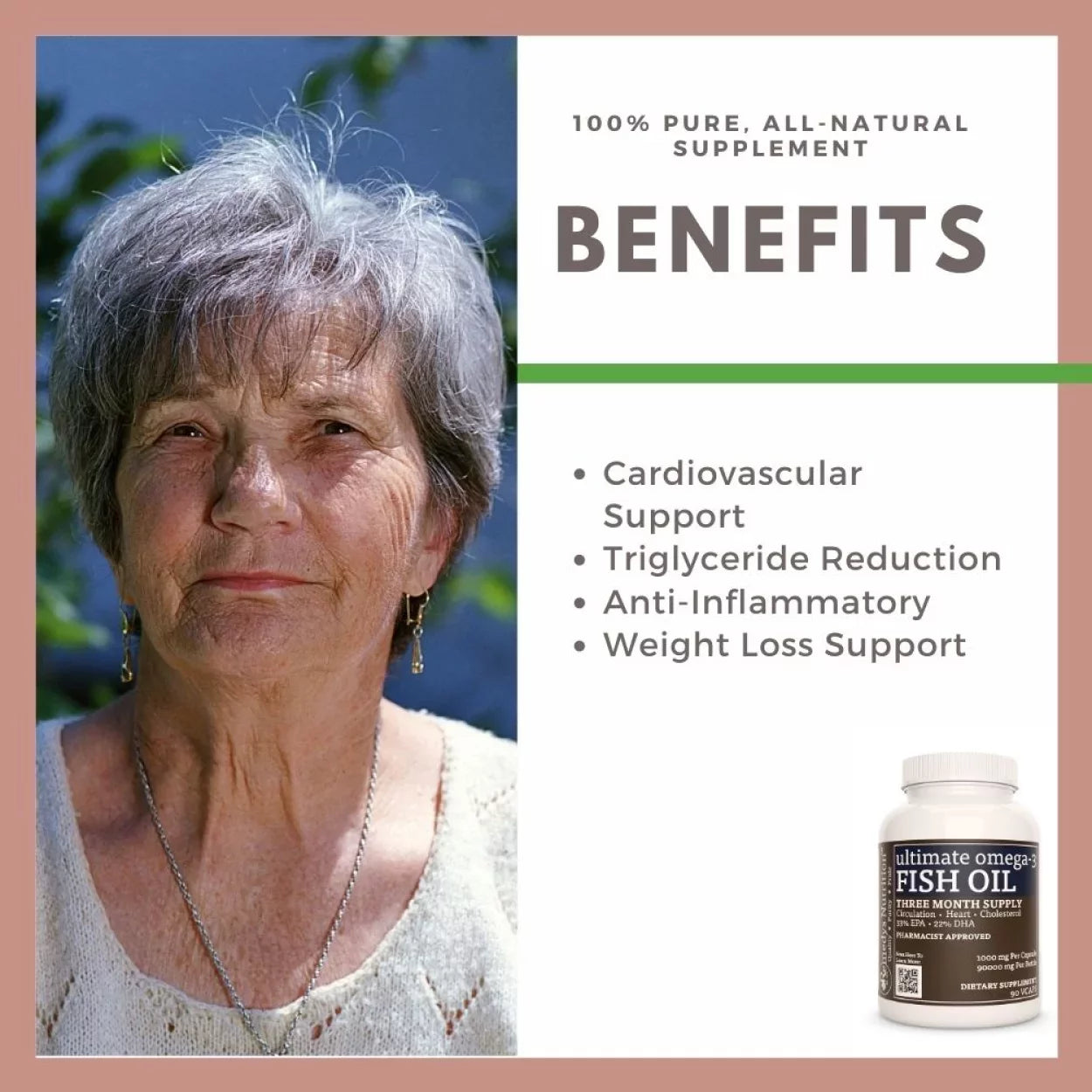
Omega-3 benefits are form- and dose-dependent, and an honest summary matters more than hype. The strongest, most consistent effect is triglyceride lowering, where omega-3 reliably helps in a dose-dependent way.[2]Omega-3 and Triglycerides Meta-Analysis — Medicine (2023) View source Other benefits are real but more modest, and we lay them out below rather than overpromise.
| Benefit Area |
What the Research Shows |
Strength of Evidence |
| Triglyceride lowering |
Omega-3 lowers blood triglycerides in a dose-dependent way; the most reliable cardiometabolic effect[2]Omega-3 and Triglycerides Meta-Analysis — Medicine (2023) View source
|
Strong |
| Inflammation |
EPA and DHA produce resolvins that help resolve inflammatory processes[3]Omega-3 and Inflammation — Biochemical Society Transactions (2017) View source
|
Moderate |
| Brain & mood |
Higher omega-3 status links to lower cognitive-decline risk; EPA-led formulas show modest adjunctive mood benefit[4]Omega-3, Dementia and Cognitive Decline — American Journal of Clinical Nutrition (2023) View source
|
Modest / mixed |
| Eye health |
Emerging evidence links DHA intake with lower age-related macular degeneration risk[5]Omega-3 and Macular Degeneration — Ophthalmology (2025) View source
|
Emerging |
For a deeper, study-by-study walkthrough, see our review of what the research actually shows about fish oil benefits.
How Omega-3 Fish Oil Works
Once absorbed, EPA and DHA are incorporated directly into your cell membranes, changing how cells signal and respond. They compete with omega-6 fatty acids for the same enzymes, shifting the body toward less inflammatory signaling molecules.[3]Omega-3 and Inflammation — Biochemical Society Transactions (2017) View source This is the core mechanism behind their effects on triglycerides, inflammation, and cell health.
Absorption depends partly on form and on whether you take the softgel with food. Long-chain omega-3s are best absorbed alongside a meal that contains some fat, which is why we recommend taking the softgel with food rather than on an empty stomach.[6]Omega-3 Bioavailability Review — Progress in Lipid Research (2014) View source Morning or evening both work for long-term benefit; our guide on the best time to take fish oil covers timing and the with-food rule in more detail.
Omega-3 for Heart Health: An Honest Look
Heart health is the most searched reason people buy fish oil, and it is also where the evidence is most nuanced. We will not tell you a daily softgel prevents heart attacks for everyone — the data do not support that blanket claim, and being straight with you matters.
The high-dose prescription EPA trial REDUCE-IT cut cardiovascular events in high-triglyceride patients already on statins.[7]REDUCE-IT: Icosapent Ethyl and CV Risk — New England Journal of Medicine (2019) View source But large trials of standard over-the-counter fish oil, including VITAL and a 2020 Cochrane review, found little or no effect on cardiovascular events for the general population.[8]Marine Omega-3 vs Placebo (VITAL) — JAMA (2021) View source
| Trial / Review |
Finding |
What It Means for You |
| REDUCE-IT (2019) |
High-dose prescription EPA cut CV events in high-triglyceride statin patients[7]REDUCE-IT: Icosapent Ethyl and CV Risk — New England Journal of Medicine (2019) View source
|
This was prescription EPA at high dose, not an OTC softgel |
| VITAL / Cochrane (2020-21) |
Little or no effect on CV events in general primary prevention[9]Omega-3 for CVD Prevention — Cochrane Review (2020) View source
|
Do not rely on fish oil alone to prevent heart attacks |
| Triglyceride meta-analysis (2023) |
Reliable, dose-dependent triglyceride reduction[2]Omega-3 and Triglycerides Meta-Analysis — Medicine (2023) View source
|
If triglycerides are your goal, this is the strongest case |
Reviews that reconcile these findings point to dose, form, and starting triglyceride level as the key variables.[10]Do Omega-3s Prevent Heart Disease? — Best Practice & Research Clinical Endocrinology & Metabolism (2023) View source For the full discussion, read our article on omega-3 for heart health.
Omega-3 for Brain, Mood, and Eyes
DHA is a major structural fat in the brain and retina, which is why omega-3 status is studied so heavily for cognition and vision. Observational data consistently tie higher omega-3 levels to slower cognitive decline, though supplement trials show only modest effects.[11]Omega-3 and Cognitive Function — BMC Medicine (2024) View source
For mood, EPA-predominant omega-3 has shown a modest adjunctive benefit in depression studies — a useful complement, never a replacement for treatment.[12]Omega-3 in Depression Meta-Analysis — Translational Psychiatry (2019) View source Benefits are clearest in people whose baseline intake or status is low, so a daily softgel makes most sense if your diet is light on oily fish.
The eye connection is worth noting too. DHA concentrates in the retina, and emerging evidence links higher omega-3 intake with a lower risk of age-related macular degeneration.[5]Omega-3 and Macular Degeneration — Ophthalmology (2025) View source As with brain and mood, the signal is strongest where dietary intake is low, reinforcing that consistent EPA+DHA is the practical goal rather than any single dramatic outcome.
How Much Omega-3 Should You Take?
The most useful way to dose fish oil is by combined EPA + DHA milligrams, not by softgel count. One Ultimate Omega-3 softgel supplies roughly 550 mg EPA+DHA, so two softgels deliver around 1,100 mg — in the range most general-wellness guidance targets. Always take with food to improve absorption.
| Goal |
Typical EPA+DHA Target |
Ultimate Omega-3 Softgels |
Timing |
| General wellness |
250–500 mg/day |
1 softgel daily |
With any meal |
| Higher intake / low fish diet |
~1,000 mg/day |
2 softgels daily |
With meals, split AM/PM |
| Elevated triglycerides |
2,000–4,000 mg/day (clinician-directed) |
Discuss dose with your doctor |
With meals |
Higher therapeutic doses for triglycerides should be supervised by a clinician. Our full fish oil dosage guide explains how to convert label percentages into real EPA+DHA milligrams.
Who Should Take Ultimate Omega-3 Fish Oil?
This softgel suits adults who do not eat oily fish two or more times a week, which is most people. It is a staple choice for individuals over 50, anyone working on triglyceride numbers, and those wanting steady EPA+DHA intake without fishy meals.
-
Adults 50+ wanting consistent EPA+DHA support
-
Low-fish diets — vegetarians who eat fish, or anyone rarely eating salmon, sardines, or mackerel
-
Triglyceride-conscious individuals working with a clinician
-
Active adults seeking general inflammation and recovery support
If you prefer a phospholipid-bound omega-3 with naturally occurring astaxanthin, our krill oil is an alternative form — some research suggests krill's phospholipid carrier may raise the omega-3 index efficiently.[13]Krill Oil and the Omega-3 Index — Lipids in Health and Disease (2013) View source
Why Choose Remedy's Ultimate Omega-3 Fish Oil
Fish oil quality varies widely between brands, and oxidized (rancid) oil is a genuine problem in the category.[14]Quality of Commercial Fish Oils — Foods (2025) View source Molecular distillation and a clean, filler-free formula are what separate a good softgel from a cheap one.
| What You Get |
Why It Matters |
| Minimum 33% EPA / 22% DHA |
~550 mg active omega-3 per softgel — you dose by what works, not filler oil |
| Molecularly distilled |
Reduces contaminants and helps guard against oxidation/rancidity[15]Over-Oxidized Fish Oils — Foods (2020) View source
|
| 90 softgels per bottle |
A full three-month supply at one softgel daily |
| No fillers, gluten, yeast, corn, or dairy |
Clean formula, non-GMO and kosher, pharmacist reviewed |
Safety, Side Effects & Drug Interactions
Fish oil is well tolerated for most adults at typical doses. The most common side effects are minor digestive ones — a fishy aftertaste, mild stomach upset, nausea, or loose stool — usually reduced by taking the softgel with food.
-
Blood thinners: high doses may affect clotting. One study found fish oil did not significantly change INR or bleeding with warfarin, but clinician review before combining is still advised.[16]Fish Oil with Warfarin and Bleeding — Nutrients (2016) View source
-
Surgery: tell your doctor, as high-dose omega-3 may be paused before procedures
-
Pregnancy & breastfeeding: omega-3 may help reduce preterm birth risk but should be used under clinician guidance.[17]Omega-3 During Pregnancy — Cochrane Review (2018) View source
Doses around 3 grams a day or more increase bleeding risk, which is why high therapeutic intake belongs with medical supervision. For the complete rundown, see our guide on fish oil side effects and safety.
Frequently Asked Questions
How much EPA and DHA is in each softgel? +
Each 1000 mg softgel is standardized to a minimum 33% EPA and 22% DHA, which works out to about 550 mg of combined EPA and DHA per softgel. That is the active omega-3 content that delivers the benefits, so dose by milligrams rather than by softgel count.
When should I take Ultimate Omega-3 Fish Oil? +
Take 1 softgel daily with a meal that contains some fat, since long-chain omega-3s absorb better with food. Benefits are long-term, so morning or evening both work. If taking 2 softgels, splitting them between meals can reduce any fishy aftertaste.
Does fish oil actually prevent heart attacks? +
Not for everyone. The 2020 Cochrane review and the VITAL trial found little or no effect of standard fish oil on cardiovascular events in the general population. High-dose prescription EPA helped high-triglyceride patients in REDUCE-IT, but that is not the same as an over-the-counter softgel.
What is the strongest proven benefit of omega-3? +
Lowering blood triglycerides is the most reliable, dose-dependent effect, confirmed across multiple meta-analyses. Effects on inflammation are moderate, while brain, mood, and eye benefits are more modest and clearest in people with low baseline omega-3 intake.
How many softgels should I take per day? +
For general wellness, 1 softgel daily (about 550 mg EPA+DHA) is enough. People on low-fish diets may take 2 softgels for roughly 1,100 mg. Doses of 2,000 to 4,000 mg for high triglycerides should be directed by a clinician.
Can I take fish oil with blood thinners? +
Talk to your doctor first. One study found fish oil did not significantly change INR or bleeding in people on warfarin, but high doses (around 3 grams or more daily) can affect clotting. Clinician review before combining is the safe approach.
Will fish oil cause weight gain? +
No, not at normal doses. Each softgel adds only about 9 calories of fat. Omega-3 has no fat-storing effect at typical intakes of 1 to 2 softgels daily; it is the overall diet, not a fish oil softgel, that drives weight changes.
What are the side effects of fish oil? +
The most common side effects are mild and digestive: a fishy aftertaste, stomach upset, nausea, or loose stool. Taking the 1 softgel dose with food usually prevents them. Serious effects are rare at normal doses below 3 grams of omega-3 per day.
Is fish oil safe during pregnancy? +
Omega-3 in pregnancy may reduce preterm birth risk, according to a 2018 Cochrane review, but use it only under your clinician's guidance. DHA is important for fetal brain and eye development, so discuss the right dose with your doctor or midwife first.
How is this different from krill oil? +
Fish oil delivers EPA and DHA in triglyceride or ester form at higher concentrations per softgel. Krill oil binds omega-3 to phospholipids and includes astaxanthin; one 2013 trial showed krill raised the omega-3 index efficiently. Fish oil typically offers more total EPA+DHA per dose at lower cost.
Can fish oil go rancid? +
Yes. Omega-3 oils can oxidize over time, and commercial fish oil quality varies between products, as shown in a 2025 analysis. Molecular distillation, a clean formula, and proper storage in a cool, dark place help keep the oil fresh through its 90-softgel supply.
How long until I notice results? +
Omega-3 builds up in cell membranes gradually, so expect at least 8 to 12 weeks of daily use before measurable changes such as lower triglycerides appear. This bottle holds a 90-softgel, three-month supply, which lines up well with that timeline.
You May Also Like
-
Virgin Krill Oil — phospholipid-bound EPA and DHA with naturally occurring astaxanthin, an alternative omega-3 form
-
Omega 3-6-9 Capsules — a combined fatty-acid blend for those wanting plant and marine sources together