What Is Virgin Krill Oil?
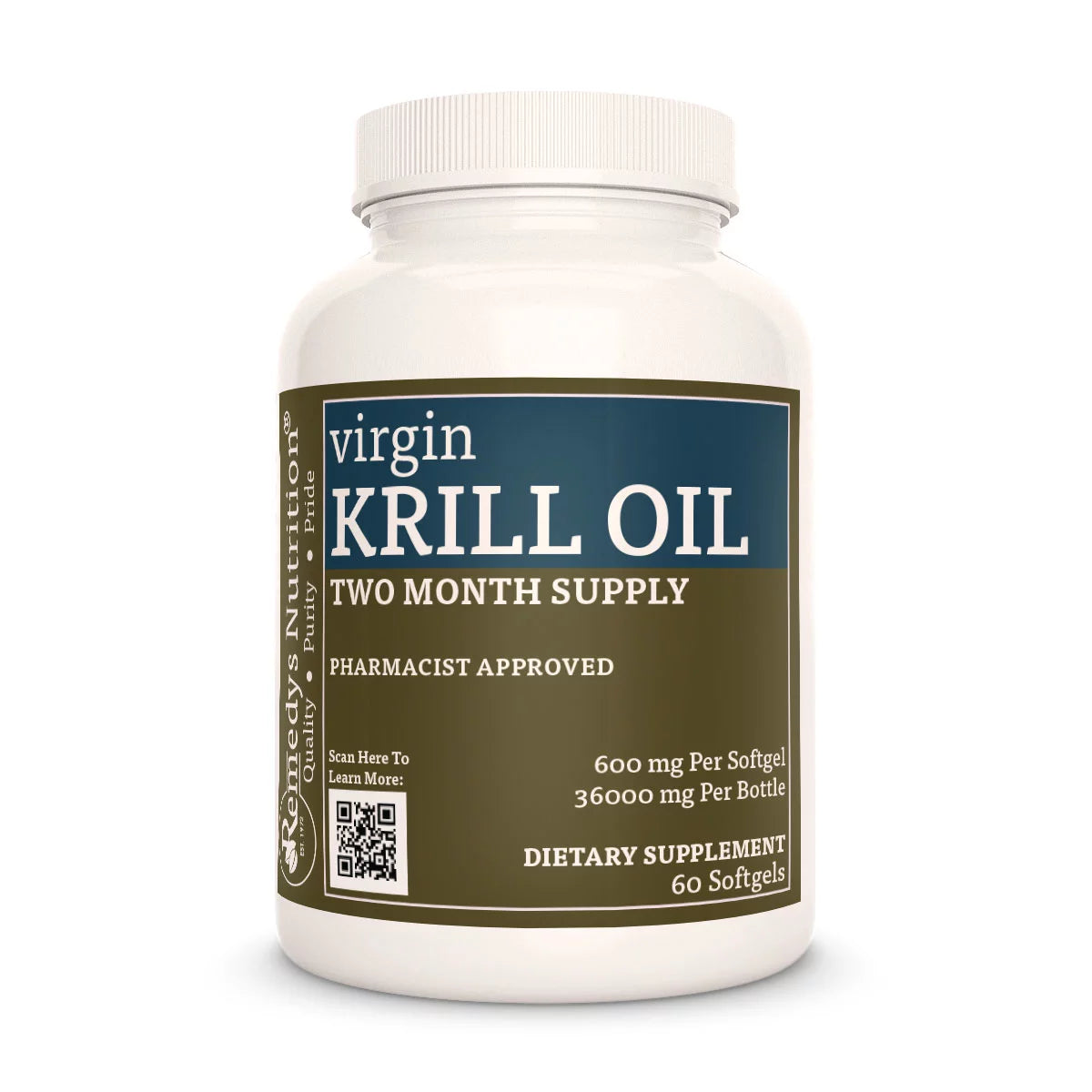
Virgin krill oil is an omega-3 supplement extracted from Antarctic krill (Euphausia superba), a small shrimp-like crustacean at the base of the ocean food chain. Each Remedy's softgel delivers 600 mg of krill oil carrying EPA and DHA, the two long-chain omega-3 fatty acids your body uses for heart, brain, and joint function.
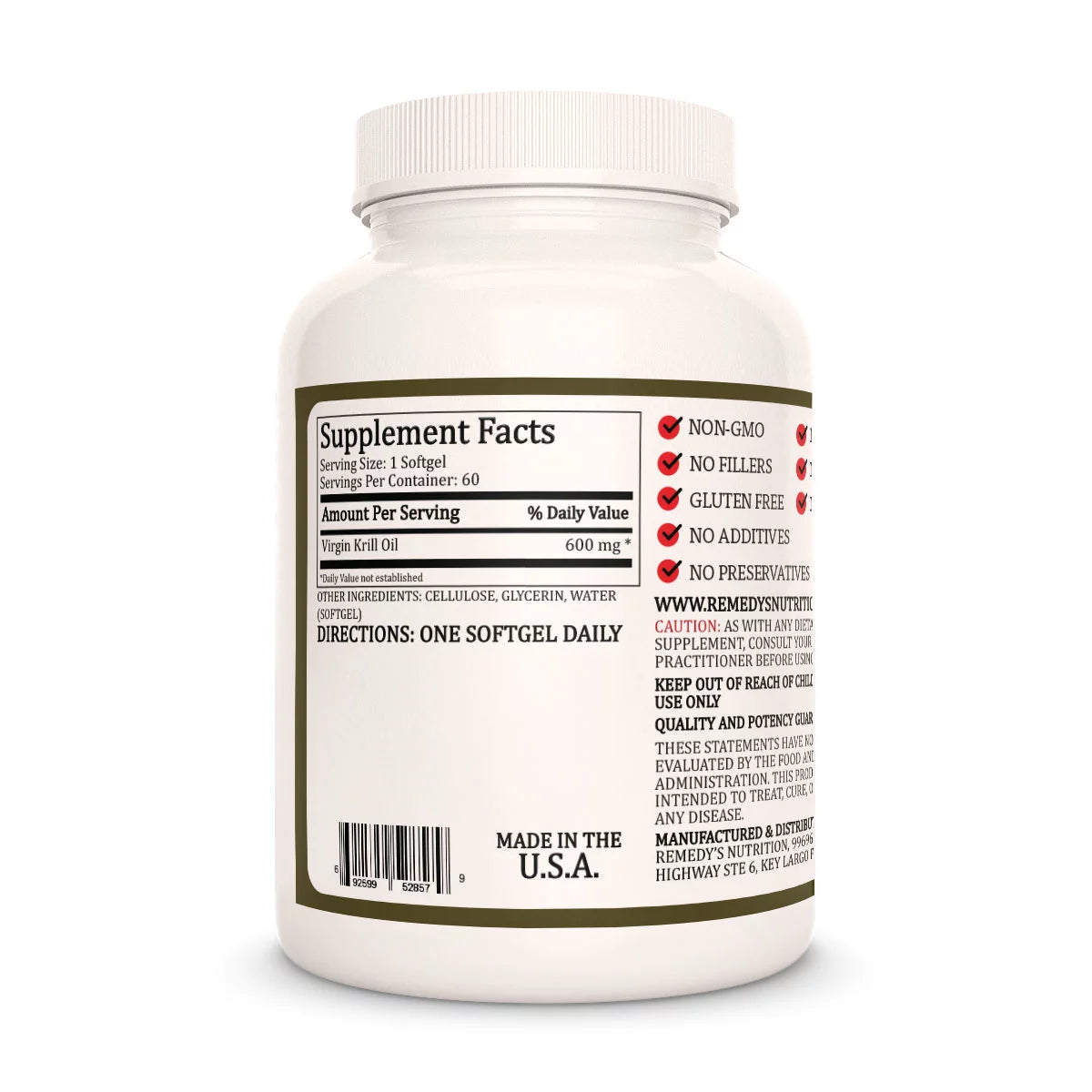
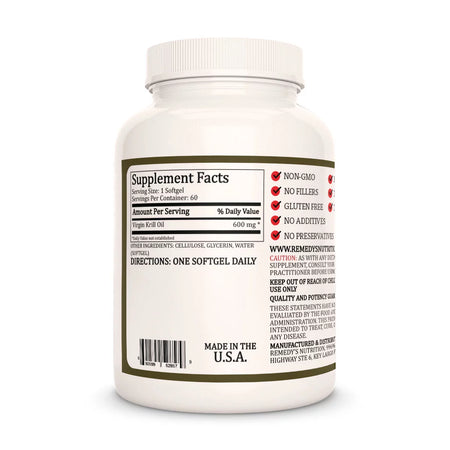
Supplement Facts
Serving size: 1 Softgel. Servings per container: 60.
| Amount Per Serving |
Amount |
% Daily Value |
| Virgin Krill Oil |
600 mg |
* |
* Daily Value not established.
Other ingredients: Cellulose, Glycerin, Water (softgel)
Directions: One softgel daily.
Non-GMO, no fillers, gluten free, no additives, no preservatives. Made in the USA.
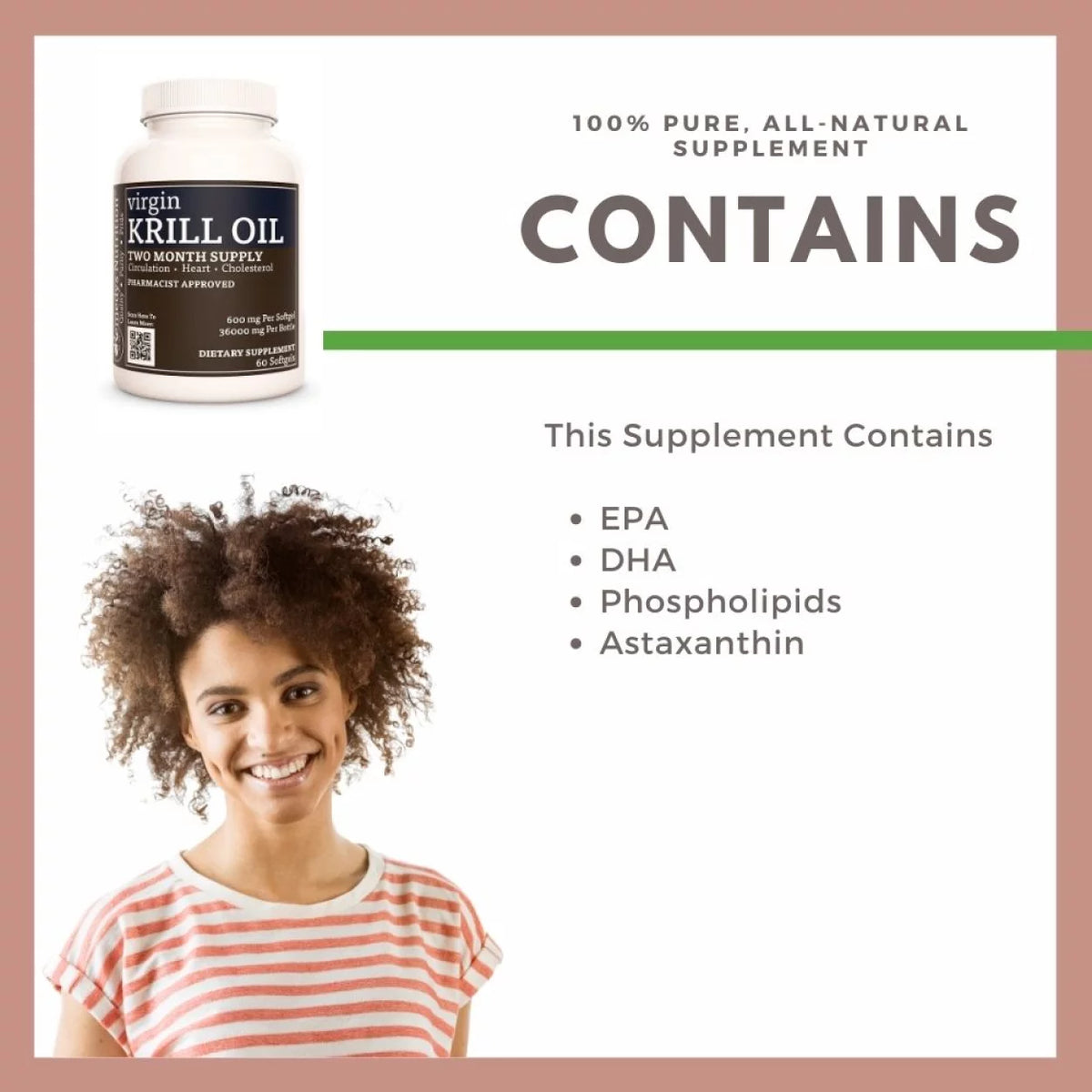
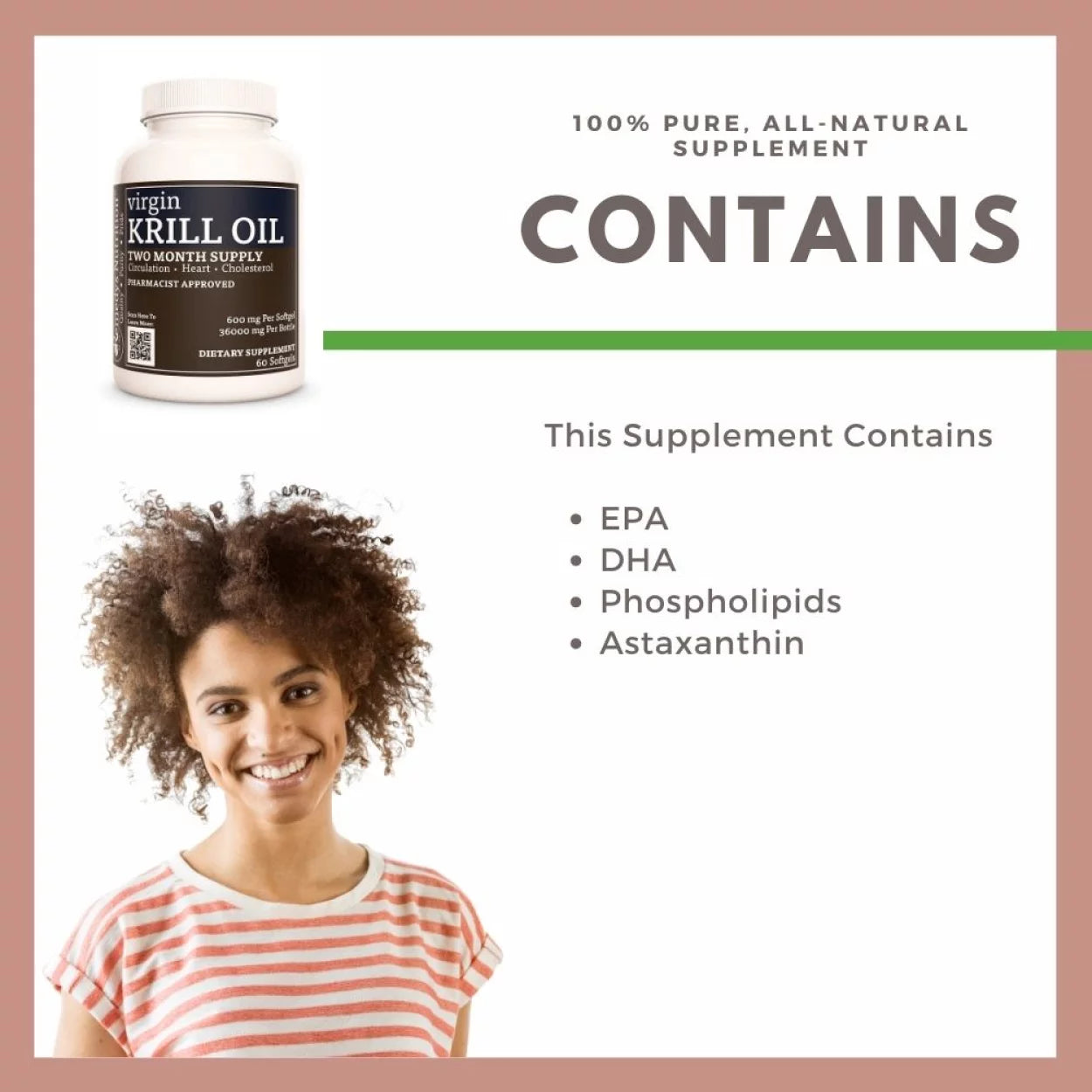
What sets krill oil apart from fish oil is the chemical form of its omega-3s. In krill, EPA and DHA are bound to phospholipids rather than triglycerides, and the oil naturally contains astaxanthin, a red carotenoid antioxidant that helps protect the delicate fatty acids from going rancid.
| Specification |
Detail |
| Krill oil per softgel |
600 mg Antarctic krill oil (Euphausia superba) |
| Omega-3 form |
EPA and DHA bound to phospholipids[1]Krill Oil vs Fish Oil Bioavailability — Vascular Health and Risk Management (2015) View source
|
| Antioxidant |
Naturally occurring astaxanthin |
| Count |
60 softgels (about a 1–2 month supply) |
| Softgel shell |
Bovine gelatin and glycerin (not vegan) |
Because krill oil is a marine concentrate, the per-softgel EPA+DHA load is naturally lower than a large fish oil capsule, and the cost per milligram of omega-3 runs higher. We are transparent about this trade-off below so you can decide whether the phospholipid form and smaller softgel are worth it for you. For a side-by-side breakdown, see our guide on krill oil vs fish oil.
Krill Oil Benefits: What the Evidence Shows
Krill oil delivers the same EPA and DHA studied across the omega-3 literature, so its benefits track with marine omega-3 research as a whole. The strongest, most consistent finding for any omega-3 source is triglyceride reduction; other benefits are real but more modest and population-dependent.
| Benefit Area |
What Research Suggests |
Honest Caveat |
| Triglycerides |
Omega-3 EPA+DHA reliably lower triglycerides in a dose-dependent way[2]Omega-3 and Triglycerides Meta-Analysis — Medicine (2023) View source
|
Strongest, best-established omega-3 effect |
| Omega-3 index |
Krill oil raised the blood omega-3 index in a controlled trial[3]Krill Oil and the Omega-3 Index — Lipids in Health and Disease (2013) View source
|
Single trial; individual response varies |
| Heart events |
Prescription high-dose EPA helped high-triglyceride patients on statins[4]REDUCE-IT: Icosapent Ethyl and CV Risk — New England Journal of Medicine (2019) View source
|
That was prescription EPA, not OTC krill; general supplements show little event reduction |
| Brain & mood |
DHA is a structural component of brain cell membranes |
Cognitive and mood signals are modest and inconsistent |
We will not tell you OTC krill oil prevents heart attacks for everyone — large trials of general-population omega-3 supplements found little or no reduction in cardiovascular events. For the full balanced picture, read our pillar guide on fish oil and omega-3.
How Krill Oil Works: The Phospholipid Form
Omega-3 absorption depends partly on how the fatty acids are packaged. Krill oil carries EPA and DHA on phospholipids, the same molecular building blocks found in your own cell membranes, while standard fish oil delivers them as triglycerides or ethyl esters.
Some studies suggest the phospholipid form may absorb somewhat more efficiently, but the size of that advantage is modest and still debated in the research[5]Omega-3 Bioavailability Review — Progress in Lipid Research (2014) View source. We describe it as a possible edge, not a guaranteed multiplier.
-
Phospholipid carrier — integrates EPA and DHA into a membrane-friendly form[6]Phospholipid Krill Oil — Food & Function (2024) View source
-
Astaxanthin — naturally present antioxidant that helps protect the oil from oxidation
-
No fishy reflux for many — the phospholipid form is often tolerated without the "fish burps" common with triglyceride fish oil
Krill Oil vs Fish Oil: An Honest Comparison
Krill oil and fish oil both deliver EPA and DHA, so the real question is which trade-offs matter to you. The table below uses our own product as one concrete data point rather than inflated claims.
| Factor |
Krill Oil (this product) |
Standard Fish Oil |
| Omega-3 form |
Phospholipid-bound |
Triglyceride or ethyl ester |
| Built-in antioxidant |
Astaxanthin included naturally |
Usually none added |
| Omega-3 per softgel |
Lower (600 mg krill oil) |
Higher (often 1000–1200 mg oil) |
| Cost per mg EPA+DHA |
Higher |
Lower |
| Aftertaste |
Often none |
Fishy reflux common |
If cost per milligram of omega-3 is your deciding factor, a concentrated fish oil wins. If you want a smaller softgel, a built-in antioxidant, and fewer fish burps, krill oil is the better fit. Either way, taking it with food matters more than the form.
Krill Oil for Heart and Triglyceride Support
Heart support is where omega-3 evidence is strongest, specifically for lowering triglycerides[7]Omega-3 and Triglycerides Meta-Analysis — Medicine (2023) View source. People with elevated triglycerides tend to see the clearest changes, while those already in a healthy range see smaller shifts.
Krill oil's EPA and DHA feed into the same pathway. For most people, 1–2 softgels daily with a fat-containing meal is a reasonable maintenance dose. To understand how omega-3s fit into overall cardiovascular care, see our article on omega-3 for heart health. It is worth separating two different heart claims that often get blurred together:
-
Lowering triglycerides — a measurable lab change that omega-3s reliably produce
-
Preventing heart attacks and strokes — a much harder outcome that large OTC omega-3 trials generally have not delivered
The clear win for krill oil is the metabolic marker, not a promise of fewer cardiac events.
Krill Oil for Brain, Joints, and Women's Cycle
Beyond the heart, DHA is a major building block of brain and retinal cell membranes, and EPA participates in the body's inflammatory-resolution pathways. Benefits in these areas are real but generally modest, and clearest in people whose baseline omega-3 intake is low.
-
Brain: DHA supports membrane structure; cognitive benefits are most evident when dietary omega-3 is low
-
Joints: EPA-driven inflammatory resolution may ease mild joint discomfort over 8–12 weeks of consistent use
-
Women's cycle: some users take 2–3 softgels daily across a cycle for comfort; evidence here is preliminary
The brain signal is the most studied of the three. Because DHA concentrates in neural and retinal membranes, omega-3 status correlates with cognitive measures, yet supplementation trials in well-nourished adults show only small effects. The practical takeaway: krill oil is most likely to help brain function in people who eat little oily fish, and least likely to move the needle in those who already eat fish twice a week.
For joints and cycle support, the same honest framing applies. EPA contributes to the resolution phase of inflammation, which is the biological rationale behind the 8–12 week joint protocols, but responses vary widely between individuals. None of these uses replace medical treatment, and effect sizes are personal. Think of krill oil as nutritional support layered on top of a balanced diet, not a cure.
Why Choose Remedy's Virgin Krill Oil
Quality matters with marine oils because the omega-3s are fragile and can oxidize. Oxidized (rancid) fish or krill oil loses potency and can taste off, which is why freshness and a built-in antioxidant are worth paying attention to[8]Over-Oxidized Fish Oils — Foods (2020) View source.
| What You Get |
Why It Matters |
| 600 mg Antarctic krill oil |
Sourced from Euphausia superba at the base of a clean ocean food chain |
| Phospholipid-bound EPA & DHA |
Membrane-friendly form many people tolerate without fishy reflux |
| Naturally occurring astaxanthin |
Built-in antioxidant that helps guard the oil against oxidation |
| Smaller softgel |
Easier to swallow than large 1000–1200 mg fish oil capsules |
| 60 softgels per bottle |
About a 1–2 month supply at 1–2 softgels daily |
Krill Oil Dosage and How to Take It
Take krill oil with a fat-containing meal, because omega-3s are fat-soluble and absorb best alongside dietary fat. Breakfast or lunch works well. The phospholipid form is often tolerated when taken alone, but food still improves uptake and reduces any mild stomach upset. For morning-versus-evening timing and the with-food rule, see our guide on the best time of day to take omega-3.
| Goal |
Suggested Dose |
Timing |
| General wellness |
1 softgel (600 mg) daily |
With breakfast |
| Heart / triglyceride support |
1–2 softgels daily |
Split AM/PM with meals |
| Joint comfort protocol |
2 softgels daily, 8–12 weeks |
With meals |
| Cycle support |
2–3 softgels daily |
With meals across the cycle |
Do not exceed 3 grams of total omega-3 daily without provider guidance. Consistency over weeks matters more than occasional large doses.
Krill Oil Safety and Drug Interactions
Krill oil is well tolerated for most adults, but it is a marine shellfish product with a few specific cautions. Read these before starting, especially if you take medication or have allergies.
| Consideration |
What to Do |
| Shellfish allergy |
Krill is a crustacean; avoid if allergic and choose an algae-based omega-3 instead |
| Blood thinners |
Omega-3 may add to anticoagulant effects; review with your provider first[9]Fish Oil with Warfarin and Bleeding — Nutrients (2016) View source
|
| Pregnancy |
Omega-3 in pregnancy should be used under clinician guidance[10]Omega-3 During Pregnancy — Cochrane Review (2018) View source
|
| Surgery |
Many providers pause omega-3 about 1 week before procedures |
| Storage |
Keep cool and sealed; discard if it smells strongly rancid |
For a fuller breakdown of who should be cautious and how to minimize side effects, see our guide on fish oil side effects and safety.
Frequently Asked Questions
What does krill oil do? +
Krill oil supplies omega-3 EPA and DHA for heart, brain, and joint support. The best-established effect is lowering triglycerides at a combined 600 mg or more of EPA+DHA daily. It also naturally contains astaxanthin, an antioxidant. Other benefits are real but more modest and depend on your baseline omega-3 intake.
How is krill oil different from fish oil? +
Krill oil carries omega-3s on phospholipids and includes natural astaxanthin, while fish oil uses triglyceride or ester forms. Studies suggest the phospholipid form may absorb somewhat better, but the edge is modest and debated. Fish oil costs less per mg of EPA+DHA; krill oil offers a smaller softgel and usually no fishy aftertaste.
How much krill oil should I take daily? +
1 softgel (600 mg) daily covers general maintenance. Heart and triglyceride protocols use 1–2 softgels daily, and joint or cycle support research used 2–3 softgels for 8–12 weeks. Take with a fat-containing meal for best absorption, and do not exceed 3 grams of total omega-3 daily without provider guidance.
When is the best time to take krill oil? +
Take it with a meal that contains fat, ideally breakfast or lunch. Omega-3s are fat-soluble, so dietary fat improves uptake. The phospholipid form tolerates being taken alone better than fish oil, but 1 softgel with food still maximizes absorption and reduces any mild stomach upset.
Can I take krill oil if I have a shellfish allergy? +
No. Krill is a crustacean related to shrimp and crab, so people with confirmed shellfish allergies should avoid it and choose an algae-based omega-3 instead. If you are uncertain about an allergy, talk to your provider before starting; do not take even 1 softgel without clearing it first.
Does krill oil actually absorb better than fish oil? +
Possibly, but the advantage is modest and still debated. Some trials suggest the phospholipid form may raise the omega-3 index efficiently, while reviews note the difference is smaller than often marketed. We do not claim a fixed 2–3x multiplier. Taking it with food influences absorption more than the krill-versus-fish form does.
How long until krill oil works? +
Expect 4–12 weeks for measurable changes. Triglyceride and omega-3 index shifts show up on lab tests around 8–12 weeks. Joint comfort improvements typically emerge over 6–12 weeks. Consistent daily use at 1–2 softgels with food drives results more than short bursts of higher doses.
Is krill oil safe with blood thinners? +
Use caution. Omega-3 can add to the effects of anticoagulants, though 1 study found fish oil did not significantly change INR with warfarin. Always review with your prescriber before combining, and many providers pause omega-3 about 1 week before surgery to reduce bleeding risk.
Does krill oil cause fishy burps? +
Usually less than fish oil. The phospholipid form is often tolerated without the fishy reflux that affects many fish oil users. Taking 1 softgel with a meal further reduces any aftertaste. If burping occurs, splitting the dose or taking it mid-meal typically helps.
Is this krill oil vegan? +
No. The softgel shell uses bovine gelatin and glycerin, and krill itself is an animal source, so it is not suitable for vegans or vegetarians. Plant-based eaters should choose an algae-derived omega-3 supplement, which provides DHA and EPA without any marine animal ingredients.
Can krill oil go rancid? +
Yes. Like all marine oils, krill oil can oxidize over time, which lowers potency and creates an off smell. The naturally occurring astaxanthin helps protect it, but you should still store the 60-softgel bottle cool and sealed and discard it if it smells strongly rancid.
How many softgels are in a bottle? +
Each bottle holds 60 softgels of 600 mg krill oil. At 1 softgel daily that is a 2-month supply; at 2 softgels daily it lasts about 1 month. Higher protocols of 2–3 softgels daily for joint or cycle support will use the bottle faster, so plan reorders accordingly.
You May Also Like
-
Ultimate Omega-3 Fish Oil — concentrated triglyceride-form softgels with about 550 mg EPA+DHA each, at a lower cost per milligram
-
Omega 3-6-9 Softgels — a combined fish, flax, and borage blend for broad fatty-acid coverage in one daily softgel