
Choosing a probiotic supplement comes down to 5 label details: strain names, CFU count, survival through expiry, capsule protection, and cost per dose. Capsules on one shelf can range from 5 billion to 100 billion CFU, yet a bigger number does not guarantee a better product.
This guide shows how to read any probiotic label. It compares four capsules we sell using their real label data and flags who should ask a clinician first. Remedy's Nutrition sells the four products featured here, so treat us as an interested party and check every claim against the bottle.
Quick Answer
A good probiotic supplement names the genus, species and strain of every organism and states CFU through the expiration date. Its capsule should protect live cells. Strain identity matters more than a bigger CFU number. Our 4 capsules are labeled for 1 capsule daily, and people with weakened immune systems should ask a clinician first.
Key Takeaways
- Strain names have 3 parts: genus, species, and a strain code
- Check 1 thing first: CFU guaranteed through the expiration date
- Cost per billion CFU spans $0.02 to $0.06 across our 4 capsules
- A 100 billion CFU blend of unnamed strains cannot be matched to studies
- Weakened immune systems and central lines: ask a clinician before 1 dose
How to Read a Probiotic Label in 6 Steps
A reliable probiotic label gives 6 details: the full strain name, the CFU per serving, the CFU guaranteed at expiry, the delivery system, storage directions, and any added prebiotic fibers. If a label skips the strain code or the expiry guarantee, you cannot match it to published research.
A probiotic is defined as live microorganisms that confer a health benefit in adequate amounts, so the organism and the live count both matter.[1]ISAPP Consensus Statement on the Term Probiotic — Nat Rev Gastroenterol Hepatol 2014 View source Our complete probiotic guide explains what research shows for specific goals.
- Find the full name. Look for genus, species and strain code together, such as Bifidobacterium lactis Bl-04.
- Read the CFU per serving. Confirm whether the number is per capsule or per daily serving.
- Look for a count through expiry. A count at manufacture says little about what remains months later.
- Check the delivery system. Enteric-coated or delayed-release capsules are designed to open after the stomach.
- Follow the storage directions. Some products are shelf-stable, while others need refrigeration.
- Scan the other ingredients. Note prebiotic fibers, fillers and allergens.
Quality reviewers recommend confirming strain identity and viable counts, and having label accuracy checked by an independent laboratory.[2]Probiotic Authentication and Label Accuracy — Front Microbiol 2023 View source Ask any seller, including us, what testing backs the label.
Six terms appear on almost every probiotic label:
- Genus
- The first word of the name, such as Lactobacillus or Bifidobacterium.
- Species
- The second word, such as acidophilus or lactis.
- Strain
- The letter-and-number code, such as La-14, that identifies one specific organism.
- CFU
- Colony-forming units: the count of live cells able to multiply. It measures quantity, not benefit.
- Enteric coating
- A coating designed to dissolve after the stomach rather than in stomach acid.
- Prebiotic
- A substrate that host microorganisms selectively use to confer a health benefit.[3]ISAPP Consensus Statement on the Definition of Prebiotics — Nat Rev Gastroenterol Hepatol 2017 View source
Four Remedy's Nutrition Probiotics Compared
We sell 4 probiotic capsules, from 5 billion to 100 billion CFU per capsule and from $17.99 to $59.99 per bottle. The table uses each listing's own label data, read on November 1, 2026, so you can check every row against the bottle.
| Product | Bottle | CFU per capsule | Strains on the panel | Count through expiry stated? | Prebiotic fibers |
|---|---|---|---|---|---|
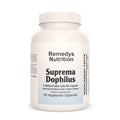
| Suprema Dophilus Probiotic | 60 capsules, $17.99 | 5 billion (listing text) | 8 species named, no strain codes | Not stated | FOS and larch arabinogalactan, amounts not stated |
| Colon Health 50 Billion | 30 capsules, $39.99 | 50 billion | 2 strains with codes: B. lactis Bl-04 (40 billion) and L. acidophilus La-14 (10 billion) | Yes, when stored at room temperature | FOS 25 mg and larch arabinogalactan 25 mg |
| Women's 50 Billion | 30 capsules, $39.99 | 50 billion | 7 strains with codes, grouped as a 40 billion Lactobacillus blend and a 10 billion Bifidobacterium blend | Yes, when stored at room temperature | FOS and larch arabinogalactan, 50 mg combined |
| 100 Billion Probiotic | 30 capsules, $59.99 | 100 billion | Strains listed with codes, one blend total of 421 mg, no per-strain counts | Not stated on the listing | FOS 25 mg and larch arabinogalactan 25 mg |
Two label gaps are worth knowing. Suprema Dophilus names species but no strain codes and states no count through expiry. That means it cannot be matched to specific studies. The 100 Billion capsule lists strain codes but gives one blend total instead of a count per strain.
Colon Health shows the most detail per strain. All 4 listings describe the capsules as enteric coated, but none shows coating test results.

Cost per Capsule, Day and Billion CFU
At 1 capsule daily, cost runs from $0.30 a day with Suprema Dophilus capsules to $2.00 with the 100 Billion capsule. Cost per billion CFU runs the other way, from $0.060 down to $0.020. Neither figure measures quality, so use both only after the strain and label checks.
| Product | Capsules | Price | Cost per capsule | Cost per 30 days | Cost per billion CFU |
|---|---|---|---|---|---|
| Suprema Dophilus Probiotic | 60 | $17.99 | $0.30 | $9.00 | $0.060 |
| Colon Health 50 Billion | 30 | $39.99 | $1.33 | $39.99 | $0.027 |
| Women's 50 Billion | 30 | $39.99 | $1.33 | $39.99 | $0.027 |
| 100 Billion Probiotic | 30 | $59.99 | $2.00 | $59.99 | $0.020 |
Prices are the listed prices on November 1, 2026, before sales, subscriptions and shipping. Cost per billion CFU favors high-count capsules by design, because one dose carries more cells. Whether you need that many is a separate question.
Does a Higher CFU Count Work Better?
Not necessarily, because dose evidence belongs to the specific product tested. In a 28-day trial, adults taking 5 or 25 billion CFU daily of the same 8-strain capsule had no adverse events.[4]Low- and High-Dose Multi-Strain Probiotic Trial — J Diet Suppl 2021 View source
A hospital trial of one 4-strain product found fewer antibiotic-associated diarrhea cases at about 17 billion than at 4 billion CFU.[5]Probiotic Dose-Response in Hospital Patients — Vaccine 2014 View source That result applies to that product and setting.
- Match the strain to the research before you compare counts.
- Use the studied dose for that strain as your reference, not the biggest number on the shelf.
- Treat 50 and 100 billion CFU capsules as choices, not automatic upgrades.
Why Strain Names Matter More Than Total CFU
Benefits shown for one probiotic strain do not automatically apply to others, according to NCCIH.[6]Probiotics: Usefulness and Safety — National Center for Complementary and Integrative Health View source The agency also notes that some products have contained organisms missing from the label, so ask for a strain code.
A 2022 meta-analysis of 13 trials of Bifidobacterium lactis in healthy adults found more frequent bowel movements but no better abdominal pain or bloating.[7]Bifidobacterium lactis and Gastrointestinal Symptoms Meta-Analysis — Nutr Rev 2022 View source Evidence for most strains rests on small, mixed trials, so treat digestive-comfort support* as possible, not guaranteed.
- Colon Health prints strain codes (Bl-04, La-14), so you can search each code for its own research.
- Suprema Dophilus prints species only, so research on a species cannot be assumed to apply.
- If a label shows no strain code, ask the maker for it before you buy.

Capsule Protection, Storage and Shelf Life
Live bacteria can be lost during manufacturing, storage and stomach transit. In a lab study of one freeze-dried strain, enteric-coated capsules stayed intact in simulated stomach fluid but opened in simulated intestinal fluid.[8]Enteric Coated Capsules and Storage of Freeze-Dried L. acidophilus — Heliyon 2024 View source After 6 months, survival depended on the protectant and storage temperature.
- Enteric coating: designed to open after the stomach. All 4 of our listings describe the capsules as enteric coated.
- Expiry guarantee: Colon Health and Women's 50 Billion state their count is provided through the expiration date at room temperature. The other 2 listings do not.
- Shelf-stable or refrigerated: either can work if the label guarantees the count and you follow its storage directions.
- Heat: keep any bottle away from hot cars, radiators and humid bathrooms.
When and How to Take a Probiotic
Unless the label says otherwise, take a probiotic with a meal at a consistent time. A 2025 lab study of Lactobacillus rhamnosus GG found better survival with or after a meal than on an empty stomach.[9]Food Matrix and Timing on Probiotic Survival In Vitro — Foods 2025 View source It tested 1 uncoated strain, so treat it as a hint.
- With antibiotics: many clinicians suggest spacing doses 2 to 4 hours apart. Ask your pharmacist.
- How long: trials typically run 4 to 12 weeks, so judge a product after at least 4 weeks.
- Early gas: mild gas can appear in the first 1 to 2 weeks. Call a clinician if it is severe or persists.
For a fuller comparison of morning, night and with-food schedules, see our guide to when to take probiotics.
Safety: Who Should Ask a Clinician First
Probiotics have a long record of safe use in healthy people. NCCIH reports, however, that the risk of harm is greater with severe illness or compromised immunity. Severe or fatal infections have been reported in premature infants, and the FDA warned health care providers about this in 2023.
| Situation | What to do |
|---|---|
| Weakened immune system (chemotherapy, transplant, advanced HIV) | Ask your clinician before starting any probiotic. |
| Central venous catheter or recent major abdominal surgery | Ask your clinician before starting. |
| Serious illness or a hospital stay | Use only under medical supervision. |
| Premature infants | Never self-directed; the neonatal care team decides. |
| Pregnant or breastfeeding | Ask your provider first. |
| Children | Ask a pediatrician; our capsules are formulated for adults. |
| Taking antibiotics, immunosuppressants or anticoagulants | Ask your pharmacist about timing and interactions. |
Safety outcomes are inconsistently reported in published trials, so a lack of reported harm is not proof of safety in every group.[10]Risk and Safety of Probiotics — Clin Infect Dis 2015 View source For common effects such as gas, read our probiotic side effects guide.
*These statements have not been evaluated by the Food and Drug Administration. The products discussed are not intended to diagnose, treat, cure, or prevent any disease.

Frequently Asked Questions
Can you take too many probiotics? +
Yes, though serious harm is uncommon in healthy adults. Taking well beyond the labeled 1 capsule can cause gas, bloating or loose stools, and safety reviews describe rare infections in susceptible people. Stay at the labeled serving and ask a clinician before combining 2 or more probiotic products.
What is the best time of day to take probiotics? +
No single time is proven best, so consistency matters most. A 2025 lab study of 1 strain found better survival with or after a meal than on an empty stomach, which makes breakfast or dinner a sensible default. Choose 1 time you will repeat every day.
What should you not mix with probiotics? +
Nothing is strictly off limits for most healthy adults, but 3 pairings need care. Antibiotics can kill live cultures, so many clinicians suggest spacing doses 2 to 4 hours apart. Hot liquids can harm cultures if you open a capsule. Ask a pharmacist about immunosuppressant medicines.
How long should you take probiotics? +
Trials typically run 4 to 12 weeks, so give a product at least 4 weeks before judging it. Whether to continue depends on your goal, and evidence for long-term daily use is thinner than for short courses. Review it with your clinician after 8 to 12 weeks.
How long to wait to drink coffee after probiotics? +
No clinical data set a required gap, but a 30-minute wait is a common habit. Capsules are swallowed whole, so brief contact with a warm drink matters little. Heat is the real risk, so do not open a capsule into hot coffee.
Can probiotics support digestive comfort? +
Some strains may support digestive comfort*, but results depend on the strain. A 2022 meta-analysis of 13 trials of Bifidobacterium lactis in healthy adults found more frequent bowel movements but no improvement in abdominal pain or bloating. Mild gas in the first 1 to 2 weeks is possible.
Who should not take probiotics? +
People with weakened immune systems, serious illness or a central venous catheter need clinician approval first. NCCIH says the risk of harm is greater in severe illness, and premature infants (born before 37 weeks) have had severe infections. Ask your provider first if you are pregnant or nursing.
Should children take probiotics? +
Ask a pediatrician first, because our capsules are formulated for adults and children's amounts differ. NCCIH notes that long-term effects of early probiotic use are uncertain. Do not split an adult capsule of 5 to 100 billion CFU for a child.
Does a probiotic need added prebiotic fiber? +
No, but it can help. A prebiotic is a substrate that gut microbes use selectively, and 3 of our 4 formulas list 50 mg of combined FOS and larch arabinogalactan. Dietary fiber from oats, beans and fruit also feeds gut bacteria, so added fiber is a bonus, not proof of quality.
Does a higher CFU count mean a better probiotic? +
No. A 2021 trial gave adults 5 or 25 billion CFU of the same 8-strain mix for 28 days with no adverse events. A 2014 hospital trial favored about 17 billion over 4 billion CFU for 1 four-strain product. Dose evidence is product-specific, so match the studied strain.
Do shelf-stable probiotics work as well as refrigerated ones? +
They can, if the label guarantees the count through the expiration date under the stated storage. A 6-month lab study of 1 freeze-dried strain found survival depended on the protectant used and the storage temperature. Always follow the bottle's directions and keep it away from heat.
Products Mentioned in This Guide
Related Reading
Related Products
Shop Suprema Dophilus Probiotic
60 enteric coated vegan capsules at 5 billion CFU each, a lower-count and lower-cost way to start a daily routine.
Go to ShopShop Colon Health 50 Billion Probiotic
A 30-day bottle with B. lactis Bl-04 and L. acidophilus La-14 plus two prebiotic fibers at 50 billion CFU per capsule.
Go to Shop