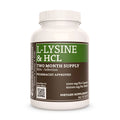

Cold sore trials used 312 mg to 3,000 mg of lysine a day, and labels in that range do not all mean the same thing. Some count the salt, and some count the lysine.
That difference is about 20%, and it decides where a 1,000 mg capsule sits among the trial doses.
Quick Answer: How Much Lysine Should You Take a Day?
There is no official dose. For cold sores, trials at about 1,000 mg a day mostly failed, and the strongest result used 3,000 mg a day for 6 months. A 2019 safety review set 6,000 mg a day as a provisional no-adverse-effect level. Check whether a label counts lysine or lysine HCl, which is about 80% lysine.
Key Takeaways
- 0 official dose exists; cold sore trials used 312 to 3,000 mg.
- Lysine HCl is about 80% lysine, so 1,000 mg gives 800 mg.
- The 1984 trial's 1,248 mg of salt equals about 1,000 mg lysine.
- The strongest cold sore result used 3,000 mg daily for 6 months.
- A 2019 review set 6,000 mg daily as a provisional no-adverse-effect level.
Related Products
Salt Weight or Lysine Weight
Lysine is sold as L-lysine hydrochloride, a salt, for the uses set out in the overview of lysine benefits. The chloride part adds weight but no lysine.
| What the label states | Lysine you actually get | Lysine HCl weight |
|---|---|---|
| 1,000 mg L-lysine HCl | About 800 mg | 1,000 mg |
| 1,000 mg L-lysine | 1,000 mg | About 1,250 mg |
| 1,248 mg L-lysine HCl, the 1984 trial | About 1,000 mg | 1,248 mg |
| 3 x 1,000 mg lysine, the 1987 trial | 3,000 mg | About 3,750 mg |
L-lysine hydrochloride has a molecular weight of 182.65.[1]L-Lysine monohydrochloride, CID 69568, molecular weight 182.65 — PubChem, National Library of Medicine View source Lysine itself has 146.19, so the salt is 80.0% lysine.[2]L-Lysine, CID 5962, molecular weight 146.19 — PubChem, National Library of Medicine View source
What “& HCL” Means on Our Label
Our product name says L-Lysine & HCL. That is the hydrochloride salt form, not a second ingredient.
- & HCL: Lysine hydrochloride, 1 salt.
- Not: Betaine HCl or added stomach acid.
- Label line HCL 25 mcg: Not a separate ingredient with its own dose.
- Open question: Whether 1000 mg counts the salt or the lysine.
In 1,000 mg of lysine hydrochloride, the hydrochloride part weighs about 200 mg, not 25 mcg. So the lysine hydrochloride capsule we sell holds either 800 mg or 1,000 mg of lysine, and we say so until the label is confirmed.

Cold Sore Doses, in Lysine Terms
Converted to lysine, the failed and successful trials sit closer together than labels suggest.
- 1980, failed: 1,000 mg of salt, about 800 mg lysine.
- 1984, failed: 1,200 mg of salt, about 960 mg lysine.
- 1984, worked with diet: 1,248 mg of salt, about 1,000 mg lysine.
- 1987, worked: 3,000 mg of lysine, in 3 doses.
The 1984 trial named its salt dose, and 624 mg a day did not work.[3]Treatment of recurrent herpes simplex infections with L-lysine monohydrochloride — Cutis (1984) View source The 1987 trial stated 1,000 mg of lysine per dose, 3 times a day.[4]Success of L-lysine therapy in frequently recurrent herpes simplex infection — Dermatologica (1987) View source
The full results sit in which cold sore trials worked.
How Much Comes From Food
A supplement adds to a baseline that is already large for most people.
- Requirement: About 30 mg per kg a day, so 2,100 mg at 70 kg.
- A US diet in 1987: About 8,110 mg a day.
- 1 capsule: 800 to 1,000 mg on top.
- Who may fall short: Low-protein and cereal-based diets.
The 30 mg per kg figure is the current recommendation for adults.[5]Dietary Lysine Requirements of Older Adults Stratified by Age and Sex — Journal of Nutrition (2024) View source The 8.11 g intake came from a 16-person dietary study.[6]Assessment of dietary intake of lysine and arginine in patients with herpes simplex — Journal of the American Dietetic Association (1987) View source

The Upper End
No official upper limit exists. The best estimate comes from pooling trials.
- Studies pooled: 71, from 16.8 mg to 17,500 mg a day.
- Duration: 1 to 1,095 days.
- Main effects: Nausea, stomach ache, diarrhea.
- Provisional level: 6,000 mg a day without adverse effects.
That 2019 review found no significant rise in stomach symptoms over control.[7]Safety assessment of L-lysine oral intake: a systematic review — Amino Acids (2019) View source Who should stay below any of this is in the 6,000 mg safety ceiling.
Timing, Food and Splitting the Dose
No trial compared morning with evening, or food with no food.
- Split doses: The 3,000 mg trial gave 1,000 mg 3 times a day.
- Another trial: 400 mg of the salt, 3 times a day.
- With food: A reasonable default if your stomach is sensitive.
- Duration: Positive trials ran 6 to 12 months.
Speak to a Clinician Before Taking Lysine If
- You have kidney disease, or have ever been told your kidney function is reduced
- You are pregnant or breastfeeding; we found 0 trials of lysine supplements in pregnancy
- You take high-dose calcium, or an aminoglycoside antibiotic such as gentamicin
- Your cold sores are frequent, severe, near the eye, or you are immunocompromised
- You have gallbladder or heart disease, which one review flags as a theoretical concern

Frequently Asked Questions
How much lysine should I take to help with cold sores? +
The trials in its favour used about 1,000 mg of lysine with a low-arginine diet, or 3,000 mg a day for 6 months. At about 1,000 mg alone, 3 trials found no benefit.
Should I take 500mg or 1000mg of lysine? +
Neither has strong support for cold sores. 624 mg a day failed in a 1984 trial, and about 1,000 mg failed in others; the best result used 3,000 mg.
Is it safe to take 3,000 mg of lysine at once? +
The 3,000 mg trial split it into 3 doses of 1,000 mg. A 2019 review found mainly stomach symptoms and set 6,000 mg a day as a provisional safe level.
Should you take L-lysine morning or night? +
0 trials compared timing. The 3,000 mg trial dosed 3 times a day, so spreading doses across meals is the pattern with data behind it.
What is the difference between L-lysine and L-lysine HCl? +
L-lysine HCl is the hydrochloride salt, the stable form sold in capsules. It is about 80% lysine by weight, so 1,000 mg holds about 800 mg lysine.
Is lysine or L-lysine better for cold sores? +
On a supplement label they are the same thing. L- names the form the body uses, and at least 3 trials named L-lysine monohydrochloride.
What is the best lysine supplement for cold sores? +
No trial compared brands. Check 3 things: whether the mg counts lysine or the salt, the amount per capsule, and how many capsules reach your dose.
What is the maximum lysine dose per day? +
There is no official limit. A 2019 review of 71 studies proposed 6,000 mg a day as a provisional no-adverse-effect level, based on stomach symptoms.
How long should I take lysine for cold sores? +
The positive trials ran 6 to 12 months of daily use. 0 controlled trials showed benefit from a few days taken during an outbreak.
How many capsules is 3,000 mg? +
Three capsules of 1000 mg, split across the day. If the 1000 mg counts the salt, 3 capsules hold about 2,400 mg of lysine.
Related Reading
Related Products