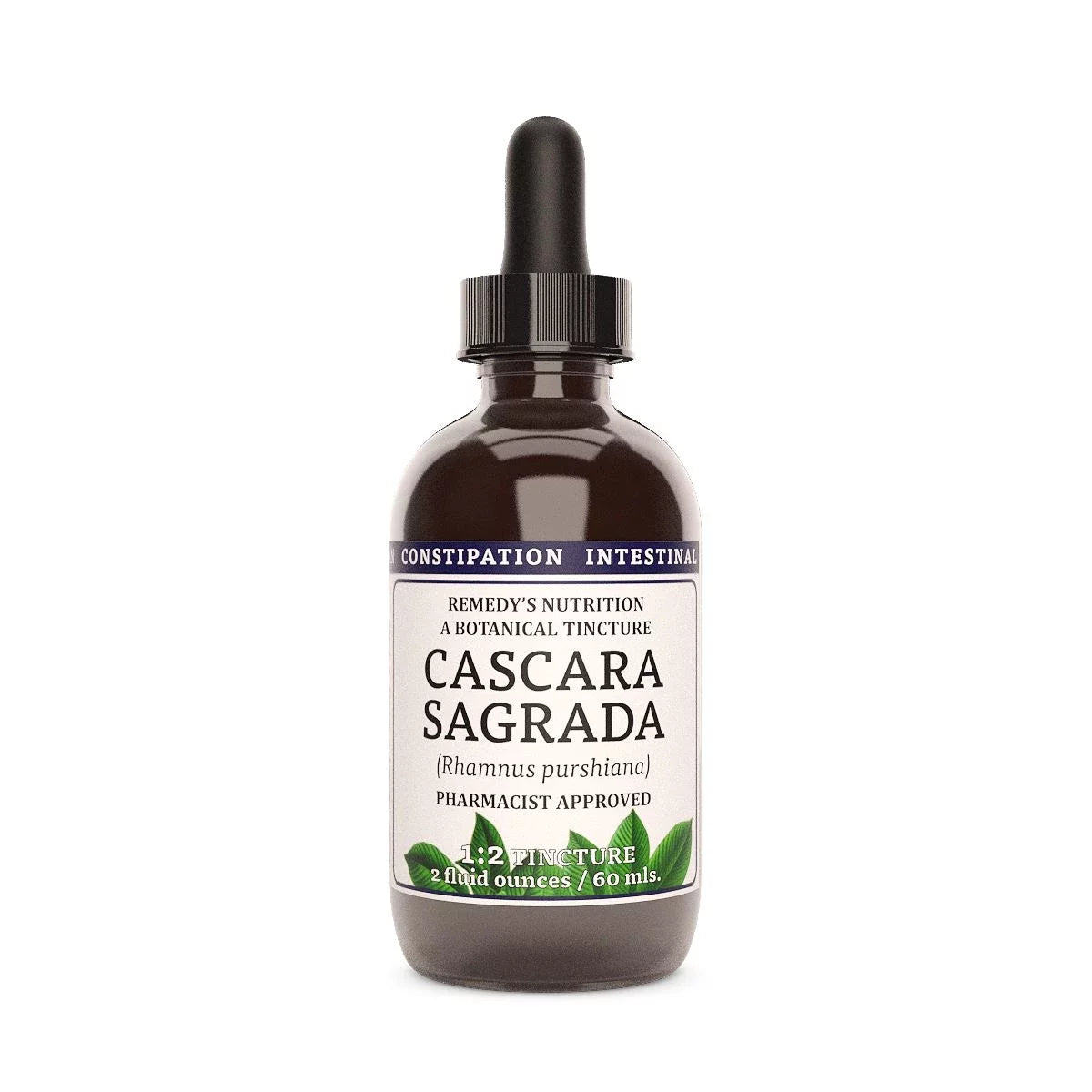
Quick Answer: Cascara Sagrada Tincture
Cascara sagrada tincture is a stimulant herbal laxative made from Frangula purshiana bark used for short-term constipation relief. Take 1 to 2 mL (20 to 40 drops) once at bedtime; effects appear in 6 to 12 hours. Maximum use is 7 days. Absolutely contraindicated in pregnancy, breastfeeding, IBD, and bowel obstruction.
What Is Cascara Sagrada Tincture?
Cascara sagrada tincture is a liquid extract of Frangula purshiana (also classified Rhamnus purshiana) aged bark in 40 to 50% food-grade alcohol. The bark must be aged at least 1 year after harvest because fresh bark contains anthrones that cause severe griping and vomiting. Aged bark contains anthraquinone glycosides — cascarosides A, B, C, D — which are the active mild stimulant laxatives. Each 2 mL dropperful from a 2 fl oz bottle contains a clinically effective dose.
For broader buying advice on bark-based tinctures, see the complete tincture buying guide.
Cascara Sagrada Benefits: Clinical Evidence
Cascara was an FDA-approved over-the-counter laxative ingredient until 2002, when the agency removed it from the OTC monograph due to insufficient submitted safety data — not due to documented harm at typical doses. It remains legal as a dietary supplement and has 100 plus years of medical use. Most clinical use is at 20 to 30 mg of cascarosides, equivalent to 1 to 2 mL of standardized tincture.
| Benefit |
Key Finding |
Reference Dose |
| Occasional constipation relief |
Bowel evacuation within 6 to 12 hours of bedtime dose in 85 to 95% of users |
20 to 30 mg cascarosides (1 to 2 mL) |
| Pre-procedure bowel prep (historical) |
Used for over 60 years in colonoscopy prep before being replaced by polyethylene glycol |
Higher doses, single use |
| Mechanism of action |
Cascarosides reach the colon, are activated by gut bacteria, then stimulate Auerbach plexus — increases peristalsis |
Lab and animal data |
| Stool softening |
Anthraquinones increase water and electrolyte secretion into the colon by 30 to 50% |
Standard tincture dose |
| Onset speed |
Effect predictable at 6 to 12 hours — ideal for evening dosing with morning relief |
Single dose |
| Short-term tolerability |
Well-tolerated for less than or equal to 7 days; 5 to 10% of users report cramping |
1 to 2 mL nightly, max 7 nights |
External research: Cascara sagrada toxicology review (NIH Bookshelf), Anthraquinone laxative review (PubMed), and the FDA OTC laxative monograph history.
Cascara Sagrada for Occasional Constipation
Cascara sagrada tincture is intended for short-term relief of occasional constipation when bulk fibers and osmotic laxatives have not produced a bowel movement within 24 to 48 hours. Take 1 to 2 mL at bedtime; expect a comfortable bowel movement 6 to 12 hours later, typically the next morning. Do not exceed 7 consecutive nights of use — the colon adapts to stimulant laxatives, and dependency can develop over weeks of continuous use.
For ongoing digestive support without stimulant action, consider dandelion root tincture as a gentler bitters herb that supports natural bowel function.
FDA OTC removal note. Cascara was removed from the FDA's OTC laxative monograph in 2002 due to insufficient industry safety submissions, not safety incidents at standard doses. It remains legal as a dietary supplement and is widely used under medical guidance. Limit short-term use only.
Cascara Sagrada vs Senna and Other Stimulant Laxatives
Three plant-based stimulant laxatives are commonly used: cascara sagrada, senna, and aloe latex. All three contain anthraquinone glycosides that act on the colon's nerve plexus, but they differ in potency and tolerability. Cascara is generally considered the mildest and most predictable, with onset at 6 to 12 hours and a 1 in 10 cramping rate. Senna acts in 6 to 12 hours but causes cramping in 15 to 25% of users. Aloe latex is the strongest and least predictable — rarely recommended for self-care.
For users who tolerate one but not another, cascara is often the first choice because of its predictable onset and lower cramping rate. All three share the same 7-day maximum use rule and the same absolute contraindications (pregnancy, IBD, bowel obstruction). Bulk fiber and osmotic laxatives like polyethylene glycol are first-line for ongoing support; stimulants are rescue tools only.
How to Take Cascara Sagrada Tincture
The standard adult dose is 1 to 2 mL (20 to 40 drops) once at bedtime, taken in 4 oz of water or juice. Effects begin in 6 to 12 hours, typically producing a soft, complete bowel movement the next morning. Use only when needed; do not exceed 7 consecutive nights. Drink an extra 16 to 24 oz of water during use to prevent electrolyte loss.
| Use Case |
Dose |
Timing |
Maximum Duration |
| Occasional constipation |
1 to 2 mL (20 to 40 drops) |
Once at bedtime |
7 nights, then 4-week break |
| First-time user (sensitive) |
0.5 to 1 mL (10 to 20 drops) |
Bedtime, with food |
Reassess after 2 nights |
| Travel-related constipation |
1 mL nightly |
3 to 5 night maximum |
Single trip use only |
| NOT for daily maintenance |
0 mL — use fiber instead |
n/a |
Cascara is short-term only |
For label literacy, see reading a tincture label and the beginner herb dosing framework.
Why Choose Remedy's Nutrition® Cascara Sagrada Tincture
| What You Get |
Why It Matters |
| 2 fl oz amber glass bottle |
Approximately 30 single-dose servings — UV-protective glass preserves cascaroside stability |
| Aged bark, not fresh |
Bark aged at least 1 year — fresh bark contains anthrones that cause severe griping and vomiting |
| Food-grade alcohol carrier |
40 to 50% ethanol extracts cascarosides efficiently and acts as a 3+ year preservative |
| Calibrated dropper |
Precise 1 mL doses — no guesswork at the lowest effective amount |
| USA-made, GMP facility |
Meets FDA 21 CFR 111 dietary supplement manufacturing standards |
| Single-herb formulation |
No combined laxatives or fillers — clean ingredient list lets you control dose precisely |
See our capsule vs tincture form comparison.
Safety, Interactions and Contraindications
Absolute contraindications. Do not use cascara sagrada if you are pregnant (any trimester), breastfeeding, have inflammatory bowel disease (IBD, Crohn's, ulcerative colitis), bowel obstruction, appendicitis-like pain, or any undiagnosed abdominal pain. Stimulant laxatives in these conditions can cause perforation or severe complications.
| Concern |
Detail |
| Maximum 7 days |
Stimulant laxatives cause colonic adaptation and laxative dependency after 2 to 4 weeks of continuous use |
| Pregnancy |
Absolute contraindication — cascarosides cross to fetus and may stimulate uterine activity |
| Breastfeeding |
Cascarosides pass into breast milk and may cause infant diarrhea — do not use during lactation |
| IBD, Crohn's, ulcerative colitis |
Absolute contraindication — stimulation can worsen inflammation and cause flares |
| Bowel obstruction or undiagnosed pain |
Absolute contraindication — perforation risk |
| Electrolyte loss |
Repeated use causes potassium and sodium loss — especially risky with diuretics or digoxin |
| Children under 12 |
Not recommended — pediatric stimulant laxative use should be physician-directed only |
| Discoloration of urine |
Harmless yellow-brown or red color from anthraquinone metabolites — not blood; resolves within 24 hours of last dose |
For broader risk context, see stimulant laxative cautions.
Frequently Asked Questions
What does cascara sagrada do for your body? +
Cascara sagrada acts on the colon as a stimulant laxative within 6 to 12 hours of bedtime dosing. The cascarosides reach the large intestine, are converted by gut bacteria into active anthrones, and stimulate the Auerbach nerve plexus. This increases peristalsis and water secretion by 30 to 50%, producing a soft bowel movement.
Does cascara get rid of parasites? +
No clinical trial documents cascara as an antiparasitic agent. The herb is a stimulant laxative that increases bowel movement frequency, which can mechanically clear some intestinal contents, but it does not kill parasites. Use prescription antiparasitics if parasitic infection is confirmed by 1 of the standard 3 stool tests.
What is the homeopathic medicine cascara sagrada used for? +
Homeopathic Cascara Sagrada (typically 6X to 30C dilutions) is used by homeopathic practitioners for chronic atonic constipation and digestive sluggishness. Note: this is different from herbal cascara tincture — homeopathic preparations are diluted past the point of measurable cascaroside content. Our product is a herbal tincture, not homeopathic.
What are the magical uses of cascara sagrada? +
In folk-magical traditions, cascara sagrada bark (the name means "sacred bark" in Spanish) was carried for protection, money draws, and legal matters. These uses are folkloric and have no medical or scientific basis. The bark's only documented medical use is as a short-term laxative for occasional constipation.
How fast does cascara sagrada tincture work? +
Effects appear in 6 to 12 hours after a bedtime dose, with peak action in the early morning. The cascarosides need time to reach the colon and be activated by gut bacteria — this is why a faster-acting laxative like polyethylene glycol works in 30 to 60 minutes by contrast.
Can I take cascara sagrada every day? +
No. Maximum use is 7 consecutive nights, then a 4-week break. Daily use of any stimulant laxative for 2 to 4 plus weeks causes colonic adaptation and laxative dependency. Long-term users may lose normal bowel function. Switch to fiber-based or osmotic laxatives for ongoing needs.
Is cascara sagrada the same as senna? +
Both are anthraquinone-class stimulant laxatives, but they come from different plants: cascara from Frangula purshiana bark, senna from Senna alexandrina leaves and pods. Cascara is generally considered milder and more predictable. Both share the same 7-day maximum use rule.
Why was cascara removed from FDA OTC list? +
In 2002 the FDA removed cascara from the OTC stimulant laxative monograph because manufacturers did not submit the requested safety data within the deadline — not because of documented safety incidents at standard doses. It remains a legal dietary supplement with over 100 years of medical use history.
Can cascara cause dependency? +
Yes — with daily use beyond 2 to 4 weeks. The colon adapts to stimulant laxatives and may lose its ability to function without them. This is reversible if cascara is discontinued for 4 to 8 weeks while increasing fiber and water. Limit use to 7 nights per cycle.
Where does Remedy's cascara come from? +
Our cascara sagrada is sourced from sustainably harvested aged bark and extracted in a GMP-certified facility in the United States. The 2 fl oz bottle contains pure aged-bark tincture with 40 to 50% food-grade ethanol — aged at least 12 months before extraction to remove harmful fresh-bark compounds.
You May Also Like