












Women's 50 Billion™ Probiotic 30 Enteric Coated Vegan Capsules
- Supports Gut Microbiome Balance*
- Promotes Digestive & Immune Wellness*
- High-Potency 50 Billion CFU Formula*


Couldn't load pickup availability
*These statements have not been evaluated by the Food and Drug Administration. This product is not intended to diagnose, treat, cure, or prevent any disease.
What Is Women's 50 Billion™ Probiotic?
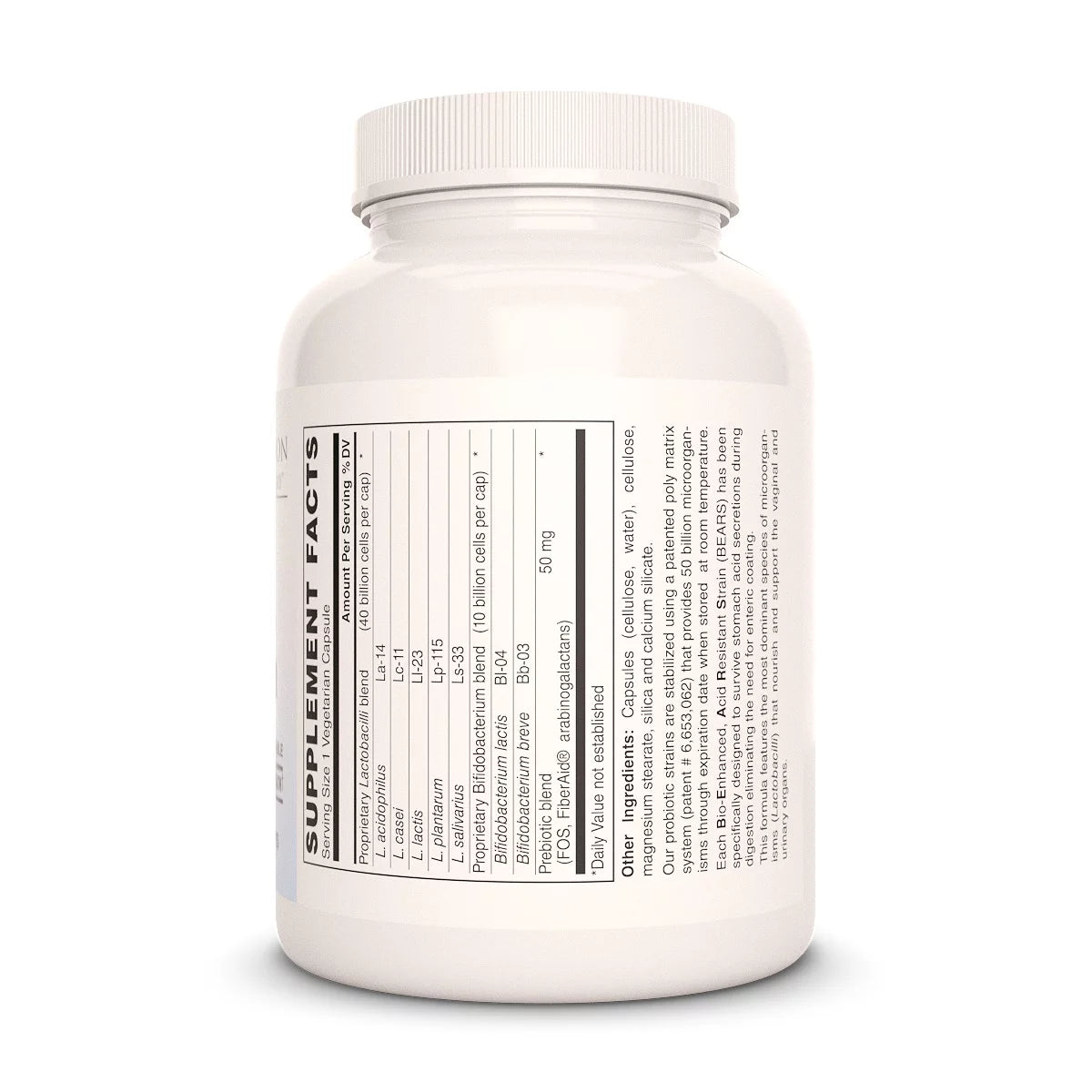
Women's 50 Billion™ Probiotic is a daily multi-strain probiotic supplement designed for women's gut, vaginal, and urinary health. Each enteric-coated vegan capsule delivers 50 billion CFU across 7 well-studied probiotic strains plus prebiotic fiber to feed the bacteria once they reach the gut.
The formula combines 5 Lactobacillus species (acidophilus, casei, lactis, salivarius, plantarum), 2 Bifidobacterium species (lactis, breve), and a prebiotic blend of fructooligosaccharides and larch arabinogalactan. Together they support the 100 trillion microbes already living in your gut.
Quick Facts
50 billion CFU • 7 probiotic strains + prebiotics • Enteric-coated vegan capsules • 30-day supply • No fillers, dairy, gluten, soy, or GMO. For the bigger picture on how probiotics work, see our complete probiotic guide.
Best Probiotic for Women: Why This Formula Works
Women have 2 distinct microbiomes that need support: the gut microbiome (similar across genders) and the vaginal microbiome, which is uniquely dominated by Lactobacillus species at roughly 95% of healthy bacteria. When that balance shifts due to antibiotics, hormones, or stress, recurring yeast infections, BV, and urinary issues become more common.
This formula combines strains studied across more than 30 clinical trials for women's health concerns. The 50 billion CFU dose sits at the upper end of the standard daily range (10 to 50 billion CFU), giving you a meaningful therapeutic dose per capsule rather than a maintenance trickle.
Probiotic Strains: What Each One Does
Strain identity matters more than CFU count. Here is what each of the 7 strains contributes:
| Strain | Primary Job | Best For |
|---|---|---|
| Lactobacillus acidophilus | Vaginal and gut acidity balance | Yeast prevention, digestion |
| Lactobacillus plantarum | Reduces bloating and gas | IBS, bloating, gut comfort |
| Lactobacillus casei | Immune support, antibiotic recovery | Cold and flu resistance |
| Lactobacillus salivarius | Oral and gut barrier support | Oral health, gum balance |
| Lactobacillus lactis | Lactic acid production | Lactose tolerance, gut pH |
| Bifidobacterium lactis | Constipation relief, immunity | Regularity, immune defense |
| Bifidobacterium breve | Anti-inflammatory in colon | Gut lining repair |
| Prebiotic blend (FOS + Larch) | Feeds the strains above | Synbiotic effect |
Probiotics for Vaginal Health
The vaginal microbiome is naturally about 95% Lactobacillus. When that balance drops — from antibiotics, hormonal birth control, douching, or stress — pH rises and yeast or bacterial overgrowth becomes more likely. Recurring yeast infections, bacterial vaginosis (BV), and chronic discharge are 3 common signals.
The good news: oral probiotics actually reach the vaginal canal. The bacteria travel from the gut through the perineum and colonize naturally. You do not need a vaginal suppository for most situations — a daily capsule works. Most women see meaningful change after 4 to 8 weeks of daily use.
| Concern | How Probiotics Help | Timeline |
|---|---|---|
| Recurring yeast infections | Restore Lactobacillus dominance | 4 to 8 weeks |
| Bacterial vaginosis (BV) | Lower vaginal pH back to 3.8–4.5 | 2 to 4 weeks |
| Chronic discharge | Stabilize healthy flora | 4 to 6 weeks |
| Post-antibiotic recovery | Replace bacteria killed by antibiotics | 2 to 4 weeks |
For more women-specific dosing detail, see our guide on probiotics for women.
Probiotics for Urinary Tract Health
Lactobacillus strains in this formula support the urinary tract through 2 mechanisms. They produce lactic acid that creates an unfavorable environment for E. coli (the bacteria behind 80 to 90% of UTIs), and they compete for adhesion sites that pathogens would otherwise occupy.
- Lactobacillus rhamnosus and reuteri are the most studied for urinary balance, with 30+ trials behind them
- Daily use at 25 to 50 billion CFU shows benefit for women with recurring UTIs
- Pair with cranberry for stacked support; the 2 work on different mechanisms
- Not a treatment for an active UTI — see a doctor for that
Probiotics for Gut Health and Bloating
Beyond women-specific concerns, this formula covers everyday gut goals. Bifidobacterium lactis and Lactobacillus plantarum are the workhorses here, both with solid evidence for IBS, bloating, and regularity.
Most women notice these shifts in the first 4 weeks of daily use:
- Less bloating — usually within 2 to 3 weeks
- More regular bowel movements — 1 to 2 weeks
- Reduced gas — 2 to 4 weeks (after a possible 1-week adjustment)
- Steadier energy — 4 to 8 weeks as gut inflammation drops
- Smoother digestion of dairy — from increased lactase activity
For deeper detail on IBS and gut concerns, see our probiotics for gut health and IBS guide.
Probiotics for Menopause and Hormonal Shifts
Estrogen levels drop during menopause, and so do vaginal Lactobacillus populations. This is why postmenopausal women see more vaginal dryness, recurring infections, and urinary changes. A daily probiotic helps maintain Lactobacillus levels independent of hormonal shifts.
Probiotics also support 3 other menopause-related areas:
- Bone density indirectly — better gut absorption of calcium and vitamin D
- Weight management — reduced bloating and steadier digestion
- Mood support — gut-brain axis effects on serotonin precursors
Why Choose Remedy's Women's 50 Billion™
| What You Get | Why It Matters |
|---|---|
| 50 billion CFU per capsule | Therapeutic dose, not a maintenance trickle |
| 7 clinically studied strains | Multi-strain coverage outperforms single-strain for general use |
| Enteric-coated capsules | Protects 90% of bacteria from stomach acid |
| Prebiotic blend included | Feeds the strains immediately — synbiotic effect |
| Vegan, no dairy | Suitable for plant-based diets and lactose-sensitive users |
| No fillers, no GMO | Clean ingredient list with 0 artificial additives |
| 30-day supply | Full clinical study window in 1 bottle |
| Made in USA | Quality control and 3rd-party testing standards |
Dosage: How Much and When
The standard dose is 1 capsule daily. The capsule is enteric-coated, which means it survives stomach acid regardless of timing. That said, here is when most women take it:
| Goal | Daily Dose | Best Timing |
|---|---|---|
| General gut and immune | 1 capsule (50 billion CFU) | With breakfast |
| Vaginal balance | 1 capsule daily | Anytime, consistent |
| Bloating / IBS | 1 capsule daily | Morning, with food |
| Post-antibiotic recovery | 1 capsule daily for 2–4 weeks | 2–4 hr after antibiotic dose |
| Menopausal support | 1 capsule daily long-term | Anytime, consistent |
For more on optimal timing windows, see our guide on when to take probiotics.
Safety and Side Effects
Probiotics are 1 of the cleanest supplement categories on the market. About 80 to 90% of users report no side effects at all. Here is what 10 to 20% may notice in the first 1 to 2 weeks:
| Side Effect | How Common | What to Do |
|---|---|---|
| Mild gas / bloating | 10 to 20% in first 2 weeks | Wait 2 weeks, often resolves |
| Stomach upset | Uncommon | Take with food |
| Mild headaches | Rare; histamine-sensitive users | Discuss with provider |
| Loose stools | Uncommon at 50 billion CFU | Take every other day, then resume |
Talk to a doctor first if you:
- Have a severely weakened immune system (chemo, transplant, advanced HIV)
- Have a central venous catheter or recent major abdominal surgery
- Are pregnant or breastfeeding (generally safe but confirm with your provider)
- Take immunosuppressants or post-transplant medications
What to Pair It With
The probiotic works best when paired with prebiotic fiber from food. Aim for 25 to 35 grams of fiber daily from oats, beans, fruit, vegetables, and whole grains. Other supplements that pair well:
- Cranberry or D-mannose for urinary tract support
- Magnesium glycinate for sleep and gentle digestion
- Vitamin D for immune and bone support
- Calcium with magnesium for bone density during menopause
- Digestive enzymes if you also struggle with food breakdown
The combination of probiotic + prebiotic fiber is called a synbiotic. For details on the difference, see probiotics vs prebiotics.
Frequently Asked Questions
What is the best probiotic for women? +
The best women's probiotic delivers 25 to 50 billion CFU daily and includes Lactobacillus and Bifidobacterium strains studied for women's health. This 50 billion CFU formula combines 7 strains plus prebiotic fiber for synbiotic support across vaginal, urinary, and gut health. Most women see results after 4 to 8 weeks of daily use.
How does this probiotic help vaginal health? +
The Lactobacillus strains travel from the gut through the perineum and colonize the vaginal canal naturally. They restore the 95% Lactobacillus dominance that protects against yeast and BV. Daily oral use at 50 billion CFU has been shown across 30-plus trials to reduce recurring yeast and BV episodes within 4 to 8 weeks.
Can I take this probiotic every day long-term? +
Yes. Daily long-term use is the standard across more than 60 clinical trials. The bacteria you take are largely flushed within 1 to 2 weeks, so daily replenishment is required to maintain benefits. There is no need for cycling. People with weakened immune systems or central venous catheters should consult a doctor first.
How long until I see results? +
Bloating and digestion often improve in 1 to 2 weeks. Vaginal balance and recurring yeast issues take 4 to 8 weeks of daily use. Immune support and steadier energy show at 6 to 8 weeks. Daily consistency matters more than dose size; missing 2 days a week extends the timeline by 30 to 50%.
Should I take it in the morning or at night? +
Either works because the capsule is enteric-coated and bypasses stomach acid. Morning with breakfast is the most common choice and easiest to remember. Evening also works. The 1 rule that does matter: take it at the same time each day for at least 4 weeks to build a steady gut population.
Can I take it on an empty stomach? +
Yes, because the enteric coating protects the bacteria from stomach acid. With non-coated probiotics, an empty stomach kills 80 to 90% of the bacteria within minutes. Enteric-coated capsules like these reach the intestines intact, so timing is flexible. With food still works fine and may reduce any first-week stomach sensitivity.
Can I take this with antibiotics? +
Yes, with 1 timing rule: space the probiotic 2 to 4 hours apart from each antibiotic dose. Otherwise the antibiotic kills the live bacteria you just swallowed. Continue the probiotic for at least 2 weeks after finishing the antibiotic course to help your gut and vaginal flora recover.
Is it safe during pregnancy? +
Probiotics at 10 to 50 billion CFU daily are generally considered safe during pregnancy, and some studies suggest they may reduce the risk of childhood eczema when taken in the third trimester. Always confirm with your prenatal care provider before starting any supplement during pregnancy or breastfeeding.
Will it cause bloating? +
Some women experience mild bloating in the first 1 to 14 days as the gut adjusts to new bacterial species. About 10 to 20% of new users notice this. It typically resolves within 2 weeks. If bloating persists past that or gets noticeably worse, take the capsule every other day for 1 week then resume daily.
Why is enteric coating important? +
Stomach acid sits at pH 1.5 to 3.5, acidic enough to kill 80 to 90% of unprotected probiotic bacteria within minutes. Enteric-coated capsules dissolve only after they exit the stomach, delivering more than 90% of the live bacteria to the intestines where they can colonize. This is why CFU count alone is meaningless without protection.
What does 50 billion CFU mean? +
CFU stands for "colony-forming units," which is how live probiotic bacteria are counted. 50 billion CFU means 50 billion live bacteria per capsule. The standard daily range for women is 10 to 50 billion CFU, with 50 billion being the upper end of the therapeutic range used in most women's health trials.
Does it need refrigeration? +
No. This formula is shelf-stable for up to 24 months when stored at room temperature in a cool, dry place away from direct sunlight. The enteric coating and freeze-drying process keep the bacteria viable without refrigeration. Avoid leaving the bottle in a hot car or near radiators above 75°F (24°C).
Can men take this probiotic? +
Yes. While the formula is optimized for women's vaginal and urinary balance, the 7 strains and prebiotic fiber also support gut, immune, and antibiotic-recovery goals that apply to anyone. Men taking it for general gut health get the same digestive benefits at 1 capsule daily for 4 to 8 weeks.