What L-Carnitine Is
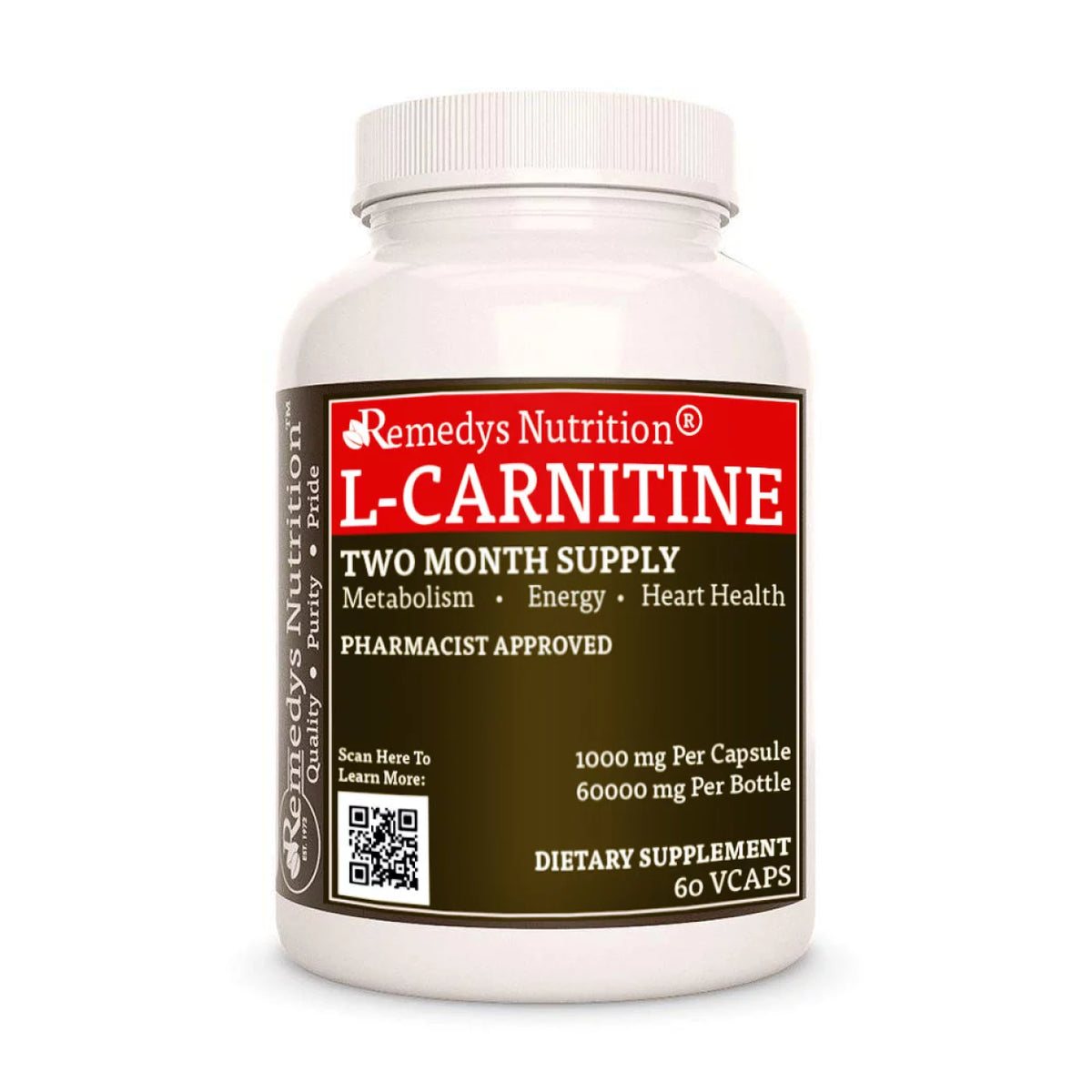
L-carnitine is a compound your body builds from the amino acids lysine and methionine, and its job is to carry long-chain fatty acids into mitochondria so they can be burned for energy. Remedy's L-Carnitine supplies 1000 mg per vegan capsule, with 60 capsules per bottle, as a single ingredient.
It is one of the most heavily researched compounds in this shop, and that research points two ways.
-
1000 mg per capsule: Single-ingredient L-carnitine.
-
60 capsules: Two months at 1 daily.
-
What it does: Transports fatty acids into mitochondria.
-
Where else you get it: Your own liver and kidneys, plus red meat.
The full evidence map is in our L-carnitine overview.
Supplement Facts
Serving size: 1 Vegan Capsule. Servings per container: 60.
| Amount Per Serving |
Amount |
% Daily Value |
| L-Carnitine |
1000 mg |
* |
* Daily Value not established.
Other ingredients: Cellulose, Glycerin, Water (vegan capsule)
Directions: One capsule daily, with food.
Made in the USA.
What the Evidence Actually Shows
Rather than print a benefits list, we would rather print the size of the file behind it. These counts came off PubMed and anyone can rerun them.
| What PubMed holds on carnitine |
Count |
| Records mentioning carnitine |
20,321 |
| Records tagged as human |
9,324 |
| Randomized or clinical trials |
991 |
| Systematic reviews or meta-analyses |
251 |
| Papers on trimethylamine or TMAO |
539 |
Four separate meta-analyses have pooled the weight question. The 2017 analysis covered 9 trials and 911 adults of adequate methodological quality.[1]The effect of (L-)carnitine on weight loss in adults: a systematic review and meta-analysis of randomized controlled trials — Obesity Reviews (2017) View source Both 2021 reviews added dose-response modelling because a single pooled average was hiding wide variation between studies.[2]Effects of l-carnitine supplementation on weight loss and body composition: A systematic review and meta-analysis of randomized controlled trials — Clinical Nutrition ESPEN (2021) View source
The Half Most Sellers Skip
There are 539 papers on a pathway that belongs on every carnitine page, and it appears on almost none of them.
-
What happens: Gut bacteria convert carnitine into trimethylamine.
-
What that becomes: TMAO, in the liver.
-
What TMAO did in mice: Accelerated atherosclerosis.
-
What was measured in people: Omnivores produce far more of it than vegans.
The distinction matters and we keep it: the atherosclerosis was in mice, while the difference in TMAO production between omnivores and vegans was measured in humans.[3]Intestinal microbiota metabolism of L-carnitine, a nutrient in red meat, promotes atherosclerosis — Nature Medicine (2013) View source The whole question is taken apart in L-carnitine side effects and TMAO.
Which Form This Is
L-carnitine and acetyl-L-carnitine sit next to each other on every shelf and are not interchangeable.
-
This product: Plain L-carnitine.
-
What the weight meta-analyses used: Plain L-carnitine, in all 4.
-
Acetyl-L-carnitine: A different molecule, studied for different endpoints.
-
Do we stock it: No.
The comparison is in L-carnitine vs acetyl-L-carnitine.
How to Use It
Trials have used roughly 1 to 3 grams a day, which makes this one of the few supplements where a real range can be quoted.
-
Our label: 1 capsule daily, with food.
-
Per bottle: 60 capsules, which is 2 months.
-
Minimum useful trial: 8 weeks, in most pooled studies.
-
Review point: 12 weeks, using body composition rather than scale weight.
Formats are compared in L-carnitine dosage and forms.
Safety and Who Should Be Careful
Tolerability across 991 trials is undramatic, and the exclusions are specific rather than general.
| Situation |
Position |
| Kidney disease or dialysis |
Ask first, carnitine handling changes entirely |
| Taking warfarin |
Ask first, carnitine has been reported to affect it |
| Seizure disorder |
Ask first, this is a standard label caution |
| Underactive thyroid |
Ask first, carnitine may blunt thyroid hormone action |
| Pregnant or breastfeeding |
Avoid, the trials give no guidance |
Reported side effects are mild and mostly digestive, with a fishy body odour appearing in some people at higher doses because of the same trimethylamine step described above.
What We Do Not Claim
Several things are commonly said about carnitine that we will not repeat.
-
We do not call it: A fat burner.
-
We do not claim: That it works without a calorie deficit.
-
We do not claim: That it treats infertility.
-
We do not claim: That it improves endurance or power.
The fertility research is real and it mostly measures sperm parameters rather than pregnancy, which is a distinction we keep in L-carnitine and male fertility.
Why Choose Remedy's L-Carnitine
No trial makes one carnitine better than another, so the honest differentiators are the form, the amount and what the page admits to.
-
Plain L-carnitine: The form the weight meta-analyses used.
-
1000 mg: Inside the range the trials used.
-
Single ingredient: 0 other actives, no proprietary blend.
-
Both halves stated: Including the TMAO pathway.
The training angle is in L-carnitine for exercise and endurance.
Frequently Asked Questions
What does L-carnitine do? +
It carries long-chain fatty acids into mitochondria so they can be burned. That is 1 transport job, not a metabolism booster.
Does L-carnitine burn fat? +
Not on its own. 4 meta-analyses find a modest effect on weight, and the reviewers describe the clinical findings as inconsistent.
How much is in a capsule? +
1000 mg of L-carnitine, with 0 other active ingredients. There are 60 capsules per bottle.
How much should I take? +
Trials used roughly 1 to 3 grams daily. Our capsule sits at the lower end of that range.
What is TMAO? +
A compound gut bacteria help produce from carnitine, covered by 539 papers. In mice it accelerated atherosclerosis.
Is this acetyl-L-carnitine? +
No. This is plain L-carnitine, which is the form all 4 weight meta-analyses used.
How long does 1 bottle last? +
Sixty capsules is 2 months at 1 capsule daily.
Should I take it with food? +
With food is the safer default, because the most common complaint is 1 of mild stomach upset.
Does it work without exercise? +
0 trials tested that. Every study in this literature ran alongside diet or exercise.
Is the liquid different? +
Same compound, different format. The capsule gives a fixed 1000 mg, the liquid lets you adjust in smaller steps.
You May Also Like