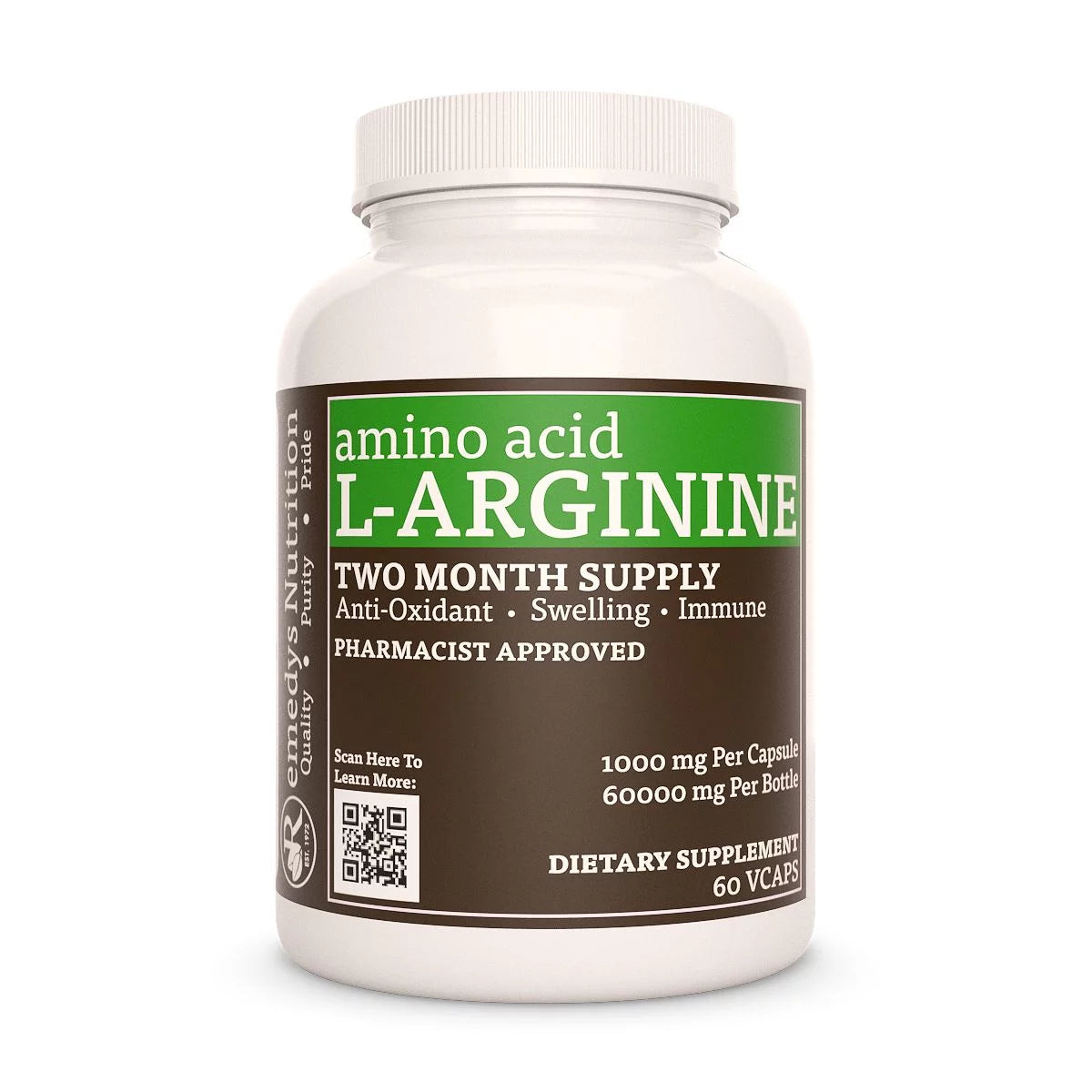
What Is L-Arginine?
L-arginine is a conditionally essential amino acid and the direct substrate your body uses to make nitric oxide, the signalling gas that tells blood vessels to relax and widen.[1]Clinical Pharmacology of L-Arginine — Annu Rev Pharmacol Toxicol (2001) View source A typical mixed diet supplies 4 to 6 grams per day, which is why clinical trials use supplemental doses of 3 to 6 grams on top of food to move nitric oxide output measurably.
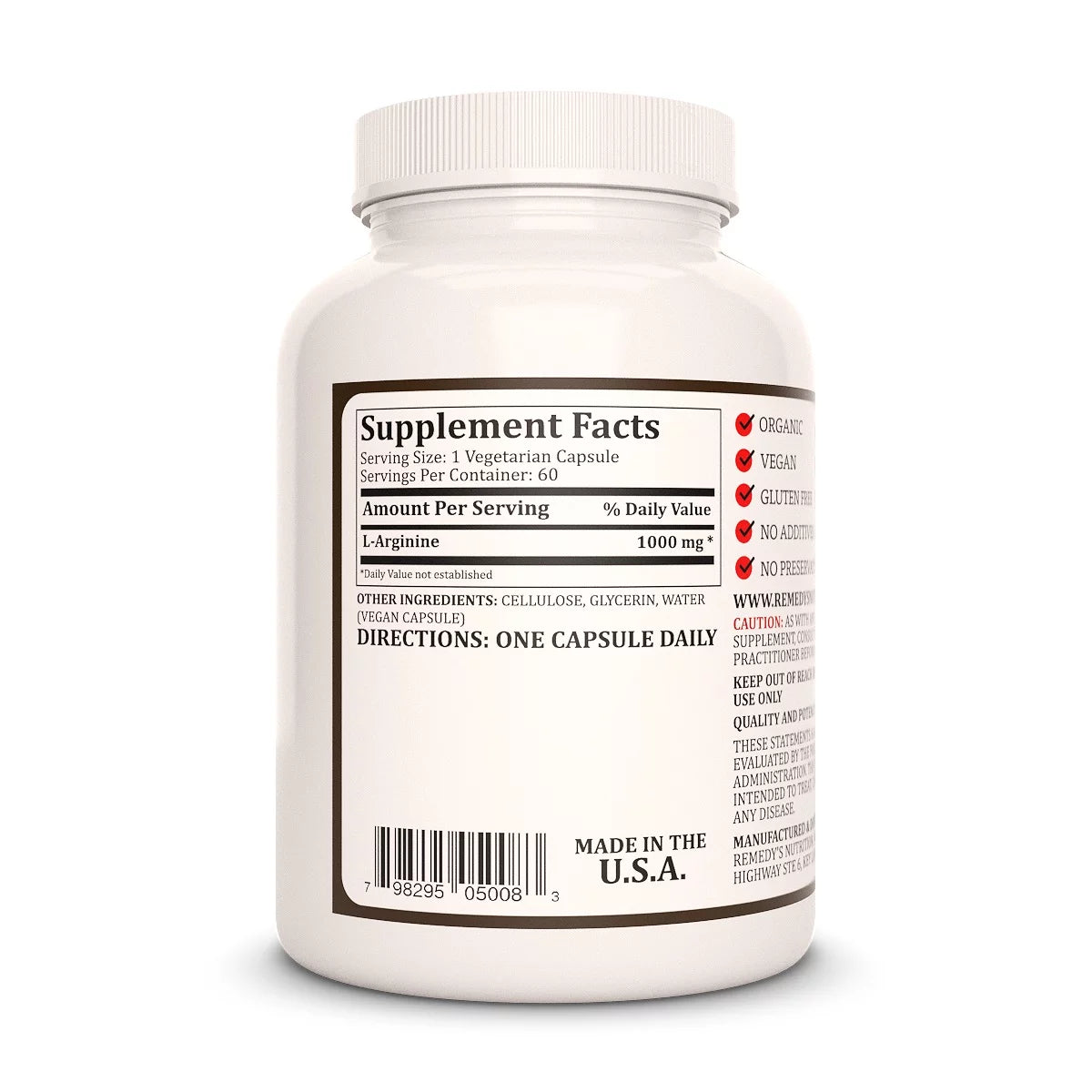
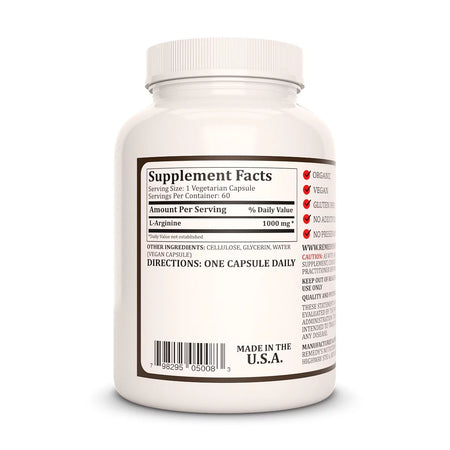
Supplement Facts
Serving size: 1 Vegetarian Capsule. Servings per container: 60.
| Amount Per Serving |
Amount |
% Daily Value |
| L-Arginine |
1000 mg |
* |
* Daily Value not established.
Other ingredients: Cellulose, Glycerin, Water (vegan capsule)
Directions: One capsule daily.
Organic, vegan, gluten free, no additives, no preservatives. Made in the USA.
This is a single-ingredient amino acid product: 1000 mg of L-arginine HCl per vegan capsule, 60 capsules per bottle, with no proprietary blend and no undisclosed fillers. If you want a multi-pathway formula that also covers the dietary nitrate route, see Nitric Oxide Surfer instead.
L-Arginine Benefits: Clinical Evidence
L-arginine benefits are strongest where nitric oxide production is already impaired: older adults, elevated blood pressure, and metabolic conditions. The table summarises what randomized human trials have actually measured, with the dose each result came from.
| Benefit Area |
Key Clinical Finding |
Dose Used in Trials |
| Blood Pressure |
Systolic reduced 5.4 mmHg and diastolic 2.7 mmHg across 11 randomized, double-blind, placebo-controlled trials[2]L-Arginine and Blood Pressure Meta-Analysis — Am Heart J (2011) View source
|
4–24 g/day, 4–24 weeks |
| Vasodilation |
Oral dosing produced measurable peripheral vasodilation, with plasma arginine rising several-fold within 60–90 minutes[3]L-Arginine Pharmacokinetics in Healthy Humans — Br J Clin Pharmacol (1998) View source
|
6 g single oral dose |
| Exercise Tolerance |
Acute dosing reduced the oxygen cost of moderate-intensity exercise and extended high-intensity tolerance[4]Acute L-Arginine and Exercise Tolerance — J Appl Physiol (2010) View source
|
6 g, 60 min pre-exercise |
| VO2max |
Systematic review found gains concentrated in untrained and recreationally active people rather than elite athletes[5]L-Arginine and VO2max Systematic Review — Clin Nutr ESPEN (2021) View source
|
1.5–20 g/day |
| Erectile Function |
High-dose oral L-arginine improved erectile function in 31% of men with low baseline nitric oxide markers[6]L-Arginine for Erectile Dysfunction — BJU Int (1999) View source
|
5 g/day, 6 weeks |
For the full breakdown of which benefits hold up and which are overstated, read our guide to what L-arginine is good for.
How L-Arginine Produces Nitric Oxide
Nitric oxide synthase (NOS) converts L-arginine into nitric oxide and citrulline inside the endothelial cells lining every blood vessel. More substrate available to that enzyme means more nitric oxide released, which relaxes vascular smooth muscle and lowers resistance to flow.
-
Substrate — L-arginine is the only amino acid NOS can use to make nitric oxide.
-
Competition — the enzyme arginase diverts arginine into the urea cycle instead.
-
Inhibition — ADMA, a naturally occurring molecule, blocks NOS and rises in cardiovascular disease[7]ADMA and Endothelial Dysfunction — Br J Pharmacol (2012) View source
-
Practical result — supplementation helps most when arginine availability is the limiting step.
That mechanism is covered in more depth in our overview of how nitric oxide supplements work.
L-Arginine for Blood Pressure and Circulation
Blood pressure is the benefit with the largest pooled dataset behind it. Averaged across 11 randomized controlled trials, oral L-arginine lowered systolic pressure by 5.4 mmHg and diastolic by 2.7 mmHg, an effect size comparable to a single lifestyle intervention rather than a medication.
-
Best responders — adults with systolic readings above 130 mmHg at baseline.
-
Weak responders — healthy adults already under 120/80.
-
Effective dose — 4 to 6 g/day, split across 2 or 3 servings.
-
Timeline — judge results at 8 weeks, not at 2.
Our article on does L-arginine lower blood pressure goes through the trial-by-trial detail.
L-Arginine for Exercise Performance and Pump
The exercise evidence is real but narrower than pre-workout marketing implies. A 6-gram acute dose reduced the oxygen cost of moderate-intensity work and extended high-intensity tolerance, meaning the same effort demanded less oxygen.
| Training Type |
Expected Effect |
Evidence Strength |
| Endurance, 5–30 min efforts |
Lower oxygen cost, longer time to exhaustion |
Strongest |
| Repeated high-intensity sets |
Perceived pump, faster between-set recovery |
Moderate |
| Maximal strength (1RM) |
Little to no change |
Weak |
| Elite athletes |
Minimal; nitric oxide output is already efficient |
Weak |
The training-context detail sits in our review of L-arginine for exercise and pre-workout.
L-Arginine Benefits for Men
Erectile tissue depends on the same nitric oxide pathway as the rest of the vascular system, which is why L-arginine has been studied for erectile function specifically. Results scale with dose and with how impaired baseline nitric oxide production is.
-
5 g/day improved erectile function in 31% of men with abnormal nitric oxide markers, versus 12% on placebo.
-
1.5 g/day alone performed no better than placebo, so low doses are not a shortcut[8]L-Arginine First-Line ED Treatment — Urol Int (1999) View source
-
1.7 g arginine plus 80 mg pycnogenol restored function in 92.5% of participants by month 3 in one open trial[9]Pycnogenol and L-Arginine for ED — J Sex Marital Ther (2003) View source
-
Never stack with sildenafil or tadalafil without medical advice; both amplify the same pathway.
L-Arginine Benefits for Women
Women were underrepresented in the early cardiovascular trials, but the mechanism does not differ by sex. Estrogen itself upregulates endothelial nitric oxide synthase, so supplementation adds to an already-active pathway in premenopausal women and matters more after menopause when that support falls away.
-
Circulation — the same 4 to 6 g/day range applies; there is no separate female dose.
-
Cold hands and feet — a common reason women try it, driven by peripheral vasodilation.
-
Post-menopause — the group most likely to notice a change, as eNOS support declines.
-
Pregnancy — only under the direction of your obstetric provider.
L-Arginine vs L-Citrulline: Which Precursor to Choose
L-citrulline converts to arginine in the kidneys and escapes the arginase and first-pass metabolism that removes much of an oral arginine dose.[10]L-Citrulline vs L-Arginine Pharmacokinetics — Br J Clin Pharmacol (2008) View source That makes citrulline more efficient per gram for plasma arginine, while arginine keeps the deeper blood pressure dataset.
| Criterion |
L-Arginine |
L-Citrulline |
| Blood pressure evidence |
11 pooled randomized trials |
Smaller dataset, mainly arterial stiffness at 5.6 g/day[11]L-Citrulline and Arterial Stiffness — Br J Nutr (2011) View source
|
| Plasma arginine per gram |
Lower — heavy first-pass loss |
Higher — bypasses arginase |
| Training output |
Oxygen cost and endurance |
Reps to failure up 53% at 8 g citrulline malate[12]Citrulline Malate and Resistance Exercise — J Strength Cond Res (2010) View source
|
| GI tolerance |
Loose stools common above 10 g/day |
Few complaints at matched doses |
| Combined |
1 g of each raises plasma arginine more than 2 g of arginine alone[13]Combined L-Arginine and L-Citrulline — Biol Pharm Bull (2017) View source
|
The full head-to-head is in our comparison of L-arginine vs L-citrulline for nitric oxide.
Foods High in L-Arginine vs Supplementation
Food covers your baseline requirement comfortably. Reaching a studied 3 to 6 gram supplemental dose from diet alone is where it stops being practical, as the per-serving numbers below show.
| Food (100 g) |
Approx. L-Arginine |
To reach 3 g |
| Pumpkin seeds |
~5.3 g |
~57 g of seeds (~330 kcal) |
| Peanuts |
~3.5 g |
~86 g (~490 kcal) |
| Soybeans (dry) |
~2.6 g |
~115 g |
| Turkey breast |
~1.9 g |
~158 g |
| Chicken breast |
~1.4 g |
~215 g |
| This product |
1000 mg per capsule |
3 capsules, 0 extra calories |
Why Choose Remedy's L-Arginine HCl
The main thing that separates arginine products is not the molecule, it is whether the label tells you how much you are getting. Everything here is single-ingredient and disclosed.
| What You Get |
Why It Matters |
| 1000 mg per capsule |
Reaching a 3–6 g trial dose takes 3 to 6 capsules, not a guess |
| L-arginine HCl form |
The form used in nearly all the cited trials; about 87% arginine by weight |
| Single ingredient |
No proprietary blend hiding the arginine amount behind other powders |
| Vegan capsule |
No gelatin, suitable for plant-based and vegetarian diets |
| 60 capsules |
20 days at 3 g/day, or a 30-day run at 2 g/day for tolerance testing |
| Made in the USA |
Produced in a facility following current Good Manufacturing Practices |
L-Arginine Dosage and Timing
Dose and timing both matter. Plasma arginine peaks 60 to 90 minutes after a serving and returns toward baseline within about 4 hours, so a single morning capsule does not cover an evening session.
| Goal |
Daily Dose |
Timing |
Time to Effect |
| Blood pressure and circulation |
4–6 g (4–6 capsules) |
Split morning and evening |
4–8 weeks |
| Pre-workout pump |
3–6 g (3–6 capsules) |
30–60 min before training |
Same session |
| Endurance sessions |
6 g (6 capsules) |
60–90 min before |
Same session |
| Starting out |
3 g (3 capsules) |
With water, split if needed |
Assess tolerance over 7 days |
| Upper limit |
10 g without medical guidance |
Always split |
Observed safe level ~30 g/day[14]Risk Assessment for L-Arginine — Regul Toxicol Pharmacol (2008) View source
|
Take it with water rather than a large protein meal, which slows absorption and blunts the peak. Full titration protocols are in our guide to how much L-arginine per day.
Safety, Side Effects and Drug Interactions
L-arginine is well tolerated at the doses used in research, and reviews of athlete populations found no kidney toxicity at intakes up to 30 g/day in healthy people.[15]Renal Safety of L-Arginine — Nutrients (2018) View source The interactions below matter more than the raw dose.
| Consideration |
Why It Matters |
What To Do |
| Recent heart attack |
9 g/day for 6 months raised mortality in a 153-patient post-infarction trial[16]L-Arginine in Post-MI VINTAGE Trial — JAMA (2006) View source
|
Avoid entirely; this is the clearest contraindication |
| Nitrate medication |
Nitroglycerin and isosorbide act on the same pathway |
Do not combine without medical supervision |
| Blood pressure medication |
Additive lowering can cause dizziness |
Log readings twice daily for the first 2 weeks |
| PDE5 inhibitors |
Sildenafil and tadalafil amplify the same signal |
Discuss with a clinician before stacking |
| Herpes simplex |
HSV uses arginine to replicate; lysine competes for the same transporter[17]L-Lysine and Recurrent Herpes Simplex — Dermatologica (1987) View source
|
Ask a clinician before exceeding 3 g/day |
| Digestive upset |
Loose stools and nausea rise sharply above 10 g/day |
Split the dose or drop by 1 to 2 g |
| Pregnancy and nursing |
Standard supplement doses are not well studied |
Only under obstetric direction |
The full safety picture, including who should skip it, is in our guide to L-arginine side effects and safety.
Frequently Asked Questions
How much L-arginine should I take per day? +
Most adults use 3 to 6 grams daily, which is 3 to 6 capsules of this 1000 mg product. Start at 3 grams for the first week to check tolerance, then move up. Blood pressure protocols cluster at 4 to 6 grams split across 2 servings. Do not exceed 10 grams daily without medical guidance.
When is the best time to take L-arginine? +
For circulation and blood pressure, split the dose morning and evening. For training, take 3 to 6 grams 30 to 60 minutes before the session, since plasma arginine peaks at 60 to 90 minutes. Take it with water rather than a large protein meal, which slows absorption and flattens the peak.
How long does L-arginine take to work? +
Two different timelines apply. Acute vasodilation happens within 60 to 90 minutes of a serving, which is what pre-workout users feel. A measurable change in resting blood pressure needs 4 to 8 weeks of consistent daily use. Trials shorter than 4 weeks generally reported no significant effect.
Does L-arginine actually lower blood pressure? +
On average, yes. A meta-analysis of 11 randomized, double-blind, placebo-controlled trials found systolic pressure fell 5.4 mmHg and diastolic 2.7 mmHg. The effect is largest in people whose baseline readings are already elevated and close to nil in adults already under 120/80.
Is L-arginine or L-citrulline better? +
It depends on the goal, and the numbers differ. Citrulline raises plasma arginine more per gram because it bypasses first-pass metabolism, and 8 grams of citrulline malate raised reps to failure by 53%. Arginine has the deeper blood pressure dataset with 11 pooled trials. Many people stack 2 to 3 grams of each.
Is L-arginine safe to take every day? +
For most healthy adults, yes, at 3 to 6 grams daily. Risk assessment places the observed safe level near 30 grams per day, though digestive side effects usually appear around 10 grams. Reviews of athletes found no kidney toxicity at intakes up to 30 grams in healthy people.
What are the side effects of L-arginine? +
The most common are digestive: nausea, bloating, and loose stools, which rise sharply above 10 grams a day. Some people get a brief headache from vasodilation in the first week. Lightheadedness can occur if your blood pressure is already low. Dropping the dose by 1 to 2 grams usually resolves it.
Can L-arginine trigger a herpes outbreak? +
It may in people who already carry HSV, because the virus uses arginine to replicate. The concern applies to supplemental doses above roughly 3 grams a day, not to dietary arginine. Trials of 1,248 mg of daily lysine, arginine's competitor, reduced recurrence frequency. Speak with a clinician first if you get outbreaks.
Can I take L-arginine with blood pressure medication? +
Only with your prescriber's knowledge. L-arginine lowers pressure through nitric oxide, so effects stack with ACE inhibitors, beta-blockers, and calcium channel blockers. The risk is symptomatic hypotension. If you proceed, log readings twice daily for the first 2 weeks and report any dizziness on standing.
Who should avoid L-arginine entirely? +
Anyone within 6 months of a heart attack. A trial of 153 post-infarction patients taking 9 grams daily was stopped early after excess deaths in the arginine group. Also avoid it if you take nitrate drugs like nitroglycerin, and check with a clinician if you have kidney or liver disease.
Does L-arginine help with erectile function? +
Results depend heavily on dose. A trial using 5 grams daily for 6 weeks improved function in 31% of men with low nitric oxide markers, versus 12% on placebo. A 1.5 gram daily dose performed no better than placebo. Never combine it with sildenafil or tadalafil without medical advice.
Can I get enough L-arginine from food? +
For your baseline requirement, yes. A mixed diet supplies 4 to 6 grams a day. Adding a studied 3 gram supplemental dose from food means about 57 grams of pumpkin seeds or 158 grams of turkey breast daily, on top of what you already eat. Three capsules do it with zero extra calories.
What form of L-arginine is in this product? +
L-arginine HCl, 1000 mg per vegan capsule, 60 capsules per bottle. HCl is the form used in nearly all the cited trials and is roughly 87% arginine by weight, so each capsule delivers about 870 mg of actual arginine. It is a single ingredient with no proprietary blend.
You May Also Like
-
Nitric Oxide Surfer 1000 mg — multi-ingredient formula that adds the dietary nitrate pathway on top of amino acid precursors
-
Beet Root 1000 mg — concentrated nitrate source for the second nitric oxide pathway, useful alongside arginine
-
CoQ10 100 mg — mitochondrial support commonly paired with nitric oxide precursors for cardiovascular routines