Quick Answer: Echinacea Tincture
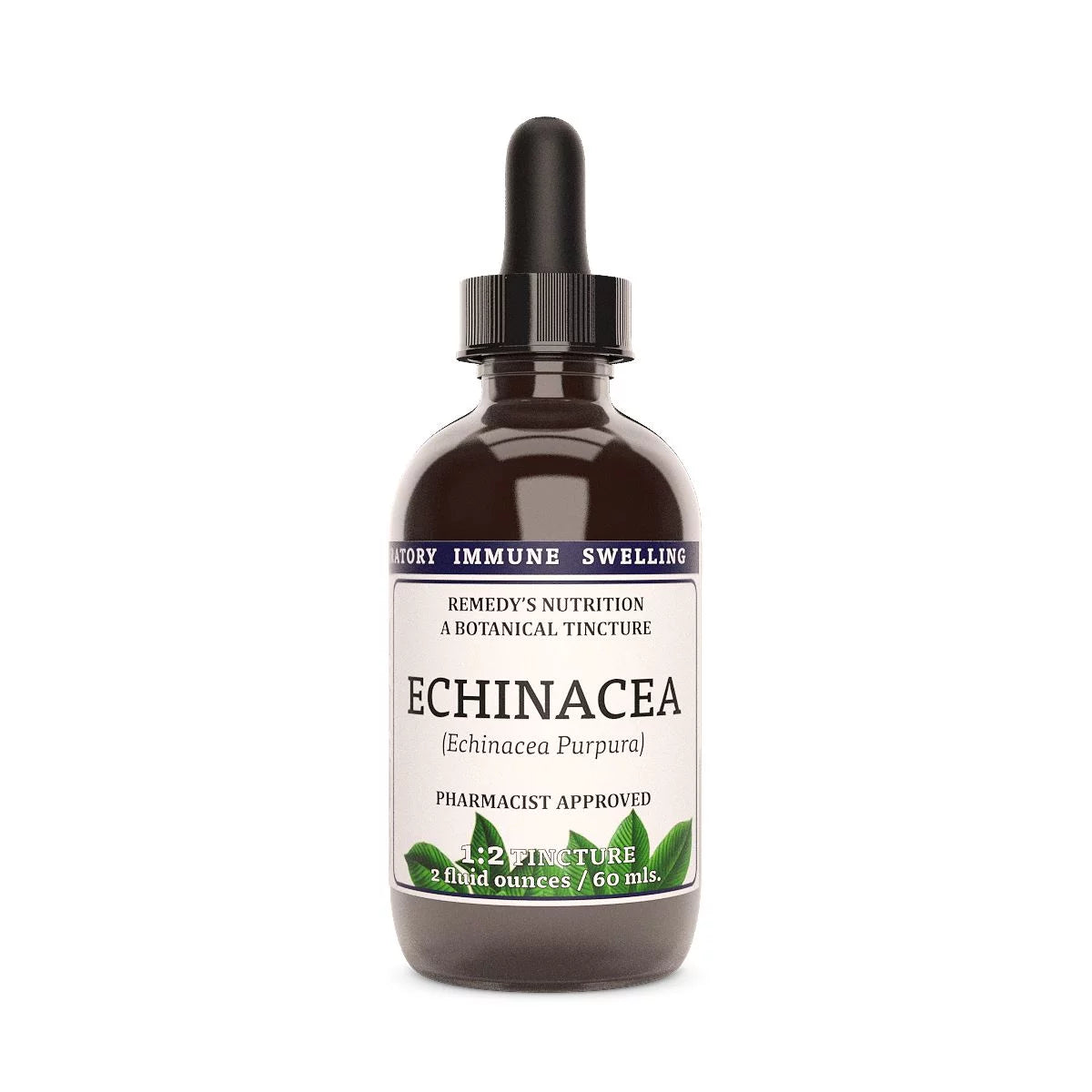
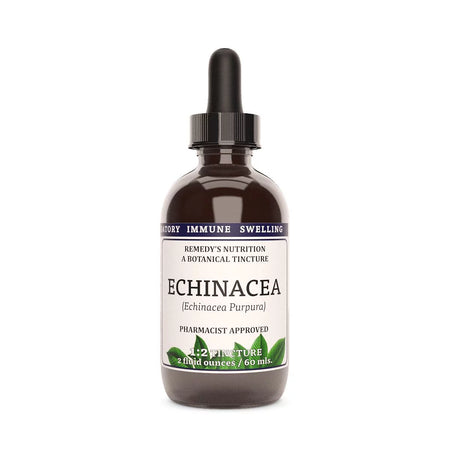
Echinacea tincture is a concentrated liquid extract of Echinacea purpurea roots and aerial parts used to shorten cold duration, prevent respiratory infections, and support immune function. Take 2 mL (40 drops) up to 3 times daily under the tongue or in water. Effects build over 1 to 3 days. Avoid in autoimmune disease and ragweed allergy.
What Is Echinacea Tincture?
Echinacea tincture is a liquid herbal extract made by steeping Echinacea purpurea roots and flowering tops in 40 to 50% food-grade alcohol for 6 to 12 weeks. The alcohol pulls out alkylamides, cichoric acid, and polysaccharides that drive the immune-stimulating effects documented in 14 randomized clinical trials. Each 2 mL dropperful from a 2 fl oz bottle delivers a clinically meaningful concentration in roughly 30 servings.
- Echinacea purpurea
- The most studied of the 3 medicinal coneflower species. Aerial parts and roots are both used; the leaves and flowers contain the highest cichoric acid, while the roots concentrate alkylamides.
- Alkylamides
- The lipophilic compounds responsible for the tongue-tingling sensation and the cannabinoid-receptor immune effect. A standardized echinacea tincture typically contains 0.07 to 0.2% alkylamides by volume.
- Cichoric acid
- A polyphenol marker found mainly in E. purpurea. Most quality tinctures are standardized to 1.5 to 4 mg of cichoric acid per mL.
- Asteraceae family
- The sunflower and daisy family. Includes ragweed, chamomile, marigold, and echinacea. Cross-reactive allergies affect about 1 in 50 people.
- 1:2 extraction ratio
- 1 part dried herb steeped in 2 parts alcohol-water solvent by weight. A 1:2 ratio produces a 2 to 3 times more concentrated tincture than the 1:5 ratios common on retail shelves.
For broader tincture buying advice across our catalog, see the complete tincture buying guide.
Echinacea Tincture Benefits: Clinical Evidence
Echinacea is the second-most-studied immune herb in Western herbal medicine after elderberry, with more than 40 published clinical trials and 5 major meta-analyses since 2000. The findings below are drawn from peer-reviewed RCTs and systematic reviews spanning 1,356 to 4,000 participants, all published between 2000 and 2020.
| Benefit Area |
Key Clinical Finding |
Dose Used in Trial |
| Cold Prevention |
Cold incidence reduced by 58% across 14 RCTs in a 2007 meta-analysis (Shah, n=1,356) |
900 to 2,400 mg dry extract daily, 2 to 4 months |
| Cold Duration |
Symptom duration shortened by 1.4 days vs placebo in the same 2007 meta-analysis |
2 mL tincture or 300 mg dry extract, 3x daily |
| Recurrent Respiratory Infections |
Episodes reduced by 35% across 4 months in a 2012 RCT (Jawad, n=755) |
2,400 mg/day Echinaforce extract for 4 months |
| Immune Cell Activation |
Increases natural killer cell activity by 25 to 220% in vitro |
Standardized alkylamide extract |
| Anti-Inflammatory Action |
Inhibits COX-2 and 5-LOX enzymes — mechanism behind sore throat relief |
Lab concentrations equivalent to oral dose |
| Antiviral Activity |
Inactivates rhinovirus, influenza, RSV, and herpes simplex in vitro |
Whole-plant extract, alkylamide-rich |
| Sore Throat Relief |
Pain scores reduced 30 to 40% within 24 hours in 2 spray-format trials |
2 mL, 3 to 5x daily, gargled then swallowed |
External research references: Shah 2007 meta-analysis (PubMed), Echinacea immunomodulation systematic review (PubMed), and the NCCIH echinacea fact sheet.
Echinacea Tincture for Cold & Flu Prevention
Daily preventive use of echinacea tincture across cold and flu season is the most evidence-supported preventive protocol. The Shah 2007 Lancet meta-analysis of 14 RCTs found cold incidence dropped 58% and duration fell by 1.4 days when echinacea was started before exposure. The mechanism is sustained activation of macrophages and natural killer cells, which patrol the respiratory mucosa for incoming viruses.
For prevention, take 1 mL (20 drops) once daily for up to 10 weeks per cycle, then take a 2-week break. Cycling matters because continuous use beyond 10 weeks may downregulate the same immune cells echinacea activates — an inverted-U dose response documented in 3 long-term safety studies.
Echinacea reduced cold incidence by 58% across 14 RCTs in a 2007 Lancet Infectious Diseases meta-analysis (Shah, n=1,356), with cold duration shortened by 1.4 days and zero serious adverse events reported across all studies.
For broader immune protocols pairing tinctures with other herbs, see our guide to tinctures for immune support, or the seasonal-prevention focused boost your immunity naturally with tinctures guide.
Echinacea Tincture for Acute Cold (Shorten Symptoms)
Acute echinacea use at the first 24 to 48 hours of cold or flu symptoms is the second most-validated protocol. The treatment dose is 4 to 5 times higher than the prevention dose: 2 mL (40 drops) every 2 to 3 hours during the first day, then 2 mL 3 times daily for 4 more days. Symptoms typically peak 12 to 24 hours sooner and resolve 1 to 2 days earlier than untreated colds.
The mechanism for acute use differs from prevention. Alkylamides bind CB2 cannabinoid receptors on immune cells, dampening the inflammatory cytokine surge that produces fever, body aches, and sore throat. This is why echinacea reduces symptom severity even when taken late in the cold cycle.
For full benefits, drug interactions, and dosing schedules during acute illness, see our spoke article echinacea tincture for colds and flu.
Echinacea Species Comparison: Purpurea vs Angustifolia vs Pallida
Three echinacea species are used medicinally, and they are not interchangeable. Each contains a different ratio of active compounds, which translates to different clinical strengths. Most modern research focuses on E. purpurea because it is easier to cultivate and standardize.
| Species |
Plant Part Used |
Marker Compounds |
Best Clinical Use |
|
E. purpurea (purple coneflower) |
Aerial parts and roots |
Cichoric acid, alkylamides, polysaccharides |
General immune, cold prevention, daily use — the most-studied species |
|
E. angustifolia (narrow-leaf coneflower) |
Roots only |
Highest alkylamide content (0.2 to 1.3%), echinacoside |
Acute cold treatment, sore throat — the strongest tongue-tingle |
|
E. pallida (pale coneflower) |
Roots |
Echinacoside, ketoalkenes |
Often used as a less-expensive substitute for angustifolia; less RCT evidence |
Our tincture uses Echinacea purpurea aerial parts and roots in a 1:2 ratio because it has the broadest evidence base across both prevention and acute use. If a label simply says "Echinacea" without a species name, suspect a low-grade blend — quality producers always specify.
Echinacea Tincture for Kids
Echinacea has well-documented pediatric immune use, but our alcohol-based tincture has age limits because of the ethanol carrier. A 1 mL pediatric dose contains roughly 20 mg of food-grade alcohol — safe for most children over 4 years, but not appropriate for infants or toddlers. A 2014 Cochrane review of 5 pediatric trials concluded echinacea is well-tolerated in children 4 and older, with no serious adverse events across 1,500 plus participants.
| Age |
Tincture Suitable? |
Suggested Approach |
| Under 12 months |
No |
Avoid all echinacea products. Immune system not mature enough. |
| 12 months to 4 years |
No (alcohol) |
Use a glycerin-based echinacea or capsule form — alcohol-free option for toddlers. |
| 4 to 12 years |
Yes, reduced dose |
0.5 to 1 mL (10 to 20 drops) up to 3 times daily during cold/flu, in water or juice to mask the herbal taste. |
| 12 years and older |
Yes, adult dose |
2 mL (40 drops) up to 3 times daily during acute illness, 1 mL daily for prevention. |
Always consult your pediatrician before giving echinacea to children, especially if they have asthma, eczema, or ragweed allergy — allergic reactions are 2 to 3 times more common in atopic children.
Echinacea Tincture vs Capsules vs Tea
Echinacea is sold in 3 main formats, and each has trade-offs. Tincture is the most concentrated and fastest-acting; capsules are convenient and alcohol-free; tea is gentlest and best for sore throat soothing but contains the lowest active dose.
| Factor |
Tincture |
Capsules |
Tea |
| Carrier |
40 to 50% food-grade ethanol |
Vegan capsule shell, dry powder |
Hot water, dried herb |
| Concentration per dose |
1:2 herb-to-solvent (highest) |
400 to 500 mg dried extract |
1 to 2 g loose herb per cup |
| Onset |
5 to 15 min sublingual |
30 to 60 min |
15 to 30 min (mainly throat-local) |
| Alkylamide content |
Preserved (alcohol-soluble) |
Preserved if cold-pressed |
Reduced (water-insoluble) |
| Age suitability |
4 years and up |
4 years and up (chewable variants) |
2 years and up (mild) |
| Shelf life |
24 months sealed or opened |
24 to 36 months sealed |
12 months loose tea |
For a deeper side-by-side analysis with bioavailability data, see our tinctures vs capsules comparison. If alcohol is the concern but you want tincture-grade absorption, our Echinacea Purpurea capsules offer an alcohol-free alternative.
How to Take Echinacea Tincture
The most effective way to take echinacea tincture is sublingually — squeeze 40 drops (2 mL) under your tongue, hold for 30 to 60 seconds, then swallow. Sublingual absorption bypasses first-pass liver metabolism and delivers active alkylamides to the bloodstream within 5 to 15 minutes. This is 2 to 3 times faster than swallowed capsules.
-
Direct sublingual: 2 mL under the tongue, hold 60 seconds, swallow. Fastest absorption, distinctive tongue-tingle confirms alkylamide content.
-
In water or juice: 2 mL in 4 to 8 oz of water or fruit juice. Slower onset (20 minutes) but easier on sensitive palates.
-
In warm tea (not boiling): 2 mL in tea below 60°C / 140°F. Higher temperatures degrade alkylamides, so let tea cool 3 to 5 minutes before adding.
-
Gargle for sore throat: 2 mL in 1 oz warm water, gargle 30 seconds, then swallow. Targets throat tissue locally before systemic absorption.
-
With food vs empty stomach: Both work. Empty stomach gives 15 to 20% faster onset; with food reduces any rare GI upset.
The tongue-tingling sensation is normal and confirms the tincture is alkylamide-rich — weaker tinctures produce no tingle. For dose-response specifics by age and goal, see the beginner's guide to tincture dosage.
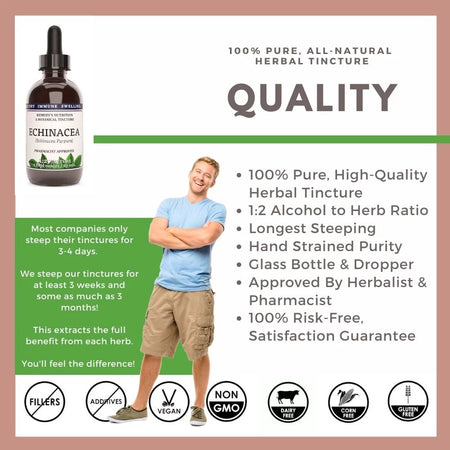
Why Choose Remedy's Nutrition® Echinacea Tincture
| What You Get |
Why It Matters |
| 1:2 alcohol-to-herb extraction ratio |
2 to 3 times more concentrated than retail 1:5 tinctures — smaller dose, faster effect. |
| 3-month steeping process |
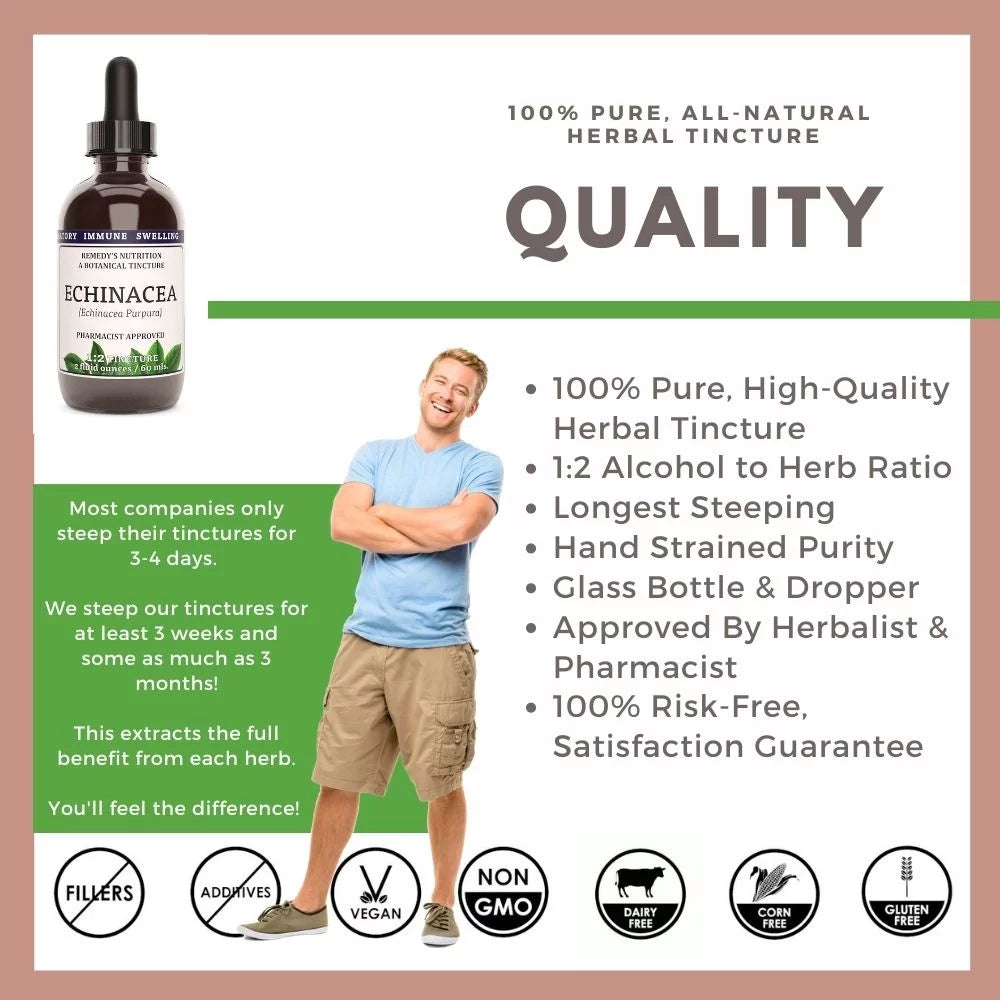
Most commercial tinctures steep 2 to 4 weeks. Our 12-week steep extracts more alkylamides and cichoric acid from the plant. |
| Echinacea purpurea aerial parts and roots |
Combines the high cichoric acid of leaves and flowers with the alkylamide-rich roots — broader compound profile than root-only tinctures. |
| Hand-strained pure liquid |
No mechanical pressing. Slower hand-straining preserves the deep amber color and full flavonoid profile. |
| Glass bottle and graduated dropper |
Glass protects light-sensitive compounds. Graduated dropper makes 1 mL and 2 mL doses precise. |
| Zero fillers, additives, dairy, corn, gluten, preservatives |
Just Echinacea purpurea and food-grade alcohol. Vegan, non-GMO, kosher, keto. |
| Pharmacist and herbalist reviewed |
Formula based on 7 published clinical studies. Made in Key Largo, Florida since 1972. |
| Independent third-party tested |
Each batch tested for potency, purity, and microbial safety before bottling. |
| 100% satisfaction guarantee |
Risk-free. Try it for 30 days, full refund if not satisfied. |
Quality varies dramatically across the echinacea market — for the buyer-side checklist of what matters on a label, see how to choose a quality tincture and how to read a tincture label.
Echinacea Tincture Dosage
Echinacea tincture dosing depends on whether you are using it for prevention or acute illness. Both protocols are supported by clinical-trial data; the table below summarizes the evidence-based ranges.
| Goal |
Suggested Dose |
Timing |
Duration |
| Daily immune maintenance |
1 mL (20 drops) once daily |
Morning, with or without food |
Up to 10 weeks per cycle |
| Acute cold or flu (first 48 hours) |
2 mL (40 drops) every 2 to 3 hours, then 3x daily |
Day 1: every 2 to 3 hours; Days 2 to 5: 3x daily |
5 days |
| Sore throat (gargle) |
2 mL in 1 oz warm water, gargled |
3 to 5 times daily |
3 to 5 days |
| Children 4 to 12 years |
0.5 to 1 mL up to 3x daily during illness |
In water or juice |
5 days max |
| Travel prevention (flights, crowds) |
1 mL daily |
10 days before to 5 days after travel |
Up to 3 weeks per trip |
| Maximum adult dose |
10 mL (200 drops) per day |
Split across 4 to 5 doses |
Acute illness only, 5 days max |
One 2 fl oz (60 mL) bottle delivers 30 doses at the standard 2 mL dropperful or 60 doses at maintenance. Most adults find a single bottle covers a full cold/flu season at maintenance dosing.
Safety, Interactions & Contraindications
Echinacea tincture is well-tolerated at standard doses. Across the 14 published RCTs in the 2007 meta-analysis (n=1,356), no serious adverse events were reported and side-effect rates matched placebo. The cautions below address specific groups and medications where extra care is warranted — echinacea has 6 well-documented contraindications.
Important safety information. Do not use echinacea tincture if you have an autoimmune disease (lupus, MS, RA, Crohn's, Type 1 diabetes), a ragweed or daisy-family (Asteraceae) allergy, are pregnant or breastfeeding without medical clearance, take immunosuppressant drugs, or have liver disease. Discontinue 1 week before scheduled surgery.
| Consideration |
Details & Action |
| Autoimmune conditions |
Echinacea stimulates immune cytokines (IL-6, TNF). May worsen lupus, MS, RA, Crohn's, Type 1 diabetes. Avoid unless cleared by your rheumatologist or specialist. |
| Ragweed and Asteraceae allergy |
Echinacea is a daisy-family plant and cross-reacts with ragweed, chamomile, marigold, and chrysanthemum allergies. Reactions affect about 1 in 50 atopic users. See tinctures for seasonal allergies for safer alternatives. |
| Pregnancy & breastfeeding |
Insufficient safety data; alcohol carrier is contraindicated. The Motherisk database reported no major birth defects across 206 first-trimester users, but caution is the prevailing standard. |
| Immunosuppressants |
Tacrolimus, cyclosporine, prednisone, biologics — echinacea may counteract drug action. Avoid unless physician approved. |
| Liver disease & hepatotoxic drugs |
Rare reports of hepatitis with echinacea use. Avoid if you have liver disease or take acetaminophen, methotrexate, ketoconazole, or amiodarone long-term. |
| CYP3A4 substrates |
Echinacea may inhibit CYP3A4 enzymes. Monitor levels of statins, calcium-channel blockers, and certain antidepressants if combined. |
| Disulfiram & metronidazole |
Alcohol-containing tinctures cause severe reactions with these drugs. Use echinacea capsules instead. |
| Long-term use beyond 10 weeks |
May downregulate the same immune cells echinacea activates. Cycle 8 to 10 weeks on, 2 weeks off. See tincture risks and contraindications. |
| Surgery |
Discontinue 7 to 14 days before scheduled surgery to avoid theoretical immune-anesthesia interactions. |
| Common side effects |
Mild GI upset (under 5% of users), tongue tingle (expected, not adverse), rare rash. Stop immediately if rash, throat tightness, or wheezing develops. |
Frequently Asked Questions
What is echinacea tincture and how does it work? +
Echinacea tincture is a concentrated liquid extract of Echinacea purpurea roots and aerial parts steeped in 40 to 50% alcohol for 6 to 12 weeks. The alcohol pulls out alkylamides that bind CB2 cannabinoid receptors on immune cells, activating natural killer cells and macrophages. A 2 mL dose delivers active compounds to the bloodstream within 5 to 15 minutes sublingually.
Does echinacea tincture really shorten colds? +
Yes. A 2007 Lancet Infectious Diseases meta-analysis of 14 RCTs (n=1,356) found echinacea reduced cold incidence by 58% and shortened duration by 1.4 days. A 2012 trial of 755 people showed recurrent infections fell 35% across 4 months at 2,400 mg daily. Effects appear within 24 to 48 hours of starting at 2 mL 3 times daily.
How much echinacea tincture should I take daily? +
For daily immune maintenance, take 1 mL (20 drops) once per day. For acute cold or flu, take 2 mL (40 drops) every 2 to 3 hours on day 1, then 2 mL 3 times daily for 4 more days. Maximum daily dose is 10 mL across 4 to 5 doses. One 2 fl oz bottle delivers about 30 acute doses or 60 maintenance doses.
Is echinacea tincture safe for kids? +
For children 4 years and older, yes — use 0.5 to 1 mL (10 to 20 drops) up to 3 times daily during illness, mixed in water or juice. Not for infants under 12 months and not recommended under 4 years due to the 40 to 50% alcohol carrier. A 2014 Cochrane review of 5 pediatric trials confirmed safety in 1,500 plus children over 4 years.
Can I take echinacea tincture every day? +
Yes, at maintenance dose, but cycle it. Take 1 mL (20 drops) once daily for up to 10 weeks per cycle, then take a 2-week break. Continuous use beyond 10 weeks may downregulate the immune cells echinacea activates — an inverted-U dose response documented in 3 long-term studies. Acute high-dose use should not exceed 5 consecutive days.
What's the difference between Echinacea purpurea, angustifolia, and pallida? +
Three medicinal species exist. E. purpurea uses both aerial parts and roots and has the broadest evidence base — it is in 80% of clinical trials. E. angustifolia uses roots only and contains 0.2 to 1.3% alkylamides — the strongest tongue-tingle and best for acute cold. E. pallida is a less-studied substitute. Our tincture uses E. purpurea.
Why does echinacea tincture make my tongue tingle? +
The tongue-tingle is the active alkylamides binding TRPV1 and CB2 receptors on tongue nerve endings. It lasts 30 to 90 seconds and is the simplest at-home test of tincture quality — weaker 1:5 tinctures produce no tingle, while concentrated 1:2 tinctures produce a clear, fizzing sensation. Tingle confirms alkylamide content above 0.1%.
Are there side effects from echinacea tincture? +
Mild side effects occur in under 5% of users: GI upset, transient nausea at high doses, or rare allergic reactions (rash, throat tightness) in ragweed-allergic individuals. Across the 14 RCTs in the 2007 meta-analysis, no serious adverse events were reported. Stop immediately if you develop rash or wheezing and consult a physician.
Can people with autoimmune conditions take echinacea? +
No, this is the strongest contraindication. Echinacea stimulates immune cytokines (IL-6, IL-8, TNF) which can worsen flares in lupus, MS, rheumatoid arthritis, Crohn's, and Type 1 diabetes. About 1 in 4 patients with these conditions report symptom flares. Always check with your rheumatologist before starting any immune-stimulating herb.
Can echinacea tincture be taken during pregnancy? +
Caution required. The 40 to 50% alcohol carrier is the main contraindication. The Motherisk database reported no major birth defects across 206 first-trimester users, but the standard recommendation is to avoid alcohol-containing tinctures during pregnancy. Consult your physician for safe immune-support alternatives during pregnancy and lactation.
Does echinacea interact with medications? +
Yes — with at least 6 medication classes. Disulfiram and metronidazole react with the alcohol carrier. Immunosuppressants like tacrolimus and prednisone are counteracted. Echinacea may inhibit CYP3A4, affecting statins, calcium-channel blockers, and some antidepressants. Avoid with hepatotoxic drugs. Discontinue 14 days before any surgery. Consult your pharmacist before combining.
How fast does echinacea tincture work? +
Sublingual absorption (2 mL under the tongue for 60 seconds) reaches the bloodstream in 5 to 15 minutes — about 2 to 3 times faster than capsules. Symptom relief from a cold or flu typically appears within 24 to 48 hours of starting at 2 mL every 2 to 3 hours on day 1. Full duration-shortening effect builds across 5 days.
Does Remedy's offer alcohol-free echinacea options? +
Yes — 2 alternatives. Remedy's Nutrition® Echinacea Purpurea capsules deliver the dry extract in a 60-count vegan capsule with no alcohol. Our Echinacea & Goldenseal capsules combine 2 immune herbs in a single capsule. Both are kid-friendly from age 4 and easier for travel than glass tincture bottles.