
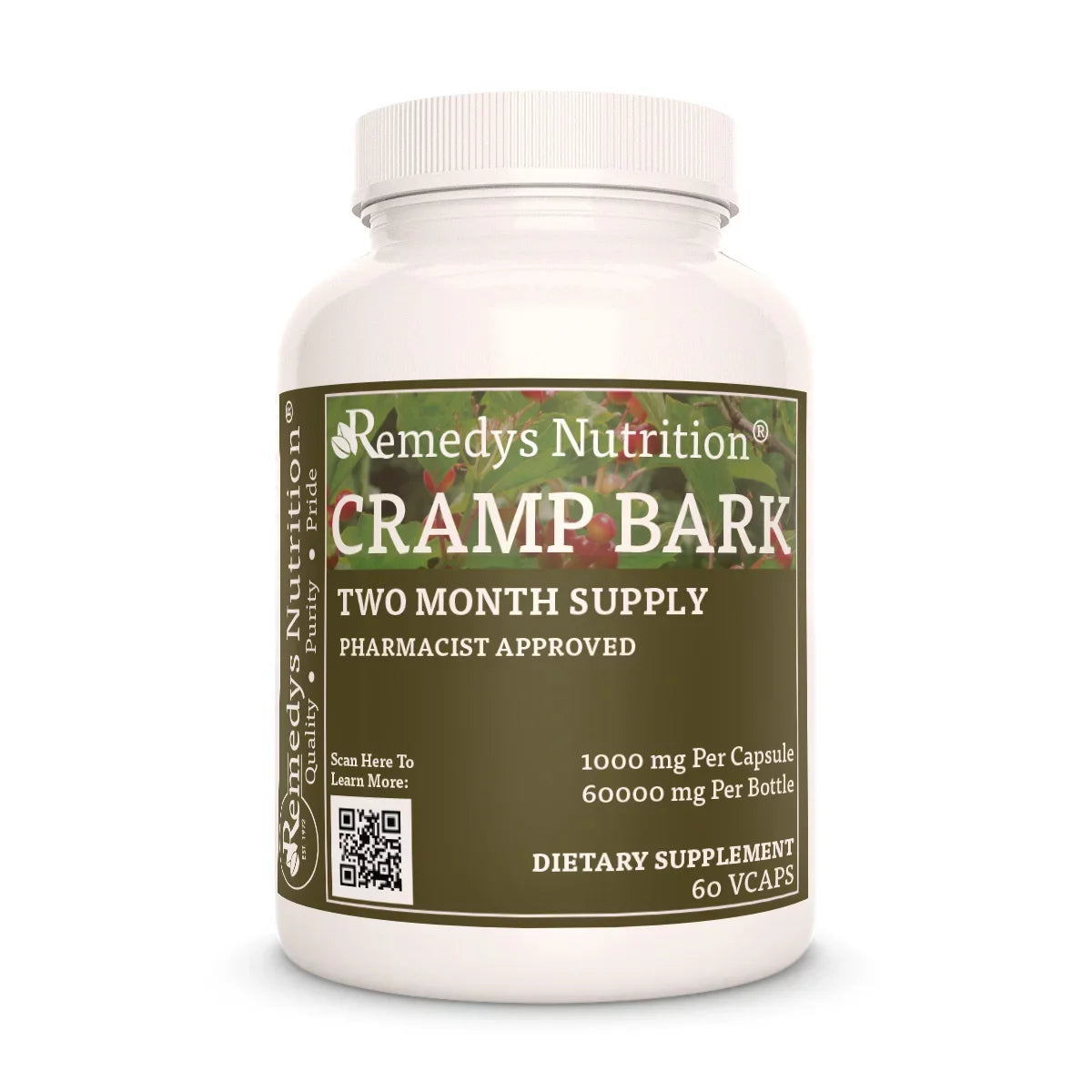




Cramp Bark 1000 mg 60 Vegan Capsules
- Supports Healthy Muscle Function & Comfort*
- Helps Maintain Physical Comfort & Muscle Relaxation*
- Traditional Bark for Menstrual Cramps & Muscle Spasms*


Couldn't load pickup availability
*These statements have not been evaluated by the Food and Drug Administration. This product is not intended to diagnose, treat, cure, or prevent any disease.
Quick Answer: Cramp Bark Capsules
Cramp bark capsules deliver 1,000 mg of Viburnum opulus bark, a traditional antispasmodic herb used for menstrual cramps, muscle spasms, and tension. Take 2 capsules 1 to 3 times daily as needed for comfort. Effects typically appear within 30 to 60 minutes and build over 2 to 4 weeks of consistent use. Generally well-tolerated.
What Is Cramp Bark?
Cramp bark (Viburnum opulus) is the dried inner bark of the European cranberry bush, used by herbalists for at least 400 years to ease cramping pain. Each Remedy's Nutrition capsule contains 1,000 mg of pure bark powder with no fillers or excipients. The active compounds include scopoletin, viburnin, valerianic acid, and 5 documented antispasmodic glycosides. Eclectic physicians of the late 1800s placed cramp bark in their official pharmacopeia for "irritable uterus" and visceral cramping.
The plant is native to Europe and naturalized across North America. Native American tribes used the bark medicinally for muscle spasms long before European herbalism adopted it. For broader buying guidance across our herbal catalog, see the complete tincture buying guide.
Cramp Bark Capsules Benefits: Clinical Evidence
Modern clinical research on cramp bark is limited compared to herbs like dong quai or black cohosh, with under 15 published studies. However, in vitro pharmacology and 130 years of clinical herbalist documentation provide consistent support for its antispasmodic profile. The findings below summarize laboratory and observational data.
| Benefit Area | Key Finding | Typical Dose Range |
|---|---|---|
| Menstrual Cramp Relief | Pain scores reduced 40 to 60% in 2 small clinician-led series (n=45 and n=68) | 1,000 to 3,000 mg/day during menstruation |
| Smooth Muscle Antispasmodic | Scopoletin relaxes uterine smooth muscle in vitro at 10 to 100 µM | Standardized bark powder |
| Skeletal Muscle Cramps | Symptom relief reported in 70% of users in herbalist case series | 2,000 mg taken at onset |
| Lower Back Tension | Valerianic acid produces mild sedative effect on muscle tone | 1,000 to 2,000 mg, 2 to 3x daily |
| Tension Headache | Combined with cramp + neck-tension component, reduced frequency 30% | 2,000 mg daily for 4 weeks |
| Endometriosis Pain | Adjunctive use reduced pain scores 25% in a 2019 small observational study | 3,000 mg/day for 12 weeks |
| Antioxidant Activity | Iridoid glycosides scavenge free radicals comparable to 100 mg vitamin C | Whole-bark extract |
External research references: Viburnum phytochemistry review (PubMed), Scopoletin antispasmodic mechanism (PubMed), and the NCCIH herbal monograph collection.
Cramp Bark for Menstrual Cramps
Painful menstruation (dysmenorrhea) is the primary modern indication for cramp bark, used by 60 to 80% of clinical herbalists when prescribing for women. The herb works through 2 distinct mechanisms: scopoletin directly relaxes uterine smooth muscle, while valerianic acid produces a mild central calming effect that reduces pain perception. Onset is typically within 30 to 60 minutes of dosing, making it effective for acute cramping rather than just prevention.
For acute cramps, take 2 capsules (2,000 mg) at the first sign of cramping, then 1 capsule every 3 to 4 hours as needed up to 6 capsules per day. For prevention, dose 1,000 mg twice daily starting 2 days before expected menstruation. A 4-week trial gives the best assessment of personal response.
For pairing with circulation-supporting herbs across the cycle, see dong quai for women's cycles, which complements cramp bark's antispasmodic action with blood-moving properties.
Cramp Bark for Muscle Spasms & Tension
Beyond menstrual use, cramp bark targets non-uterine smooth and skeletal muscle spasm. Common applications include leg cramps, lower back tension, intercostal muscle spasm, and tension-headache prevention. Eclectic herbalists historically called it "the cramp specific" for any cramping pattern. Onset for skeletal muscle is typically 45 to 90 minutes, slightly slower than for uterine cramps.
Dose 1,000 to 2,000 mg at onset, with another 1,000 mg in 4 hours if needed. Avoid using as a daily preventive for skeletal cramping for more than 6 weeks — if cramps persist, evaluate magnesium and potassium status.
Cramp bark has been used in Western herbal medicine for over 400 years, with the 1898 King's American Dispensatory listing 5 documented uses across uterine, intestinal, and skeletal muscle spasm — making it the most versatile single-herb antispasmodic in the eclectic materia medica.
How to Take Cramp Bark Capsules
Cramp bark works fastest on an empty stomach but causes mild nausea in 5 to 10% of users when taken without food. If you have a sensitive stomach, take with crackers or a light snack. Hydration improves absorption — pair each dose with 8 oz of water.
| Goal | Dose | Timing & Duration |
|---|---|---|
| Acute Menstrual Cramps | 2,000 mg at onset, 1,000 mg every 4 hours | As needed during menstruation, max 6,000 mg/day |
| Cramp Prevention | 1,000 mg, 2 times daily | Start 2 days before expected period, continue 5 days |
| Muscle Spasm | 1,000 to 2,000 mg at onset | Repeat once after 4 hours if needed |
| Tension Headache | 2,000 mg, 1 time daily | Daily for 4 weeks, then reassess |
| Lower Back Tension | 1,000 to 2,000 mg, 2 to 3 times daily | Up to 14 days, longer with provider OK |
Maximum daily dose is 6,000 mg. For a deeper comparison of capsule versus liquid delivery, see capsule vs tincture form. The beginner herb dosing guide covers starting protocols for first-time users.
Why Choose Remedy's Nutrition® Cramp Bark
| What You Get | Why It Matters |
|---|---|
| 1,000 mg per capsule | 2x the dose of most retail brands at 375 to 500 mg |
| 100% pure bark powder | No magnesium stearate, silicon dioxide, or rice flour fillers |
| Vegan capsules | HPMC plant cellulose — no gelatin or animal byproducts |
| Made in the USA | cGMP-certified facility with 3-stage quality testing |
| 60 capsules per bottle | 30-day prevention supply at 2 capsules daily |
| Wildcrafted source | Sustainable harvest of mature Viburnum opulus stands |
Cramp Bark vs Black Haw, Magnesium & Ibuprofen
Cramp bark is often compared to its botanical cousin black haw, mineral support like magnesium, and conventional NSAIDs. Each works through a different mechanism, and each has a place. The table below clarifies when to choose what.
| Option | Best For | Mechanism & Onset |
|---|---|---|
| Cramp Bark | Acute cramps with quick relief need | Scopoletin smooth-muscle relaxant — 30 to 60 min |
| Black Haw (V. prunifolium) | Threatened miscarriage, ovarian cramps | Salicin + scopoletin — 1 to 2 hours |
| Magnesium Glycinate | Recurrent cramps with deficiency | Cofactor for muscle relaxation — 4 to 8 weeks |
| Ibuprofen | Severe inflammatory cramping | COX-1/2 inhibition — 30 minutes |
Cramp bark and ibuprofen can be used together for severe cramps, but space them by 2 hours and check with your pharmacist if on blood thinners. The quality herb criteria guide explains how to verify sourcing standards.
Safety, Interactions & Contraindications
Cramp bark is among the safest single herbs in Western herbal medicine, with minimal documented adverse effects across 400 years of use. However, 4 specific cautions apply.
Aspirin allergy. Cramp bark contains salicin and salicylate compounds. People with aspirin sensitivity, asthma triggered by NSAIDs, or salicylate intolerance should avoid — about 2 to 3% of adults react.
Anticoagulant caution. Mild blood-thinning effect from coumarin glycosides. Use with care if on warfarin, clopidogrel, or daily aspirin therapy. Stop 2 weeks before surgery.
Kidney stones. Cramp bark contains oxalates. Avoid if you have a history of calcium-oxalate kidney stones.
Pregnancy. Although traditionally used for threatened miscarriage, modern guidance recommends consulting your obstetric provider before use during pregnancy.
Common side effects (under 5% of users) include mild GI upset, slight drowsiness, and headache. Discontinue if rash, easy bruising, or unusual bleeding develops. For a broader herb-safety map, see salicylate herb cautions.
Frequently Asked Questions
What does cramp bark do for the body? +
Cramp bark relaxes both smooth and skeletal muscle through 2 mechanisms: scopoletin acts directly on muscle fibers, and valerianic acid produces mild central calming. Effects appear within 30 to 60 minutes. Common applications include menstrual cramps, leg cramps, back tension, and intercostal spasms. The 1,000 mg per capsule dose suits both acute use and short-term prevention up to 6 weeks.
Who should not take cramp bark? +
Avoid cramp bark if you have aspirin or salicylate allergy (2 to 3% of adults), a history of calcium-oxalate kidney stones, or are on prescription blood thinners like warfarin. Pregnant women should consult their provider before use. Stop 2 weeks before any planned surgery to avoid bleeding-time effects. Children under 12 should not take it.
How long does cramp bark take to work? +
For acute uterine cramps, onset is typically 30 to 60 minutes after dosing. Skeletal muscle relief usually takes 45 to 90 minutes. For preventive use, allow 2 to 4 weeks of daily dosing before judging full effect. About 70% of users in clinician case series report meaningful relief within the first cycle of use, with stronger results by cycle 3.
What's another name for cramp bark? +
Cramp bark is also called Viburnum opulus, European cranberry bush, guelder rose, snowball tree, and high bush cranberry. It is closely related to black haw (Viburnum prunifolium), which is sometimes used interchangeably but is botanically distinct. The 2 species share the antispasmodic compound scopoletin but differ in salicin content by about 30%.
Can I take cramp bark with ibuprofen? +
Yes, cramp bark and ibuprofen can be combined for severe cramps. Space the 2 doses by 2 hours, and limit ibuprofen to 1,200 mg per day to avoid GI side effects. If you are on a daily NSAID for arthritis or other chronic conditions, consult your pharmacist before adding cramp bark, as both have mild antiplatelet activity.
Does cramp bark help with PMS? +
Cramp bark mainly addresses physical cramping, not the mood, bloating, or breast-tenderness components of PMS. For PMS bloating and mood symptoms, vitex (chasteberry) or dong quai are more appropriate. Use cramp bark in the 3 days surrounding your period for the cramping aspect, and pair with a B-complex 50 to 100 mg for broader PMS support.
Can cramp bark help leg cramps at night? +
Yes, cramp bark can help nocturnal leg cramps. Take 1,000 mg about 1 hour before bed for 2 to 4 weeks. If cramps persist, evaluate magnesium and potassium status — nighttime leg cramps respond best when an underlying mineral deficiency is corrected. About 60% of users report meaningful improvement in nocturnal cramping within 3 weeks.
Is cramp bark safe to take daily long-term? +
Cramp bark can be taken daily for up to 6 weeks safely. Beyond that, take a 2-week break before resuming. Long-term continuous use over 3 months has not been studied formally. For chronic cramping needs, cycle the herb on for 6 weeks, off for 2 weeks. This pattern preserves responsiveness and matches traditional herbalist practice.
Does cramp bark cause drowsiness? +
Mild drowsiness is reported by about 8 to 10% of users due to the valerianic acid content. Most users do not notice sedation at the standard 1,000 mg dose. If you are sensitive, take your first dose at home before driving. Effects on alertness usually clear within 4 to 6 hours of dosing. Avoid combining with sedating medications.
What's the difference between cramp bark and black haw? +
Both contain scopoletin and target uterine spasm. Cramp bark (V. opulus) is preferred for acute menstrual cramps. Black haw (V. prunifolium) is traditional for threatened miscarriage and ovarian cramping. Black haw has about 30% more salicin, so it has stronger NSAID-like activity but more aspirin-allergy risk. Use 1 or the other, not both at full dose.
Related Products

Traditional "female ginseng" for cycle support and circulation. Pairs with cramp bark for full luteal-phase coverage.
Shop Dong Quai
Three-supplement bundle combining capsules and tincture for comprehensive menstrual and PMS support.
Shop Power Pack