What Is Ceylon Cinnamon?
Ceylon cinnamon is the dried inner bark of Cinnamomum verum (also called C. zeylanicum), the tree botanists recognize as "true cinnamon." Native to Sri Lanka, it is prized for a delicate, sweet flavor and, more importantly, for its naturally low coumarin content compared with the common cassia sold in most supermarkets.[1]Cinnamomum verum Phytochemistry — PubMed View source
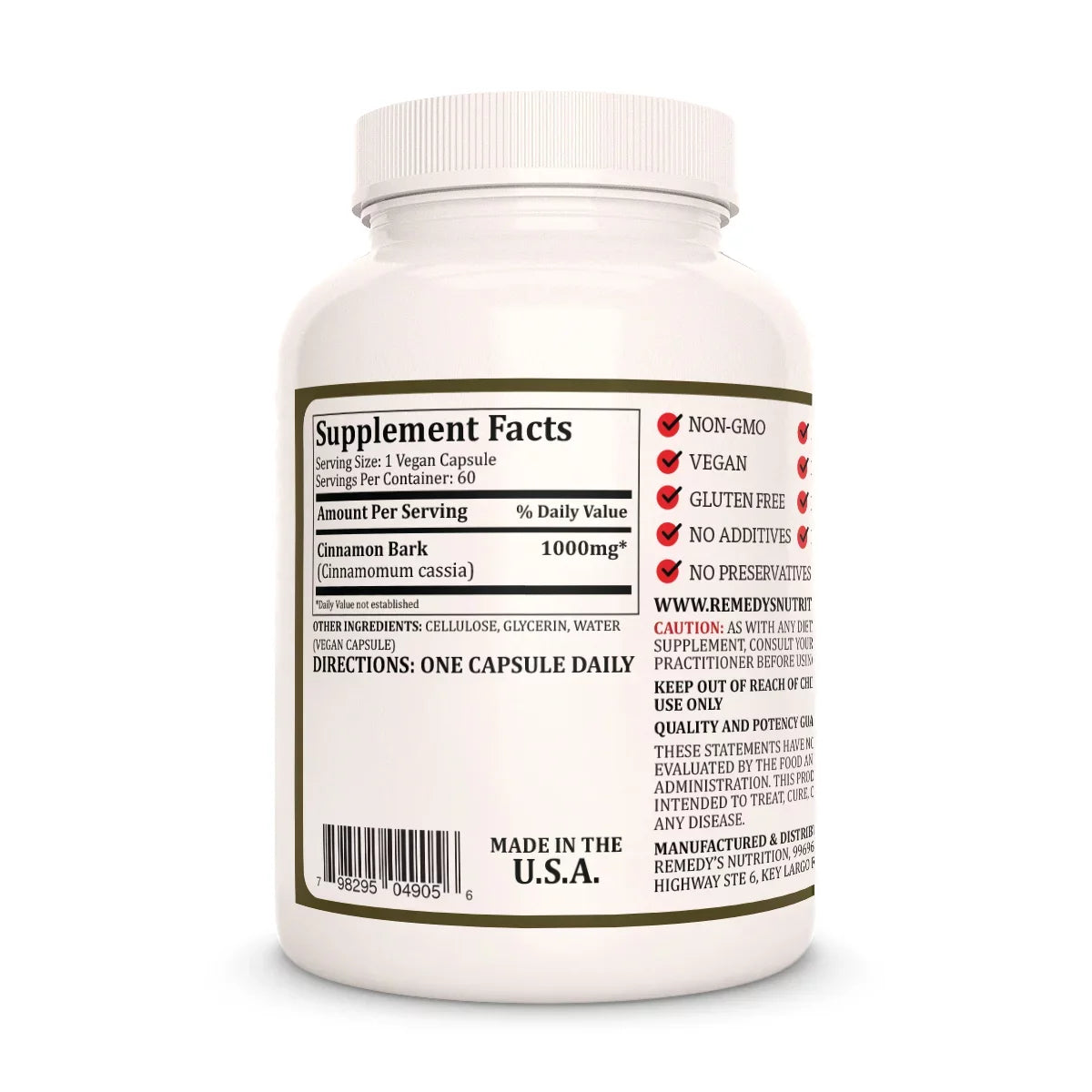
Supplement Facts
Serving size: 1 Vegan Capsule. Servings per container: 60.
| Amount Per Serving |
Amount |
% Daily Value |
| Cinnamon Bark (Cinnamomum cassia, as printed) |
1000 mg |
* |
* Daily Value not established. The botanical name is reproduced exactly as printed; it does not match the product name. See the note.
Other ingredients: Cellulose, Glycerin, Water (vegan capsule)
Directions: One capsule daily.
Non-GMO, vegan, gluten free, no additives, no preservatives. Made in the USA.
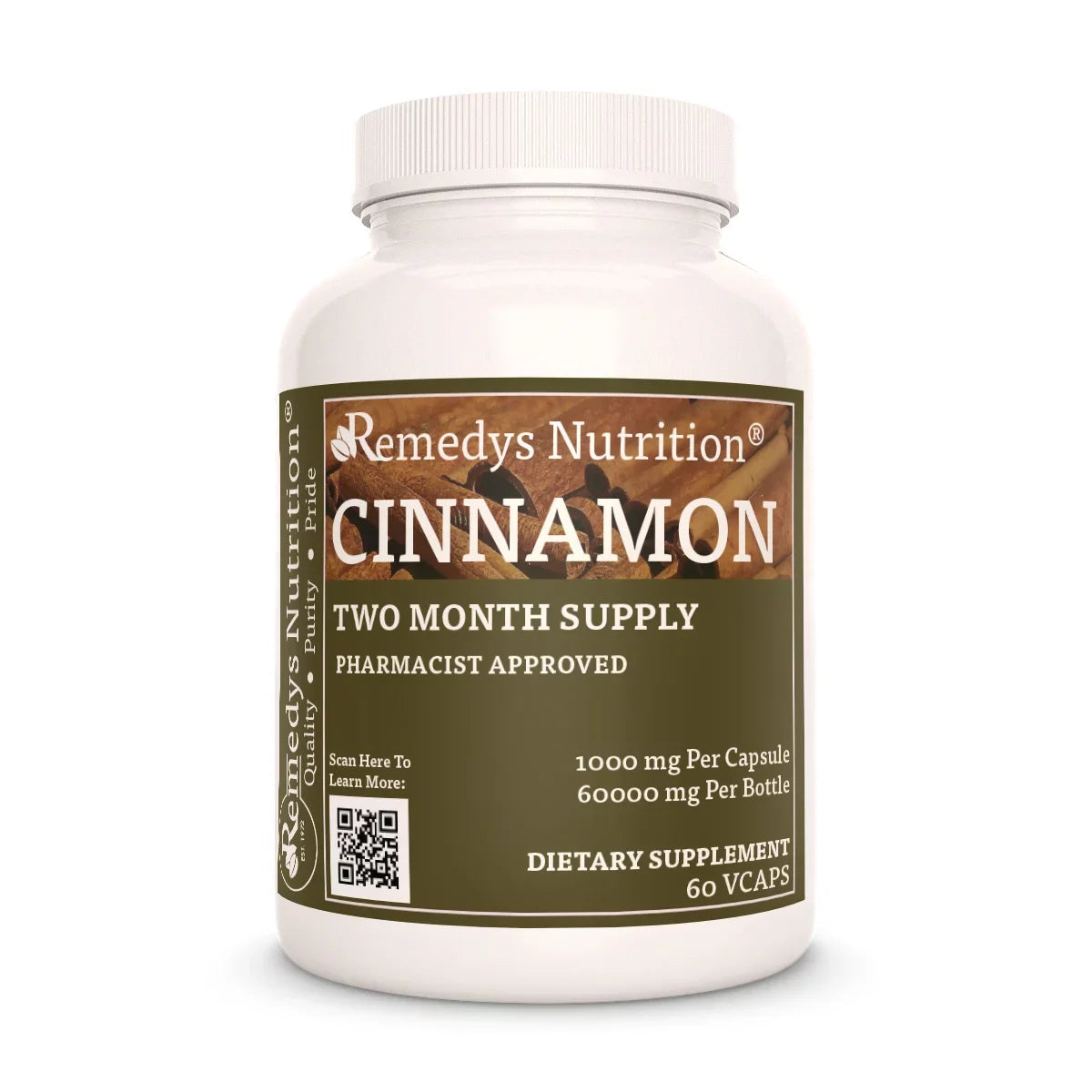
Each Remedy's Nutrition capsule delivers 1000 mg of true Ceylon cinnamon bark and nothing else — a single-ingredient, filler-free formula in a vegan capsule. The active compounds behind its effects include cinnamaldehyde, cinnamic acid, and a family of polyphenols that support antioxidant and metabolic pathways. If you want the botany and chemistry in depth, our pillar explains exactly what true Ceylon cinnamon is and how it differs from cheaper bark.
-
Species: Cinnamomum verum (true cinnamon), not Cinnamomum cassia
-
Part used: inner bark, harvested and rolled into thin, brittle quills
-
Origin: Sri Lanka is the traditional source of authentic Ceylon
-
Signature trait: low coumarin — typically under 200 mg/kg versus 2,000 to 4,000 mg/kg in cassia
Ceylon Cinnamon Benefits: Clinical Evidence
Most cinnamon research has focused on metabolic health, and results are genuinely mixed rather than miraculous. The strongest signals appear in blood sugar and lipid markers, with smaller effects on weight. The table below summarizes what controlled trials and meta-analyses actually report, so you can set realistic expectations. For a fuller walkthrough of each claim, see the evidence behind Ceylon cinnamon's benefits.
| Benefit Area |
What the Evidence Shows |
Study Type |
| Fasting Blood Sugar |
Cinnamon supplementation lowered fasting glucose and HbA1c in people with type 2 diabetes, though effect sizes varied by dose and duration[2]Cinnamon Glycemic Control Meta-Analysis — PubMed View source
|
Dose-response meta-analysis of RCTs |
| Metabolic Biomarkers |
Improvements in insulin resistance and inflammatory markers were reported, but authors caution the evidence is moderate quality[3]Cinnamon Metabolic Biomarkers Meta-Analysis — PubMed View source
|
Systematic review and meta-analysis |
| Cholesterol & Lipids |
Pooled data showed small reductions in total cholesterol, LDL, and triglycerides across adult populations[4]Cinnamon Cardiovascular Risk Factors Meta-Analysis — PubMed View source
|
GRADE-assessed meta-analysis |
| Ceylon-Specific Data |
A double-blind, placebo-controlled trial using Cinnamomum zeylanicum reported metabolic improvements in adults with diabetes[5]Ceylon Cinnamon Diabetes RCT — PubMed View source
|
Randomized controlled trial |
How Ceylon Cinnamon Works
Cinnamon's metabolic effects trace to a few complementary mechanisms rather than one magic bullet. Its polyphenols slow the breakdown of starch into glucose, help cells respond more efficiently to insulin, and blunt oxidative stress. Interestingly, the activity is species-specific: laboratory work found meaningful differences between Ceylon and cassia in enzyme inhibition and starch digestion.[6]Species-Specific Antidiabetic Activity — PubMed View source
-
Slower starch digestion: inhibits alpha-amylase and alpha-glucosidase, softening post-meal glucose spikes
-
Better insulin signaling: polyphenols support cellular glucose uptake
-
Antioxidant defense: cinnamaldehyde and related compounds reduce oxidative load
Ceylon Cinnamon for Blood Sugar Support
Important: Ceylon cinnamon is a complementary food supplement, not a treatment or cure for diabetes. It does not replace prescribed medication, insulin, or medical monitoring. If you take glucose-lowering drugs, use it only under the supervision of your doctor so your dose can be adjusted safely.
Blood sugar is where cinnamon earns most of its attention. Reviews of clinical trials report modest average reductions in fasting glucose and HbA1c, with the caveat that responses differ widely between individuals and study designs.[7]Glycaemic Outcomes of Cinnamon — PubMed View source Think of it as a small nudge alongside diet, movement, and any prescribed therapy — not a standalone fix.
Because it is so low in coumarin, Ceylon is the more sensible choice for anyone using cinnamon daily over months to support glucose goals. Our detailed guide covers the numbers and cautions for Ceylon cinnamon and blood sugar, including what to discuss with your care team before starting.
Ceylon vs Cassia Cinnamon: The Coumarin & Liver-Safety Advantage
This is the single most important reason to choose Ceylon. Cassia cinnamon — the type in most jars and baked goods — contains high levels of coumarin, a natural compound that can stress the liver at sustained high intakes.[8]Coumarin Toxicology and Risk Assessment — PubMed View source True Ceylon contains only trace amounts, which is why it is the safer form for everyday use.[9]Coumarin Levels in Ground Cinnamon — PubMed View source
| Factor |
Ceylon (Cinnamomum verum) |
Cassia (Cinnamomum cassia) |
| Coumarin content |
Trace — typically under 200 mg/kg |
High — about 2,000 to 4,000 mg/kg |
| Liver safety at daily use |
Well suited to long-term daily intake |
Repeated high intake can exceed safe coumarin limits |
| Bark appearance |
Thin, brittle, many soft layers |
Thick, hard, single curled layer |
| Flavor |
Mild, sweet, delicate |
Strong, spicy, slightly bitter |
| Typical price |
Higher (specialty) |
Lower (commodity) |
The safety math is easy to follow. The European Food Safety Authority set a tolerable daily intake for coumarin of 0.1 mg per kg of body weight, which works out to about 6 mg per day for a 60 kg adult. Roughly one teaspoon of cassia can reach or exceed that limit. By contrast, a 1000 mg capsule of our low-coumarin Ceylon bark delivers only a fraction of a milligram — a small share of that daily ceiling — so you get cinnamon's benefits without the coumarin load. For the full breakdown, read how Ceylon and cassia compare on coumarin and liver safety.
How to Identify True Ceylon Cinnamon
Mislabeling is common, and independent testing has flagged both fraud and coumarin-safety issues in the retail cinnamon market.[10]Cinnamon Safety and Fraud Analysis — PubMed View source Studies of product labels have also shown that transparency around origin and species varies widely, so a few checks protect you.[11]Authenticity of Ceylon Cinnamon Labels — PubMed View source
-
Look for the species: the label should say Cinnamomum verum or C. zeylanicum, not just "cinnamon"
-
Check the origin: authentic Ceylon is grown in Sri Lanka
-
Inspect the bark: Ceylon quills are thin and crumbly with many layers; cassia is a single hard curl
-
Prefer single-ingredient products: a 1000 mg capsule of pure bark leaves no room for undisclosed cassia
Ceylon Cinnamon for Weight & Metabolic Health
Cinnamon is often marketed for weight loss, and the honest answer is that any effect is small and supportive at best. A dose-response meta-analysis found that supplementation modestly reduced body weight and waist circumference, mainly in people with metabolic issues.[12]Cinnamon and Obesity Meta-Analysis — PubMed View source An umbrella review reached a similar conclusion — a real but minor benefit that works alongside, never instead of, diet and activity.[13]Cinnamon Anti-Obesity Umbrella Meta-Analysis — PubMed View source
- Effects on weight are measured in a few pounds over months, not dramatic loss
- Benefits cluster in people with elevated blood sugar or insulin resistance
- Pairs best with a whole-food diet, regular movement, and consistent daily use
Ceylon Cinnamon Dosage: Recommended Capsule Amounts
Remedy's Ceylon Cinnamon is standardized at 1000 mg per capsule, which makes dosing straightforward. The recommended dosage is 1 to 2 capsules (1000 to 2000 mg) per day, matching the 1 to 2 gram wellness range; a 1,200 mg daily target is just over 1 capsule and stays well within safe limits. Most clinical benefits appear in the 1 to 6 gram range, and consistency over 8 to 12 weeks matters more than any single large dose. For a deeper dive on ceilings and timing, see our guide on how much Ceylon cinnamon to take per day.
| Goal |
Typical Daily Dose |
Timing |
Duration |
| General wellness |
1 capsule (1000 mg) |
With any meal |
Ongoing |
| Blood sugar support |
1 to 2 capsules (1000 to 2000 mg) |
With the largest carbohydrate meal |
8 to 12 weeks, then reassess |
| Metabolic / weight support |
1 to 2 capsules (1000 to 2000 mg) |
Morning or with meals |
12 weeks alongside diet |
| New to cinnamon |
1 capsule (1000 mg) |
With food |
Start low, assess tolerance |
Take capsules with food to minimize any stomach upset, and if you are weighing formats, our comparison of Ceylon cinnamon powder versus capsules explains why a fixed 1000 mg capsule is easier to dose than a variable scoop. If you use diabetes medication, coordinate the dose and timing with your physician before you begin.
Why Choose Remedy's Ceylon Cinnamon
Not all cinnamon capsules are equal. Because coumarin risk and species mislabeling are real, what is in the bottle matters as much as the dose. Here is exactly what you get with Remedy's Nutrition and why each detail counts.
| What You Get |
Why It Matters |
| True Cinnamomum verum bark |
Authentic low-coumarin Ceylon — not the high-coumarin cassia most brands quietly use |
| 1000 mg per capsule |
A clinically relevant dose in a single, easy-to-track capsule |
| Single ingredient |
No fillers, binders, flow agents, or preservatives — just cinnamon bark |
| 60 vegan capsules |
A 2-month supply at one capsule daily; vegan and kosher friendly |
| Non-GMO, made in the USA |
Handmade in Key Largo, Florida, and pharmacist reviewed for quality |
Safety, Side Effects & Drug Interactions
Ceylon cinnamon is well tolerated for most healthy adults at food-supplement doses, and its low coumarin content removes the main liver concern tied to cassia. Still, it is biologically active, so a few interactions deserve attention. The table lists the situations that call for medical guidance.
| Consideration |
What to Know |
| Diabetes medication |
May add to glucose-lowering effects; monitor and coordinate dosing to avoid hypoglycemia |
| Blood thinners (warfarin) |
Coumarin is chemically related to warfarin; even low-coumarin Ceylon should be cleared with your doctor |
| Liver disease |
Choose low-coumarin Ceylon and consult your physician before daily supplementation |
| Pregnancy & breastfeeding |
Not enough safety data at supplement doses; avoid unless your doctor approves |
| Surgery |
Stop at least 2 weeks before scheduled surgery due to possible blood sugar effects |
Combining cinnamon with other metabolic supplements is common; one trial paired it with berberine in adults with type 2 diabetes.[14]Berberine and Cinnamon Combination RCT — PubMed View source Stacking active ingredients can compound glucose-lowering effects, so involve your care team first.
Who Should Avoid Ceylon Cinnamon
A supplement being natural does not make it right for everyone. If any of the following apply to you, hold off or get personalized advice before starting. Our detailed reference covers the full list of Ceylon cinnamon side effects and who should avoid it.
- People on insulin or other glucose-lowering drugs without medical supervision
- Anyone taking warfarin or other anticoagulants
- Those with active liver disease or elevated liver enzymes
- Pregnant or breastfeeding individuals, unless a doctor approves
- Anyone within 2 weeks of scheduled surgery
- People with a known cinnamon or balsam-of-Peru allergy
Frequently Asked Questions
How much Ceylon cinnamon should I take a day? +
A common daily amount is 1 to 2 capsules, or 1000 to 2000 mg of Ceylon cinnamon bark. Clinical trials used roughly 1 to 6 grams per day. Start with 1 capsule (1000 mg) with food, and if you take diabetes medication, confirm your dose with your doctor first.
Is 1 teaspoon of Ceylon cinnamon a day too much? +
For most healthy adults, 1 teaspoon (about 2 to 4 grams) of true Ceylon cinnamon per day is within the range used in studies. Because Ceylon is under 200 mg/kg coumarin, it stays well below the EFSA limit of 0.1 mg/kg body weight, unlike cassia.
Is 1,200 mg of Ceylon cinnamon safe to take daily? +
Yes. A daily 1,200 mg dose of Ceylon cinnamon sits inside the studied 1 to 6 gram range and stays far under the EFSA coumarin limit, since Ceylon holds under 200 mg/kg coumarin. With these 1000 mg capsules, 1,200 mg is just over 1 capsule, so most people take 1 or round up to 2 (2000 mg) with food.
What are the side effects of Ceylon cinnamon capsules? +
Ceylon cinnamon capsules are well tolerated at normal doses. The most common issues are mild digestive upset, heartburn, or mouth irritation, usually above 4 grams daily. Rare allergic reactions can occur in about 1 in 100 people. Taking 1 capsule with food minimizes stomach discomfort for nearly all users.
Is Ceylon cinnamon better for the liver than cassia? +
Yes. Ceylon contains under 200 mg/kg of coumarin versus 2,000 to 4,000 mg/kg in cassia. Coumarin can stress the liver at high sustained intake, so Ceylon is the safer choice for daily use. A 1000 mg capsule delivers only a fraction of a milligram of coumarin.
How do I know if my cinnamon is Ceylon? +
Check for 3 things: the label should list Cinnamomum verum, the origin should be Sri Lanka, and the bark should be thin and crumbly with many layers. Cassia is a single hard curl. Most supermarket cinnamon is cassia, not true Ceylon.
Can Ceylon cinnamon lower blood sugar? +
Meta-analyses show cinnamon can modestly lower fasting glucose and HbA1c in people with type 2 diabetes, though results vary. It is a complementary support, not a treatment. If you take glucose-lowering medication, use it only under a doctor's supervision to avoid hypoglycemia.
How long does it take Ceylon cinnamon to work? +
Most metabolic benefits in trials appear after 8 to 12 weeks of consistent daily use, not overnight. Blood sugar and lipid changes build gradually. Take 1 to 2 capsules daily with meals and reassess after about 12 weeks with your healthcare provider.
What should you not mix with Ceylon cinnamon? +
Use caution with 3 categories: diabetes medications (risk of low blood sugar), blood thinners like warfarin, and other glucose-lowering supplements such as berberine. Combining these can compound effects, so coordinate with your doctor before stacking them with cinnamon.
Is it better to take Ceylon cinnamon morning or night? +
Either works, but taking 1 capsule with your largest carbohydrate meal may help blunt the post-meal glucose rise. Timing matters less than consistency. The key is 1 to 2 capsules daily at the same time so you keep steady intake over 8 to 12 weeks.
Can I take Ceylon cinnamon every day? +
Yes. Because Ceylon is naturally low in coumarin, daily use of 1 to 2 capsules is well suited to long-term routines, unlike cassia. This 60-capsule bottle is a 2-month supply at 1 capsule per day. Check with your doctor if you have liver or blood sugar conditions.
Does Ceylon cinnamon help with weight loss? +
The effect is small. Meta-analyses report modest reductions in body weight and waist size, mainly in people with metabolic issues, on the order of 1 to 2 pounds over 12 weeks. It supports, but does not replace, a healthy diet and regular exercise for meaningful weight change.
Who should not take Ceylon cinnamon? +
Avoid or seek medical advice if you take warfarin or diabetes drugs, have liver disease, are pregnant or breastfeeding, or have surgery within 2 weeks. People with a cinnamon allergy should also avoid it. Otherwise, 1 to 2 capsules daily is fine for most healthy adults.
Why is Ceylon cinnamon more expensive than regular cinnamon? +
True Ceylon is harvested from thin inner bark of Cinnamomum verum grown mainly in Sri Lanka, a more labor-intensive process than commodity cassia. You pay more for authenticity and coumarin levels under 200 mg/kg — roughly one-tenth to one-twentieth of cassia's coumarin.
You May Also Like