Quick Answer: Black Walnut Capsules
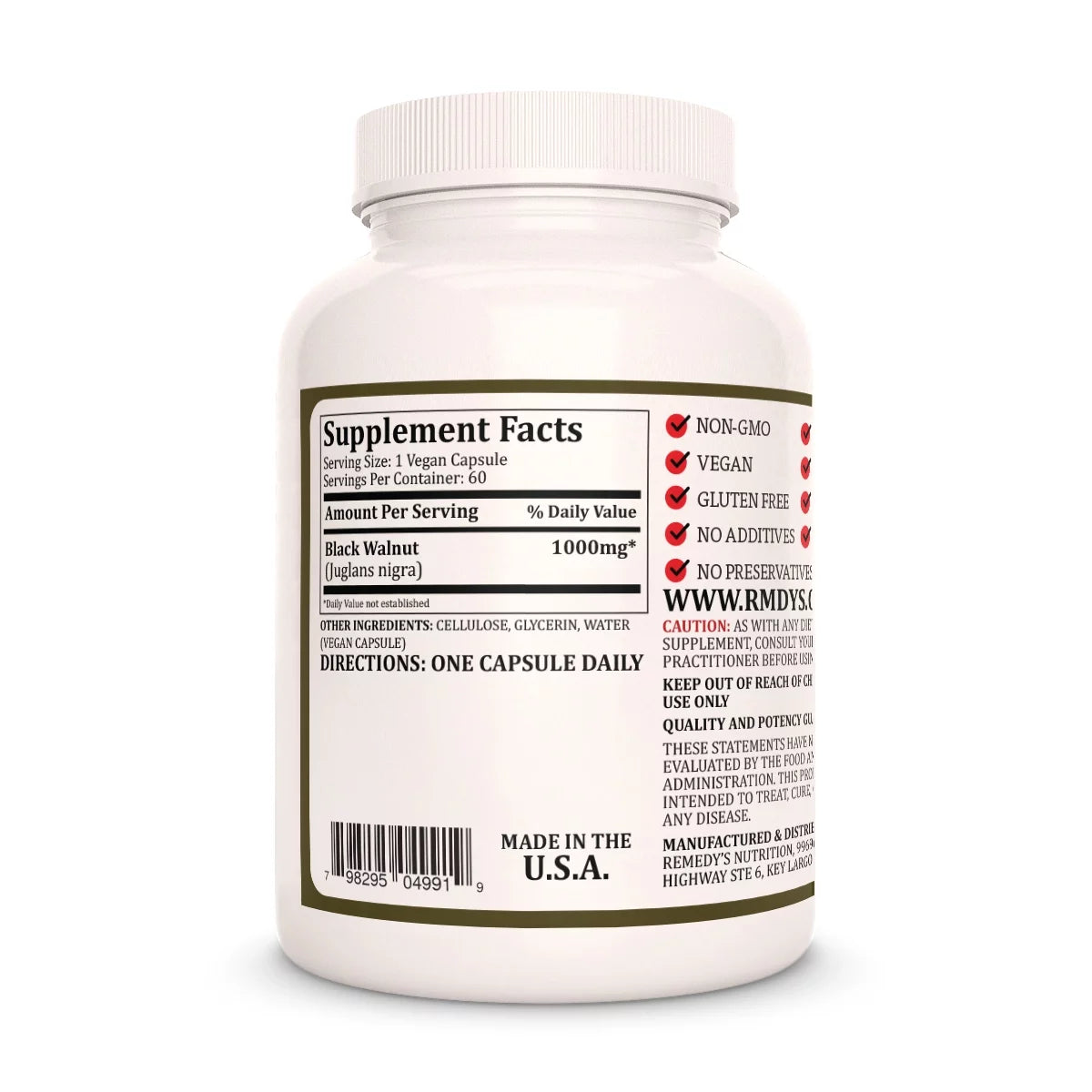
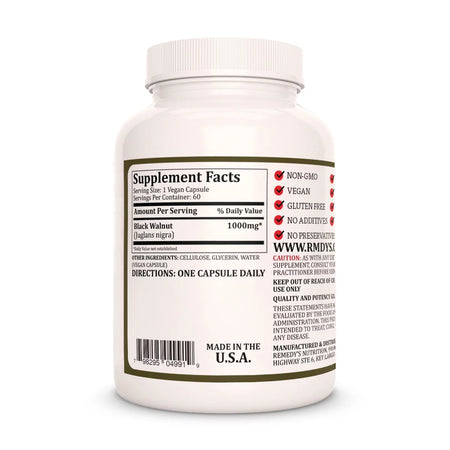
Supplement Facts
Serving size: 1 Vegan Capsule. Servings per container: 60.
| Amount Per Serving |
Amount |
% Daily Value |
| Black Walnut (Juglans nigra) |
1000 mg |
* |
* Daily Value not established.
Other ingredients: Cellulose, Glycerin, Water (vegan capsule)
Directions: One capsule daily.
Non-GMO, vegan, gluten free, no additives, no preservatives. Made in the USA.
Who Should Be Careful With This
This is not a list of side effects. It is the short list of situations where this ingredient is known to interact with something else, so you can check with your doctor or pharmacist before starting.
-
Contains tree nuts. Black walnut is a tree nut, one of the nine major US food allergens. Do not take it if you are allergic to tree nuts.
-
If you take a blood thinner, or you are pregnant or breastfeeding.
Source: FDA, Food Allergies — major food allergens.
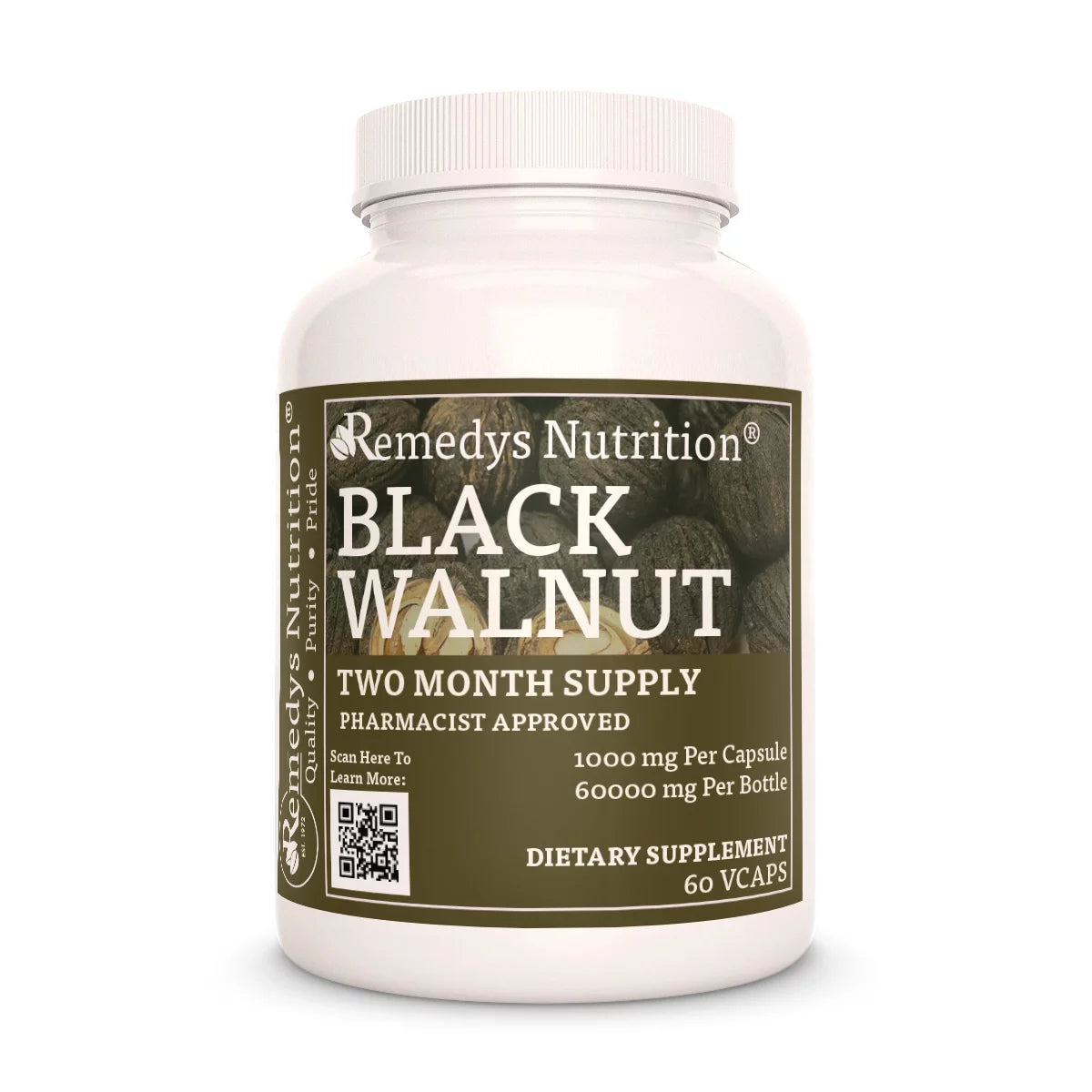
Black walnut capsules deliver 1000 mg of Juglans nigra hull powder per serving for traditional digestive cleansing, gut microbial balance, and skin support. Take 1 capsule up to 2 times daily for no more than 2 weeks at a time. Avoid with tree-nut allergy, in pregnancy, and during breastfeeding.
What Is Black Walnut?
Black walnut hulls are the green outer husks of Juglans nigra nuts, harvested before the woody shell hardens. The hulls contain juglone (a naphthoquinone with documented antimicrobial action), tannins (5 to 10% by weight), iodine traces, and ellagic acid. Native American and Eclectic herbalists used the hulls for over 200 years to support digestive cleansing. Each Remedy's capsule provides 1000 mg of dried hull powder.
For broader buying advice across our root-and-hull catalog, see the tincture catalog overview.
Black Walnut Benefits: Clinical Evidence
Black walnut has limited modern clinical trial data, with most research being in-vitro and ethnobotanical. The strongest evidence comes from microbial-inhibition lab studies and historical use protocols. Most traditional doses range 500 to 2000 mg daily for short cycles of 7 to 14 days.
| Benefit |
Key Finding |
Reference Dose |
| Antimicrobial in vitro |
Juglone inhibits 12 fungal and bacterial strains at concentrations of 10 to 50 mcg/mL |
Lab equivalent: 1000 mg oral |
| Digestive parasite cleansing (traditional) |
200 plus years of use in Native American and Eclectic medicine; no RCT data |
Traditional: 1500 to 2000 mg daily |
| Astringent skin action (topical, traditional) |
Tannin content (5 to 10%) tightens skin and reduces minor weeping |
Topical hull tea or 1 drop tincture |
| Antioxidant action |
Hull extracts show 32 to 48% DPPH free-radical scavenging in lab assays |
Lab concentration only |
| Iodine source |
Trace iodine (about 250 mcg per oz of green hull) supports thyroid in deficient states |
1000 mg supplies less than 5 mcg |
| Anti-inflammatory in vitro |
Ellagic acid inhibits COX-2 and reduces TNF-alpha in cell lines |
Lab only — clinical translation pending |
External research: Juglans nigra phytochemistry review (PMC), Juglone antimicrobial study (PubMed), and the NCCIH herbs directory.
Black Walnut for Digestive Cleansing
Black walnut is best known as 1 of 3 traditional herbs in the Hulda Clark cleanse protocol (alongside wormwood and clove), used historically for gastrointestinal microbial support. Modern in-vitro data confirms juglone inhibits 12 microbial strains, but no human RCT validates oral parasite-clearance claims. Use only in short 7 to 14-day cycles — long-term tannin exposure can irritate the gut lining and reduce iron absorption by 30 to 50%.
For digestive support that pairs with mild bitters, consider rotating with burdock root capsules in the off-weeks.
Use no longer than 14 consecutive days — tannin-induced GI irritation rises sharply after 2 weeks of continuous use, and iron absorption can drop 30 to 50% with prolonged exposure.
Black Walnut for Topical Skin Astringent Use (Traditional)
Beyond internal use, black walnut hull has a 200-year tradition of topical use for fungal skin conditions, ringworm, athlete's foot, and minor weeping wounds. The astringent tannin content (5 to 10% by weight) tightens skin and reduces minor surface inflammation. A typical traditional preparation is 1 capsule of contents stirred into 4 oz of warm water, cooled, and applied with a cotton pad 1 to 2 times daily for up to 7 days.
Topical use does not replace prescription antifungals for confirmed fungal infections like tinea, but it can be a complementary measure during the 2 to 4-week course of standard antifungal cream. Patch-test on a quarter-inch of skin first; tannin staining is harmless but cosmetically noticeable for 2 to 3 days.
How to Take Black Walnut Capsules
The standard adult dose is 1 capsule (1000 mg) once or twice daily, taken with food and 8 oz of water. Limit total daily dose to 2000 mg and total cycle to 14 days. Take a 2 to 4-week break before any second cycle. Always combine with a meal — tannins on an empty stomach cause nausea in 10 to 15% of users.
| Goal |
Dose |
Timing |
Duration |
| Short digestive cleanse |
1000 mg, 2x daily |
With breakfast and dinner |
10 to 14 days max |
| Gentle daily support |
1000 mg, 1x daily |
With largest meal |
7 days, then 2-week break |
| Astringent stool support |
1000 mg, 1 to 2x daily |
With food |
3 to 5 days |
| Off-cycle support |
None — rotate to other herbs |
Wait 2 to 4 weeks |
Resume only if needed |
For dosing principles across short-cycle herbs, see the introductory dosing rules framework.
Why Choose Remedy's Nutrition® Black Walnut
| What You Get |
Why It Matters |
| 1000 mg pure hull powder |
Most retail brands deliver 400 to 500 mg — we provide 2x the typical capsule dose |
| Green hull only, not whole nut |
The juglone and tannin compounds are concentrated in the green outer husk, not the kernel |
| Vegan HPMC capsule |
No gelatin, no animal byproducts — suitable for vegan diets |
| No fillers or excipients |
Just dried hull powder and the capsule shell — nothing else |
| USA-made, GMP facility |
Meets FDA 21 CFR 111 dietary supplement manufacturing standards |
| 60-count bottle |
Provides 2 full 14-day cycles with 4-week break, or 4 short 7-day cycles annually |
See our notes on quality herb sourcing and the capsule vs tincture form comparison.
Safety, Interactions and Contraindications
Tree-nut allergy and pregnancy contraindication. Black walnut is botanically unrelated to peanuts but cross-reactive with English walnut, pecan, and hickory in 30 to 60% of tree-nut allergic individuals. It is also contraindicated during all 3 trimesters of pregnancy and during breastfeeding due to juglone uterine effects.
| Concern |
Detail |
| Tree-nut allergy |
Cross-reactive with walnut family in 30 to 60% of tree-nut allergic individuals — do not use if reactive to pecan, hickory, or English walnut |
| Maximum 14-day cycles |
Tannin-induced GI irritation rises after 2 weeks. Iron absorption drops 30 to 50% with chronic use |
| Pregnancy and breastfeeding |
Absolute contraindication — juglone has documented uterine effects in animal models |
| Iron deficiency anemia |
Tannins bind dietary iron — do not use if anemic; if used, take 4 hours apart from iron supplements |
| Liver disease |
Insufficient safety data in advanced liver disease — avoid until cleared by hepatologist |
| Children under 12 |
No pediatric safety data — use only under qualified herbal practitioner guidance |
For broader risk context, see tannin herb cautions.
Frequently Asked Questions
What are the benefits of taking black walnut capsules? +
Black walnut capsules are traditionally used for 4 purposes: digestive cleansing (200 plus years of historical use), antioxidant support (32 to 48% DPPH scavenging in lab assays), gut microbial balance (juglone inhibits 12 strains in vitro), and astringent action from 5 to 10% tannin content. Modern RCT data is limited.
What are the side effects of taking black walnut? +
The most common side effects affect 10 to 15% of users: nausea on empty stomach, mild stomach upset, tongue staining (cosmetic, lasts 2 to 3 days), and constipation from tannin astringency. Rare reactions include allergic skin rashes in tree-nut allergic individuals and headache.
Does black walnut help with eczema? +
Topical black walnut tea has been used for over 100 years for weeping eczema, and its tannin content does provide astringent action. However, no human RCT has tested oral capsules for eczema specifically. Internal use may help only if eczema flares are linked to gut microbial imbalance — results vary widely.
What parasites does black walnut get rid of? +
In-vitro studies show juglone inhibits 12 fungal and bacterial strains plus several protozoan species at lab concentrations. However, no human RCT confirms oral capsule efficacy against intestinal parasites. Traditional use targeted pinworms and giardia, but modern parasitology recommends prescription antiparasitics for confirmed infections.
How long can I take black walnut capsules? +
Maximum 14 consecutive days, then a 2 to 4-week break. Continuous use beyond 2 weeks causes tannin-induced GI irritation in 20 to 30% of users and reduces iron absorption by 30 to 50%. Limit to 2 to 4 cycles per year for general support.
Can I take black walnut if I have a peanut allergy? +
Peanut allergy alone (botanical legume) does not predict black walnut reactivity. However, if you have a tree-nut allergy (almond, cashew, walnut, pecan), there is a 30 to 60% cross-reactivity risk. Always start with 1/4 capsule and observe for 2 hours before a full dose.
Does black walnut interact with medications? +
Black walnut tannins can reduce absorption of 6 medication classes when taken within 2 hours: iron supplements, levothyroxine, tetracycline antibiotics, fluoroquinolones, alendronate, and calcium. Separate dosing by at least 2 to 4 hours to maintain medication efficacy.
Is black walnut safe during pregnancy? +
No — black walnut is contraindicated during all 3 trimesters of pregnancy and during breastfeeding. Juglone has documented uterine effects in animal models, and human safety data is absent. Wait at least 6 weeks past weaning before using any black walnut product.
Can children take black walnut capsules? +
Black walnut should not be given to children under 12 without qualified herbal practitioner guidance. No pediatric safety data exists, and the tree-nut cross-reactivity risk is higher in children. For pediatric digestive concerns, see your pediatrician for evidence-based options.
Where does Remedy's black walnut come from? +
Our black walnut hulls are sourced from contract farms in the United States and tested in a GMP-certified facility for heavy metals, pesticides, and microbial contamination. Each 60-count bottle contains pure 1000 mg dried hull powder with 0 fillers or binders.
You May Also Like