
Most moringa pages quote the same line: 7 times the vitamin C of oranges and 17 times the calcium of milk. Those numbers are per 100 grams.
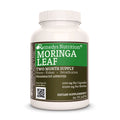
A capsule holds 1 gram. This page does the division the labels skip.
Quick Answer: How Much Nutrition Is in Moringa?
Per 100 g, dried moringa leaf powder is rich: 27.1 g protein, 2,003 mg calcium and 28.2 mg iron. But 2 capsules hold 2 g: about 0.54 g protein, 40 mg calcium, 0.56 mg iron and 0.35 mg vitamin C. That is a few percent of the Daily Value, with riboflavin the exception at about 32%.
Key Takeaways
- Nutrient multipliers for moringa are quoted per 100 g of dried powder.
- 2 capsules hold 2 g, which is exactly one fiftieth of that.
- At 2 g, calcium and iron each reach about 3% of Daily Value.
- Powder vitamin C is 17.3 mg per 100 g, not 220 mg.
- Riboflavin is the 1 exception, at about 32% of the Daily Value.
Related Products
Where the Famous Multipliers Come From
They are not invented. They compare 100 g of dried leaf powder with 100 g of other foods.
- Vitamin C: 7 times oranges, as quoted.
- Calcium: 17 times milk, as quoted.
- Iron: 25 times spinach, as quoted.
- Potassium: 15 times bananas, as quoted.
A 2021 review repeats all of these, then prints a table that quietly undercuts the first one.[1]Moringa oleifera is a Prominent Source of Nutrients with Potential Health Benefits — International Journal of Food Science (2021) View source What the plant is overall is in our moringa overview.
The Arithmetic at 1 and 2 Capsules
Here is that review's own powder column, divided down to what capsules actually hold.
| Nutrient, per 100 g of powder | 1 capsule, 1 g | 2 capsules, 2 g | Daily Value at 2 g |
|---|---|---|---|
| Protein, 27.1 g | 0.27 g | 0.54 g | About 1% |
| Calcium, 2,003 mg | 20 mg | 40 mg | About 3% |
| Iron, 28.2 mg | 0.28 mg | 0.56 mg | About 3% |
| Magnesium, 368 mg | 3.7 mg | 7.4 mg | About 2% |
| Potassium, 1,324 mg | 13 mg | 26 mg | Under 1% |
| Vitamin C, 17.3 mg | 0.17 mg | 0.35 mg | Under 1% |
| Riboflavin, 20.5 mg | 0.21 mg | 0.41 mg | About 32% |
Daily Values are the FDA's label references: 90 mg vitamin C, 1,300 mg calcium, 18 mg iron and 1.3 mg riboflavin.[2]Daily Value on the Nutrition and Supplement Facts Labels — U.S. Food and Drug Administration View source
At 1 capsule, use the middle column. Most rows round to a few percent at best.

The Vitamin C Problem
This is the claim worth checking yourself, because the source disproves it on its own page.
- Fresh leaves: 220 mg of vitamin C per 100 g.
- Dried powder: 17.3 mg per 100 g, on the same table.
- What changed: The leaf was dried and milled.
- What it means: The orange claim can only describe fresh leaves.
A separate drying study measured 271 mg of vitamin C per 100 g of fresh leaves, so the fresh figure itself is real.[3]Effect of dehydration methods on retention of carotenoids, tocopherols, ascorbic acid and antioxidant activity in Moringa oleifera leaves — Journal of Food Science and Technology (2014) View source
Composition Also Varies by Farm
Every number above is an average, and the plant takes up what its soil holds.
- Protein: 23% to 29% of dried leaf, across 2 regions.
- Calcium: 1.3% to 2.6%, a 2-fold range.
- Potassium: 1.3 to 2.0 g per 100 g.
- Implication: A label value is an estimate, not a measurement.
Those ranges came from leaves grown in 2 ecological zones of Bangladesh.[4]Nutritional and functional properties of Moringa oleifera — Metabolism Open (2020) View source Capsules hold dried leaf rather than seed, and why the leaf is the part in the capsule is its own question.

What 2 Grams Is Good For
None of this makes the leaf worthless. It makes it a small, measured serving of a green vegetable.
- Riboflavin: About a third of the Daily Value at 2 g.
- Trace elements: 35 were measured in dried leaves.
- Plant compounds: Polyphenols, which a nutrient table does not count.
- Not a replacement: For a multivitamin or for vegetables on the plate.
A Ghanaian analysis measured 35 elements in dried leaves and suggested a ceiling of 70 g a day.[5]Micro- and Macroelemental Composition and Safety Evaluation of the Nutraceutical Moringa oleifera Leaves — Journal of Toxicology (2014) View source Sold on that honest basis, our moringa leaf capsules give you 1 g of leaf each.
If You Wanted the Multiplier Amounts
You would need far more leaf than a capsule holds, and that has practical limits.
- 25 capsules: About 25 g, a quarter of the famous 100 g.
- 100 capsules: The amount the multipliers describe.
- Food trials: Some fed 20 g or more as a meal ingredient.
- Taste: At 20 g, acceptability was poor.
That meal study added 20 g of powder to a traditional dish and reported poor taste acceptability.[6]Effect of Moringa oleifera Leaf Powder on Postprandial Blood Glucose Response — Nutrients (2018) View source What a sensible routine looks like is in how much a day actually makes sense.
Speak to a Clinician Before Taking Moringa If
- You are pregnant, trying to conceive or breastfeeding
- You take metformin, insulin or another glucose-lowering medicine
- You take levothyroxine or are being treated for a thyroid condition
- You take blood pressure medicine, or are at high risk of blood clots
- You have reacted to moringa leaves before, with a rash, swelling or wheeze

Frequently Asked Questions
What nutrients is moringa high in? +
Per 100 g of powder: calcium, iron, magnesium, potassium, protein and riboflavin. At 2 g, only riboflavin reaches about 32% of the Daily Value.
Does moringa have 92 minerals? +
We found no source for that number. One analysis of dried leaves measured 35 elements, 14 major and 21 trace.
What is the best way to consume moringa? +
For nutrition, as a food in tens of grams. A capsule holds 1 g, which suits a measured routine rather than nutrient loading.
What happens if you take moringa powder every day? +
At 1 to 2 g you add a few percent of the Daily Value for most minerals. Food-sized amounts change that arithmetic.
How much vitamin C is in moringa powder? +
About 17.3 mg per 100 g on one review's table, so 2 g holds roughly 0.35 mg. Fresh leaves hold about 220 mg per 100 g.
Is moringa high in protein? +
Dried leaf is about 27% protein. But 2 g of leaf gives about 0.54 g, around 1% of the 50 g Daily Value.
How much iron is in moringa? +
About 28.2 mg per 100 g of powder. 2 capsules supply about 0.56 mg, roughly 3% of the 18 mg Daily Value.
Is moringa better than a multivitamin? +
Not for measured amounts. A multivitamin states its doses, while 2 g of moringa supplies under 5% of most Daily Values.
Why do moringa labels quote 100 g? +
Because the comparisons are made weight for weight. 100 g is the standard reference, and it equals about 100 capsules.
Related Reading
Related Products