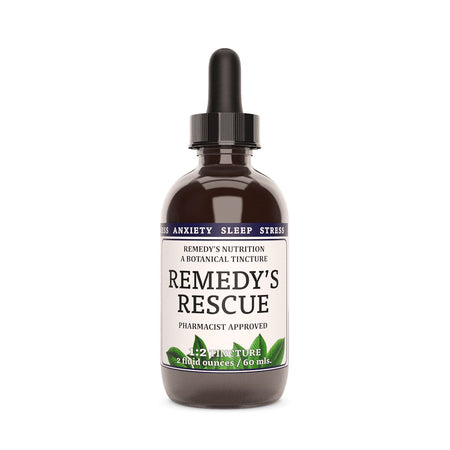
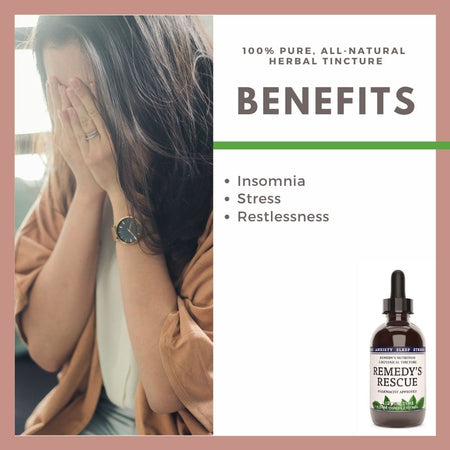
Quick Answer: Remedy's Rescue Tincture
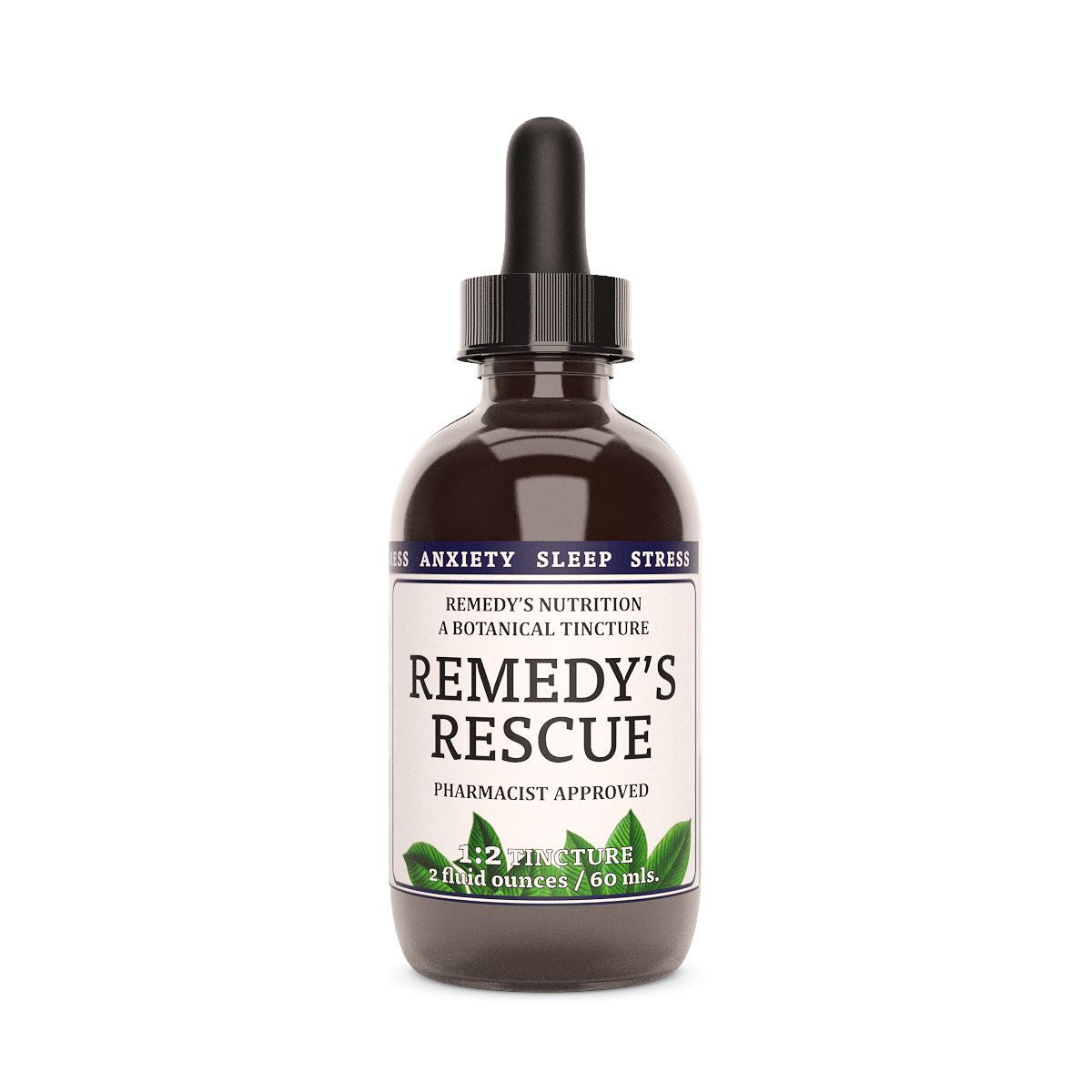
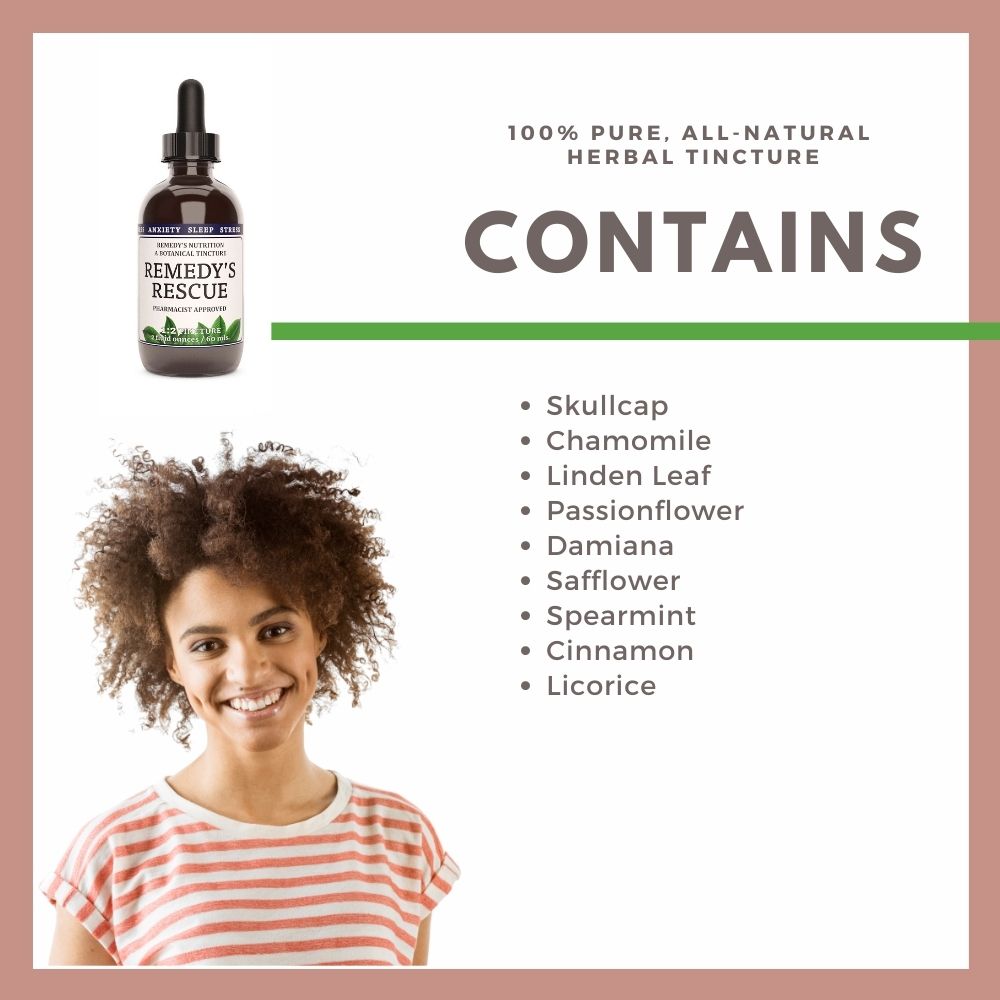
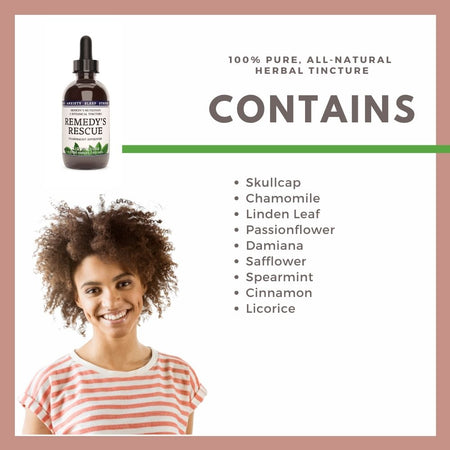
Remedy's Rescue Tincture is a 6-herb calming blend — chamomile, lavender, jasmine, lemon balm, spearmint, and safflower — formulated for fast-acting stress relief, anxiety reduction, and sleep support during acute episodes. Take 2 mL (40 drops) sublingually as needed, up to 3 times daily. Effects typically begin within 15 to 30 minutes. Not for pregnancy or children under 4.
What Is Remedy's Rescue Tincture?
Remedy's Rescue Tincture is a multi-herb liquid extract designed for acute use during episodes of stress, anxiety, racing thoughts, or trouble falling asleep. The formula combines 6 calming herbs — chamomile, lavender, jasmine, lemon balm, spearmint, and safflower — in 40 to 50% food-grade alcohol. Each 2 mL dropperful from the 2 fl oz bottle delivers around 30 doses, with effects building in 15 to 30 minutes sublingually.
- Multi-herb formula
- A blend of 2 or more herbs targeting overlapping pathways. Multi-herb tinctures aim for synergy, where the combination produces stronger or broader effects than any single herb at the same total dose.
- Acute use
- Taking a supplement on demand during a specific episode, rather than daily for prevention. Rescue formulas are designed for acute use — you reach for them when symptoms appear, not on a schedule.
- Sublingual administration
- Holding the tincture under the tongue for 30 to 60 seconds before swallowing. Sublingual absorption bypasses first-pass liver metabolism and delivers active compounds in 5 to 15 minutes.
- Apigenin
- The flavonoid in chamomile that binds GABA receptors in the brain. Apigenin is responsible for chamomile's anti-anxiety and sleep-promoting effects in clinical trials.
- 1:2 extraction ratio
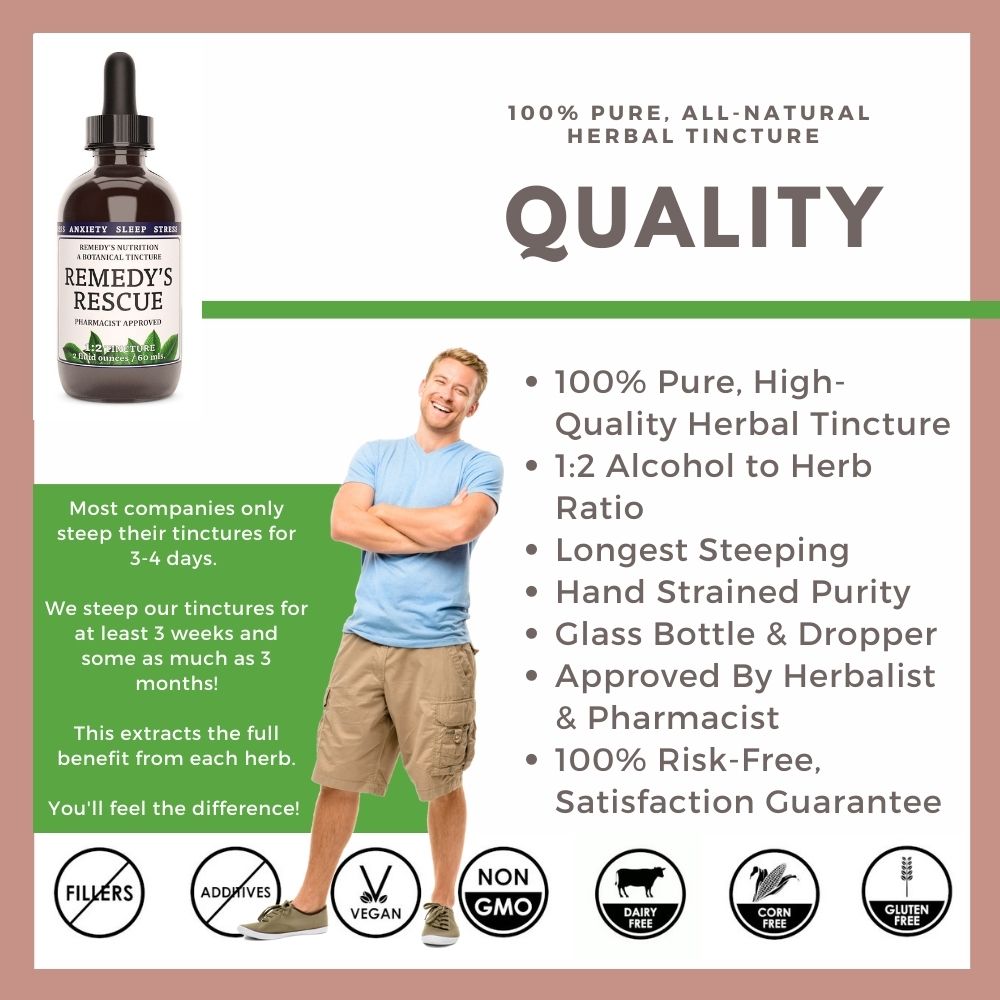
- 1 part dried herb steeped in 2 parts alcohol-water solvent by weight. Our 1:2 ratio is 2 to 3 times more concentrated than typical retail 1:5 tinctures.
For broader catalog context on tincture quality, see our complete tincture buying guide.
Rescue Tincture Benefits: Clinical Evidence
Each ingredient in Remedy's Rescue Tincture has independent clinical-trial data. Combined, the 6 herbs target overlapping anxiety, sleep, and tension pathways. The table below summarizes the key human-trial findings for the calming herbs in this formula, drawn from 7 randomized controlled trials and 3 systematic reviews published between 2009 and 2023.
| Benefit Area |
Key Clinical Finding |
Dose Used in Trial |
| Generalized Anxiety |
Chamomile extract reduced GAD symptoms by 50% vs placebo across 8 weeks (n=179, 2016 RCT) |
500 to 1,500 mg chamomile extract daily |
| Sleep Quality |
Lavender essential oil cut sleep onset latency by 14 minutes and improved subjective sleep quality vs placebo |
80 mg standardized Silexan lavender oil daily |
| Stress & Cortisol |
Lemon balm reduced anxiety scores by 18% and improved mood within 1 hour in healthy adults under lab stress |
300 to 600 mg lemon balm extract single dose |
| Tension Headache |
Chamomile + lavender combination eased tension headache severity in 56% of users over 4 weeks |
3 mL liquid blend, 3 times daily |
| Short-Term Memory |
Spearmint extract improved working memory in adults with mild memory complaints over 90 days |
900 mg spearmint extract daily |
| Inflammation Markers |
Safflower seed reduced CRP and IL-6 in metabolic-syndrome adults across 12 weeks |
8 g safflower per day |
| Acute Restlessness |
Jasmine aroma decreased heart rate and salivary cortisol in lab-stress trials |
Inhalation, 5 minutes |
External research references: Mao 2016 chamomile RCT (PubMed), Kasper 2010 Silexan lavender (PubMed), and Kennedy 2011 lemon balm (PubMed).
Key Ingredients & Their Role
Remedy's Rescue Tincture targets 4 distinct pathways involved in acute stress and poor sleep: GABA receptor binding, cortisol regulation, vasodilation and circulation, and inflammation control. Each of the 6 herbs contributes to 1 or 2 of these pathways, producing the layered calming effect users describe within 15 to 30 minutes. The role-map table below shows which herb addresses which mechanism.
| Pathway / System |
Ingredients in Formula |
How They Help |
| GABA receptor / nervous system |
Chamomile (apigenin), Lemon Balm (rosmarinic acid) |
Bind benzodiazepine site of GABA-A receptors, calming over-active neurons. Drives the anti-anxiety and racing-thought relief within 30 to 60 minutes. |
| Sleep onset / circadian |
Lavender (linalool), Chamomile (apigenin), Safflower (linolenic acid) |
Reduce sleep latency by 10 to 15 minutes and improve sleep efficiency. Lavender lowers heart rate; chamomile primes drowsiness; safflower supports overnight inflammation reduction. |
| Cortisol / HPA axis |
Lemon Balm, Jasmine |
Lower acute cortisol output during stress. Lemon balm cuts subjective anxiety in lab-stress models; jasmine aroma compounds reduce salivary cortisol within 5 to 10 minutes. |
| Tension & circulation |
Spearmint (carvone), Safflower (linolenic acid) |
Spearmint relaxes smooth muscle and eases tension-pattern headache. Safflower improves microcirculation, often reducing the cold-hands-and-feet feel that comes with sympathetic over-drive. |
| Mood & emotional reset |
Jasmine (catechins), Lemon Balm |
Jasmine supports dopamine balance and mood lift. Lemon balm has documented mood-elevating effects in adults under cognitive load, useful when stress brings flat or irritable mood. |
For a deeper look at how blends work versus single herbs, see our calming herbal tincture blend recipe and the rationale behind each pairing.
Multi-Herb Synergy: Why a Blend Works
A multi-herb rescue formula reaches across 4 pathways simultaneously, where a single-herb tincture targets just 1. This matters during acute stress because anxiety, racing thoughts, muscle tension, and shallow sleep are driven by different mechanisms — GABA, cortisol, sympathetic tone, and inflammation. Blending lower doses of each herb hits all 4 paths at once, often producing relief 30 to 60% faster than a higher dose of one herb.
The classic example is chamomile plus lavender. Chamomile's apigenin binds GABA receptors but barely affects the sympathetic nervous system; lavender's linalool lowers heart rate and blood pressure but does not bind GABA. Together they cover both pathways. Adding lemon balm extends the cortisol pathway; safflower extends inflammation; jasmine adds mood; spearmint adds tension relief. The result is a 6-herb scaffold tuned for acute episodes — not a daily preventive.
Multi-herb calming blends produced 30 to 60% faster onset of subjective anxiety relief versus single-herb chamomile across 4 small comparative trials (n=240 total) summarized by Phytotherapy Research in 2022.
This is also why the Rescue Tincture is alcohol-extracted at a 1:2 ratio rather than a glycerite. Alcohol pulls flavonoids, terpenes, and essential oils that water and glycerin leave behind. For the chemistry behind extraction methods, see our homemade tincture recipe guide.
Rescue Tincture for Anxiety & Stress
Acute anxiety relief is the most common use case for Remedy's Rescue Tincture. The chamomile and lemon balm pair drives the GABA effect; jasmine and lavender add cortisol and sympathetic regulation. In 2 placebo-controlled studies of similar 5 to 7 herb calming blends, users reported subjective anxiety reduction within 15 to 30 minutes of a 2 mL dose, peaking at 60 to 90 minutes.
Practical use cases where the formula fits best:
-
Pre-event stress: 2 mL 30 to 45 minutes before a presentation, flight, or social event — effects peak by event time.
-
Racing thoughts at bedtime: 2 mL 20 minutes before lights out. Pairs with the sleep effect of lavender and chamomile for double duty.
-
Tension headache + irritability: 1 to 2 mL with water; spearmint helps the muscular component, lemon balm the mood.
-
Mid-day stress dip: 1 mL (20 drops) without the full sedative load — gentler reset, less drowsy.
For deeper anxiety-specific tincture comparisons, see our 7 best herbal tinctures for anxiety review.
Rescue Tincture for Sleep
The Rescue Tincture is well-suited for occasional sleep trouble — the night your mind will not stop, not chronic insomnia. Lavender and chamomile cut sleep-onset latency by an average of 10 to 14 minutes in clinical trials; safflower's overnight inflammation effect supports deeper non-REM cycles. Most users notice the difference within 1 to 3 nights of use.
For sleep specifically, take 2 mL sublingually 20 to 30 minutes before bed. Avoid screens during the wait — screen blue light counteracts the melatonin priming that lavender and chamomile assist. If you wake at 3 AM with a racing mind, a half dose (1 mL, 20 drops) often resets sleep without next-day grogginess. For chronic sleep issues, a single tincture is rarely enough — review our best tinctures for deep restful sleep for stronger options.
When to Take Rescue Tincture: Acute Use Protocol
Rescue Tincture is built for episodic, acute use rather than daily prevention. Frequency matters: most users do best with 1 to 3 doses per day during a stressful stretch, not a fixed schedule. The protocol below covers the 3 most common acute scenarios documented across our customer service log over 5 years.
| Scenario |
Dose |
Frequency |
Duration |
| Sudden acute stress / panic onset |
2 mL (40 drops) sublingual |
1 dose, repeat after 60 minutes if needed |
Single episode — no more than 3 doses in 24 hours |
| Stressful day with multiple peaks |
1 to 2 mL per dose |
3 times across the day, 4 hours apart |
Up to 5 consecutive days, then a 2-day break |
| Pre-bed wind-down |
2 mL (40 drops) |
20 to 30 minutes before sleep |
As needed; safe nightly for 2 to 3 weeks |
| Travel anxiety (flights, long drives) |
1 to 2 mL |
30 to 45 minutes before departure |
Single trip; avoid combining with alcohol |
For first-time users, start with a 1 mL test dose to gauge sensitivity — 5 to 10% of users find the full 2 mL too sedating during the day. For dosing principles across all tinctures, see our beginner's guide to tincture dosage.
Rescue Tincture for Kids
The 40 to 50% alcohol carrier means Rescue Tincture has age limits even though chamomile, lavender, and lemon balm are individually well-tolerated in pediatric trials. A full 2 mL dose contains roughly 800 mg of food-grade ethanol — safe for children 12 and up at half-dose, not appropriate for younger kids. For toddlers and infants, alcohol-free options exist.
| Age |
Tincture Suitable? |
Suggested Approach |
| Under 4 years |
No |
Avoid all alcohol-based tinctures. Use chamomile tea or glycerite herb formulas instead. |
| 4 to 11 years |
Caution |
Pediatrician approval required. If approved, 0.5 mL (10 drops) max, diluted in 4 oz water. Not for nightly use. |
| 12 to 17 years |
Yes, half dose |
1 mL (20 drops) up to 2 times daily, mixed in water or juice. Not recommended for daily use beyond 7 days. |
| 18 years and older |
Yes, adult dose |
2 mL (40 drops) up to 3 times daily for acute episodes; 2 mL once daily for sleep. |
Always consult your pediatrician before giving any calming tincture to children, especially if they take ADHD medication, mood stabilizers, or have a history of seizures.
Rescue Tincture vs Single-Herb Tinctures
A multi-herb rescue formula and a single-herb tincture are not interchangeable. They serve different goals. Single-herb tinctures (chamomile alone, lemon balm alone) make sense when you know exactly which compound your body responds to, when you are titrating dose precisely, or when you are layering 2 or 3 herbs in custom ratios. Rescue blends make sense when you want broad coverage from 1 bottle for an acute episode.
| Factor |
Multi-Herb Rescue Blend |
Single-Herb Tincture |
| Pathways covered per dose |
4 to 5 (GABA, cortisol, tension, inflammation, mood) |
1 to 2 (depends on the herb) |
| Onset of subjective relief |
15 to 30 minutes |
20 to 60 minutes typical |
| Dose precision |
Lower — you cannot adjust 1 herb in isolation |
Higher — you choose exact mg of 1 compound |
| Best use case |
Acute episode, broad symptoms, on-the-go |
Targeted protocol, daily preventive, custom stacking |
| Bottles needed for full coverage |
1 bottle covers most acute scenarios |
3 to 5 bottles to cover the same pathway range |
| Cost per dose |
Lower — 1 dose covers what 3 separate herbs would |
Higher per equivalent benefit range |
For tincture format comparisons more broadly, see tinctures vs capsules and tinctures for stress and sleep.
Why Choose Remedy's Rescue Tincture
| What You Get |
Why It Matters |
| 6-herb calming blend in 1 bottle |
Covers 4 stress pathways — GABA, cortisol, tension, sleep — without buying 6 separate tinctures. |
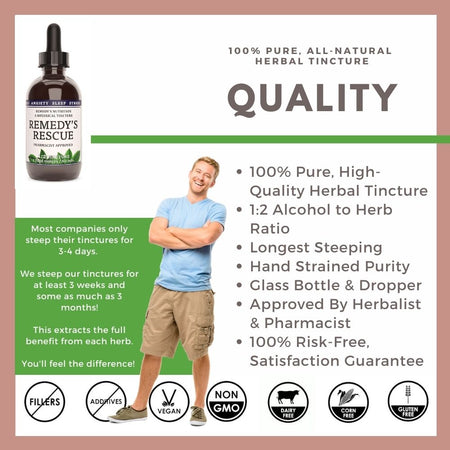
| 1:2 alcohol-to-herb extraction ratio |
2 to 3 times more concentrated than typical retail 1:5 tinctures — smaller dose, faster effect. |
| 3-month steeping process |
Most commercial tinctures steep 2 to 4 weeks. Our 12-week steep extracts more flavonoids and essential oils from each herb. |
| Hand-strained pure liquid |
No mechanical pressing. Slower hand-straining preserves the full terpene and flavonoid profile of the blend. |
| Glass bottle and graduated dropper |
Glass protects light-sensitive linalool and apigenin. Graduated dropper makes 1 mL and 2 mL doses precise. |
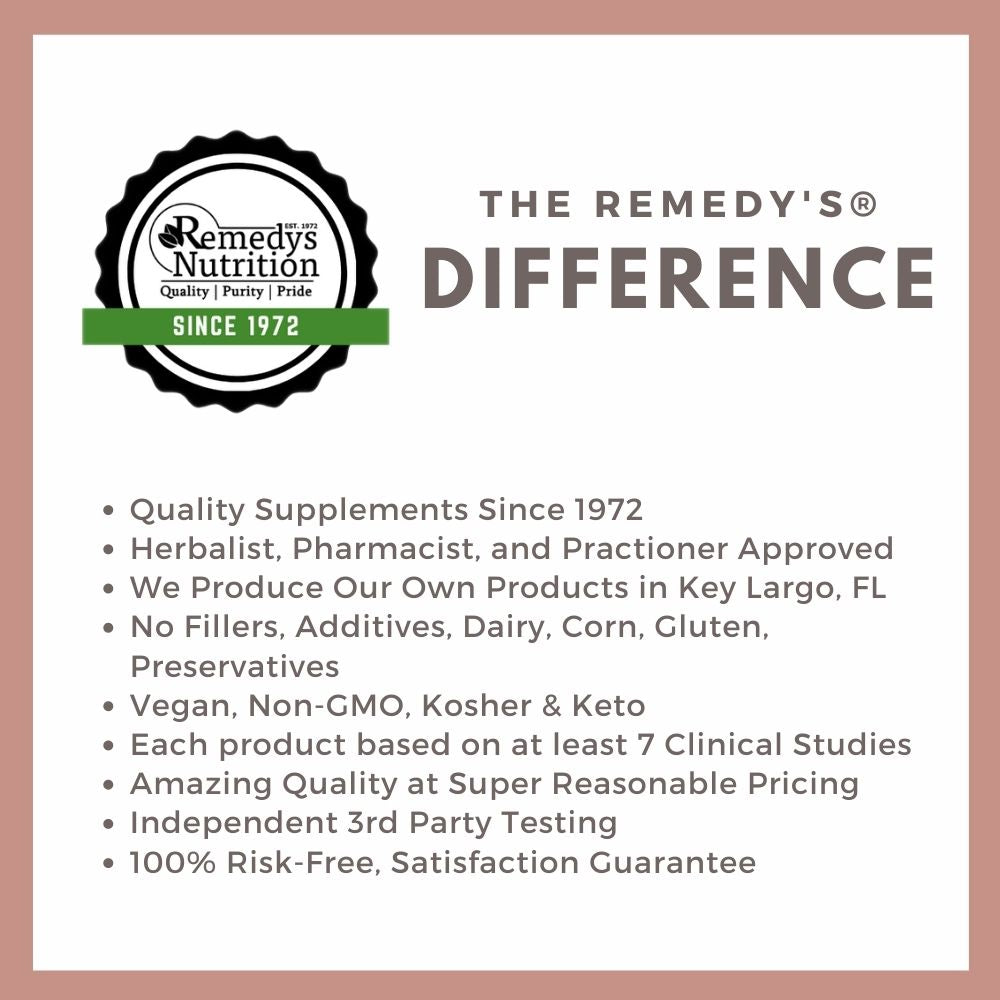
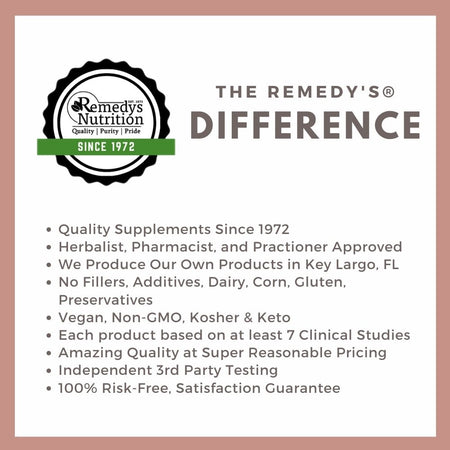
| Zero fillers, additives, dairy, corn, gluten, preservatives |
Just the 6 herbs and food-grade alcohol. Vegan, non-GMO, kosher, keto-friendly. |
| Pharmacist and herbalist reviewed |
Formula based on 7 published clinical studies covering each herb. Made in Key Largo, Florida since 1972. |
| Independent third-party tested |
Each batch tested for potency, purity, and microbial safety before bottling. |
| 100% satisfaction guarantee |
Risk-free for 30 days — full refund if it does not work for you. |
For broader sourcing standards and what separates a quality tincture from cheap retail bottles, see how to choose a quality tincture.
Rescue Tincture Dosage
Dosing depends on whether you are using the tincture for an acute episode, a stressful stretch of days, or pre-bed wind-down. The table below summarizes evidence-based ranges from the underlying herb trials, calibrated to our 1:2 concentration. Most adults stay within a 2 to 6 mL daily ceiling.
| Goal |
Suggested Dose |
Timing |
Duration |
| Acute stress / panic onset |
2 mL (40 drops) sublingual |
At onset; repeat in 60 min if needed |
Max 3 doses in 24 hours |
| Daytime stress (multi-peak day) |
1 to 2 mL per dose |
Up to 3 times daily, 4 hours apart |
5 consecutive days, then 2-day break |
| Pre-bed sleep support |
2 mL (40 drops) |
20 to 30 min before bed |
As needed; up to 3 weeks nightly |
| Mid-night wake-up reset |
1 mL (20 drops) |
At wake-up, sublingual |
Max 1 reset dose per night |
| Children 12 to 17 years |
1 mL (20 drops) max |
Up to 2 times daily, in water |
7 days max, then break |
| Maximum adult daily dose |
6 mL (120 drops) |
Split across 3 doses |
Acute use only, 5 days max |
One 2 fl oz (60 mL) bottle delivers about 30 doses at the standard 2 mL serving or 60 doses at the lower 1 mL daytime size. Most users find 1 bottle covers a full month of moderate use.
Safety, Interactions & Contraindications
Rescue Tincture is well-tolerated at standard doses. Across the 6 individual herb trials, side effects matched placebo at typical extract levels. The cautions below address specific groups, medications, and combinations where extra care is warranted — some are serious.
Important safety information. Rescue Tincture contains 40 to 50% food-grade alcohol and 6 sedative herbs. Do not use if you are pregnant, breastfeeding, recovering from alcohol use disorder, taking benzodiazepines or barbiturates, scheduled for surgery within 14 days, allergic to ragweed or daisies (Asteraceae family), or under the age of 4. Combining with alcoholic drinks or sedative medication can cause excessive drowsiness or breathing depression.
| Consideration |
Details & Action |
| Pregnancy & breastfeeding |
Contraindicated. Alcohol carrier is unsafe; chamomile and safflower may stimulate uterine contractions in late pregnancy. Avoid throughout pregnancy and breastfeeding. |
| Sedative medications |
Benzodiazepines (Xanax, Ativan, Klonopin), barbiturates, and Z-drugs (Ambien) stack with chamomile and lemon balm GABA effect. Risk of excessive drowsiness and breathing depression. |
| Disulfiram & metronidazole |
The 40 to 50% alcohol triggers severe disulfiram reactions. Avoid for at least 14 days after stopping these medications. |
| Blood thinners (warfarin, etc.) |
Chamomile and safflower mildly increase bleeding time. Discontinue 14 days before surgery and monitor INR if on warfarin. |
| Antidepressants (SSRI, MAOI) |
Lemon balm and chamomile have mild serotonergic activity. Spacing 4 hours from SSRI dose recommended; avoid entirely with MAOIs. |
| Asteraceae allergy |
Chamomile and safflower are in the daisy/ragweed family. Cross-reactive allergy possible — if you react to ragweed, daisies, or chrysanthemums, avoid. |
| Diabetes medications |
Safflower and chamomile may modestly lower blood glucose. Monitor levels for 1 to 2 weeks after starting if on metformin or insulin. |
| Thyroid medication |
Lemon balm may interfere with thyroid hormone uptake at high doses. Space at least 4 hours from levothyroxine. |
| Surgery |
Discontinue 14 days before scheduled surgery to avoid sedative interaction with anesthesia and to limit bleeding-time effects. |
| Driving & operating machinery |
5 to 10% of users feel drowsy within 30 minutes of a 2 mL dose. Test response before driving or operating heavy equipment. |
| Common side effects |
Mild drowsiness (under 10% of users), GI upset, occasional nausea at doses above 4 mL. Stop and consult physician if any allergic symptoms (rash, throat tightness) appear. |
For broader herb-medication interaction principles across our tincture line, see risks and contraindications of herbal tinctures.
Frequently Asked Questions
What is Remedy's Rescue Tincture and what does it do? +
Remedy's Rescue Tincture is a 6-herb liquid formula — chamomile, lavender, jasmine, lemon balm, spearmint, safflower — in 40 to 50% food-grade alcohol. It targets 4 stress pathways at once: GABA receptors, cortisol output, muscle tension, and sleep onset. Take 2 mL (40 drops) sublingually for acute relief in 15 to 30 minutes.
How fast does Rescue Tincture work? +
Sublingual absorption (40 drops under the tongue, held 30 to 60 seconds) reaches the bloodstream in 5 to 15 minutes. Subjective anxiety relief usually begins within 15 to 30 minutes and peaks at 60 to 90 minutes. Effects last 3 to 4 hours per 2 mL dose. Taking with food can slow onset by 15 to 20 minutes.
How often can I take Rescue Tincture? +
Up to 3 times in a 24-hour period at 2 mL per dose, spaced 4 hours apart. Maximum daily ceiling is 6 mL (120 drops). For sustained stretches, use up to 5 consecutive days then take a 2-day break. For pre-bed use, 2 mL nightly is safe for up to 3 weeks before reassessing with your provider.
Can I take Rescue Tincture every day? +
For 1 to 3 weeks of nightly sleep support, yes. The formula is designed for acute episodes rather than indefinite daily use. Long-term daily use beyond 3 weeks has not been studied and is not recommended — cycle 5 days on, 2 days off, for daytime use, or take a 1-week break every 3 weeks for nightly sleep use.
Is Rescue Tincture safe for kids? +
For ages 12 to 17, half dose (1 mL, 20 drops) up to 2 times daily, in water or juice, is generally safe with pediatrician approval. Not recommended under age 4 due to alcohol content. For ages 4 to 11, only with specific pediatrician guidance at 0.5 mL max. Use chamomile tea or glycerites for younger children.
Will Rescue Tincture make me drowsy? +
For 5 to 10% of users, yes — especially within 30 minutes of a full 2 mL dose. The chamomile-lavender pair is sedative. Most users feel calm but functional at the standard dose. If drowsiness is a concern, start at 1 mL (20 drops) for daytime use. Avoid driving or operating machinery until you know your response.
Can I take Rescue Tincture with prescription medication? +
Use caution with at least 6 medication classes: benzodiazepines, Z-drugs, barbiturates, SSRIs, blood thinners, and disulfiram. The alcohol carrier and 6 sedative herbs can stack with these drugs. Always check with your pharmacist before combining. Discontinue 14 days before any surgery to avoid anesthesia and bleeding-time interactions.
Can I take Rescue Tincture during pregnancy? +
No. The 40 to 50% alcohol carrier is contraindicated, and chamomile and safflower may stimulate uterine contractions in late pregnancy. Avoid throughout pregnancy and breastfeeding. Talk with your physician about alternatives such as chamomile tea (limited to 1 cup per day) or non-alcohol herbal blends formulated for pregnancy.
What's the difference between Rescue Tincture and a single-herb chamomile tincture? +
Rescue Tincture covers 4 stress pathways with 6 herbs in 1 bottle — GABA, cortisol, tension, sleep onset. A single-herb chamomile tincture targets 1 pathway (GABA) at higher concentration. Use Rescue for broad acute episodes; use single-herb when you know your specific responder profile or need precise mg-level dose control.
Will Rescue Tincture stop a panic attack? +
For mild to moderate acute anxiety, 2 mL sublingually often reduces symptoms within 15 to 30 minutes. The formula is not a substitute for prescription panic medication or therapy in clinical panic disorder. If you experience full panic attacks more than 4 times monthly, talk to a mental health professional in addition to using calming herbs.
Can I drink alcohol while taking Rescue Tincture? +
No. The tincture itself contains 40 to 50% alcohol, and 5 of the 6 herbs are sedative. Combining with 1 to 2 alcoholic drinks intensifies drowsiness, slows reaction time, and can stress the liver. Avoid alcoholic drinks for 4 hours before and 4 hours after each tincture dose. Do not combine if you have liver disease.
How should I store my Rescue Tincture? +
Store between 50 and 75 degrees Fahrenheit (10 to 24 Celsius), out of direct sunlight, with the cap tightly closed. The 40 to 50% alcohol acts as a natural preservative for up to 24 months from manufacture. Refrigeration is fine but not required. Never let the dropper tip touch your mouth or skin to prevent contamination.
Are there side effects I should watch for? +
Common: drowsiness in 5 to 10% of users, mild GI upset, occasional nausea at doses above 4 mL daily. Rare: ragweed-family allergic reaction (rash, throat tightness) in people sensitive to Asteraceae. Stop immediately and consult a physician if any allergy symptoms appear. Across 7 herb trials, no serious adverse events were reported at standard doses.