
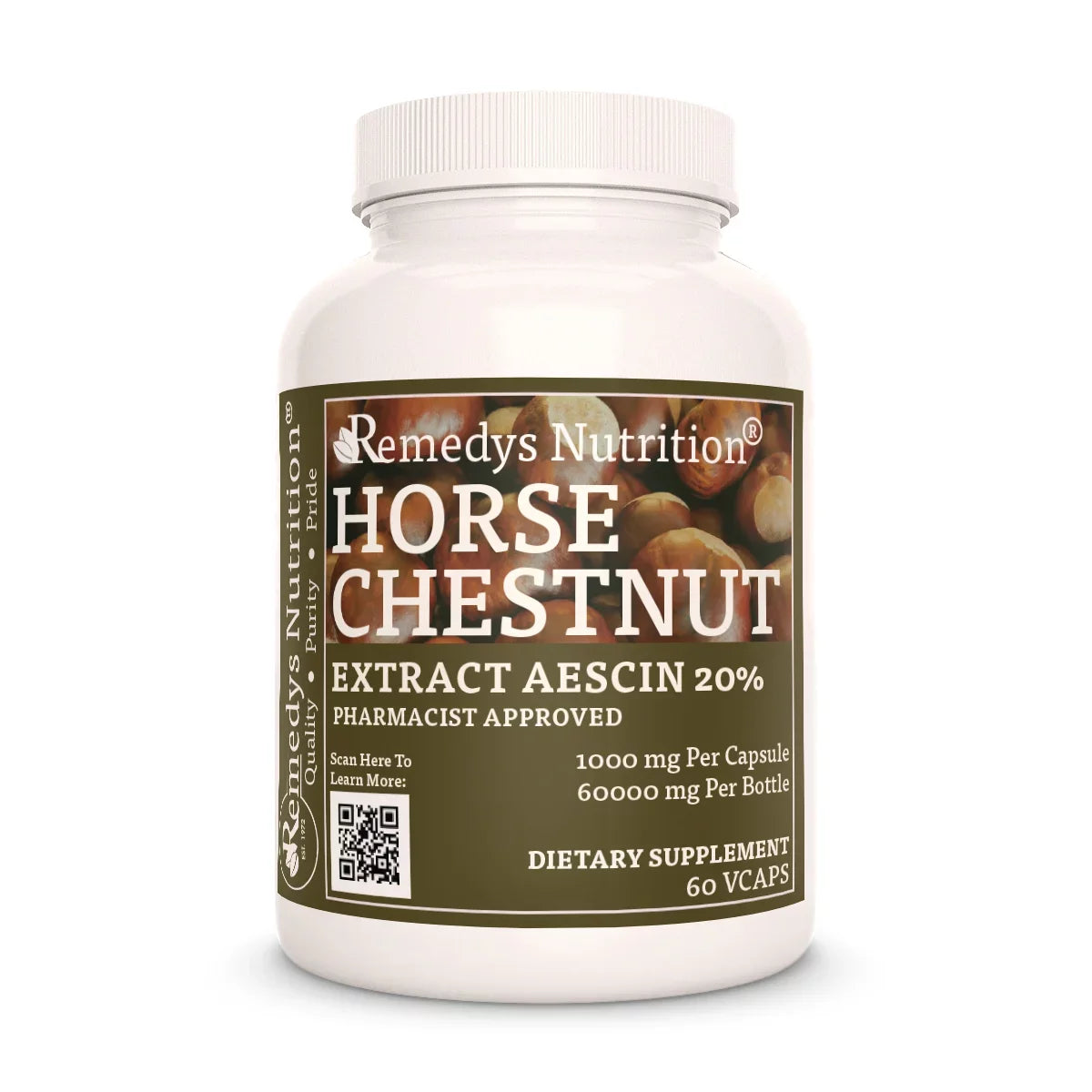





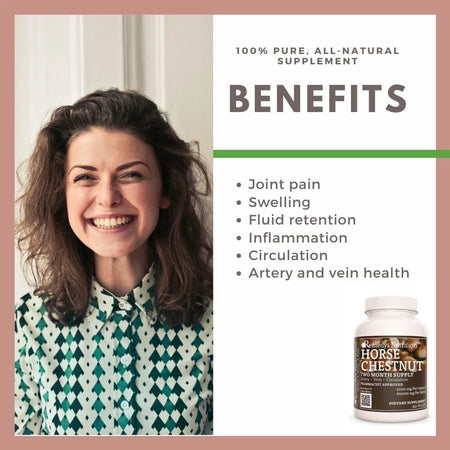





Horse Chestnut Extract Aescin Content 20% 1000 mg 60 Vegan Capsules
- Supports Vascular Structure & Function*
- Promotes Healthy Circulation & Blood Flow*
- Aescin-Rich Extract for Vein, Leg & Circulation Comfort*


Couldn't load pickup availability
*These statements have not been evaluated by the Food and Drug Administration. This product is not intended to diagnose, treat, cure, or prevent any disease.
Quick Answer: Horse Chestnut Extract
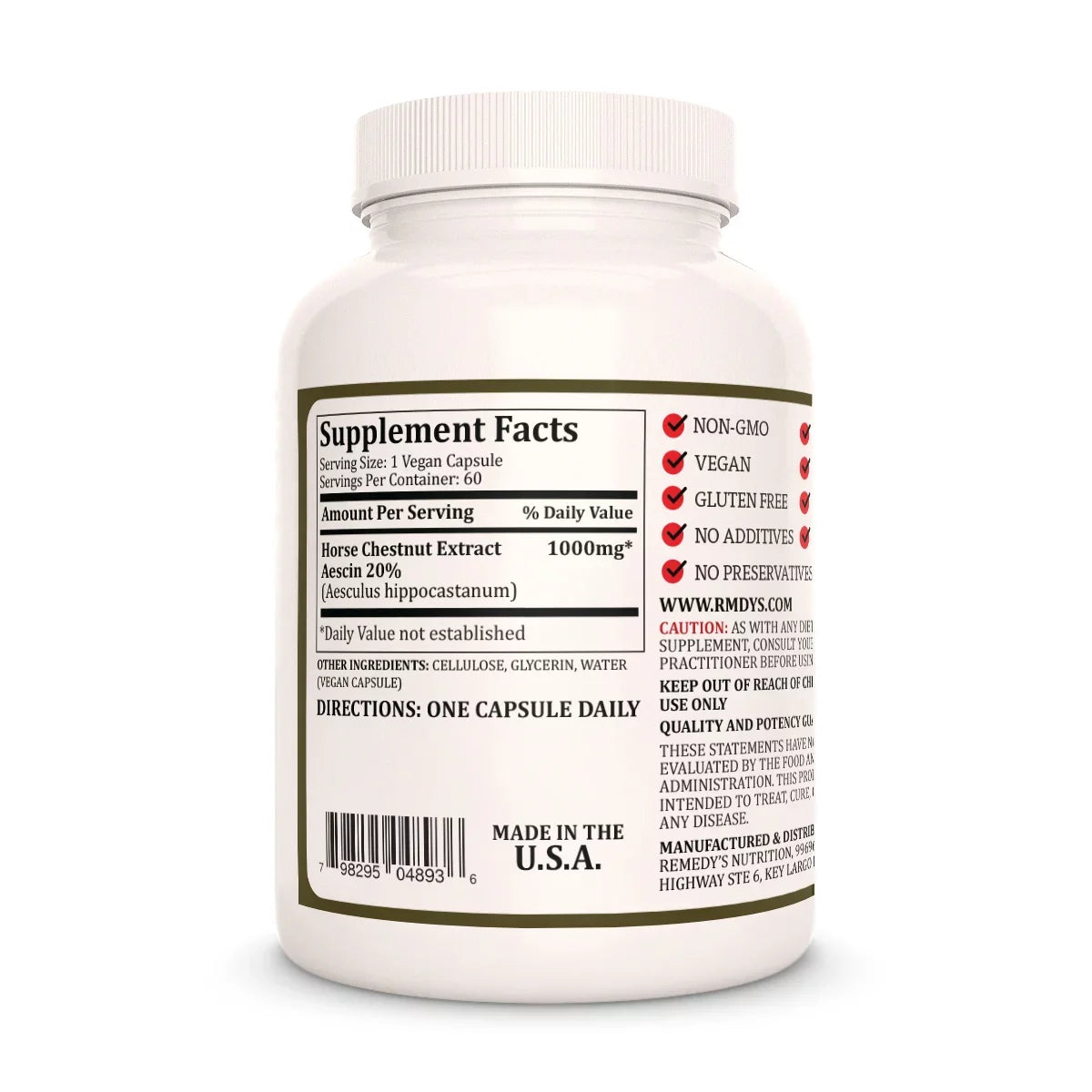
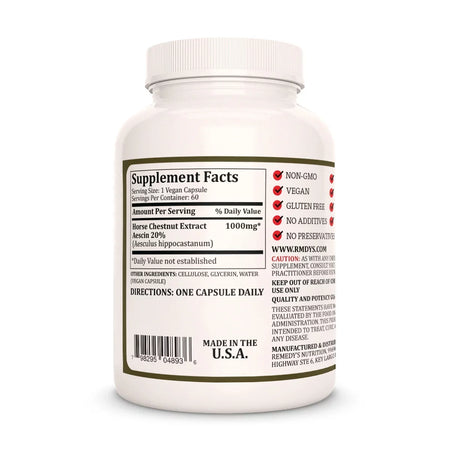
Supplement Facts
Serving size: 1 Vegan Capsule. Servings per container: 60.
| Amount Per Serving | Amount | % Daily Value |
|---|---|---|
| Horse Chestnut Extract, Aescin 20% (Aesculus hippocastanum) | 1000 mg | * |
* Daily Value not established.
Other ingredients: Cellulose, Glycerin, Water (vegan capsule)
Directions: One capsule daily.
Non-GMO, vegan, gluten free, no additives, no preservatives. Made in the USA.
Horse chestnut extract delivers 1,000 mg standardized to 20% aescin (200 mg per capsule), the venous-tonic compound that supports leg circulation, vein health, and reduces ankle and lower-leg swelling. Take 2 capsules daily for 8 to 12 weeks. The extract removes the toxic raw-seed compound esculin. Avoid in pregnancy and severe kidney disease.
What Is Horse Chestnut Extract?
Standardization is what separates a clinical-grade extract from a commodity powder. Because effect tracks aescin content, a verified 20% figure lets you dose accurately, while a product that lists only milligrams gives an unknown amount. Every capsule here is batch-tested to confirm the 200 mg of aescin on the label.
Horse chestnut extract is the standardized seed extract of Aesculus hippocastanum, a tree native to the Balkans and naturalized across Europe and North America. Each Remedy's Nutrition capsule contains 1,000 mg of extract standardized to 20% aescin (200 mg of aescin per capsule), the active compound responsible for venous-tonic effects. The extraction process removes the raw-seed toxin esculin, making the extract safe while raw seeds are not.
European phlebologists have used horse chestnut for chronic venous insufficiency since the 1960s. The German Commission E officially approved aescin extract for chronic venous insufficiency (CVI) symptoms in 1984. The 2012 Cochrane systematic review of 17 trials (n=1,580) confirmed efficacy comparable to compression stockings for leg-symptom relief.[1]Horse Chestnut Seed Extract for CVI — Cochrane Database Syst Rev (2012) View source
What the Evidence Supports
Aescin is the active fraction, and it works by tightening vein walls and cutting capillary leakage — the mechanism behind every documented use. Cochrane-reviewed trials of standardised extract report reduced leg pain, heaviness and evening swelling in chronic venous insufficiency.[3]Meta-Analysis of HCSE in CVI — Int Angiol (2002) View source Hemorrhoidal support rests on the same venous mechanism with thinner evidence behind it.
- The complete horse chestnut guide
- Does horse chestnut help varicose veins?
- Using it for swelling and edema
- Does it work for hemorrhoids?
- What aescin is and why the percentage matters
Horse Chestnut for Varicose Veins
Varicose veins form when leg-vein valves weaken and blood pools, stretching the vessel wall. Aescin targets that process by tightening vein walls and cutting capillary leakage, which eases the aching, heaviness and evening swelling around varicose veins[4]Glucocorticoid-Like Activity of Escin — Drug Des Devel Ther (2021) View source. It relieves symptoms rather than removing the vein itself, so visible veins still need medical procedures for clearance.
- Trial dosing for vein support is 50 mg aescin twice daily for 8 to 12 weeks.
- Our 1,000 mg capsule at 20% aescin delivers 200 mg, covering that in a single dose.
- Read whether horse chestnut helps varicose veins for the full evidence.
Horse Chestnut for Leg Swelling and Edema
For lower-leg swelling from chronic venous insufficiency, a pooled analysis of 13 trials found horse chestnut reduced leg volume by 46.4 mL versus placebo[3]Meta-Analysis of HCSE in CVI — Int Angiol (2002) View source. Relief usually appears within 2 to 4 weeks and builds to full benefit by 8 to 12 weeks of daily use. Sudden one-sided swelling is different and needs same-day medical review for a clot.
- Split 1,000 to 2,000 mg across the day and pair with leg elevation.
- See using horse chestnut for swelling and edema for the practical routine.
Horse Chestnut for Hemorrhoids
Hemorrhoids are swollen rectal veins, so the same venous-tonic mechanism applies, and a 2025 review lists horse chestnut among botanicals with venotonic action for hemorrhoidal symptoms[8]Natural Products in Hemorrhoid Management — Cureus (2025) View source. The evidence here is thinner than for legs, with fewer than 5 controlled trials, so it is best used as a 4 to 6 week adjunct during a flare alongside fiber and fluids.
- Typical use is 2,000 mg daily during a flare.
- See whether it works for hemorrhoids for detail.
Horse Chestnut for Skin and Circulation
Beyond oral use, aescin is used topically at 1 to 2% to calm redness, puffiness and visible capillaries of vascular origin. The same vessel-sealing action that helps leg veins reduces surface capillary leakage behind under-eye puffiness and rosacea-type flushing. Topical benefit is limited to these circulation-related concerns, not deep wrinkles.
- Oral extract supports veins systemically; topical aescin targets surface skin.
- Explore horse chestnut skin benefits and recipes for topical use.
How to Take Horse Chestnut Extract
Take horse chestnut with food to reduce mild GI upset that affects 5 to 10% of users on an empty stomach. The extract requires consistent daily use to maintain steady aescin plasma levels, since aescin half-life is approximately 20 hours.[7]Bioavailability of Beta-Aescin — Adv Ther (2003) View source
| Goal | Daily Dose | Timing & Duration |
|---|---|---|
| Chronic Venous Insufficiency | 2,000 mg (2 capsules) = 400 mg aescin | Daily for 12 weeks, then maintenance |
| Varicose Vein Support | 2,000 mg | Daily for 8 to 12 weeks, then 1,000 mg maintenance |
| Lower-Leg Edema | 1,000 to 2,000 mg | Split AM/PM for 4 to 8 weeks |
| Hemorrhoidal Support | 2,000 mg | Daily for 4 to 6 weeks during flare |
| Post-Surgical Edema | 1,000 mg | Start 3 days pre-op, continue 14 days |
Maximum studied dose is 2,400 mg per day, providing 480 mg aescin. For a deeper comparison of capsule versus liquid delivery, see capsule format benefits. The beginner herb dosing guide explains how to introduce a new herb safely.
Why Choose Remedy's Nutrition® Horse Chestnut Extract
| What You Get | Why It Matters |
|---|---|
| 1,000 mg per capsule | Clinical-grade dose vs 300 to 500 mg in most retail brands |
| Standardized to 20% aescin | 200 mg aescin per capsule — matches Cochrane-reviewed clinical trial doses |
| Esculin removed | Standardized extract is safe, unlike raw seeds which contain toxic esculin |
| 100% pure extract | No magnesium stearate, silicon dioxide, or rice flour fillers |
| Vegan capsules | HPMC plant cellulose — no gelatin or animal byproducts |
| Made in the USA | cGMP-certified facility with batch-level aescin verification |
Horse Chestnut vs Compression Stockings, Pycnogenol & Diosmin
Several venous-support options exist with different mechanisms and effort profiles. The 1996 Diehm head-to-head RCT directly compared horse chestnut versus compression stockings — the 2 produced equivalent reduction in leg edema.[2]Stockings vs Horse Chestnut in CVI — Lancet (1996) View source The table below summarizes how horse chestnut compares with other common interventions.
| Option | Best For | Mechanism & Notes |
|---|---|---|
| Horse Chestnut Extract | CVI, varicose veins, ankle swelling | Aescin venous tonic — oral, no compliance burden |
| Compression Stockings | Severe CVI, post-thrombotic syndrome | Mechanical — equivalent efficacy but daily wear required |
| Pycnogenol | Mild varicose, antioxidant support | OPC-rich, milder venous effect, broader vascular use |
| Diosmin / Hesperidin | Hemorrhoids, micro-circulation | Citrus flavonoids — faster onset, weaker for ankle edema |
Safety, Interactions and Contraindications
Do not take if you are pregnant or breastfeeding, have a bleeding disorder, or are scheduled for surgery within two weeks.
Talk to your prescriber first if you take anticoagulants or antiplatelet medication, or have kidney or liver disease. Standardised extract has esculin removed — raw seeds do not, and they are genuinely toxic.[5]Horse Chestnut: Usefulness and Safety — NCCIH, NIH View source
Frequently Asked Questions
Who should not take horse chestnut extract? +
Avoid horse chestnut if you have moderate-to-severe kidney disease (eGFR under 60), liver disease, are pregnant or nursing, or are on prescription anticoagulants. Stop 2 weeks before surgery to avoid bleeding-time effects. Children under 12 should not take it. Never use raw seeds — only standardized extract is safe.
Is horse chestnut good for ED? +
Horse chestnut is not directly used for erectile dysfunction. However, because aescin improves capillary integrity and venous return, some men with venogenic ED (vein-leakage type) may notice incidental benefit. ED has 5 distinct causes — for arterial inflow issues, L-arginine or PDE5 inhibitors target the mechanism more directly.
How long does horse chestnut take to work? +
Initial reduction in ankle swelling typically appears within 2 to 3 weeks of daily use. Maximum benefit develops at 8 to 12 weeks, matching the duration of the major Cochrane-reviewed trials. About 70% of users report meaningful symptom relief by week 8 at 2,000 mg per day. If no benefit is seen by week 12, the herb is unlikely to help your specific pattern.
Can I take horse chestnut with blood thinners? +
Use caution. Aescin has mild antiplatelet activity that adds to warfarin, clopidogrel, heparin, or daily aspirin. The combined effect can raise bleeding risk based on case reports.[6]Bleeding Risk with OTC HCSE — J Emerg Med (2012) View source Tell your physician you are starting horse chestnut so INR or platelet function can be monitored. Stop 2 weeks before any planned surgery or dental procedure.
Is horse chestnut as good as compression stockings? +
For ankle and leg edema, yes. The 1996 Diehm RCT directly compared horse chestnut versus compression stockings and found equivalent reduction in leg edema over 12 weeks. Many patients prefer oral horse chestnut because it requires no daily wear discipline. For severe CVI or post-thrombotic syndrome, stockings are still first-line; horse chestnut is best for mild-to-moderate cases.
Is horse chestnut safe to take long-term? +
Yes, horse chestnut extract has been studied for up to 12 weeks in the major RCTs, and observational use extends safely to 6 to 12 months in European phlebology practice. Continuous use beyond 12 months has not been formally studied. Take a 2-week break every 6 months to reassess need and verify continued benefit. Monitor liver enzymes annually if using long-term.
How much aescin should horse chestnut provide? +
Clinical trials used 50 mg of aescin twice daily, so 100 mg per day. Because our 1,000 mg capsule is standardized to 20% aescin, it already delivers 200 mg of aescin. Check the aescin figure rather than the milligrams of extract, since that is the number the studies dosed by.
Does horse chestnut help varicose veins or just symptoms? +
It eases symptoms, not structure. Aescin reduces the aching, heaviness and swelling of varicose veins in trials at 50 mg twice daily, but it removes 0 established veins. Visible veins need 1 of 2 procedures, sclerotherapy or laser. A Cochrane review of 17 trials supports the symptom relief.
Is horse chestnut standardized to 20% aescin? +
Yes. Each capsule is standardized to 20% aescin at 1,000 mg of extract, delivering 200 mg of aescin. That is double the classic 100 mg daily trial dose and higher than the 300 to 500 mg at 16 to 20% found in most retail brands. Standardization also confirms the toxic esculin has been removed.
Can I use horse chestnut for hemorrhoids? +
You can, as a 4 to 6 week adjunct. Hemorrhoids are swollen rectal veins, so aescin's vein-tightening action applies, though the evidence is limited to fewer than 5 controlled trials. Use 2,000 mg daily during a flare alongside fiber, fluids and sitz baths. See a clinician for bleeding lasting over 1 week.
What is the maximum safe dose of horse chestnut? +
The maximum studied dose is about 2,400 mg of extract per day, providing roughly 480 mg of aescin. Most protocols use 1,000 to 2,000 mg daily. Higher amounts are not well studied and raise the risk of stomach upset and bleeding effects, so staying within the studied 100 to 480 mg aescin range is wise.
Are the capsules vegan and filler-free? +
Yes. The capsules use HPMC plant cellulose, so 0 gelatin or animal byproducts, and contain 100% pure extract with no magnesium stearate, silicon dioxide or rice flour fillers. They are made in a cGMP-certified US facility with batch-level aescin verification confirming the 20% standardization.
When during the day should I take horse chestnut? +
Take it with food to cut the mild stomach upset seen in 5 to 10% of users on an empty stomach. Splitting the dose morning and evening keeps aescin levels steadier, since aescin has a half-life of about 20 hours. Consistency over 8 to 12 weeks matters more than the exact timing.
Related Products

Liquid extract for arterial-side cardiovascular support. Pairs with horse chestnut to cover both arterial and venous circulation.
Shop Hawthorn Tincture
Traditional lymphatic and circulatory tonic. Pairs with horse chestnut for full-spectrum lower-body circulation support.
Shop Burdock Root