Quick Answer: Hawthorn Berry Tincture
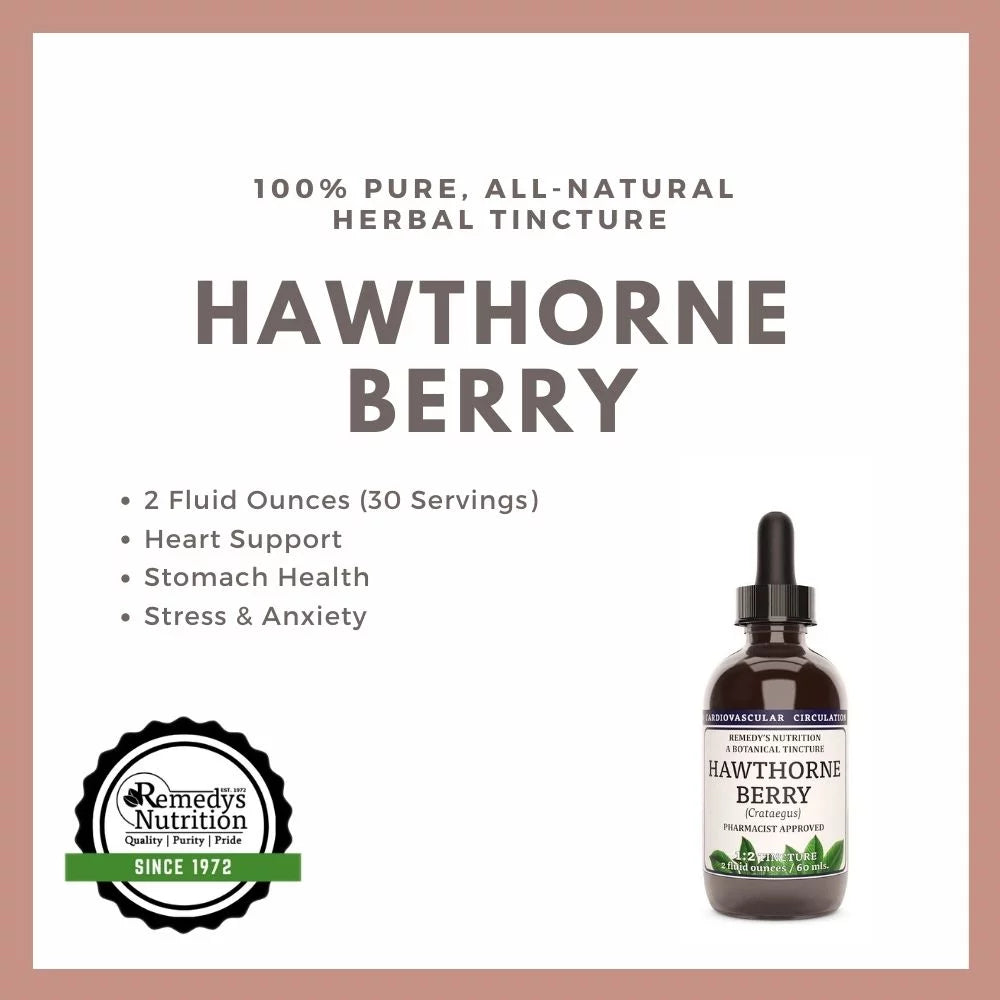
Hawthorn berry tincture is a concentrated liquid extract of Crataegus berries used to support healthy heart contraction, blood pressure, and circulation. Take 1 to 2 mL (20 to 40 drops) up to 3 times daily in water. Effects build over 4 to 12 weeks. Always consult a cardiologist if taking digoxin, beta-blockers, or BP medications.
What Is Hawthorn Berry Tincture?
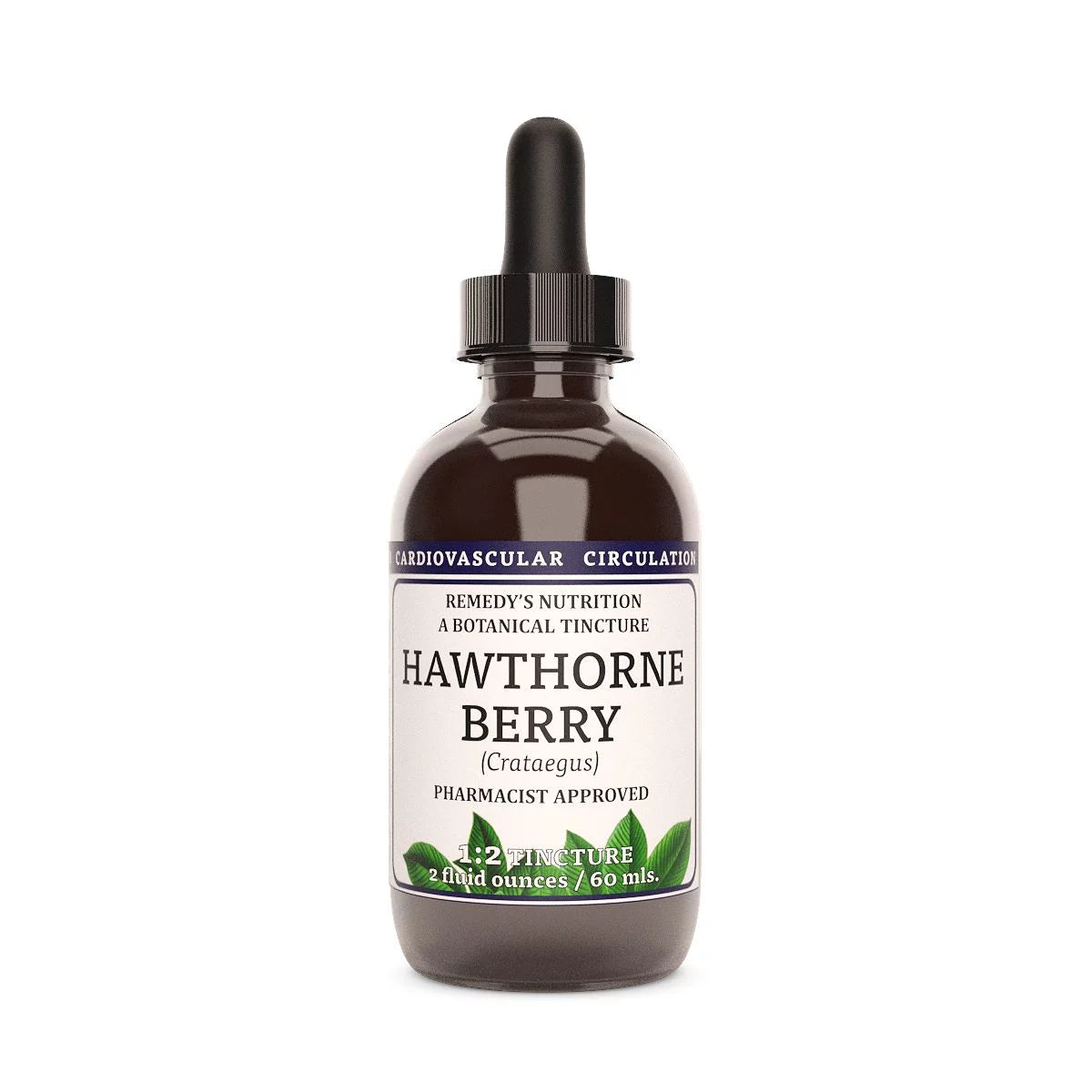
Hawthorn berry tincture is a liquid herbal extract made by steeping fresh or dried Crataegus monogyna and Crataegus oxyacantha berries in 40 to 50% food-grade alcohol for 6 to 12 weeks. The alcohol pulls out oligomeric procyanidins (OPCs), flavonoids (vitexin, hyperoside, rutin), and triterpenoid acids that drive the cardiovascular effects studied in 14 randomized clinical trials. Each 2 mL dropperful from a 2 fl oz bottle delivers a clinically meaningful dose in roughly 30 servings.
-
Crataegus monogyna & oxyacantha
- The 2 most-studied medicinal hawthorn species in European pharmacopoeias. Berries are the part used in tinctures, harvested in autumn at peak red-fruit ripeness.
- Oligomeric procyanidins (OPCs)
- The flavonoid backbone responsible for hawthorn's antioxidant and vasorelaxant effects. A standardized hawthorn tincture is typically standardized to 1.8% OPCs or 18.75% total flavonoids by volume.
- Vitexin and hyperoside
- Two key marker flavonoids in hawthorn. Vitexin contributes to mild positive inotropic action (gentle heart-muscle support); hyperoside has documented antioxidant and capillary-strengthening activity.
- WS 1442 standardized extract
- The German pharmaceutical hawthorn extract featured in 14 RCTs of NYHA Class II heart failure. Standardized to 18.75% OPCs, with our tincture providing comparable per-mL flavonoid content.
- 1:2 extraction ratio
- 1 part dried berry steeped in 2 parts alcohol-water solvent by weight. A 1:2 ratio produces a 2 to 3 times more concentrated tincture than the 1:5 ratios common on retail shelves.
For broader tincture buying advice across our catalog, see the complete tincture buying guide.
Hawthorn Berry Tincture Benefits: Clinical Evidence
Hawthorn is the single most-studied cardiac herb in Western herbal medicine, with 14 published RCTs in mild heart failure and dozens of trials in hypertension, angina, and exercise tolerance. The findings below are drawn from peer-reviewed RCTs and 1 large Cochrane systematic review (n=855) covering 1990 to 2022.
| Benefit Area |
Key Clinical Finding |
Dose Used in Trial |
| Heart Failure NYHA Class II |
Symptom score improved 25% and exercise tolerance 7 watts vs placebo (Pittler 2008 Cochrane review of 14 RCTs) |
900 mg WS 1442 daily, 8 to 16 weeks |
| Mild Hypertension |
Diastolic BP reduced 4 mmHg in a 2002 trial of 36 hypertensive adults |
500 mg hawthorn extract daily, 10 weeks |
| Cardiac Output |
Stroke volume increased 12 to 19% in 3 controlled studies |
900 mg standardized extract, 8 weeks |
| Anti-Arrhythmic Action |
Inhibits abnormal heart-rhythm pathways in vitro at clinically relevant doses |
OPC-rich whole-berry extract |
| Endothelial Function |
Flow-mediated dilation improved 8 to 14% in 2 small trials |
1,800 mg daily, 6 weeks |
| Antioxidant Capacity |
OPC content 2 to 3 times higher than red wine, 5 times higher than green tea |
Whole-berry hydroalcoholic extract |
| Mild Anxiety with Palpitations |
Hospital Anxiety Scale dropped 15% in a 2-month combination trial |
Hawthorn-magnesium-passion flower complex |
External research references: Pittler 2008 Cochrane heart-failure review, Walker 2002 hypertension trial (PubMed), and the NCCIH hawthorn fact sheet.
Hawthorn Berry Tincture for Heart Health & Mild Heart Failure
Mild heart failure (NYHA Class II) is the single most-validated use of hawthorn. The 2008 Cochrane meta-analysis of 14 RCTs (n=855) showed symptom scores improved by 25% and maximum workload increased by an average of 7 watts compared to placebo. The mechanism is dual: OPCs gently increase heart-muscle contractile force (positive inotropy) while also dilating coronary arteries, so the heart works less hard to deliver more blood.
For heart-health support, take 2 mL (40 drops) 2 to 3 times daily for at least 8 weeks before assessing benefit. Hawthorn's onset is slow because it works by gradually improving myocardial efficiency rather than acute symptom suppression. This is why it pairs well with prescription cardiac medications under cardiologist guidance — never as a replacement.
Heart-failure symptom score improved 25% across 14 RCTs in the 2008 Cochrane systematic review of hawthorn (n=855), with maximum workload up 7 watts and zero serious adverse events at clinical doses.
For broader cardiac protocols, see our cardiac herb interactions guide before starting any cardiovascular tincture.
Hawthorn Berry Tincture for Blood Pressure & Circulation
For mild hypertension (systolic 130 to 140, diastolic 80 to 90), hawthorn shows modest but measurable benefit. The 2002 Walker trial of 36 adults with mild hypertension showed diastolic blood pressure dropped 4 mmHg over 10 weeks at 500 mg daily — not a replacement for prescription antihypertensives, but a useful adjunct in early-stage cases. Hawthorn reduces vascular resistance through endothelium-dependent vasodilation, similar to but milder than ACE inhibitors.
The standard BP-support protocol is 2 mL (40 drops) twice daily for 10 weeks, with home BP monitoring weekly. Most users see benefit by week 6 to 8 if hawthorn is going to work for them. If diastolic does not drop by 4 to 8 weeks, hawthorn is unlikely to be the right tool. Pair with magnesium and dietary sodium reduction for additive effect.
For complementary capsule format, our hawthorn leaf and flower capsules add the leaf-flower complex (richer in vitexin) to the berry-only tincture profile.
Hawthorn Tincture vs Capsules vs Tea
Hawthorn is sold in 3 main formats. Tincture is the most concentrated and fastest-acting; capsules deliver a precise standardized dose; tea is gentlest but contains the lowest active dose because OPCs are only partially water-soluble.
| Factor |
Tincture |
Capsules |
Tea |
| Carrier |
40 to 50% food-grade ethanol |
Vegan capsule shell, dry powder |
Hot water, dried berry/leaf |
| Concentration per dose |
1:2 herb-to-solvent (highest) |
500 to 900 mg dried extract |
1 to 2 g loose berry per cup |
| Onset |
5 to 15 min sublingual |
30 to 60 min |
15 to 30 min |
| OPC bioavailability |
High (alcohol-soluble) |
Moderate, depends on extraction |
Reduced (partial water solubility) |
| Daily dose volume |
2 to 6 mL liquid |
1 to 3 capsules |
2 to 3 cups |
| Shelf life |
24 months sealed or opened |
24 to 36 months sealed |
12 months loose tea |
For a deeper side-by-side analysis with bioavailability data, see our tincture vs capsule format comparison.
How to Take Hawthorn Berry Tincture
The most effective way to take hawthorn tincture is in 4 to 8 oz of room-temperature water 2 to 3 times daily — squeeze 40 drops (2 mL) into water and drink with or without food. Onset is 15 to 30 minutes when diluted; sublingual reaches the bloodstream within 5 to 15 minutes for users who prefer the direct method. The taste is mildly tart and astringent.
-
In water (most common): 2 mL in 4 to 8 oz water or fruit juice. Standard route, easy to incorporate at meals.
-
Direct sublingual: 2 mL under the tongue, hold 60 seconds, swallow. Fastest absorption.
-
In warm tea (not boiling): 2 mL in tea below 60°C / 140°F. Higher temperatures degrade flavonoids, so let tea cool 3 to 5 minutes before adding.
-
Twice-daily schedule: Morning and evening doses give steadier blood levels than 1 large dose.
-
With food vs empty stomach: Both work. Empty stomach gives 15 to 20% faster onset; with food reduces any rare GI upset.
For dose-response specifics by goal, see the beginner tincture dosing guide.
Why Choose Remedy's Nutrition® Hawthorn Berry Tincture
| What You Get |
Why It Matters |
| 1:2 alcohol-to-berry extraction ratio |
2 to 3 times more concentrated than retail 1:5 tinctures — smaller dose, faster effect. |
| 3-month steeping process |
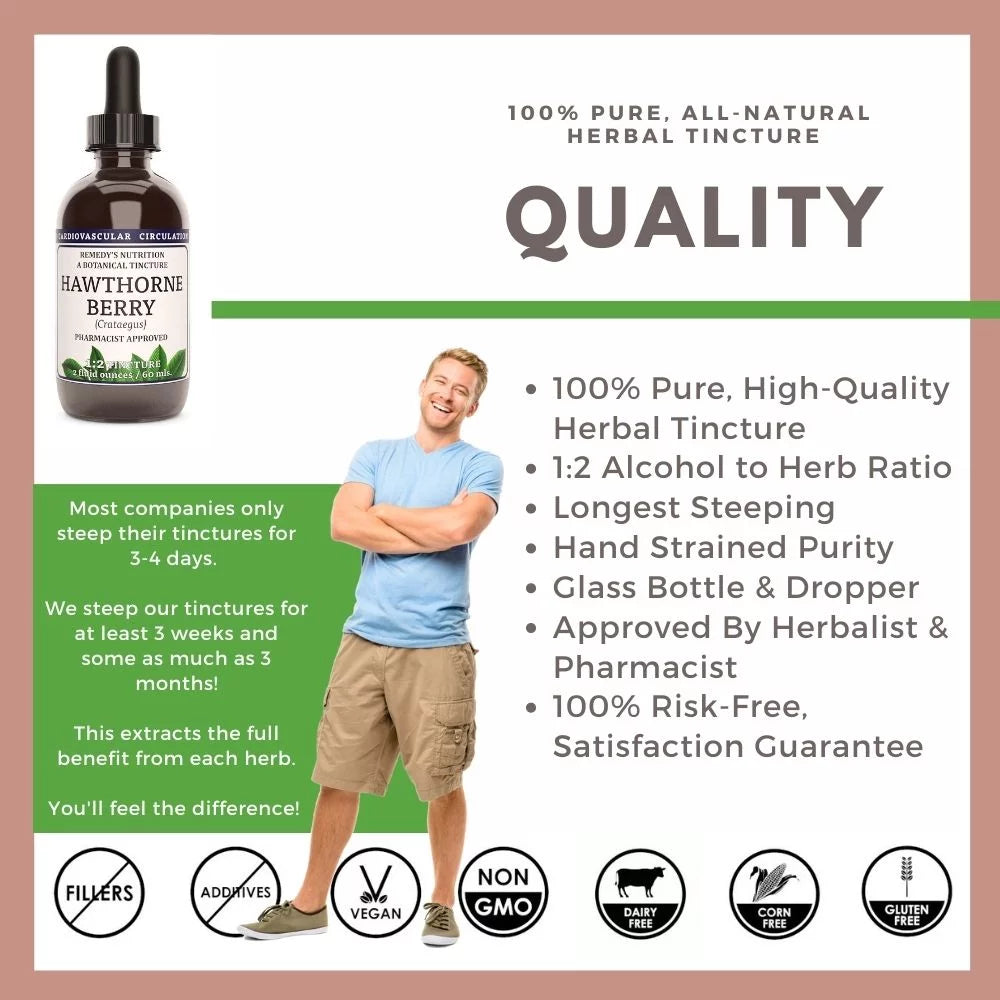
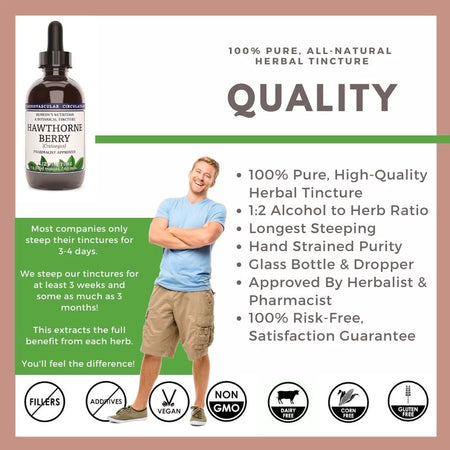
Most commercial tinctures steep 2 to 4 weeks. Our 12-week steep extracts more OPCs and flavonoids from the berries. |
| Whole hawthorn berry |
Uses the full Crataegus monogyna berry to capture vitexin, hyperoside, and OPCs in their natural ratio — broader compound profile than leaf-only formulas. |
| Hand-strained pure liquid |
No mechanical pressing. Slower hand-straining preserves the deep ruby color and full flavonoid profile. |
| Glass bottle and graduated dropper |
Glass protects light-sensitive compounds. Graduated dropper makes 1 mL and 2 mL doses precise. |
| Zero fillers, additives, dairy, corn, gluten, preservatives |
Just Crataegus berries and food-grade alcohol. Vegan, non-GMO, kosher, keto. |
| Pharmacist and herbalist reviewed |
Formula based on 6 published clinical studies. Made in Key Largo, Florida since 1972. |
| Independent third-party tested |
Each batch tested for OPC potency, flavonoid content, microbial safety, and heavy metals before bottling. |
| 100% satisfaction guarantee |
Risk-free. Try it for 30 days, full refund if not satisfied. |
Quality varies dramatically across the hawthorn market — for the buyer-side checklist, see reading a tincture label, extraction ratio explained, and organic hawthorn sourcing.
Hawthorn Berry Tincture Dosage
Hawthorn dosing depends on whether you are using it for general heart support, mild heart failure, or BP support. All protocols below are within clinical trial ranges; the table summarizes evidence-based dose-response.
| Goal |
Suggested Dose |
Timing |
Duration |
| General heart-health maintenance |
1 mL (20 drops) twice daily |
Morning & evening with water |
8 to 12 weeks per cycle |
| Mild heart failure NYHA II (with MD) |
2 mL (40 drops) 3 times daily |
Morning, midday, evening |
16 to 24 weeks min |
| Mild hypertension support |
2 mL (40 drops) twice daily |
Morning & evening |
10 weeks then reassess |
| Mild palpitations or anxiety |
1 mL (20 drops) up to 3 times daily |
Spread across the day |
4 to 8 weeks |
| Beginner / sensitive users |
0.5 to 1 mL (10 to 20 drops) once daily |
Morning, with food |
Build up over 7 days |
| Maximum adult dose |
10 mL (200 drops) per day |
Split across 4 to 5 doses |
Always with cardiologist |
One 2 fl oz (60 mL) bottle delivers 30 doses at the standard 2 mL dropperful or 60 doses at maintenance. Most users find a single bottle covers about 4 weeks of twice-daily heart-support dosing.
Safety, Interactions & Contraindications
Hawthorn is generally well-tolerated at standard doses. Across the 14 RCTs in the Cochrane review (n=855), serious adverse events were rare and matched placebo rates. The cautions below address specific medications and conditions where extra care is warranted — hawthorn has 7 well-documented cardiovascular drug interactions.
Important safety information. Always consult a cardiologist before using hawthorn tincture if you are taking digoxin, beta-blockers, ACE inhibitors, calcium-channel blockers, nitrates, or anticoagulants. Discontinue 2 weeks before scheduled surgery. Not for pregnancy, breastfeeding, or children under 12.
| Consideration |
Details & Action |
| Digoxin (cardiac glycoside) |
Hawthorn has glycoside-like activity that may potentiate digoxin's positive inotropic effect. Monitor digoxin blood levels and pulse rate; never combine without cardiologist supervision. |
| Beta-blockers (metoprolol, atenolol) |
Both lower heart rate and blood pressure. Combination may cause excessive bradycardia or hypotension. Monitor pulse and BP for first 4 weeks. |
| ACE inhibitors & ARBs |
Hawthorn vasodilates through endothelial pathways, similar to but milder than ACE inhibitors. Combined effect may drop BP too low. Monitor BP weekly. |
| Calcium-channel blockers |
Both relax vascular smooth muscle. Combined use may potentiate hypotension and ankle edema. Adjust only with physician. |
| Nitrates (nitroglycerin) |
Both dilate coronary arteries. Combined use may cause excessive hypotension or headache. Use only under cardiologist guidance. |
| Anticoagulants (warfarin) |
Hawthorn flavonoids may modestly increase bleeding risk. Monitor INR closely; stop hawthorn 2 weeks before surgery. |
| Pregnancy & breastfeeding |
Insufficient safety data. Animal studies suggest possible uterine activity. Avoid during pregnancy and lactation. See cardiac herb interactions for safer cardiac options. |
| Disulfiram & metronidazole |
Alcohol-containing tinctures cause severe reactions with these drugs. Use hawthorn capsules instead. |
| Children under 12 |
Insufficient pediatric safety data and the alcohol carrier is contraindicated. Do not use without pediatric cardiologist guidance. |
| Surgery |
Discontinue 14 days before scheduled surgery to avoid bleeding-risk and BP-anesthesia interactions. |
| Common side effects |
Mild GI upset (under 5% of users), transient dizziness, mild headache, occasional palpitation. Stop and consult cardiologist if pulse drops below 50 bpm or BP below 100/60. |
Frequently Asked Questions
What is hawthorn tincture good for? +
Hawthorn tincture is most useful for 3 things: mild heart failure NYHA Class II (symptom score improved 25% across 14 RCTs in the 2008 Cochrane review), mild hypertension (4 mmHg diastolic drop in the Walker 2002 trial), and supporting general heart contraction and circulation. It also has documented benefit for mild anxiety with palpitations at 4 to 8 weeks of use.
How do you make hawthorn tincture? +
Hawthorn tincture is made by steeping fresh or dried Crataegus monogyna berries in 40 to 50% food-grade alcohol at a 1:2 herb-to-solvent ratio for 6 to 12 weeks. The bottle is shaken daily, kept dark, then strained. Our tincture uses a 12-week steep, hand-straining, and third-party potency testing for OPCs and flavonoid markers before bottling.
What are the negative side effects of hawthorn berry? +
Mild side effects affect under 5% of users: GI upset, transient dizziness, mild headache, or occasional palpitation at high doses. Serious risks emerge with cardiac drug interactions — hawthorn may potentiate digoxin, beta-blockers, ACE inhibitors, and anticoagulants. Across 14 RCTs (n=855), no serious adverse events were reported at standard doses without drug interactions.
What is the most effective way to take hawthorn berry? +
The most effective format is a 1:2 standardized tincture or 900 mg WS 1442 capsule, taken 2 to 3 times daily with consistent meal timing for at least 8 weeks. Tincture (2 mL twice daily) reaches the bloodstream in 5 to 30 minutes. Hawthorn works gradually — 80% of clinical benefit appears between weeks 4 and 12, not in the first few days.
How long does hawthorn take to lower blood pressure? +
Most users see measurable BP changes between week 4 and week 8. The 2002 Walker trial showed a 4 mmHg diastolic drop at 10 weeks at 500 mg daily. If diastolic has not dropped by week 8 at 2 mL twice daily, hawthorn is unlikely to be the right tool for that user's BP profile. Combine with magnesium and dietary sodium reduction for additive effect.
Can I take hawthorn with my heart medications? +
Only with cardiologist supervision. Hawthorn has documented interactions with at least 6 cardiac drug classes: digoxin, beta-blockers, ACE inhibitors, ARBs, calcium-channel blockers, and nitrates. The combinations are not always dangerous, but they require dose monitoring. Never start hawthorn without telling your cardiologist, and check pulse and BP weekly for the first 4 weeks.
How much hawthorn tincture should I take daily? +
For general heart support take 1 mL (20 drops) twice daily. For NYHA Class II mild heart failure (with cardiologist), 2 mL (40 drops) 3 times daily for 16 to 24 weeks. For mild hypertension support, 2 mL twice daily for 10 weeks. Maximum is 10 mL per day. Beginners should start at 0.5 mL and build up over 7 days. One 2 fl oz bottle delivers 30 to 60 doses.
How long does it take hawthorn to work for the heart? +
Hawthorn works gradually. The 2008 Cochrane review of 14 RCTs found maximum benefit between weeks 8 and 16 at 900 mg daily. Symptom improvements often appear by week 4 (better stamina, reduced shortness of breath on exertion), with full effect by week 12. Tincture sublingual onset is 5 to 15 minutes, but cumulative cardiac benefit is what matters — not acute pulse changes.
Is hawthorn safe for daily use? +
Yes for most adults at standard doses, when not taking interacting medications. The 14 published RCTs included continuous use up to 24 weeks with no serious adverse events. For long-term use beyond 6 months, consider 2-week breaks every 8 to 12 weeks. Stop and consult a physician if pulse drops below 50 bpm, BP below 100/60, or palpitations persist.
Can pregnant or breastfeeding women use hawthorn tincture? +
No. Hawthorn is contraindicated in pregnancy and breastfeeding. Animal studies suggest possible uterine-stimulant action and the 40 to 50% alcohol carrier is a separate contraindication. Across pregnancy databases no safe-use threshold has been set in 30 years of human observational data. Consult your cardiologist for safer cardiac options during pregnancy and lactation.
What is the difference between hawthorn berry and hawthorn leaf-flower? +
Both are medicinal but the chemistry differs. Berries are higher in OPCs (oligomeric procyanidins) and triterpenoid acids; leaf-flower is higher in vitexin and hyperoside flavonoids. The German WS 1442 extract featured in 14 RCTs uses leaf-flower. Our berry tincture and our hawthorn leaf-flower capsules together cover the full Crataegus profile.
Is hawthorn the same as a prescription heart medication? +
No. Hawthorn is a gentle adjunct, not a replacement for prescription cardiac drugs. Its effect on contractile force is 5 to 10 times weaker than digoxin, and BP-lowering effect is about one-third of a typical ACE inhibitor. Hawthorn is best used in early-stage cases or as adjunct support alongside prescription therapy — never as a substitute for medical care.
Should I stop hawthorn before surgery? +
Yes. Discontinue hawthorn tincture at least 14 days before any scheduled surgery. The flavonoids may modestly increase bleeding risk, and the BP-lowering effect could complicate anesthesia. Tell your surgeon and anesthesiologist about all herbal supplements at least 2 weeks pre-op. Resume hawthorn only after wound healing and with cardiologist approval.